AQA · GCSE · French
Course version: 8658 · Version from Sept 2016
Verbs: imperfect: avoir, être and faire
The imperfect tense (l'imparfait) describes ongoing past actions, habits, or background information such as weather, age, and feelings.
- Point 4 of 20
- 4 key terms
Study notes
From the teaching notes for this specification point.
The idea
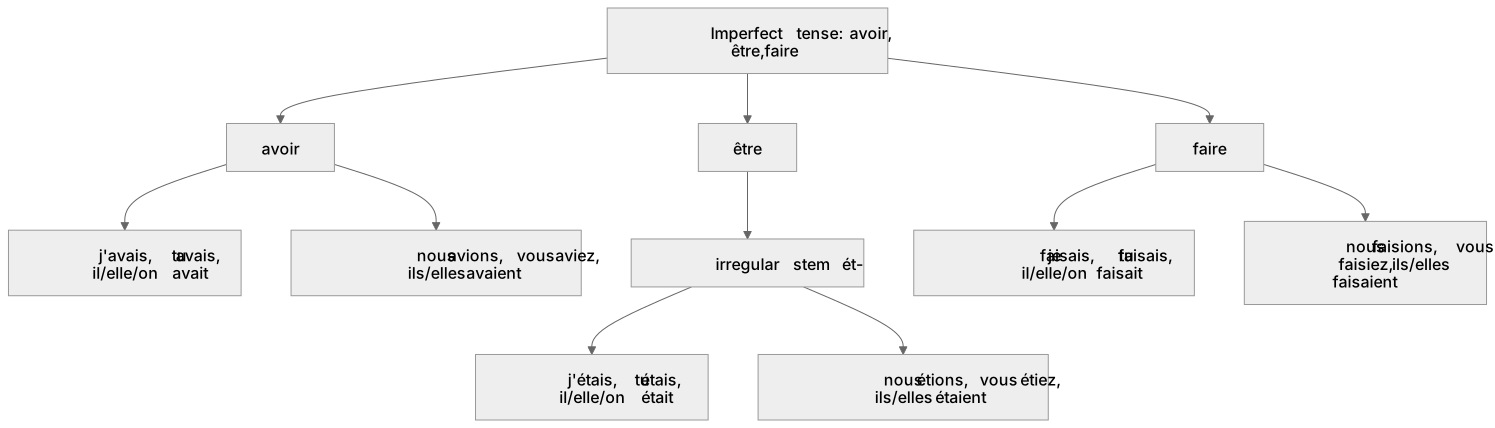
The imperfect tense (l'imparfait) describes ongoing past actions, habits, or background information such as weather, age, and feelings. You must know how to use the imperfect forms of 'avoir' (to have), 'être' (to be), and 'faire' (to do/make). The conjugations for 'avoir' are: j'avais, tu avais, il/elle/on avait, nous avions, vous aviez, ils/elles avaient. For 'être', the stem is irregular: j'étais, tu étais, il/elle/on était, nous étions, vous étiez, ils/elles étaient. For 'faire', the forms are: je faisais, tu faisais, il/elle/on faisait, nous faisions, vous faisiez, ils/elles faisaient. These are essential for phrases like 'il faisait beau' (the weather was nice) or 'j'avais cinq ans' (I was five years old).
What earns the marks
- Identify the correct imperfect conjugation of 'avoir' for a given subject pronoun.
- Recognise the irregular stem 'ét-' used for the imperfect tense of 'être'.
- Select the correct imperfect conjugation of 'faire' to describe past weather conditions or activities.
- Distinguish between the imperfect forms of 'avoir', 'être', and 'faire' in reading and listening comprehension tasks.
Common mistakes and how to put them right
Confusing the imperfect forms of 'avoir' and 'être', such as using 'j'avais' instead of 'j'étais' to say 'I was'.
Put it right: 'j'avais' means 'I had' (or 'I was' only for age, hunger, thirst), while 'j'étais' means 'I was' for descriptions and locations.
Misspelling the imperfect endings, particularly confusing the 'je'/'tu' ending (-ais) with the 'il/elle/on' ending (-ait).
Put it right: Learn the specific endings for each subject pronoun and check them carefully.
Using the perfect tense instead of the imperfect to describe weather or background situations in the past.
Put it right: Use the imperfect tense of 'faire' (e.g., 'il faisait beau') for past weather descriptions.
Exam tips
- Look out for phrases like 'quand j'étais plus jeune' (when I was younger) as a trigger for using the imperfect tense.
- Remember that age in the past requires the imperfect of 'avoir' (e.g., 'j'avais dix ans'), not 'être'.
- Practice the pronunciation of the imperfect endings, as '-ais', '-ait', and '-aient' all sound identical, which can be a distractor in listening exams.
Try the lesson
The start of the Verbs: imperfect: avoir, être and faire lesson, made from teaching notes for this specification point.
Have a go first
Which of the following sentences correctly uses the imperfect tense of the verb 'être' to say 'He was happy'?
Listen
The imperfect tense (l'imparfait) describes ongoing past actions, habits, or background information such as weather, age, and feelings. You must know how to use the imperfect forms of 'avoir' (to have), 'être' (to be), and 'faire' (to do/make). The conjugations for 'avoir' are: j'avais, tu avais, il/elle/on avait, nous avions, vous aviez, ils/elles avaient. For 'être', the stem is irregular: j'étais, tu étais, il/elle/on était, nous étions, vous étiez, ils/elles étaient. For 'faire', the forms are: je faisais, tu faisais, il/elle/on faisait, nous faisions, vous faisiez, ils/elles faisaient. These are essential for phrases like 'il faisait beau' (the weather was nice) or 'j'avais cinq ans' (I was five years old). A strong answer earns marks for these points. Identify the correct imperfect conjugation of 'avoir' for a given subject pronoun. Recognise the irregular stem 'ét-' used for the imperfect tense of 'être'. Select the correct imperfect conjugation of 'faire' to describe past weather conditions or activities. Distinguish between the imperfect forms of 'avoir', 'être', and 'faire' in reading and listening comprehension tasks. A common slip: Confusing the imperfect forms of 'avoir' and 'être', such as using 'j'avais' instead of 'j'étais' to say 'I was'. Instead, 'j'avais' means 'I had' (or 'I was' only for age, hunger, thirst), while 'j'étais' means 'I was' for descriptions and locations. Exam tip: Look out for phrases like 'quand j'étais plus jeune' (when I was younger) as a trigger for using the imperfect tense.
See it
Key words
Say what each word means before you turn the card.
Past descriptions
Try answering aloud or in your head before turning the card.
Weather expressions
Try answering aloud or in your head before turning the card.
Personal background
Try answering aloud or in your head before turning the card.
Irregular verbs
Try answering aloud or in your head before turning the card.
See every definition
- Past descriptions
- The imperfect tense describes ongoing past actions, habits, or background information such as weather, age, and feelings.
- Weather expressions
- The imperfect of 'faire' is used for past weather descriptions, as in 'il faisait beau'.
- Personal background
- The imperfect of 'avoir' states age in the past, as in 'j'avais cinq ans'.
- Irregular verbs
- The stem 'ét-' is irregular and is used for the imperfect tense of 'être'.
Label the diagram
Some boxes have lost their names. Pick the right name for each number.
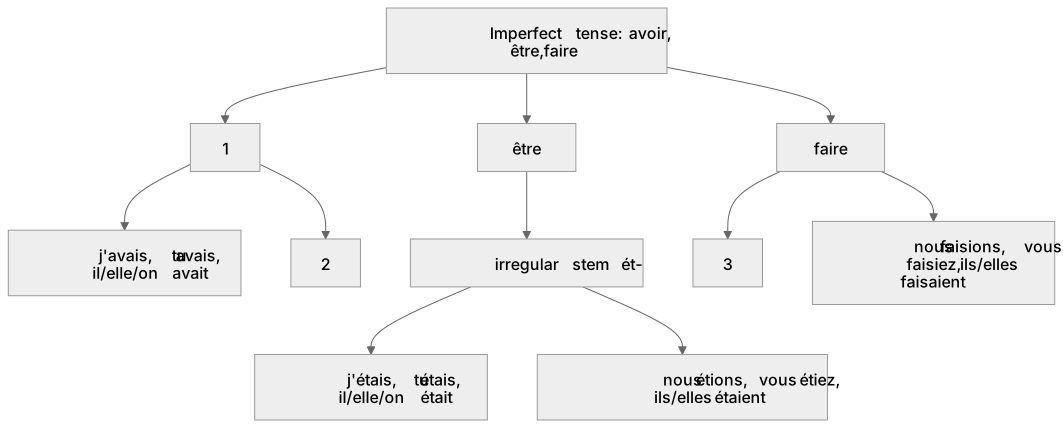
1Box 1
2Box 2
3Box 3
There is more to this lesson
The full lesson goes on to check your understanding and help you earn the marks. Create a free account to carry on, with your progress saved.
A week of Premium from your first lesson · Then the free plan continues · No card, no charge
Test your understanding of Verbs: imperfect: avoir, être and faire
Active recall beats re-reading. Take an instant quiz now to test what you’ve learned and lock it into long-term memory.
A week of Premium from your first lesson · Then the free plan continues · No card, no charge