Inferring meaning from context — OCR GCSE Study Guide
Exam Board: OCR | Level: GCSE
This guide focuses on a critical skill for the OCR GCSE French exam: inferring meaning from context. Mastering this allows candidates to decode authentic texts and audio, moving beyond literal translation to understand nuance, attitude, and implicit information, which is essential for achieving top marks."
## Overview
Inferring meaning from context is a cornerstone of the OCR GCSE French specification (J720), weighted heavily under Assessment Objectives AO1 (Listening) and AO3 (Reading). This skill requires candidates to act as language detectives, using grammatical, lexical, and structural clues to deduce the meaning of unfamiliar language and the underlying attitudes or emotions in a text or audio clip. Examiners are not just testing vocabulary; they are assessing a candidate's ability to analyse how language works. This involves distinguishing between distractors and correct answers, understanding complex sentence structures like negation, and identifying synonyms. This guide will equip you with the strategies to move beyond simple word-matching and develop a logical, analytical approach to comprehension, which is precisely what is rewarded with the highest marks.
{{asset:inferring_meaning_from_context_podcast.mp3}}
## Key Strategies for Inferring Meaning
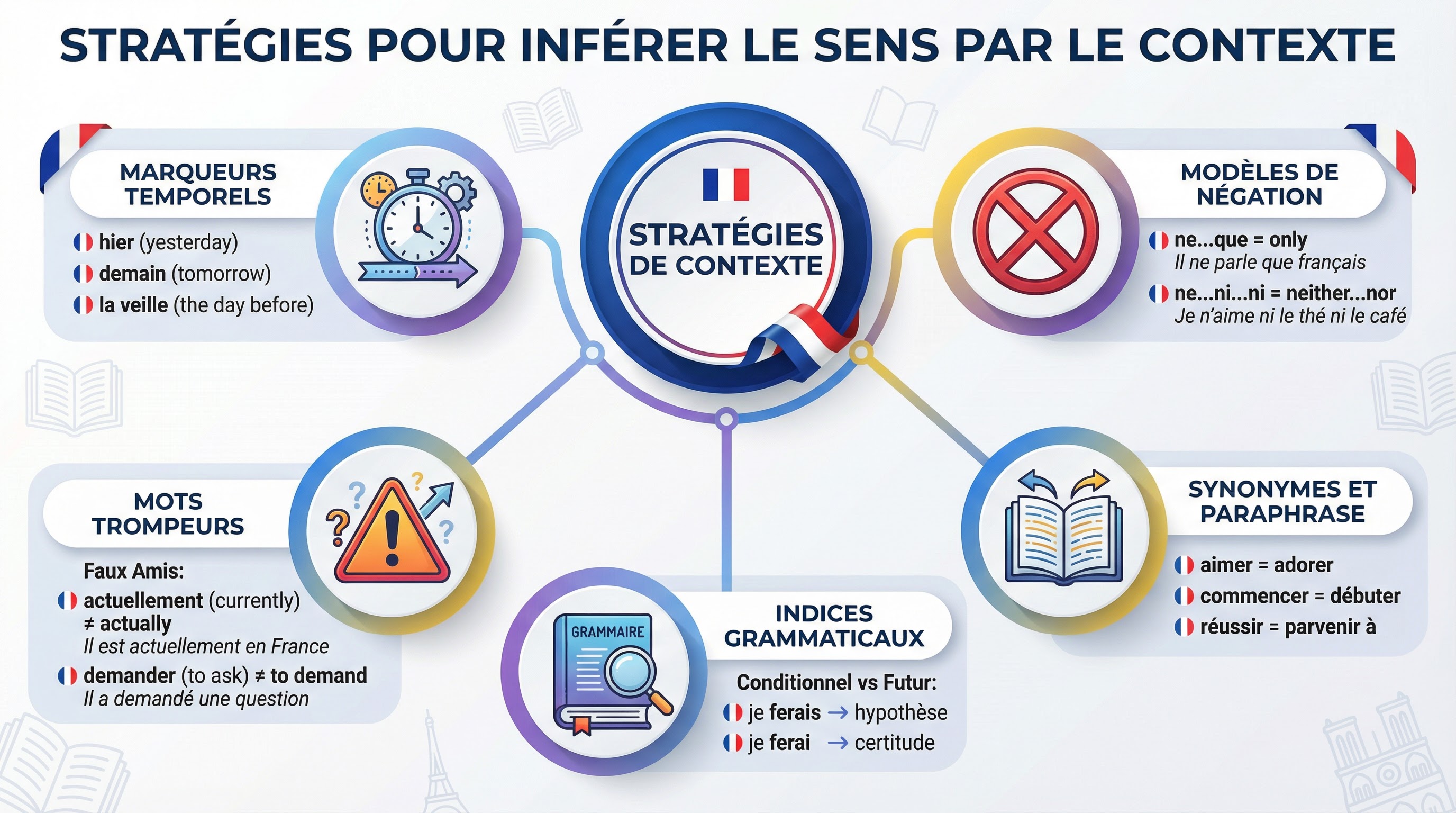
### 1. Time Markers (Marqueurs Temporels)
**What they are**: Words or phrases that indicate the chronology of events.
**Why they matter**: Examiners frequently test understanding of timelines. A question might ask about a future plan, while the text describes a past event. Identifying time markers is crucial to selecting the correct information.
**Specific Knowledge**: Candidates must know and recognise markers such as:
- **Past**: `hier` (yesterday), `la veille` (the day before), `la semaine dernière` (last week), `il y a` (ago)
- **Present**: `maintenant` (now), `aujourd'hui` (today), `actuellement` (currently)
- **Future**: `demain` (tomorrow), `le lendemain` (the next day), `la semaine prochaine` (next week), `bientôt` (soon)
### 2. Negation Patterns (Modèles de Négation)
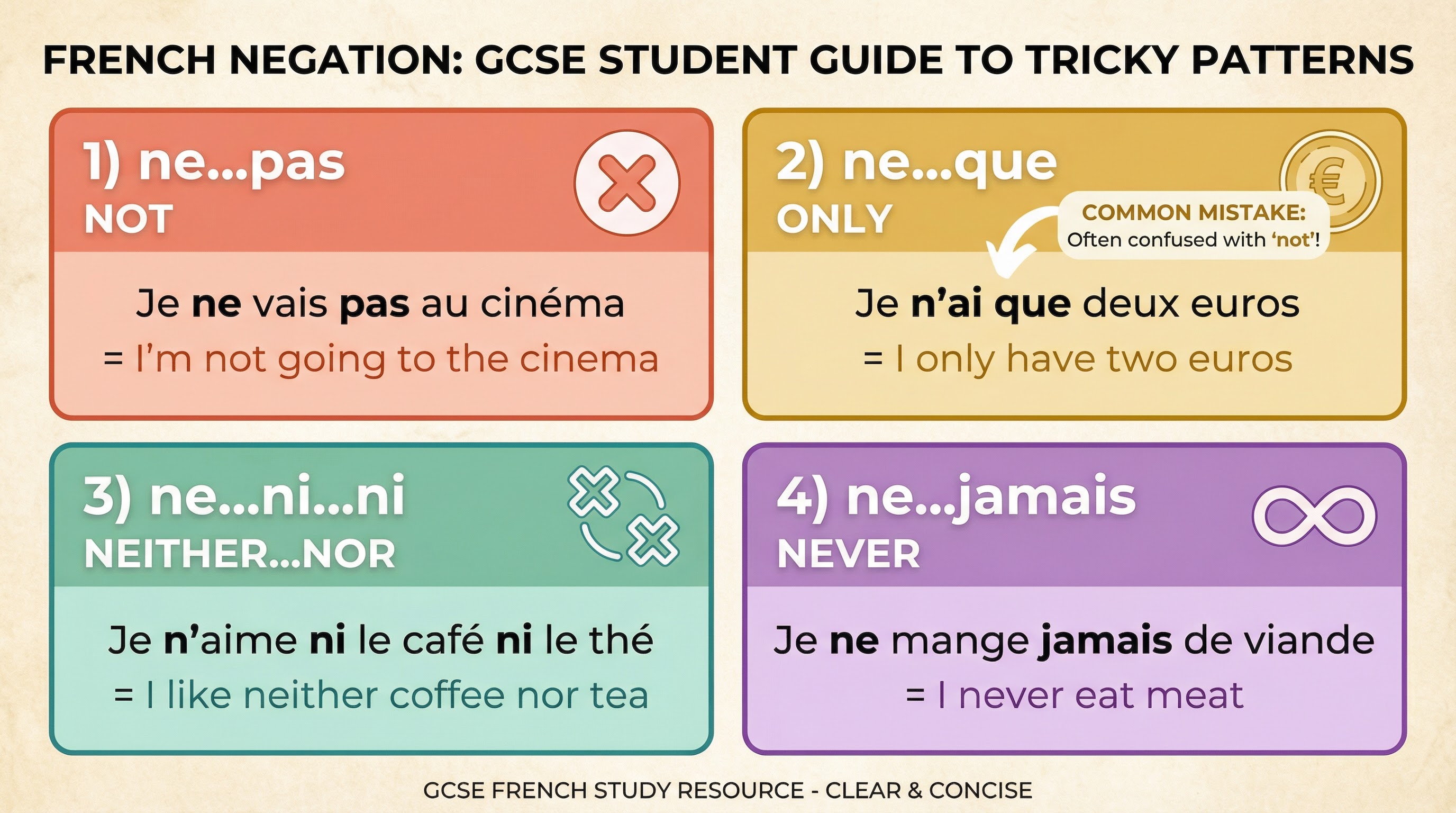
**What they are**: Structures that negate or limit a part of a sentence. These are often more complex than a simple 'not'.
**Why they matter**: Misinterpreting a negation pattern can completely change the meaning of a sentence and lead to lost marks. Examiners use these to test for precise understanding.
**Specific Knowledge**: Beyond `ne...pas` (not), candidates must master:
- `ne...que`: means 'only', not 'not'. (e.g., *Il n'a que cinq euros* = He only has five euros.)
- `ne...ni...ni`: means 'neither...nor'. (e.g., *Elle n'aime ni le sport ni la musique* = She likes neither sport nor music.)
- `ne...jamais`: means 'never'.
- `ne...plus`: means 'no longer' / 'not anymore'.
### 3. Synonyms and Paraphrasing
**What it is**: The use of different words in the question and the source text to express the same idea.
**Why it matters**: This is a direct test of vocabulary breadth and comprehension over simple 'keyword spotting'. A candidate who only looks for the exact words from the question in the text will fall into traps.
**Specific Knowledge**: Build families of words with similar meanings. For example:
- **To like**: `aimer`, `adorer`, `apprécier`, `être fan de`
- **To start**: `commencer`, `débuter`
- **To succeed**: `réussir`, `parvenir à`, `arriver à`
### 4. Grammatical Clues
**What they are**: Information provided by verb tenses, pronouns, and adjectival agreements.
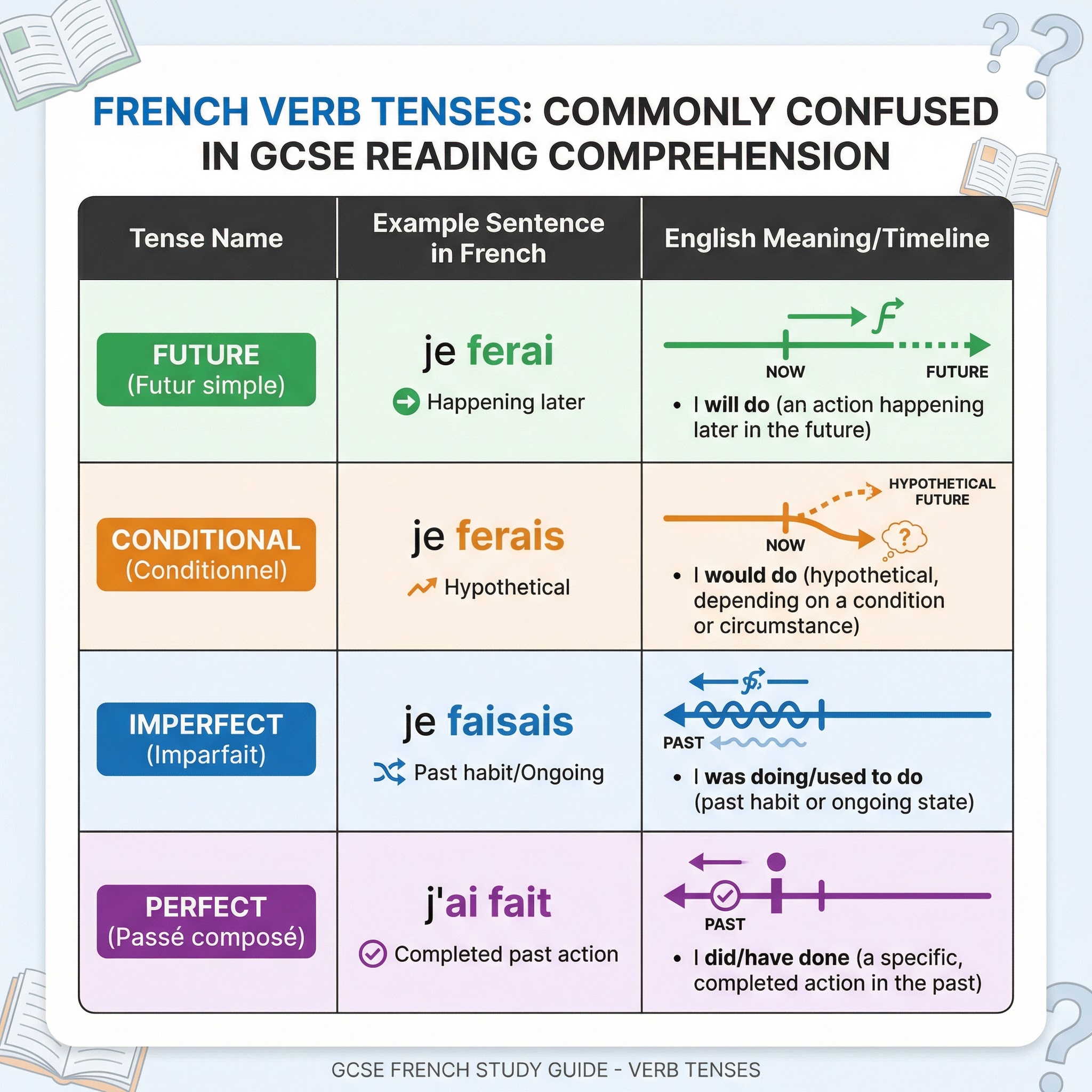
**Why it matters**: The choice of tense can distinguish between a definite plan (future), a hypothetical situation (conditional), or a past habit (imperfect). This is a subtle but critical area for marks.
**Specific Knowledge**: Focus on commonly confused pairs:
- **Future vs. Conditional**: `je ferai` (I will do) vs. `je ferais` (I would do).
- **Perfect vs. Imperfect**: `j'ai mangé` (I ate - a single, completed action) vs. `je mangeais` (I was eating / used to eat - a continuous or habitual past action).
### 5. Distractors and False Friends (Mots Trompeurs et Faux Amis)
**What they are**: Words in the text that are designed to mislead. Distractors are often lifted directly into incorrect multiple-choice options. False friends are words that look similar in English but have different meanings.
**Why it matters**: This is the most common trap. Candidates who are rushing or relying on keyword spotting will select the wrong answer because a word looks familiar.
**Specific Knowledge**: Be wary of common false friends:
- `actuellement` (currently) vs. 'actually'
- `demander` (to ask) vs. 'to demand'
- `attendre` (to wait) vs. 'to attend'
- `rester` (to stay) vs. 'to rest'
- `la librairie` (bookshop) vs. 'library' (`la bibliothèque`)
"