Study Notes
Overview
Trigonometry at A-Level is the study of the relationships between angles and side lengths of triangles, extended to waves and circles. It is a fundamental part of mathematics, forming a bridge between geometry and algebra. In your Edexcel exam, you will be expected to be fluent in manipulating complex trigonometric expressions, solving equations, and proving identities. This topic frequently links with calculus (differentiation and integration of trig functions) and mechanics, making it a cornerstone of the specification. Typical exam questions involve multi-step problem solving, requiring you to select the appropriate identity or formula and apply it accurately. Mastery of radian measure is essential, as is the ability to work with the reciprocal functions (sec, cosec, cot) and the addition and double angle formulae. This guide will equip you with the core knowledge and exam strategies to tackle this challenging but rewarding topic.
Key Concepts
Concept 1: Radians and the Unit Circle
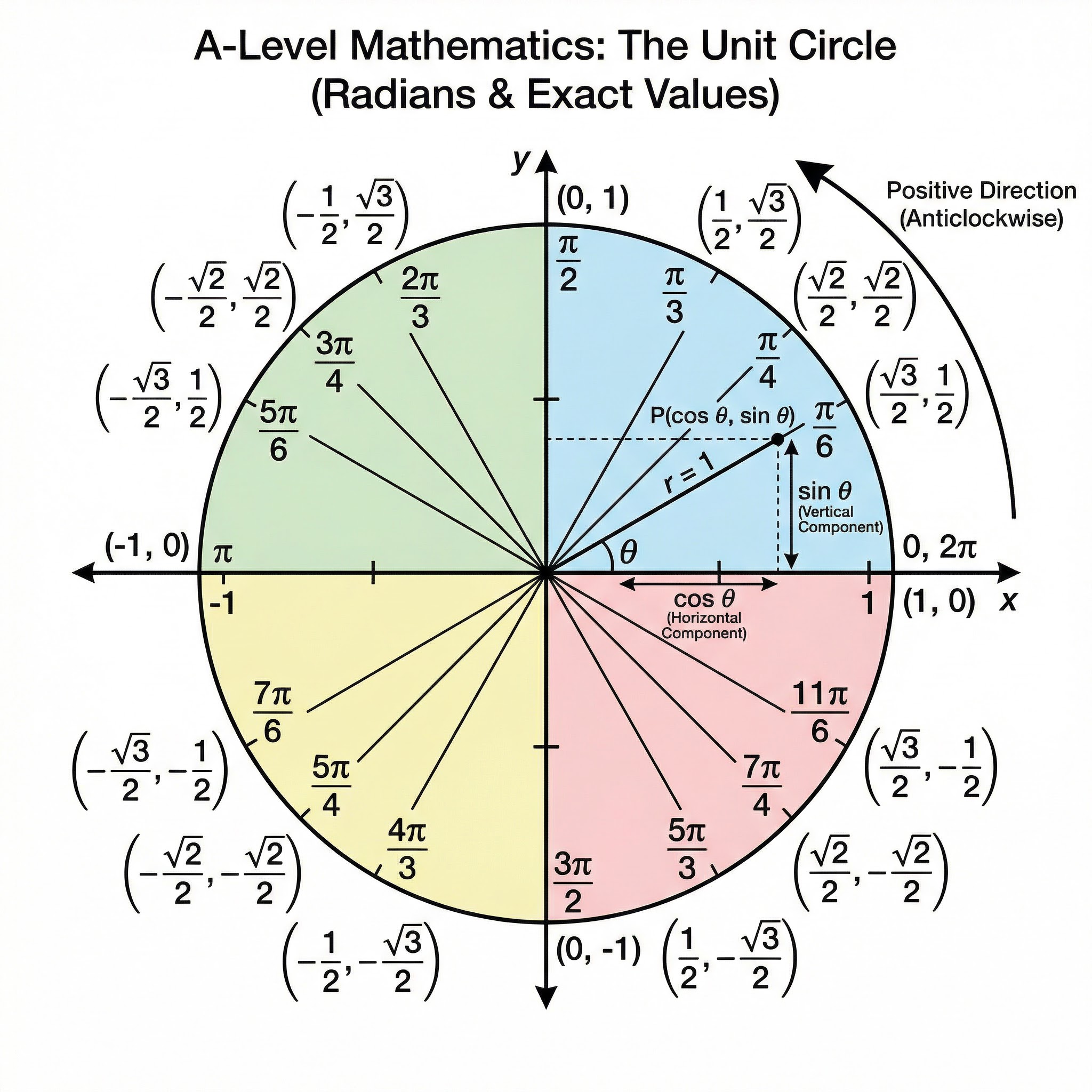
At A-Level, angles are most commonly measured in radians. A radian is the angle subtended at the center of a circle by an arc that is equal in length to the radius. The key relationship to remember is π radians = 180°. You must be able to convert fluently between degrees and radians. All calculus involving trigonometry requires radians, as do the small angle approximations. The unit circle is a circle with a radius of 1 centered at the origin. It is a powerful tool for understanding trigonometric functions. For any point (x, y) on the unit circle, the coordinates are given by (cos θ, sin θ), where θ is the angle measured anti-clockwise from the positive x-axis. This visual representation helps in understanding the sign of trig functions in different quadrants and deriving key identities.
Example: To convert 120° to radians, you calculate 120 * (π/180) = 2π/3 radians.
Concept 2: Reciprocal and Pythagorean Identities
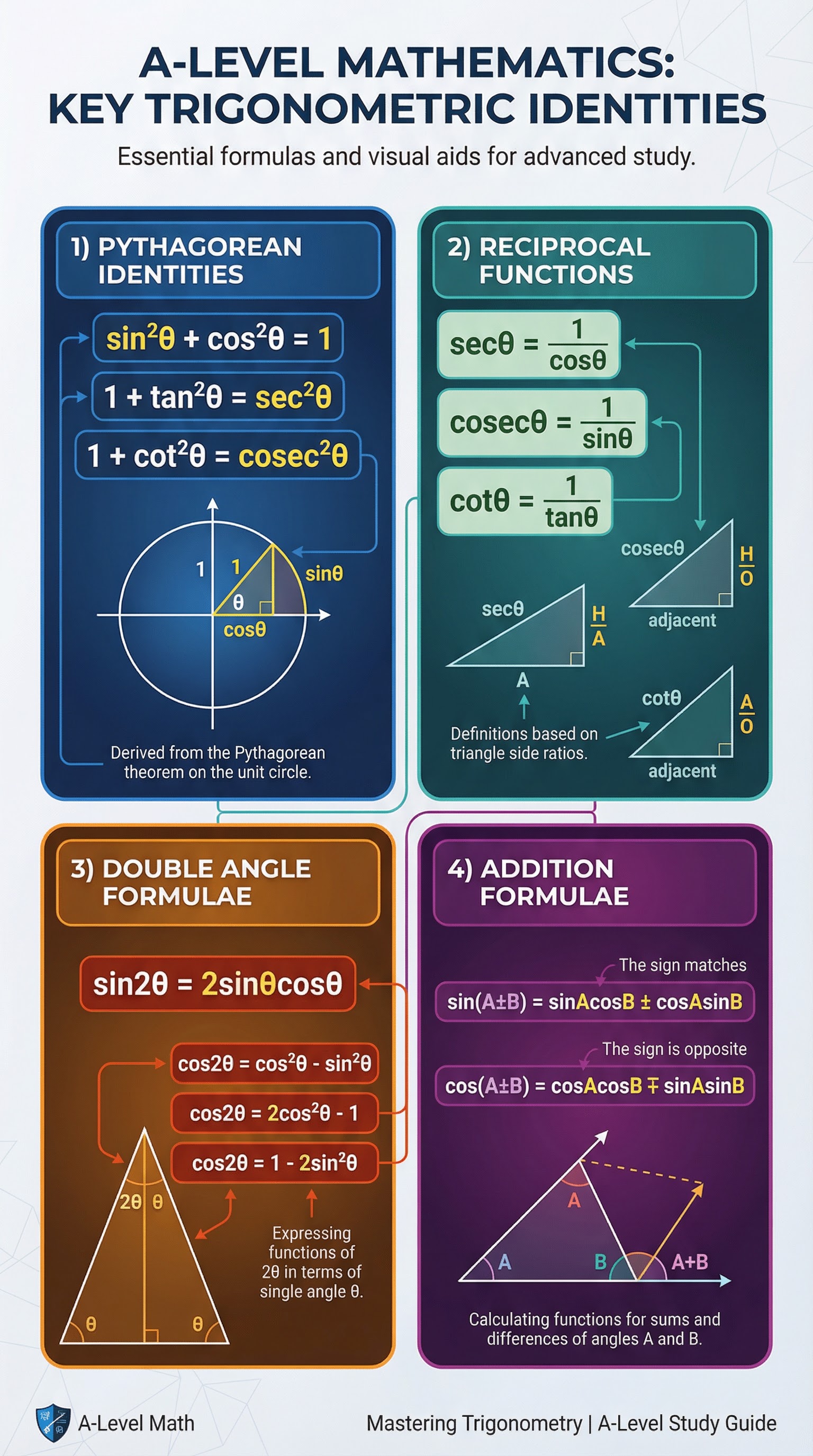
The three reciprocal functions are secant (sec), cosecant (cosec), and cotangent (cot). They are defined as:
- sec θ = 1/cos θ
- cosec θ = 1/sin θ
- cot θ = 1/tan θ = cos θ/sin θ
These lead to the three Pythagorean Identities, which are essential for simplifying expressions and solving equations. The first is derived directly from the unit circle (x² + y² = 1).
- sin²θ + cos²θ ≡ 1 (Must memorise)
- 1 + tan²θ ≡ sec²θ (Given on formula sheet)
- 1 + cot²θ ≡ cosec²θ (Given on formula sheet)
To derive the second and third identities, you simply divide the first identity by cos²θ and sin²θ respectively. Examiners expect you to be able to do this.
Concept 3: Addition and Double Angle Formulae
These formulae allow you to find the trigonometric ratio of a sum or difference of angles, or of a multiple of an angle. They are crucial for solving more complex equations and are provided on the formula sheet.
Addition Formulae (Given on formula sheet):
- sin(A ± B) ≡ sinAcosB ± cosAsinB
- cos(A ± B) ≡ cosAcosB ∓ sinAsinB
- tan(A ± B) ≡ (tanA ± tanB) / (1 ∓ tanA tanB)
Double Angle Formulae (Derived from addition formulae, given on formula sheet):
- sin(2A) ≡ 2sinAcosA
- cos(2A) ≡ cos²A - sin²A ≡ 2cos²A - 1 ≡ 1 - 2sin²A
- tan(2A) ≡ 2tanA / (1 - tan²A)
Candidates must be adept at selecting the correct form of the cos(2A) identity to simplify an equation. For example, if the equation also contains a cosA term, using the 2cos²A - 1 form is often the best approach.
Mathematical/Scientific Relationships
- Radians to Degrees: Radians = Degrees × (π / 180)
- Degrees to Radians: Degrees = Radians × (180 / π)
- Arc Length: s = rθ (θ in radians) - (Must memorise)
- Area of a Sector: A = ½r²θ (θ in radians) - (Must memorise)
- Small Angle Approximations (for small θ in radians):
- sin θ ≈ θ
- cos θ ≈ 1 - θ²/2
- tan θ ≈ θ
(All given on formula sheet)
Practical Applications
Trigonometry is not just an abstract topic; it has numerous real-world applications. It is used in:
- Navigation: GPS systems use trigonometric principles (triangulation) to pinpoint locations.
- Engineering: Civil engineers use trigonometry to calculate forces in structures like bridges and to design curved roads.
- Physics: It describes the motion of waves, including sound, light, and water waves, as well as oscillations like pendulums.
- Computer Graphics: Trigonometric functions are used to rotate and transform objects in 3D space, essential for video games and animated films.
Visual Resources
2 diagrams and illustrations
Interactive Diagrams
2 interactive diagrams to visualise key concepts
Conceptual Flow Outline
A flowchart outlining the general process for solving trigonometric equations.
Conceptual Flow Outline
A process diagram for applying the R-formula (harmonic form).
Worked Examples
3 detailed examples with solutions and examiner commentary
Practice Questions
Test your understanding — click to reveal model answers
Show that the equation 2cos²x = 4 - 5sinx can be written as 2sin²x - 5sinx + 2 = 0.
Hint: Use a Pythagorean identity to replace the cos²x term.
Solve, for -180° ≤ θ < 180°, the equation 3tanθ = 2cosθ.
Hint: Express tanθ in terms of sinθ and cosθ, then form a quadratic in sinθ.
Given that sinA = 3/5 and cosB = 5/13, where A is obtuse and B is acute, find the exact value of cos(A - B).
Hint: You will need to find cosA and sinB first. Use Pythagorean identities and consider the quadrants to determine the correct signs.
Find the smallest positive solution to the equation tan(2x - π/4) = 1.
Hint: Let y = 2x - π/4 and solve for y first. Then solve for x.
Using the small angle approximation, find an approximate value for cos(0.1) - sin(0.2).
Hint: Use the small angle approximations for cos(x) and sin(x).