Pearson Edexcel · A-Level · Mathematics
Vectors
Master Edexcel A-Level Vectors with this comprehensive guide. We break down everything from basic notation to complex 3D geometric proofs, giving you the tools to secure top marks. This guide is packed with examiner insights, worked examples, and memory aids to make your revision effective and engaging.
- 6 min read
- 3 worked examples
- 5 practice questions
- 7 key terms
Study Notes
Overview
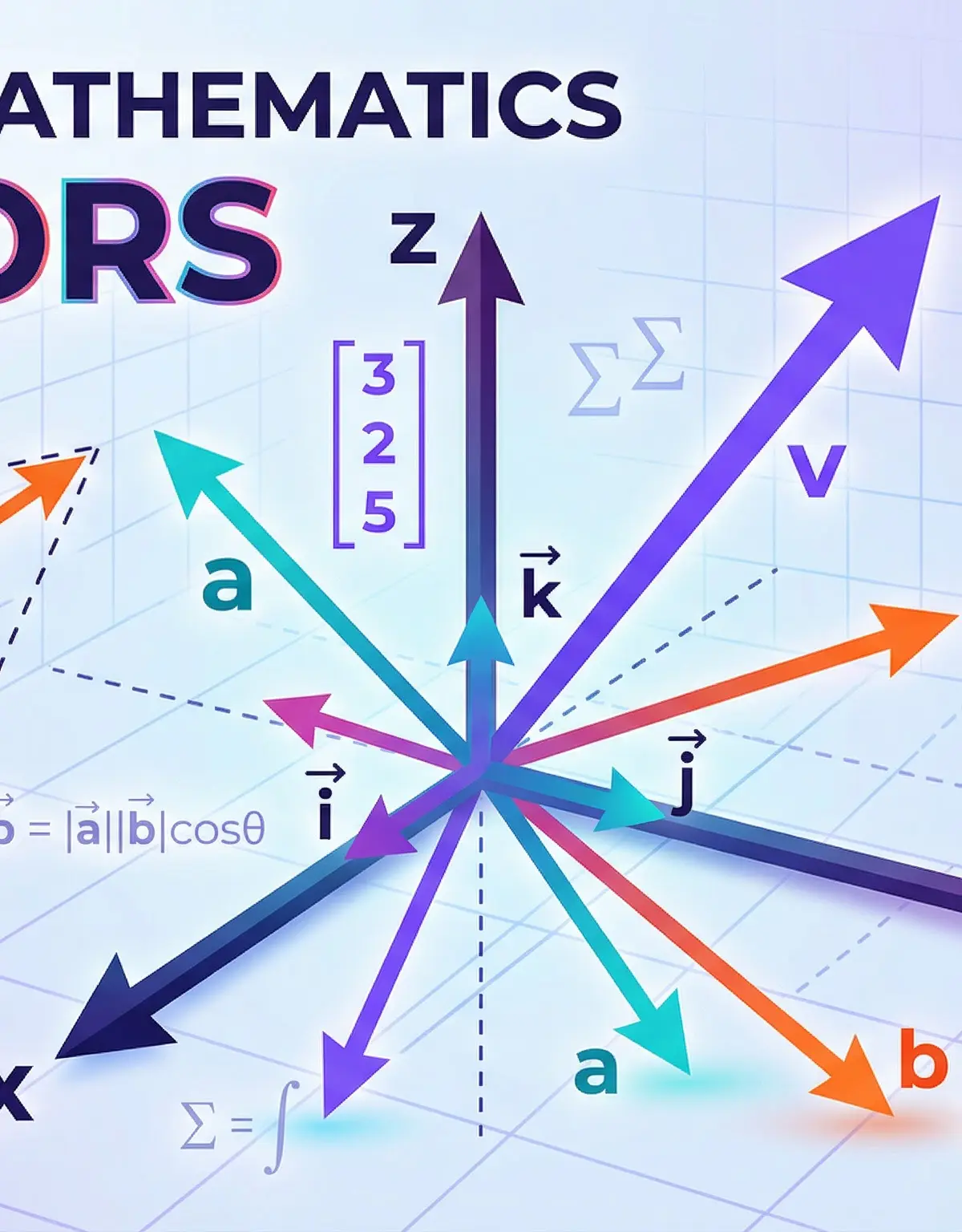
Vectors are a cornerstone of A-Level Mathematics, providing a powerful language to describe quantities that possess both magnitude and direction. This topic, specification point 3.12 for Edexcel, moves beyond simple GCSE concepts into a rigorous exploration of 2D and 3D space. A firm grasp of vectors is essential not only for pure mathematics, where they are used for geometric proofs involving lines and shapes, but also for mechanics, where they are fundamental to modelling forces, velocity, and acceleration. Examiners frequently test vector reasoning in multi-step problems that require candidates to construct logical arguments. Typical questions range from calculating magnitudes and distances to proving properties like collinearity or finding the point of intersection of two lines. Success in this area demonstrates a deep understanding of spatial relationships and mathematical structure.

Key Concepts
Concept 1: Vector Notation and Representation
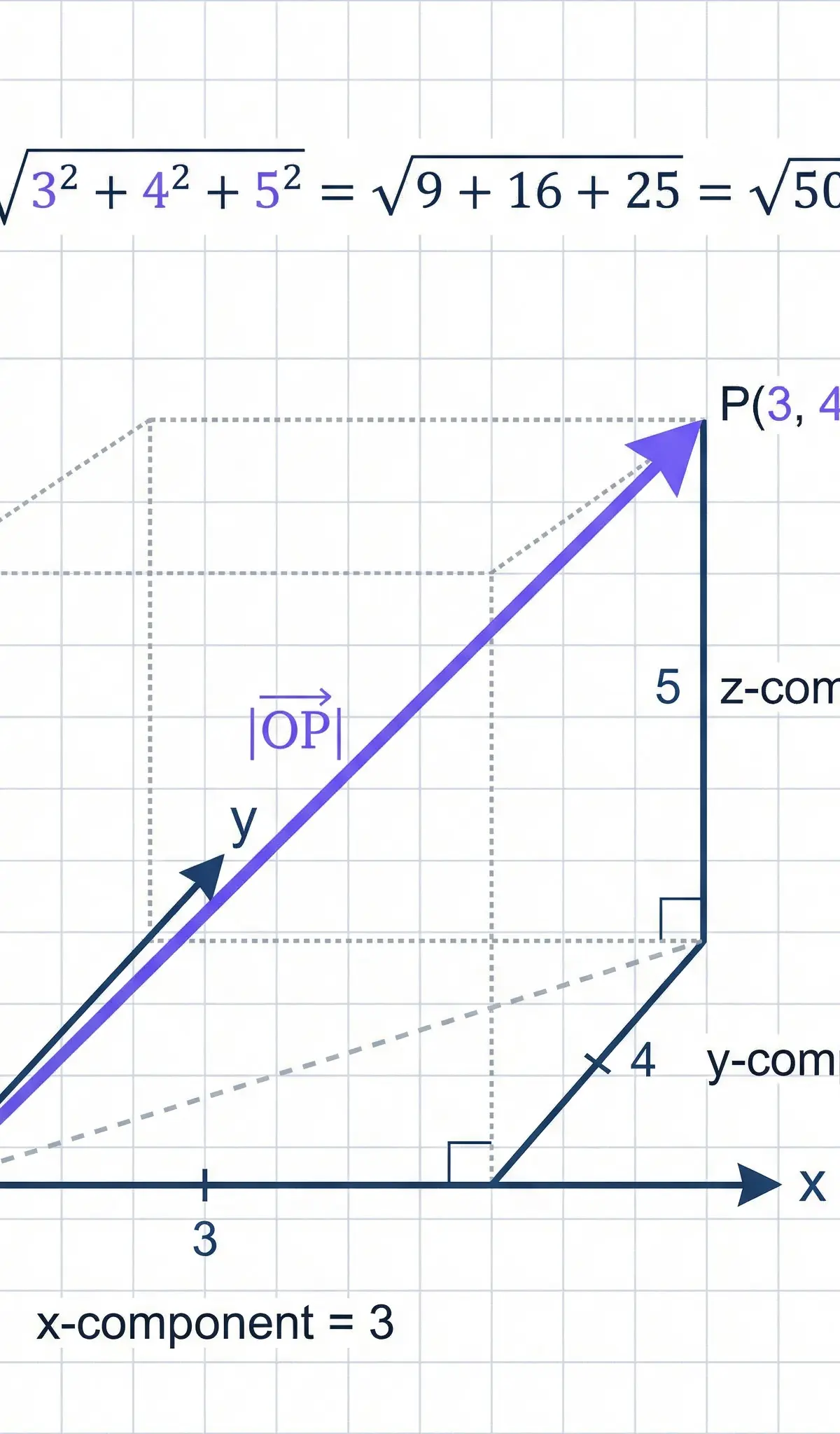
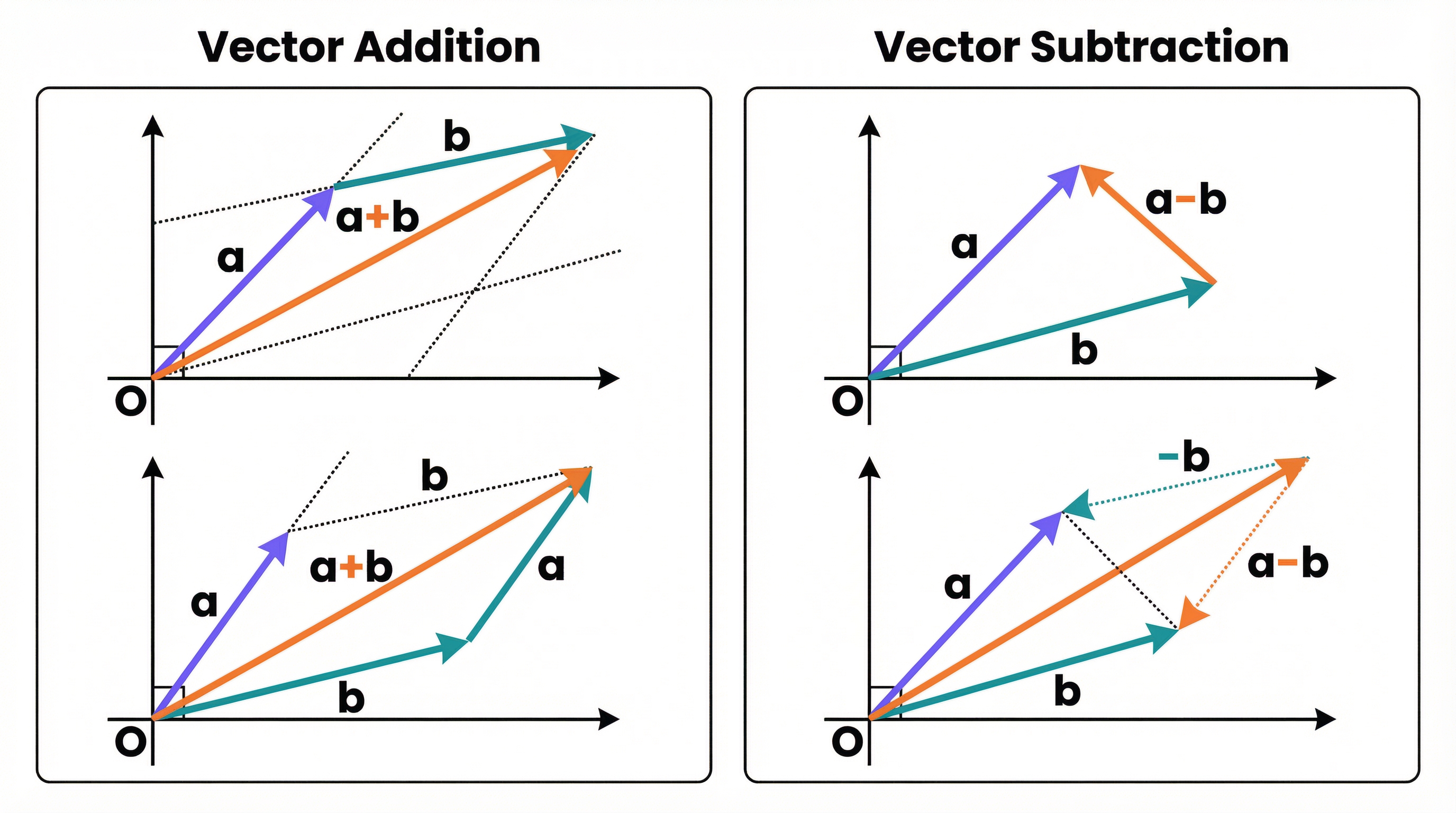
A vector can be represented in several ways, and candidates must be fluent in all of them. The most common are column vectors and i, j, k notation. A 2D displacement vector that moves 3 units right (positive x-direction) and 4 units up (positive y-direction) can be written as a column vector (3, 4) or as 3i + 4j. In 3D, we add a third component, k, for the z-direction. For example, 2i - 5j + k corresponds to the column vector (2, -5, 1). It is crucial to distinguish between position vectors, which give the coordinates of a point relative to the origin (O), and displacement vectors, which describe the journey between two points. The displacement vector from point A to point B, denoted AB, is found by subtracting the position vector of the start point from the end point: AB = OB - OA = b - a. Confusing this with a + b is a frequent source of lost marks.
Concept 2: Magnitude and Unit Vectors
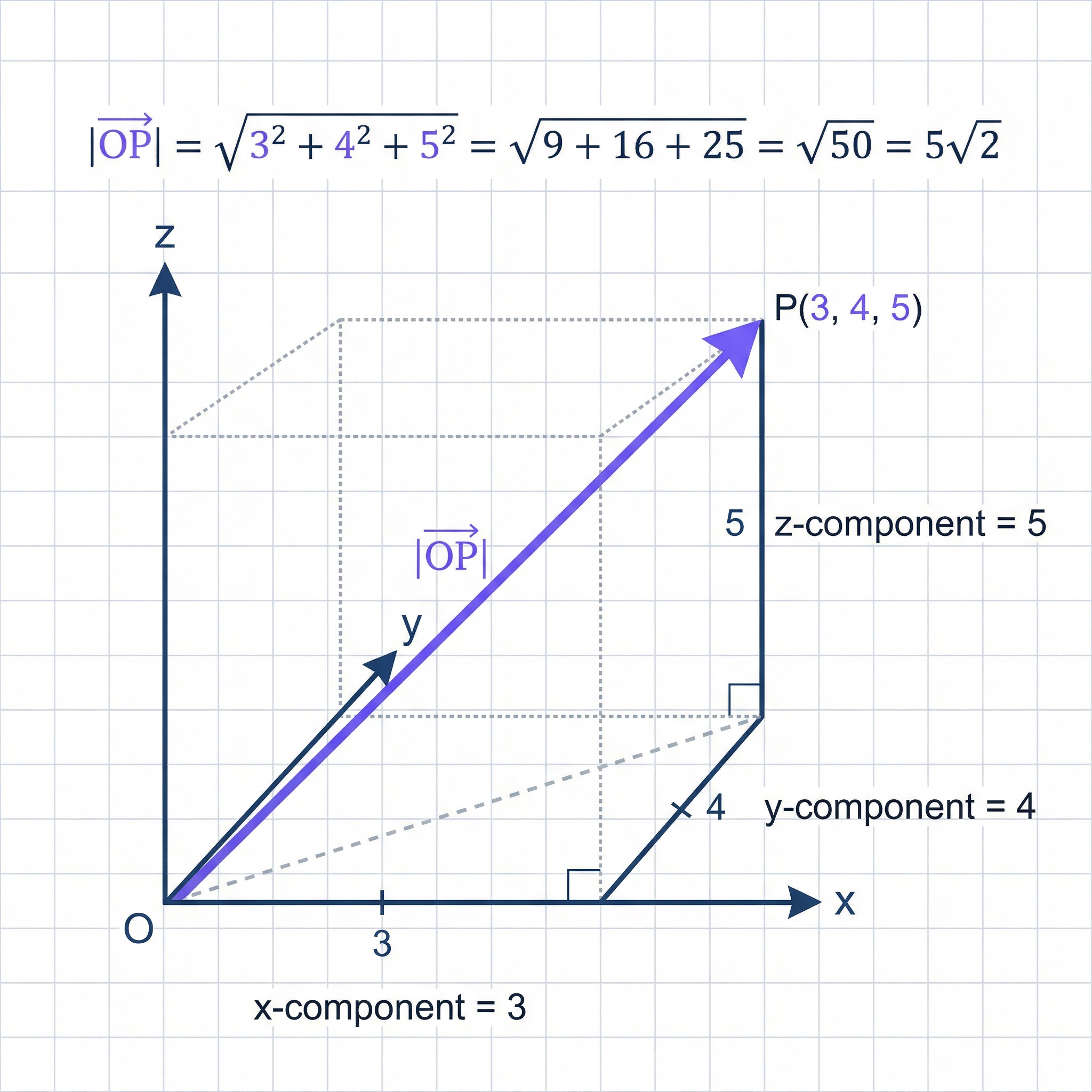
The magnitude (or modulus) of a vector is its length, a scalar quantity. It is calculated using Pythagoras's theorem in 2D or 3D. For a vector v = xi + yj + zk, its magnitude |v| is given by the formula |v| = sqrt(x^2 + y^2 + z^2). A common error is mishandling negative components; remember that squaring a negative number yields a positive result (e.g., (-4)^2 = 16). A unit vector is a vector with a magnitude of 1. To find the unit vector in the direction of a vector v, you divide the vector by its magnitude: û = v / |v|. This is a key skill for questions involving directions in space.
Concept 3: Vector Arithmetic
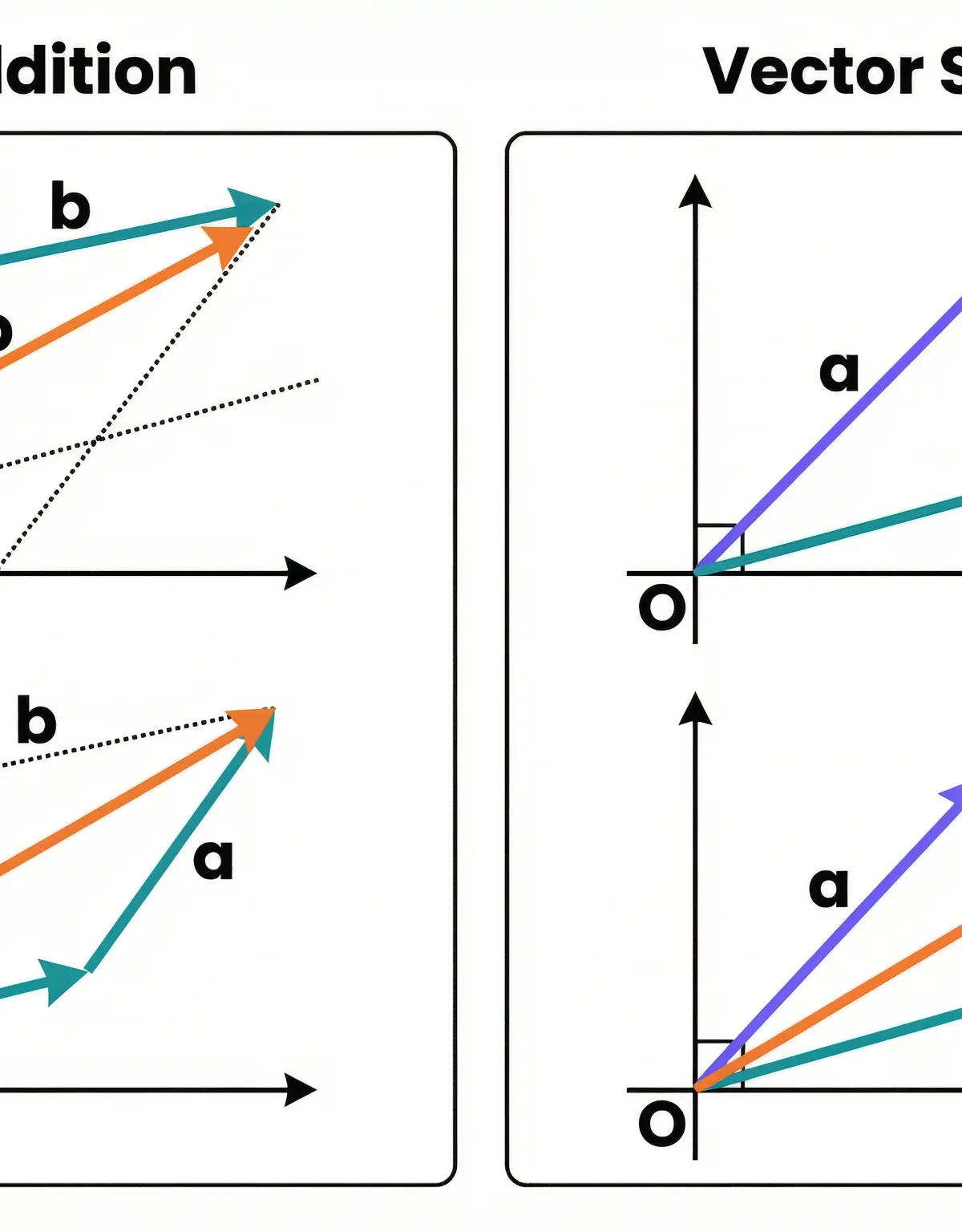
Vectors can be added, subtracted, and multiplied by scalars. To add or subtract vectors, you simply perform the operation on the corresponding components. For example, if a = (a1, a2) and b = (b1, b2), then a + b = (a1 + b1, a2 + b2). Geometrically, this is represented by the triangle law (placing vectors head-to-tail) or the parallelogram law. Multiplying a vector by a scalar changes its magnitude but not its direction (unless the scalar is negative, in which case the direction is reversed). If v = (x, y), then kv = (kx, ky). This concept is the foundation for understanding parallel vectors: two vectors a and b are parallel if and only if a = kb for some non-zero scalar k.
Concept 4: Geometric Proofs with Vectors
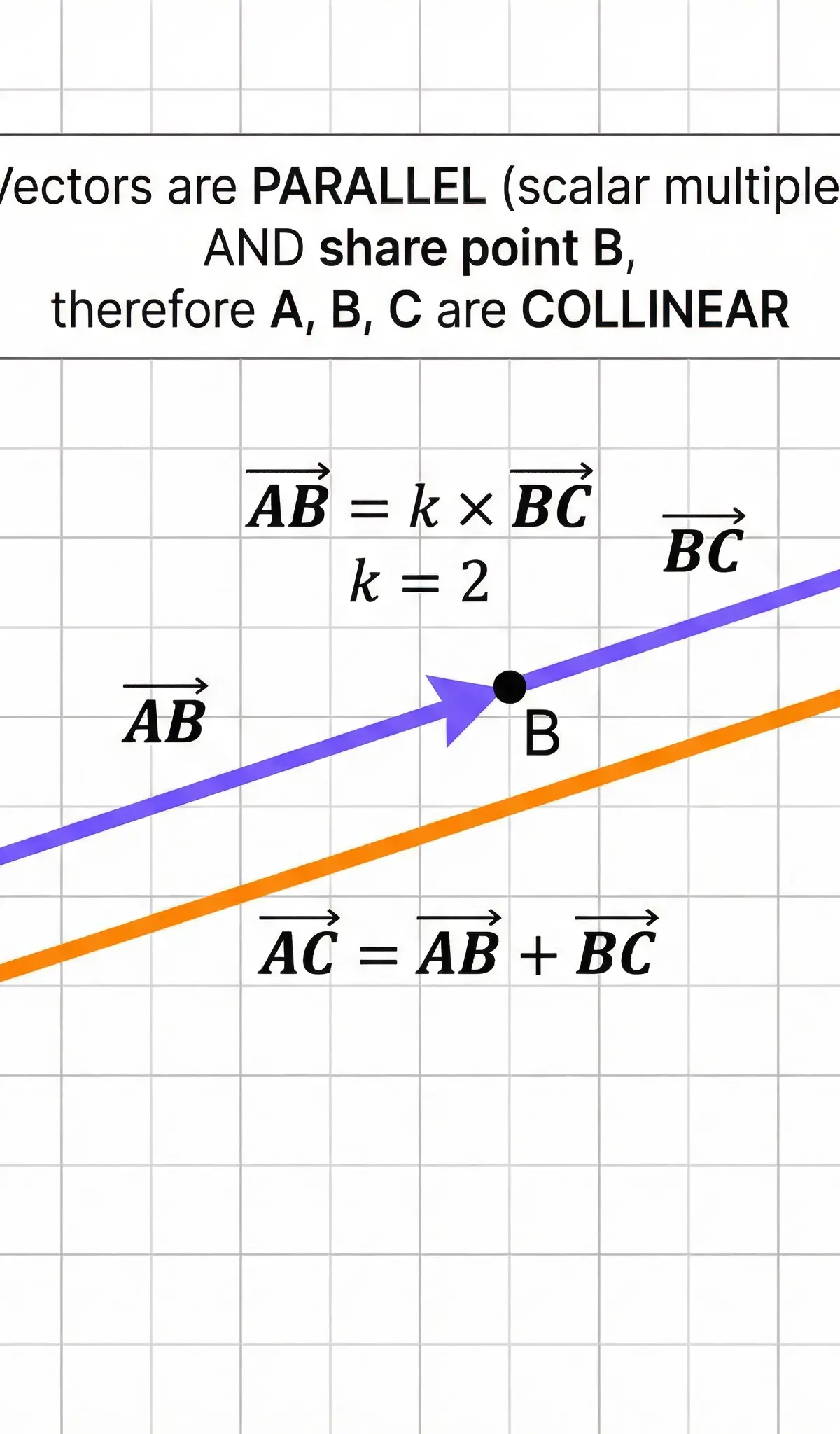
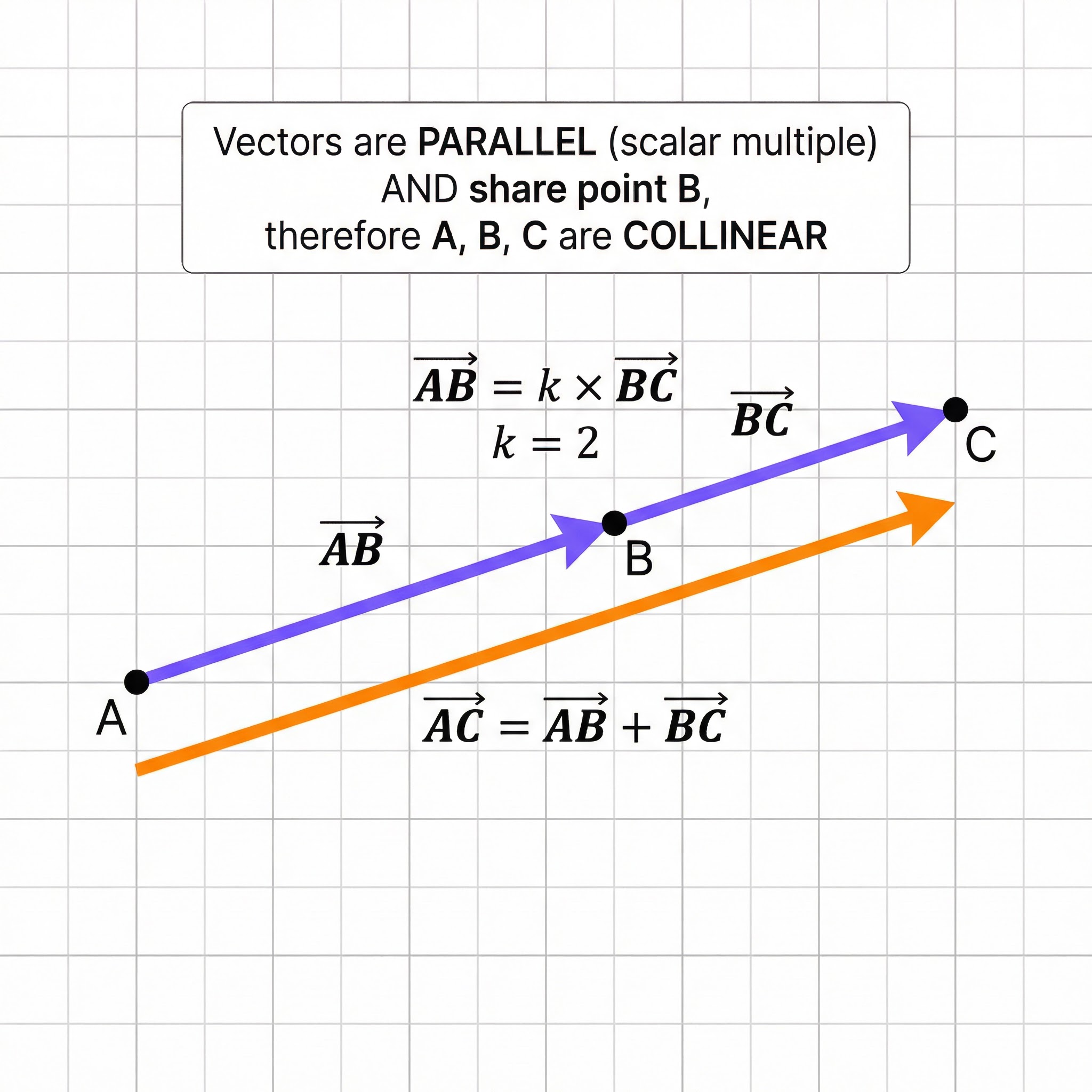
Vectors are a powerful tool for proving geometric properties. A classic exam question involves proving that three points, A, B, and C, are collinear (lie on the same straight line). To earn full marks, a candidate must provide a two-part conclusion: 1. Show that the vectors AB and BC are parallel (i.e., AB = k * BC). 2. State that they share a common point (point B). Simply proving they are parallel is insufficient, as parallel vectors can exist anywhere in space. Other common proofs involve showing that a shape is a specific type of quadrilateral (e.g., a parallelogram, where you must show that opposite sides are equal and parallel, AB = DC).
Mathematical Relationships
- Displacement Vector:
AB = b - a(Must memorise) - Magnitude of a 3D Vector:
|v| = sqrt(x^2 + y^2 + z^2)(Given on formula sheet) - Unit Vector:
û = v / |v|(Must memorise) - Scalar (Dot) Product:
a · b = |a||b|cos(θ)(Given on formula sheet). This is used to find the angle between two vectors. - Condition for Parallel Vectors:
a = kbfor some scalark. (Must memorise) - Condition for Perpendicular Vectors:
a · b = 0. (Must memorise)
Practical Applications
Vectors are not just an abstract concept; they are essential in many fields. In Physics and Engineering, vectors are used to model forces, velocity, acceleration, and momentum. For example, when calculating the resultant force on an object, engineers add the force vectors acting on it. In Computer Graphics, vectors are used to determine the position and orientation of objects in a 3D virtual world, as well as for lighting calculations (using the dot product to determine how light reflects off a surface). In Aviation and Marine Navigation, pilots and captains use vectors to calculate their course, factoring in the velocity of their vehicle and the velocity of the wind or current.
Visual Resources
3 diagrams and illustrations
Interactive Diagrams
2 interactive diagrams to visualise key concepts
Conceptual Flow Outline
Flowchart showing the logical steps to prove collinearity. This is the structure candidates must follow to secure full marks.
Conceptual Flow Outline
Comparison of the Triangle Law and Parallelogram Law for vector addition. Both yield the same resultant vector.
Worked Examples
3 worked examples — open one to explore the question and available guidance.
Practice Questions
Test your understanding — click to reveal model answers
The vector a has magnitude 20 and is in the direction of 3i - 4j. Find the vector a.
Hint: First, find the unit vector in the direction of `3i - 4j`. Then, scale it by the required magnitude.
Given p = 2i + 5j and q = 3i - j. Find the vector r such that 2p + r = q.
Hint: Rearrange the equation to make `r` the subject.
OABC is a parallelogram. OA = a and OC = c. The diagonals OB and AC intersect at the point P. Prove that P is the midpoint of both diagonals.
Hint: Find the position vector of P by travelling along both diagonals, using a scalar parameter for the fraction of the way along (e.g., `OP = λOB`). Then equate the two expressions for OP.
Find the angle between the vectors a = 2i + 2j - k and b = 3i - 4j + k. Give your answer in degrees to 1 decimal place.
Hint: Use the scalar product formula: `a · b = |a||b|cos(θ)`.
A particle has a velocity vector v = (2t - 1)i + (t^2)j m/s. Find the speed of the particle at t = 3 seconds.
Hint: Speed is the magnitude of the velocity vector. First find the velocity vector at t=3, then find its magnitude.