OCR · GCSE · Mathematics
Calculations
Master the core of your GCSE Maths exam with this guide to Calculations. Learn the secrets to using your calculator effectively, conquer the order of operations (BIDMAS), and perfect your rounding skills to secure every possible mark.
- 5 min read
- 3 worked examples
- 5 practice questions
- 6 key terms
Study Notes
Overview
Calculations are the absolute foundation of your OCR GCSE Mathematics exam. This topic (specification reference 1.3) is not just about getting the right answer, but about demonstrating a full understanding of the process and presenting your work in a way that earns maximum credit. It covers the strict hierarchy of operations (BIDMAS), the accurate use of a calculator for complex tasks, and the critical skill of rounding to an appropriate degree of accuracy. While these skills are tested directly, they are also essential for almost every other topic in the specification, from Algebra to Geometry. A typical exam question will require you to perform a multi-step calculation, often asking you to give your answer to a specific number of significant figures or decimal places, or to use estimation to check your result.
Key Concepts
Concept 1: The Hierarchy of Operations (BIDMAS)
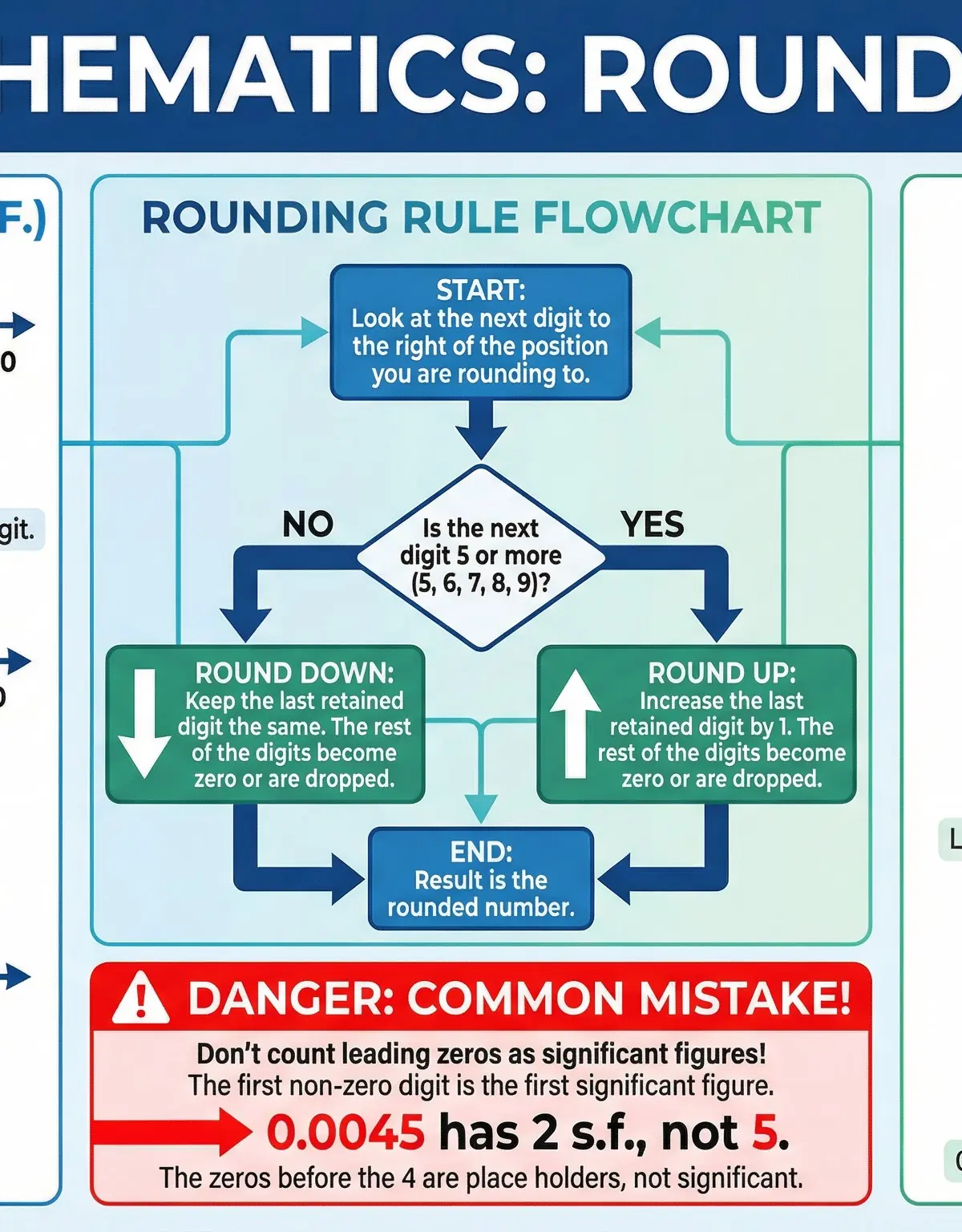
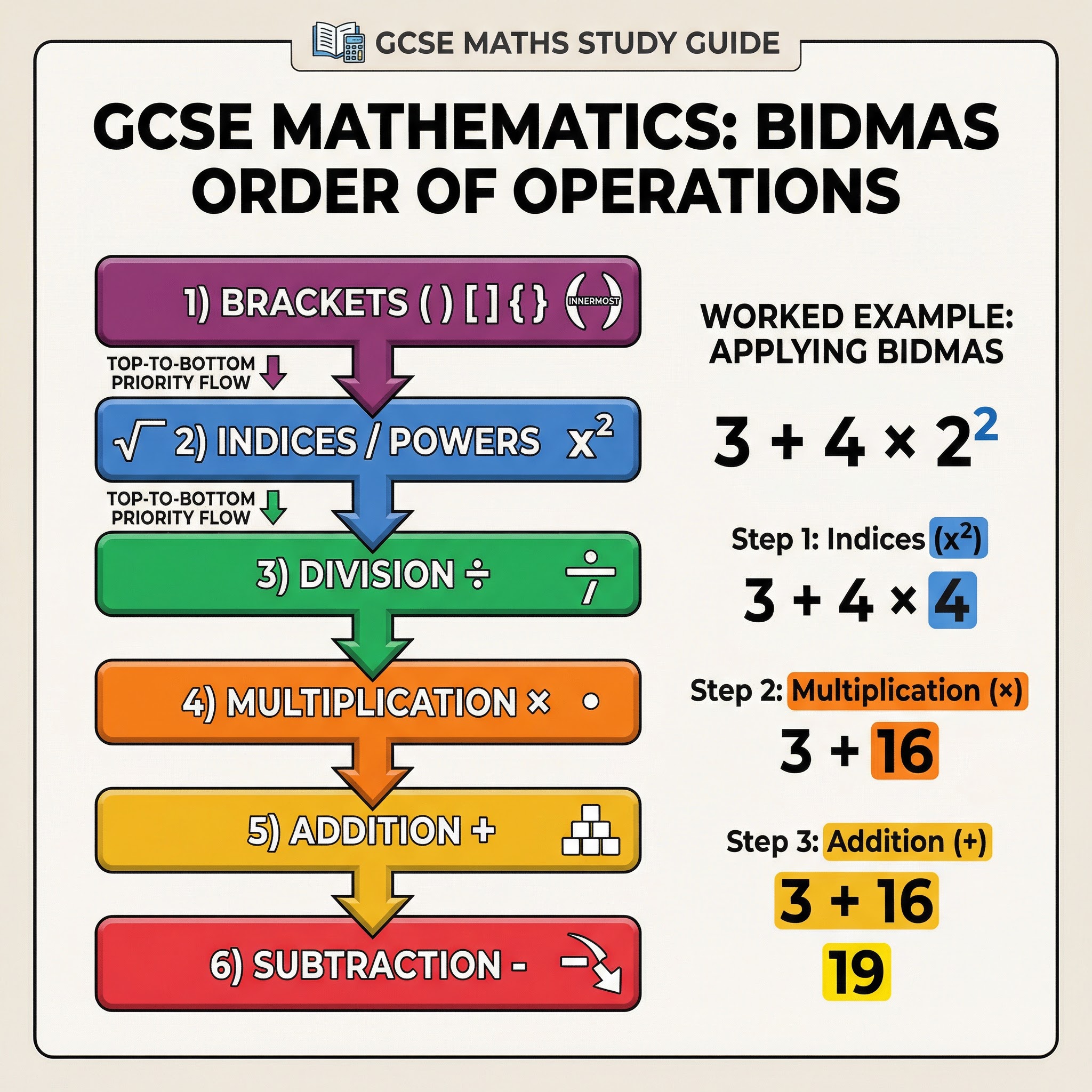
BIDMAS is a non-negotiable rulebook for the order in which you must perform calculations. It ensures that every mathematician, from a GCSE student to a top-level researcher, gets the same answer from the same calculation. It stands for:
- Brackets
- Indices (or Order, meaning powers and roots)
- Division and Multiplication (equal priority, work left to right)
- Addition and Subtraction (equal priority, work left to right)
Think of it like a pyramid: you deal with the operations at the top first and work your way down. Examiners frequently set traps for candidates who simply work from left to right. Forgetting BIDMAS is one of the most common ways to lose marks.
Example: Calculate 7 + (6 - 2) * 3^2
- Brackets:
(6 - 2) = 4. The calculation becomes7 + 4 * 3^2. - Indices:
3^2 = 9. The calculation becomes7 + 4 * 9. - Multiplication:
4 * 9 = 36. The calculation becomes7 + 36. - Addition:
7 + 36 = 43.
Concept 2: Rounding and Estimation
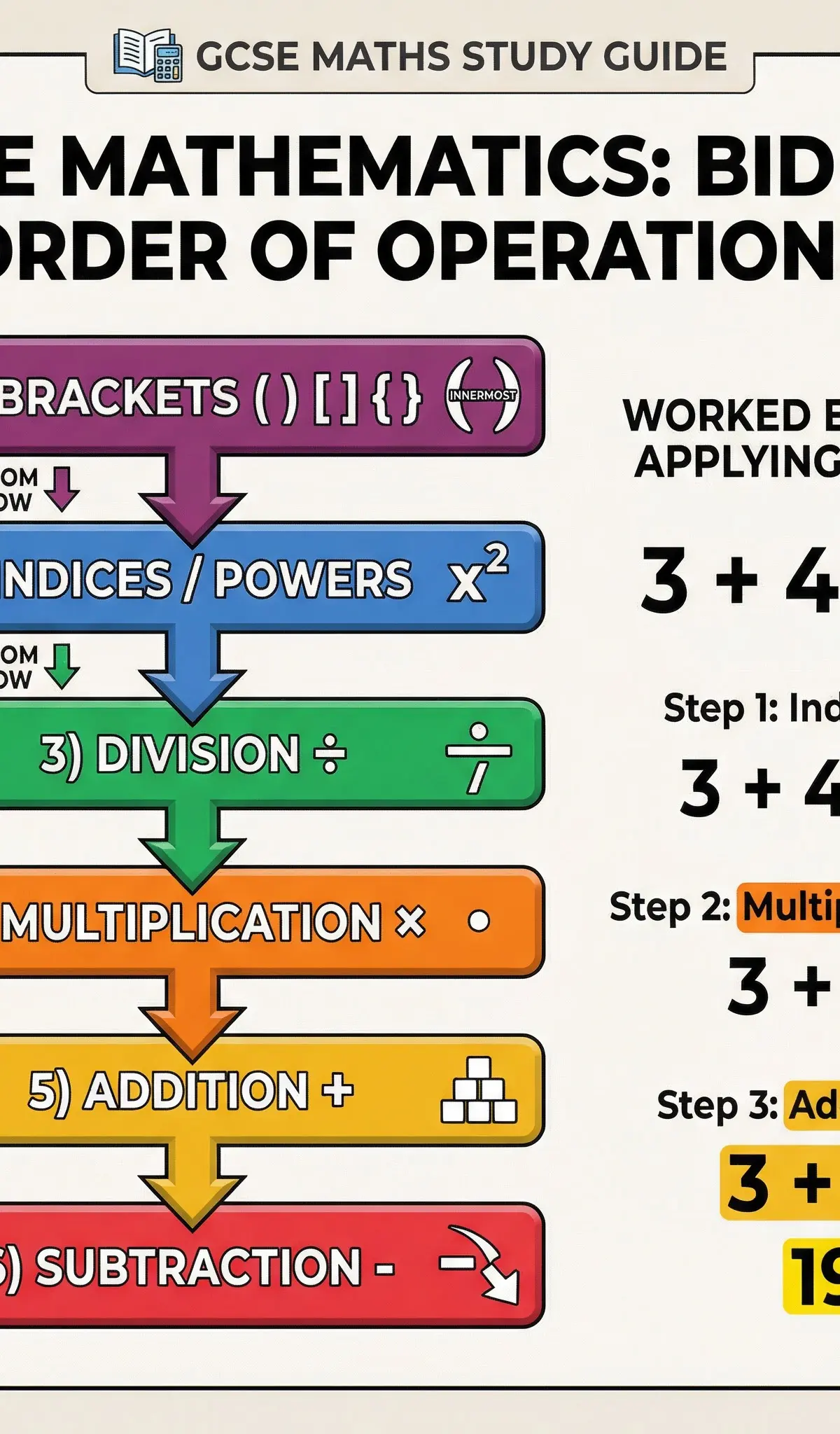
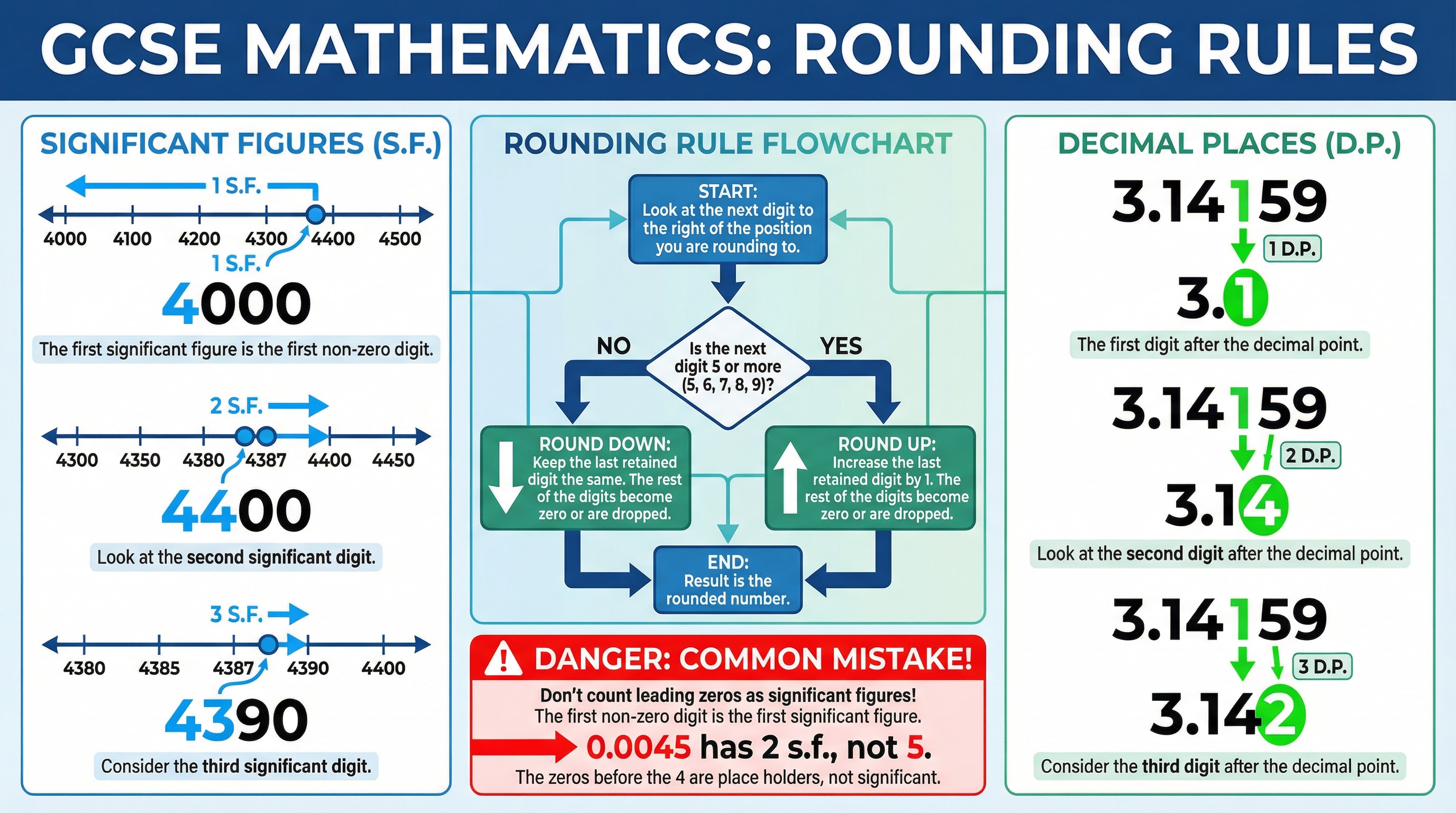
Rounding is a key skill used to make numbers simpler and to express an answer to an appropriate level of accuracy. You will be asked to round to a specific number of decimal places (d.p.) or significant figures (s.f.).
- Decimal Places: Count from the decimal point.
4.567to 2 d.p. is4.57. - Significant Figures: The first significant figure is the first non-zero digit.
0.0508to 2 s.f. is0.051.
Estimation is a vital checking mechanism. For 'Estimate' questions, you MUST round every number to 1 significant figure before performing the calculation. This gives you a rough answer to check against your detailed calculation. An exact answer to an estimation question will score 0 marks.
Example: Estimate the value of (48.7 * 9.8) / 18.3
- Round each number to 1 s.f.:
50 * 10 / 20 - Calculate:
500 / 20 = 25. This is your estimated answer.
Concept 3: Calculator Skills
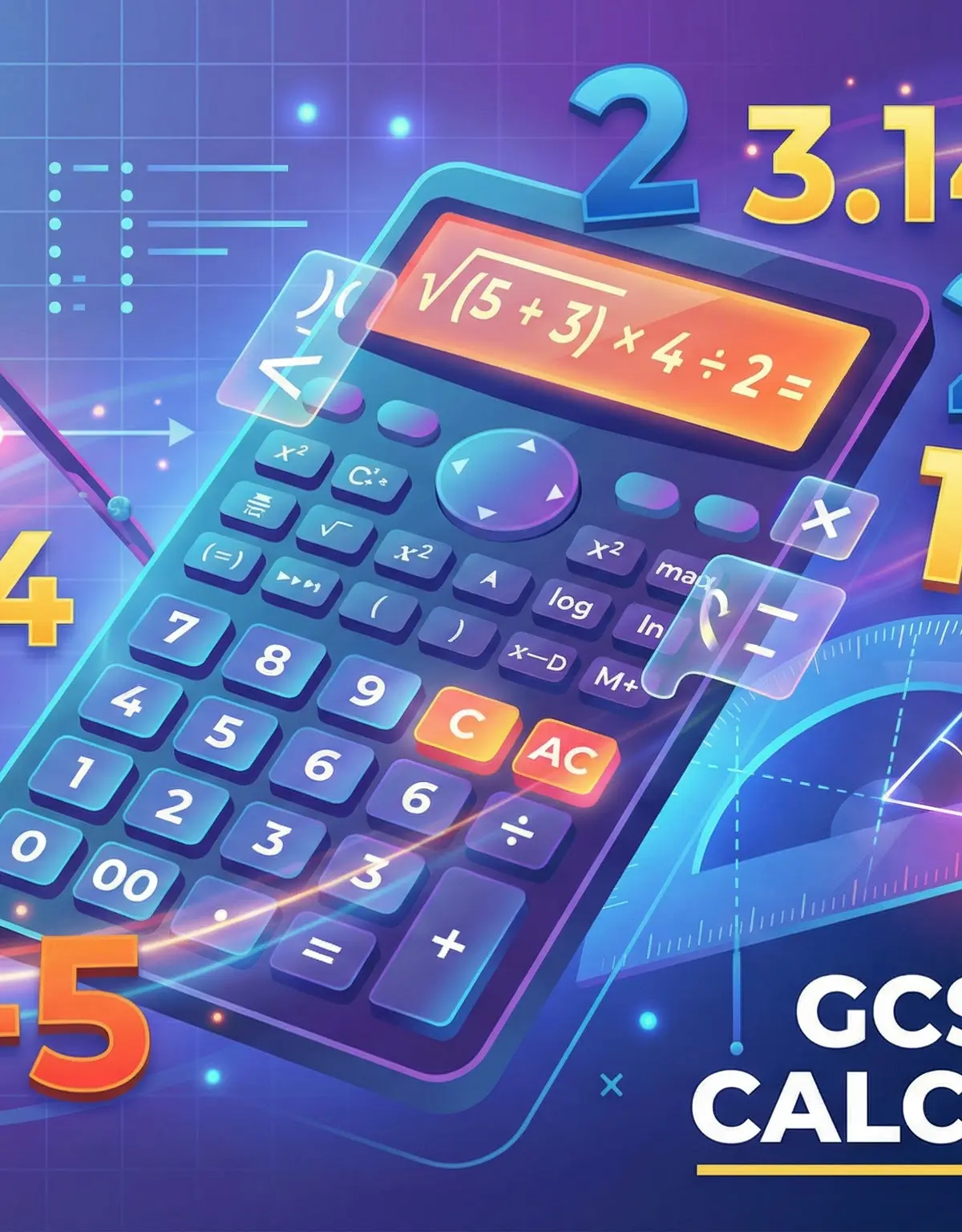
Your calculator is a powerful tool, but it follows your instructions precisely. A common error is squaring negative numbers. Typing -5^2 often gives -25 because the calculator squares the 5 first, then applies the negative. You must use brackets: (-5)^2 to get the correct answer of 25. You should also be familiar with your calculator's functions for fractions, standard form, and using the memory (ANS) button to avoid premature rounding in multi-step problems.
Mathematical/Scientific Relationships
-
Inverse Operations: These are operations that 'undo' each other. Addition and subtraction are inverses; multiplication and division are inverses. This is crucial for solving equations and for checking your work.
- If
a + b = c, thenc - b = a. - If
a * b = c, thenc / b = a.
- If
-
Bounds: For any number rounded to a certain degree of accuracy, there is a range of possible values it could have been. This is its error interval. For a number
xrounded to the nearest integern, the error interval isn - 0.5 <= x < n + 0.5. This concept is Higher Tier only.
Practical Applications
Calculations are everywhere in the real world. You use them when:
- Managing Finances: Calculating bills, interest on savings, or budgeting expenses.
- DIY and Construction: Measuring materials, calculating areas, and scaling plans.
- Science: Calculating concentrations, speeds, or densities in experiments.
- Technology: Understanding data storage, processing speeds, and file sizes.
Being able to perform calculations accurately and efficiently is a fundamental life skill, and the exam tests your ability to apply these skills in various real-world contexts.
Visual Resources
2 diagrams and illustrations
Interactive Diagrams
2 interactive diagrams to visualise key concepts
Conceptual Flow Outline
A flowchart showing the step-by-step application of BIDMAS to solve a calculation.
Conceptual Flow Outline
A decision-making flowchart for determining the upper and lower bounds of a rounded number (Higher Tier).
Worked Examples
3 worked examples — open one to explore the question and available guidance.
Practice Questions
Test your understanding — click to reveal model answers
Calculate (3.5 * 8.4) / (6.7 - 4.2). Give your answer to 1 decimal place.
Hint: Use the fraction button on your calculator. Remember to do the subtraction in the denominator first.
Estimate the value of (38.9 * sqrt(98.5)) / 19.5.
Hint: The command word is 'Estimate'. What must you do to every number before you calculate?
Show that 3 1/3 - 1 3/4 = 1 7/12.
Hint: Convert the mixed numbers to improper fractions first.
A car travels 250 miles, correct to the nearest 10 miles. The journey took 4 hours, correct to the nearest hour. Calculate the minimum possible average speed of the car. Give your answer in miles per hour.
Hint: This is a Higher Tier bounds question. To find the minimum speed (Distance/Time), you need the smallest possible distance and the largest possible time.
Find the value of (2.8 * 10^4) * (6.4 * 10^2). Give your answer in standard form.
Hint: Multiply the numbers and add the powers of 10. Remember to adjust the final answer to be in correct standard form.