OCR · GCSE · Mathematics
Equations
Equations (Topic 2.2) is a cornerstone of OCR GCSE Mathematics, testing your ability to solve linear, quadratic, and simultaneous equations across both Foundation and Higher tiers. Mastering this topic unlocks marks throughout the exam, from pure algebra questions to problem-solving in geometry and statistics. This guide provides you with the core methods, exam techniques, and memory hooks to confidently tackle any equation question.
- 6 min read
- 5 worked examples
- 6 practice questions
- 8 key terms
Study Notes

Overview
Equations are the bedrock of mathematics, providing the essential tools to model real-world problems and solve for unknown values. For your OCR GCSE Mathematics exam, Topic 2.2 is a powerhouse of marks, assessing your ability to manipulate and solve a wide range of equations, from simple linear expressions to complex quadratic and simultaneous systems. A strong command of this topic is not just about securing marks in dedicated algebra questions; it provides the foundational skills needed to tackle problems in geometry, statistics, and ratio. Examiners are looking for candidates who can not only follow a process but also understand the logic behind it, choosing the most efficient method for a given problem. This guide will equip you with the core knowledge, exam techniques, and memory aids to confidently navigate any equation-based question the exam throws at you.
Key Concepts
Concept 1: Solving Linear Equations
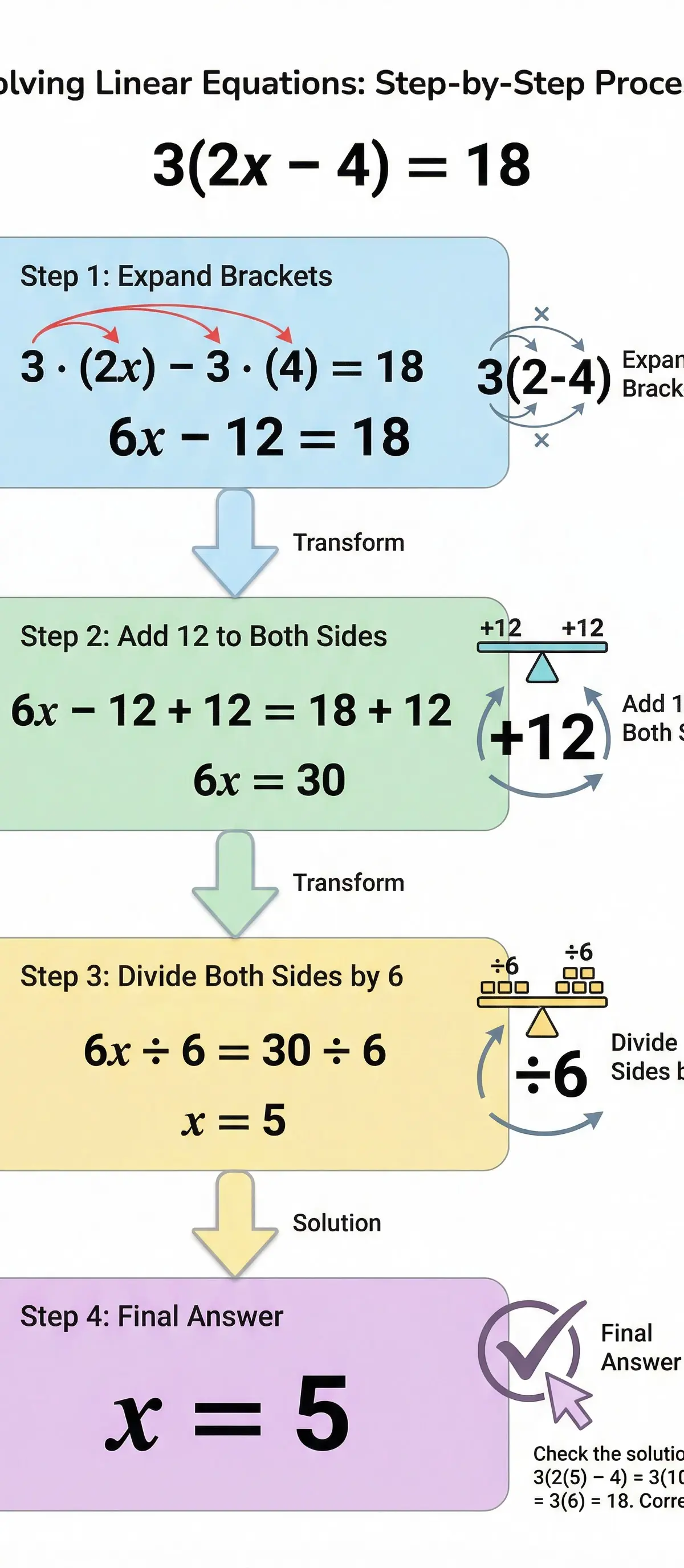
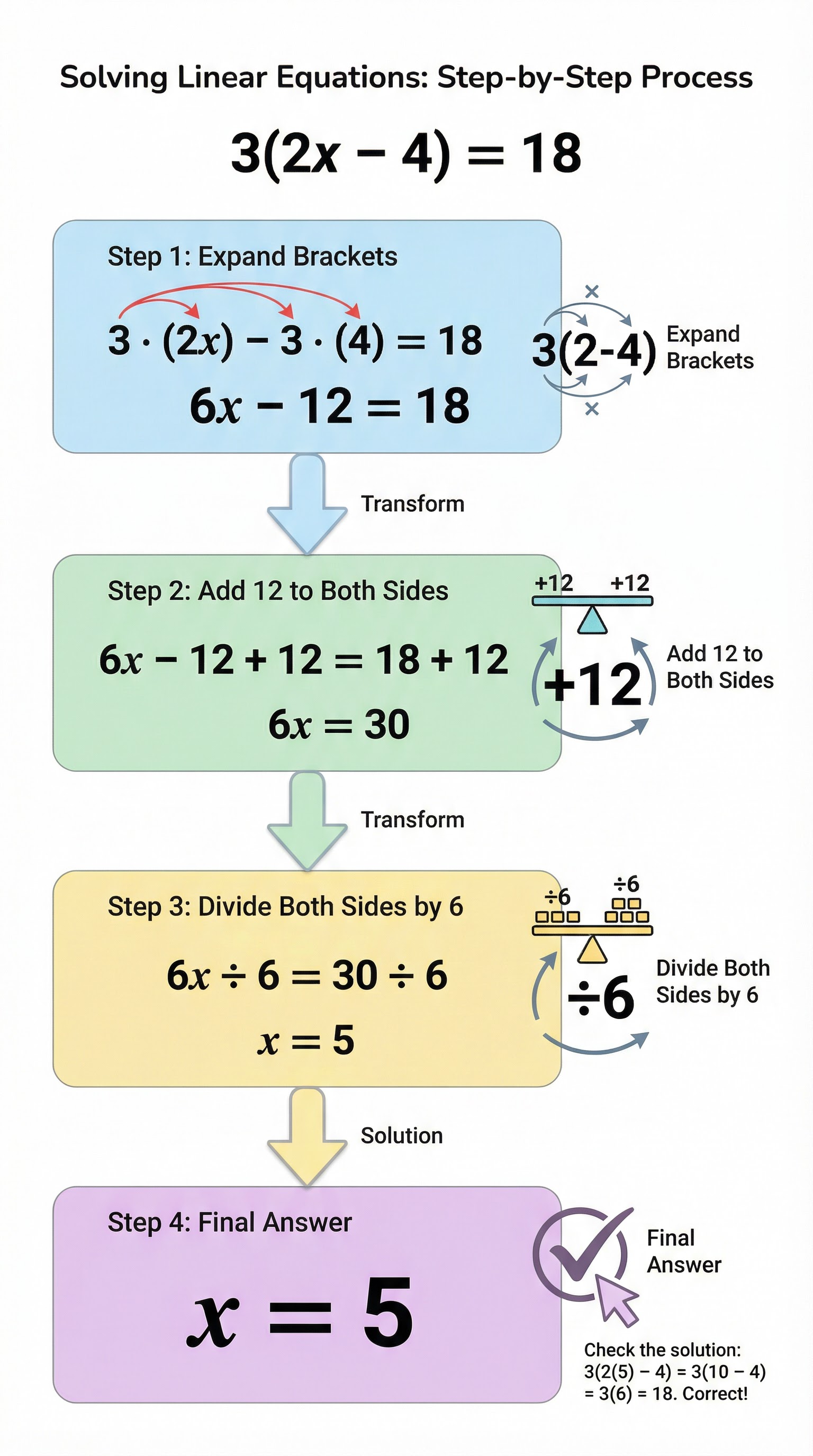
At its heart, a linear equation describes a straight-line relationship. Solving one is like a detective story where you are trying to find the value of the unknown variable, usually 'x'. The fundamental principle is balancing. Imagine an old-fashioned set of scales. To keep them balanced, whatever you do to one side, you must do to the other. Your mission is to isolate 'x' on one side of the equals sign. To do this, you systematically undo the operations being applied to 'x' by using their inverse operations, following the reverse order of BIDMAS. Addition and subtraction are undone with each other, as are multiplication and division.
Example: Solve 4x - 5 = 11
- The last operation applied to the 'x' term was subtracting 5. The inverse is adding 5. Add 5 to both sides:
4x - 5 + 5 = 11 + 5, which simplifies to4x = 16. - 'x' is being multiplied by 4. The inverse is dividing by 4. Divide both sides by 4:
4x / 4 = 16 / 4, which gives the solutionx = 4.
Concept 2: Solving Quadratic Equations (Higher Tier)
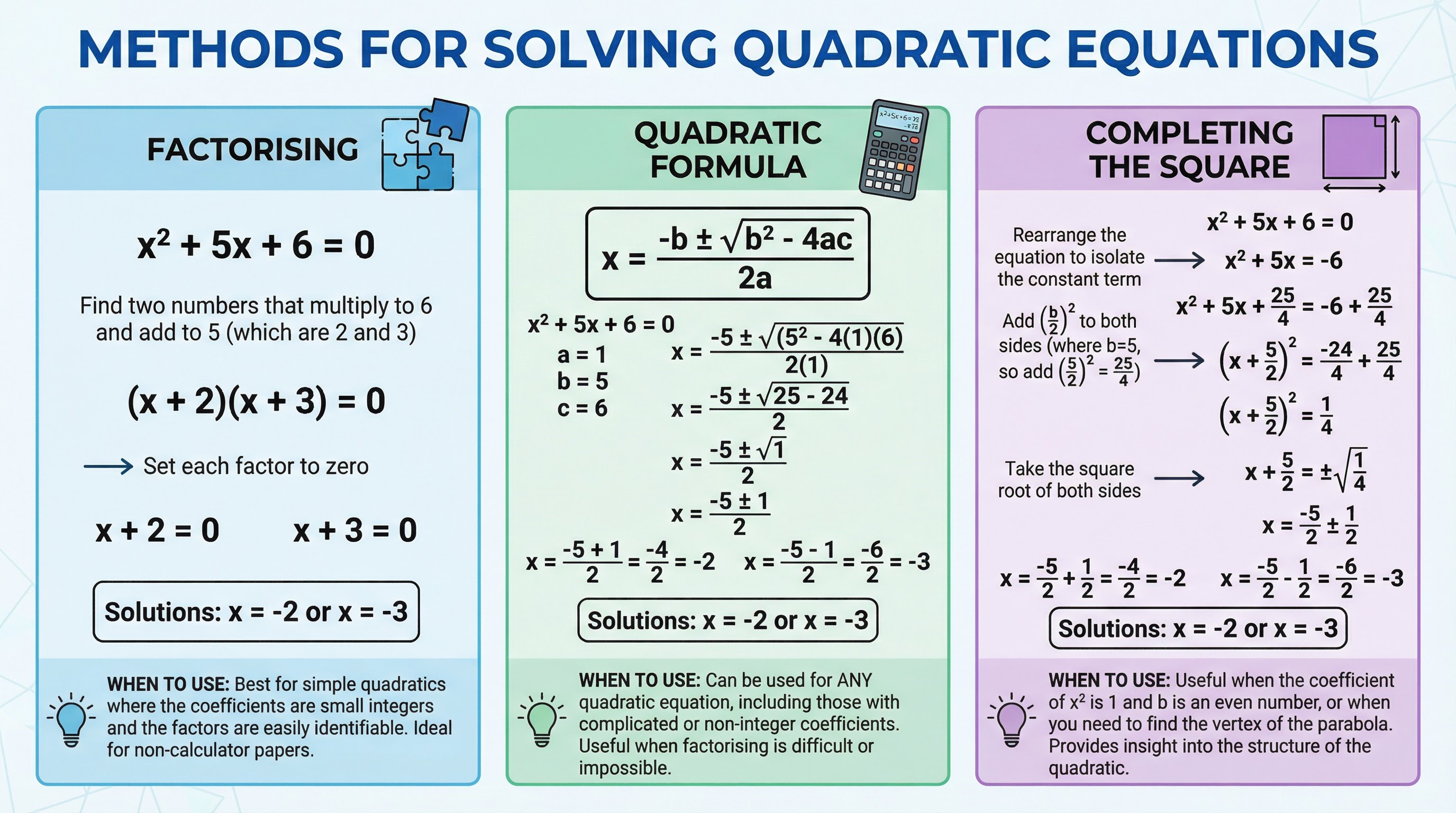
Quadratic equations involve a term with the variable squared (e.g., x²). They are the algebraic representation of parabolas. Unlike linear equations which have one solution, quadratics can have up to two real solutions. There are three primary methods for solving them, and choosing the right one is a key exam skill.
- Factorising: This is the quickest method but only works for "neat" quadratics. The first step is always to ensure the equation equals zero. Then, you look for two numbers that multiply to make the constant term and add to make the coefficient of the x term.
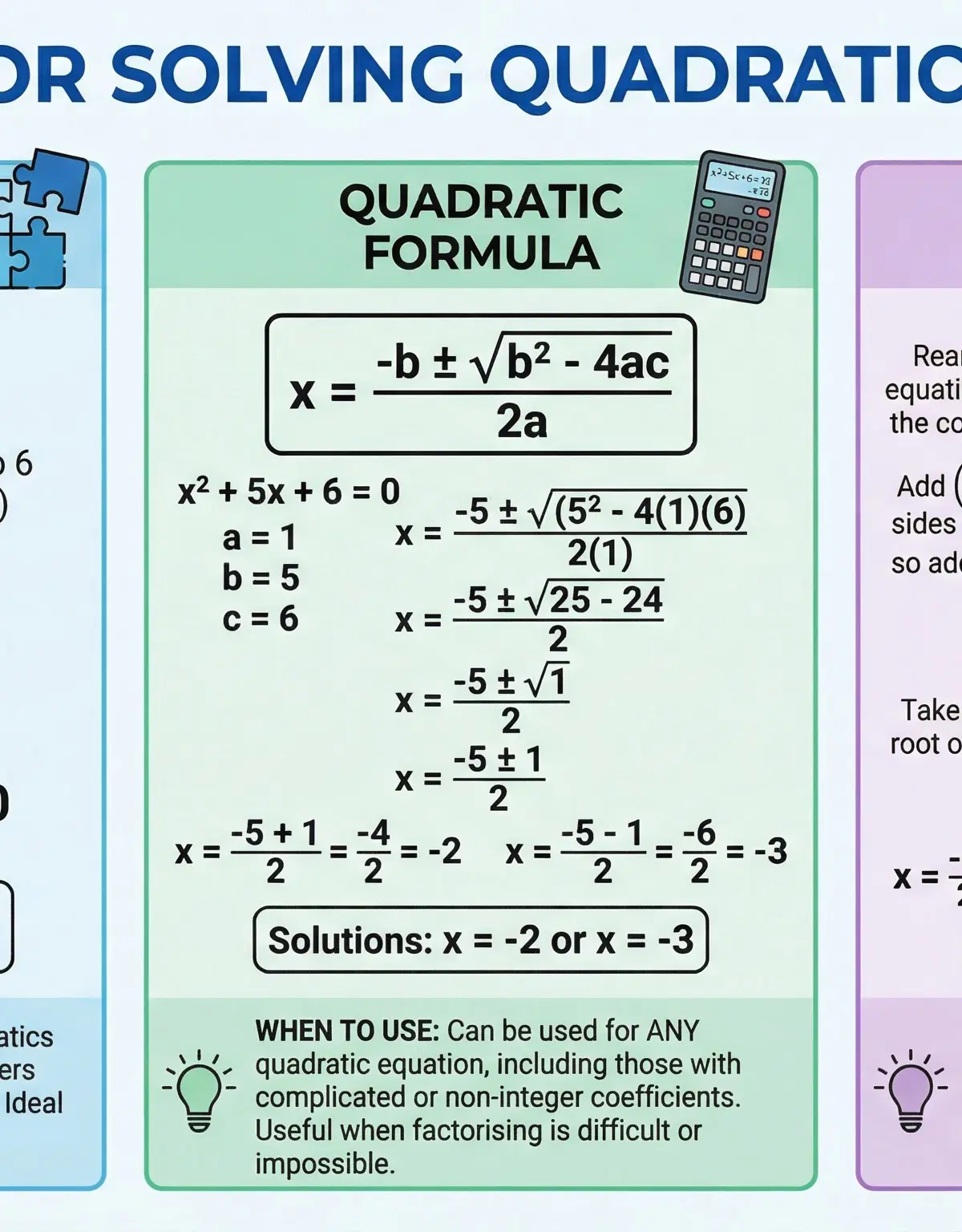
- The Quadratic Formula: This is the universal tool that can solve any quadratic equation. You MUST memorise this formula. It is your go-to method when the question asks for an answer to a specific number of decimal places or significant figures, which is a clear hint that the equation won't factorise nicely.
- Completing the Square: This method is powerful for finding the turning point (vertex) of a parabola and is also a valid way to solve any quadratic. It involves rewriting the quadratic expression as a perfect square plus or minus a constant.
Concept 3: Solving Simultaneous Equations
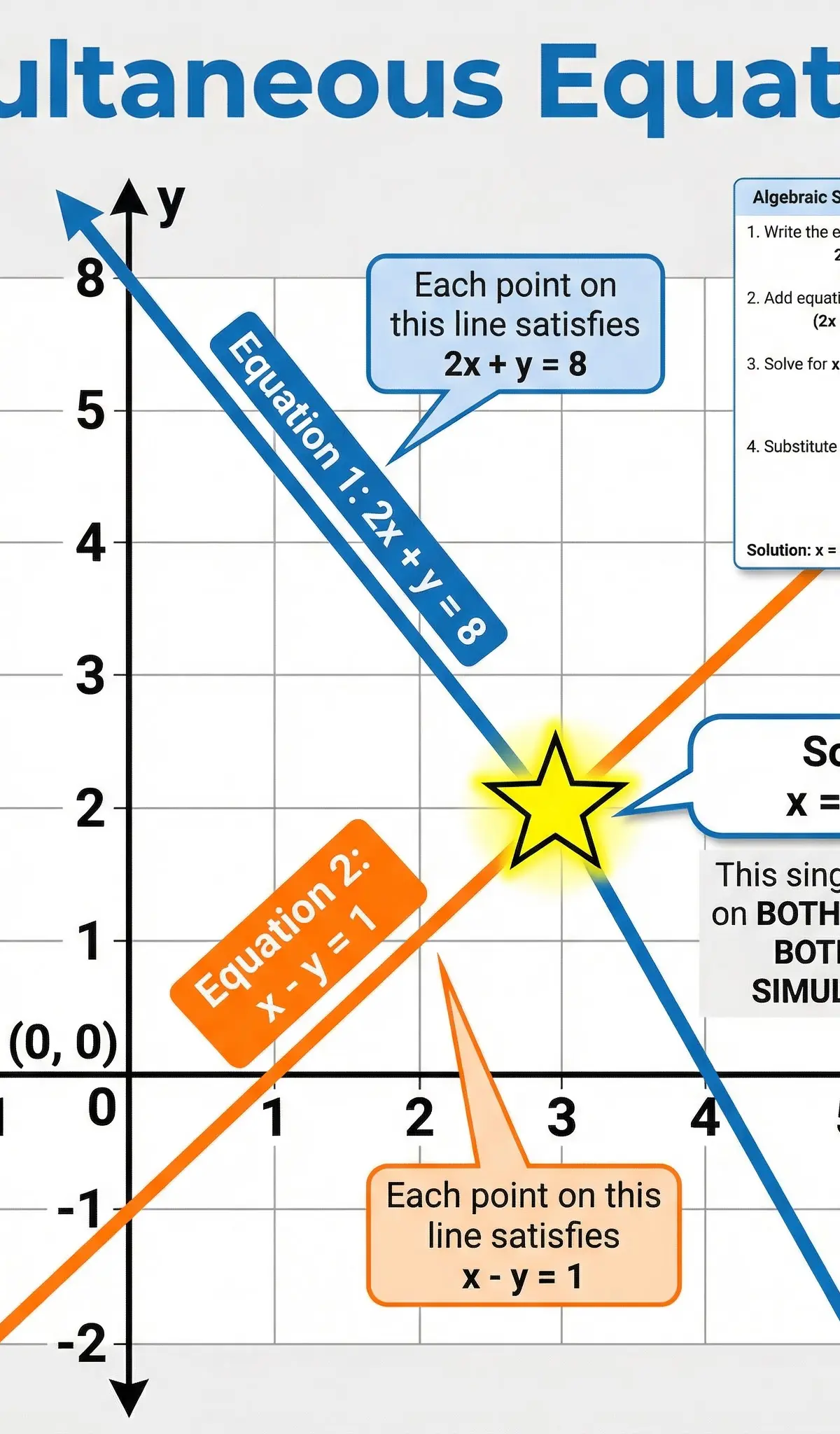
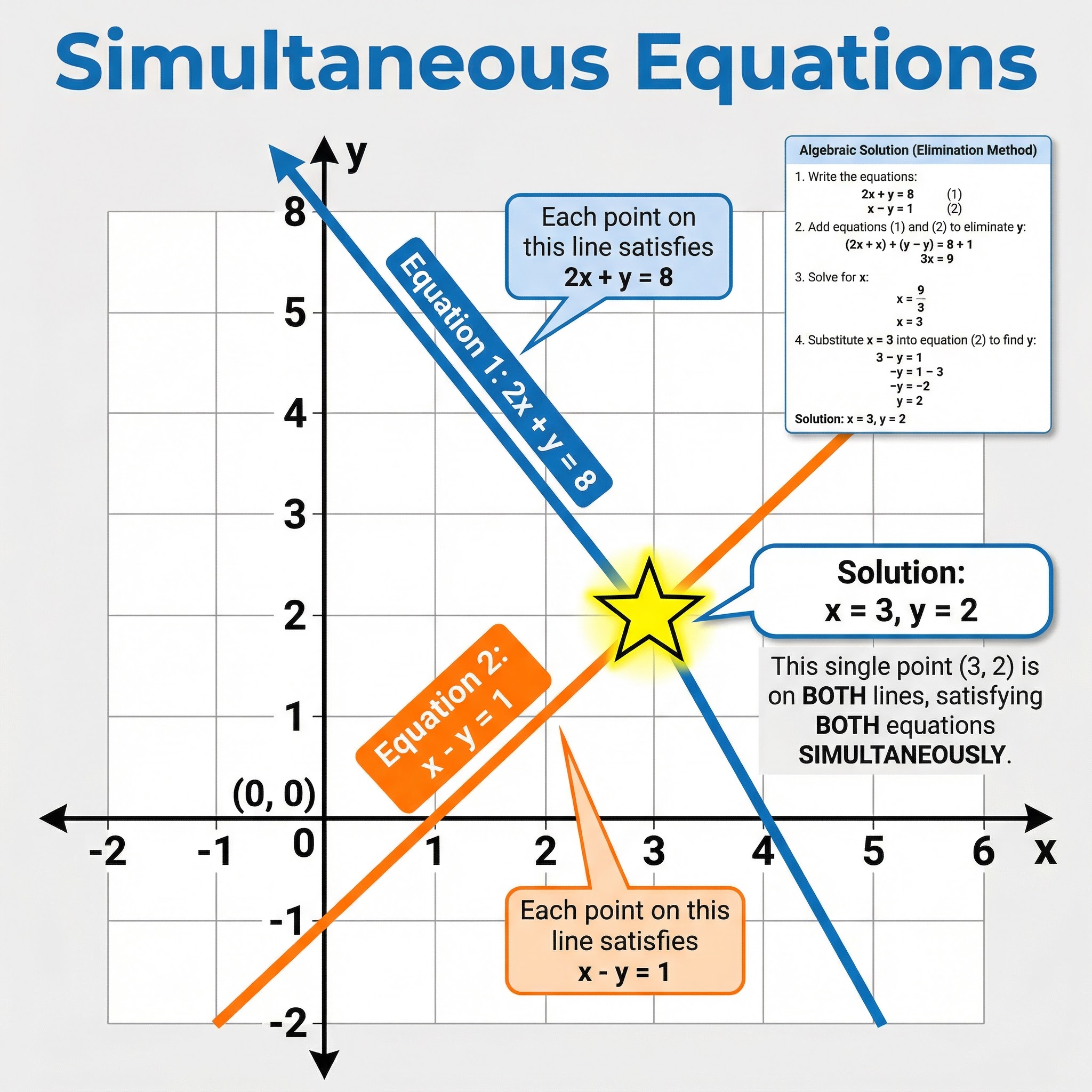
Simultaneous equations involve finding a set of values that satisfy two or more equations at the same time. Geometrically, this represents finding the point of intersection between two lines or curves. For GCSE, you will encounter two linear equations (Foundation and Higher) or one linear and one quadratic equation (Higher Tier only).
- Elimination Method: This is often the most efficient method for two linear equations. The goal is to manipulate one or both equations (by multiplying them) so that the coefficient of either x or y is the same. You then add or subtract the equations to eliminate that variable, leaving a simple linear equation to solve.
- Substitution Method: This method is essential for solving a linear and quadratic pair. You rearrange the linear equation to make either x or y the subject, and then substitute this expression into the quadratic equation. This results in a single quadratic equation which you can then solve using the methods described above.
Mathematical/Scientific Relationships
-
The Quadratic Formula (Must memorise):
For any quadratic equation in the formax² + bx + c = 0, the solutions are given by:
x = (-b ± √(b² - 4ac)) / 2aais the coefficient of the x² term.bis the coefficient of the x term.cis the constant term.
-
The Discriminant (Higher Tier):
The part of the quadratic formula inside the square root,b² - 4ac, is called the discriminant. It tells you how many real solutions the quadratic has:- If
b² - 4ac > 0, there are two distinct real solutions. - If
b² - 4ac = 0, there is exactly one real solution (a repeated root). - If
b² - 4ac < 0, there are no real solutions.
- If
Practical Applications
Equations are not just abstract concepts; they are used to model and solve real-world problems across many fields:
- Physics: Calculating the trajectory of a projectile, understanding relationships between speed, distance, and time.
- Finance: Modelling investment growth, calculating interest, and creating business profit models.
- Engineering: Designing structures like bridges, where forces must be balanced (forming systems of simultaneous equations).
- Business: In "form and solve" questions, you might create an equation to find the break-even point for a product or to optimise pricing.
Visual Resources
3 diagrams and illustrations
Interactive Diagrams
2 interactive diagrams to visualise key concepts
Conceptual Flow Outline
Decision flowchart for choosing the correct method to solve different types of equations
Conceptual Flow Outline
How the discriminant determines the number and nature of solutions to a quadratic equation
Worked Examples
5 worked examples — open one to explore the question and available guidance.
Practice Questions
Test your understanding — click to reveal model answers
Solve the equation 7 - 2x = 13.
Hint: Start by isolating the term with x by moving the constant to the other side.
Solve the equation 4(x + 3) = 2(x - 1).
Hint: Expand both sets of brackets first, then collect the x terms on one side.
Solve the equation x² - 2x - 15 = 0.
Hint: Look for two numbers that multiply to -15 and add to -2.
Solve the equation 2x² + 5x - 1 = 0, giving your answers to 2 decimal places.
Hint: The question asks for 2 decimal places, so use the quadratic formula.
Solve the simultaneous equations:
2x + 3y = 13
x + y = 5
Hint: Try the elimination method. Multiply the second equation to match one of the coefficients in the first equation.
A rectangular garden has a length that is 4 metres more than its width. The area of the garden is 60 m². Form and solve an equation to find the dimensions of the garden.
Hint: Let the width be w metres. What is the length in terms of w? Use the area formula.