Fractions, Decimals and Percentages — OCR GCSE Study Guide
Exam Board: OCR | Level: GCSE
This comprehensive guide covers Fractions, Decimals, and Percentages (FDP) for OCR GCSE Mathematics, equipping students with essential conversion skills, arithmetic techniques, and percentage multiplier methods to confidently tackle exam questions across both Foundation and Higher tiers.

## Overview
Fractions, Decimals, and Percentages (FDP) form the bedrock of mathematical fluency at GCSE level and beyond. This topic is not merely about isolated calculations; it represents a fundamental understanding of how different numerical representations interconnect and apply across real-world contexts. Whether you are calculating a discount in a shop, determining compound interest on savings, or expressing experimental error in science, FDP skills are indispensable. OCR examiners test this topic extensively across both calculator and non-calculator papers, ranging from straightforward conversion questions worth 1-2 marks to complex multi-step problems involving reverse percentages and compound interest worth 4-6 marks. Mastery of FDP unlocks access to higher-level concepts in algebra, ratio and proportion, and data handling. This guide provides you with the core knowledge, exam-winning strategies, and memory aids necessary to approach any FDP question with confidence and precision.

## Key Concepts
### Concept 1: The FDP Connection
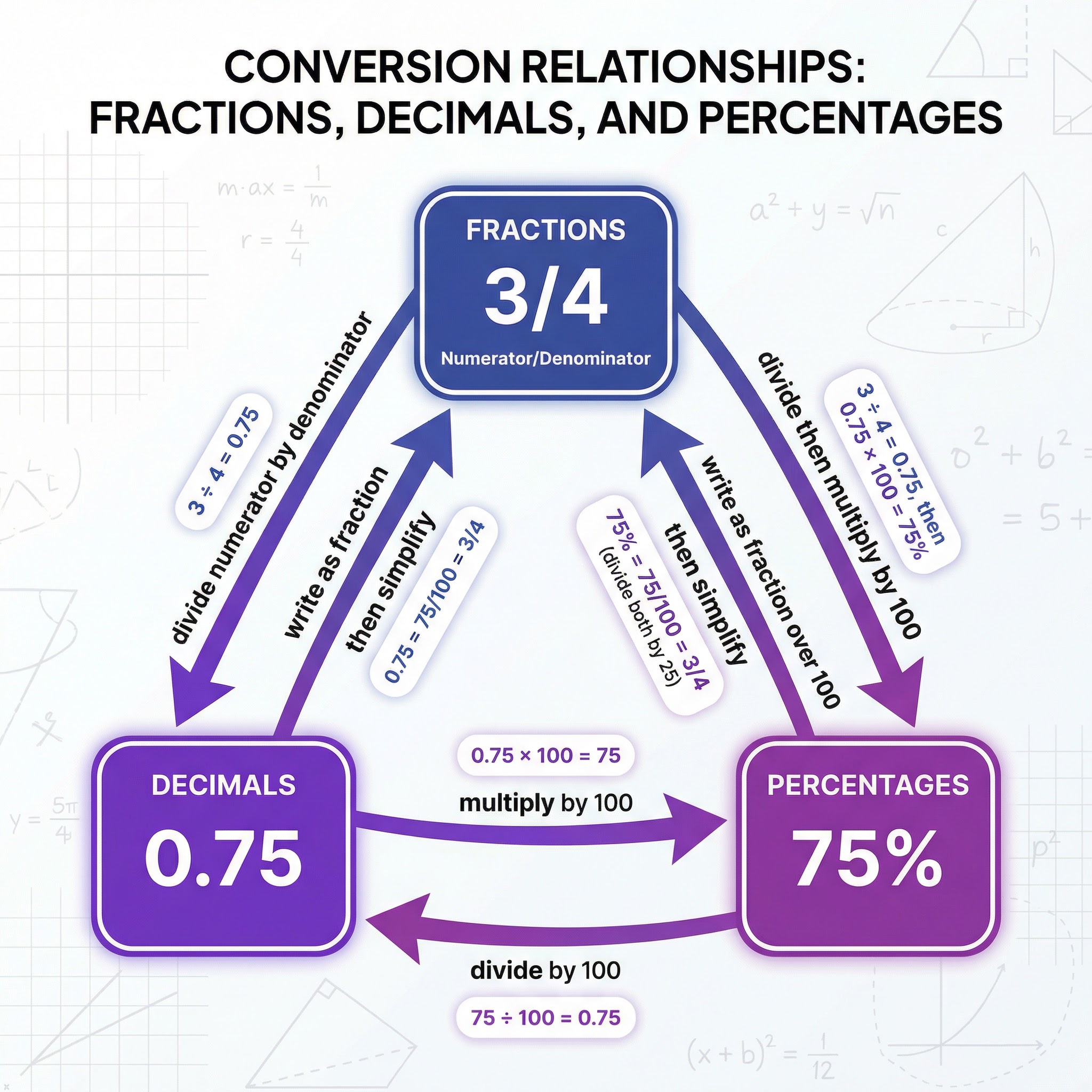
Fractions, decimals, and percentages are three different ways of expressing the same value. They are interchangeable representations of a part of a whole. The key to exam success is being able to convert between them quickly and accurately, particularly under non-calculator conditions.
**Fraction to Decimal**: Divide the numerator (top number) by the denominator (bottom number). For example, 3/4 = 3 ÷ 4 = 0.75.
**Decimal to Percentage**: Multiply the decimal by 100. For example, 0.75 × 100 = 75%.
**Percentage to Fraction**: Write the percentage over 100 and simplify to its lowest terms. For example, 75% = 75/100 = 3/4 (dividing both numerator and denominator by 25).
### Concept 2: Fraction Arithmetic
**Adding and Subtracting Fractions**: You can only add or subtract fractions when they share a common denominator. This is because the denominator tells you the size of the parts, and you cannot combine parts of different sizes without first making them equivalent.
*Example*: Calculate 2/5 + 1/4.
1. Find the lowest common multiple (LCM) of the denominators 5 and 4, which is 20.
2. Convert each fraction to an equivalent fraction with denominator 20:
- 2/5 = (2×4)/(5×4) = 8/20
- 1/4 = (1×5)/(4×5) = 5/20
3. Add the numerators: 8/20 + 5/20 = 13/20.
**Multiplying Fractions**: This operation is more straightforward. Multiply the numerators together and multiply the denominators together. Simplify if possible.
*Example*: Calculate 3/4 × 2/3.
1. Multiply numerators: 3 × 2 = 6
2. Multiply denominators: 4 × 3 = 12
3. Result: 6/12, which simplifies to 1/2 (dividing both by 6).
**Dividing Fractions**: Use the 'Keep, Change, Flip' method. This works because dividing by a fraction is equivalent to multiplying by its reciprocal.
*Example*: Calculate 4/5 ÷ 2/3.
1. **Keep** the first fraction: 4/5
2. **Change** the division sign to multiplication: ×
3. **Flip** the second fraction upside down: 3/2
4. Now multiply: 4/5 × 3/2 = 12/10, which simplifies to 6/5 or 1 1/5.
### Concept 3: Percentage Multipliers
The percentage multiplier method is one of the most powerful techniques for calculator papers. It allows you to calculate percentage increases and decreases in a single step, reducing arithmetic errors and saving valuable exam time.
**Percentage Increase**: Add the percentage increase to 100% and convert to a decimal multiplier.
- To increase by 20%, you want 120% of the original amount. The multiplier is 1.20.
- To increase by 7%, the multiplier is 1.07.
**Percentage Decrease**: Subtract the percentage decrease from 100% and convert to a decimal multiplier.
- To decrease by 15%, you want 85% of the original amount. The multiplier is 0.85.
- To decrease by 30%, the multiplier is 0.70.
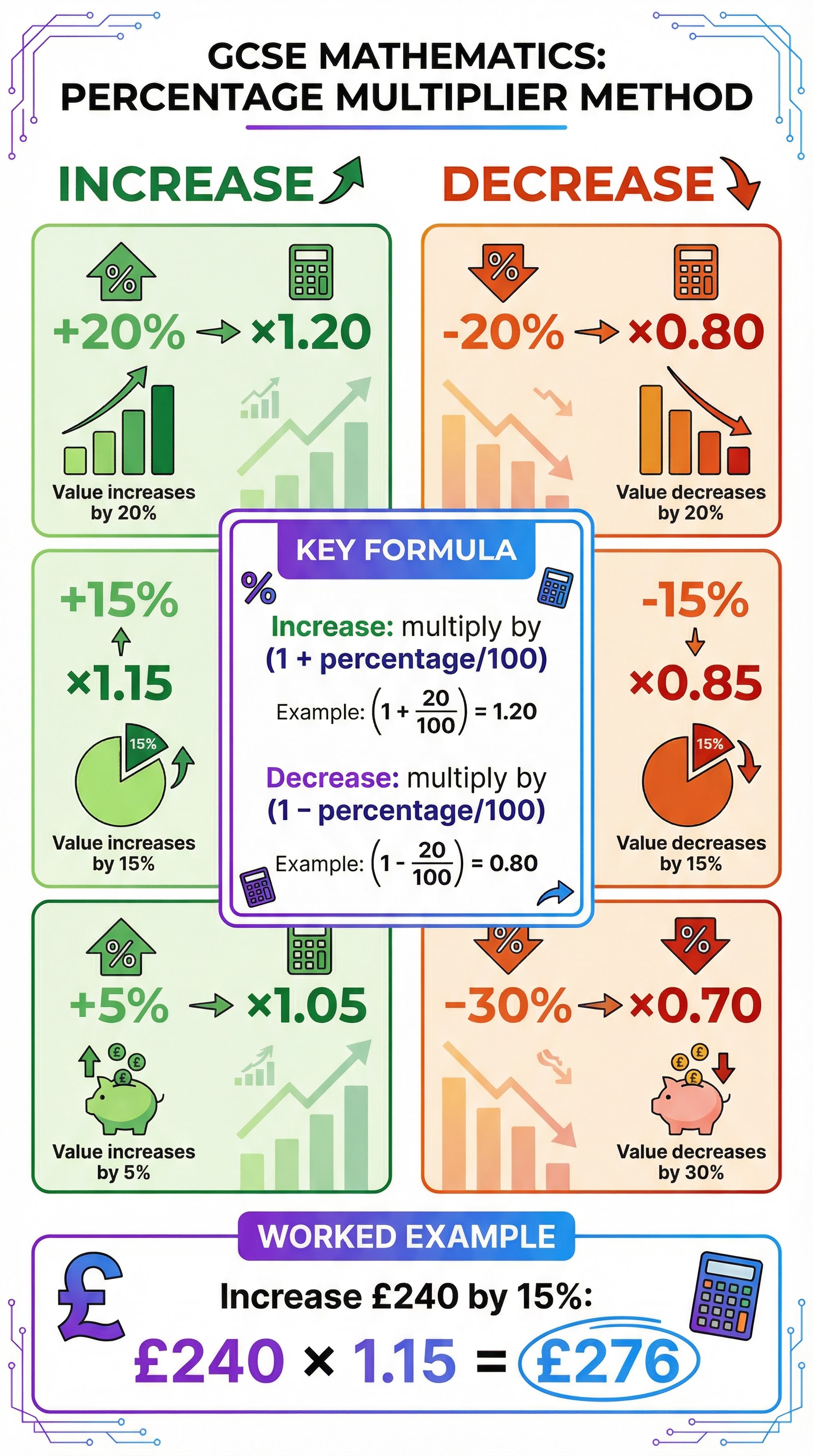
*Example*: Increase £240 by 15%.
Multiplier = 1.15
New amount = £240 × 1.15 = £276
### Concept 4: Reverse Percentages (Higher Tier)
Reverse percentage problems are where you are given the final value after a percentage change and asked to find the original value. This is a common Higher tier question type and requires careful algebraic thinking.
*Example*: A jumper is priced at £45 after a 10% discount. Find the original price.
1. A 10% discount means the sale price represents 90% of the original price.
2. The multiplier is 0.90.
3. Let the original price be P. Then: P × 0.90 = £45
4. To find P, divide both sides by 0.90: P = £45 ÷ 0.90 = £50
The key principle: if you multiply to go forward, you divide to go backward.
## Mathematical/Scientific Relationships
**Simple Interest Formula**: Interest = Principal × Rate × Time (Must memorise)
Where:
- Principal = the initial amount invested or borrowed
- Rate = the interest rate per time period (as a decimal)
- Time = the number of time periods
**Compound Interest Formula**: Total Amount = Principal × (1 + Rate/100)^Time (Given on formula sheet)
This formula accounts for interest being calculated on the accumulated amount each year, not just the original principal.
## Practical Applications
**Finance**: Calculating discounts during sales, adding VAT to prices, determining interest rates on loans and savings accounts, calculating profit and loss in business contexts.
**Science**: Expressing concentrations of solutions as percentages, calculating percentage error and percentage uncertainty in experimental measurements, representing proportions in statistical data.
**Everyday Life**: Splitting restaurant bills proportionally, understanding statistics and percentages reported in news media, scaling recipes up or down, calculating tips and service charges.