OCR · GCSE · Mathematics
Volume
Master the essential OCR GCSE Mathematics topic of Volume (3.3) with this comprehensive study guide. We break down everything from basic prisms to complex composite solids, giving you the examiner's perspective on how to secure every mark. This guide is packed with worked examples, memory hooks, and exam-style questions to build your confidence for both Foundation and Higher tiers.
- 6 min read
- 3 worked examples
- 5 practice questions
- 6 key terms
Study Notes

Overview
Volume is a fundamental concept in geometry that measures the three-dimensional space an object occupies. For your OCR GCSE Mathematics exam, this topic is a reliable source of marks if you are well-prepared. It spans from straightforward calculations for simple shapes like cuboids (Foundation) to more complex problems involving spheres, cones, and composite solids (Higher). Examiners test your ability to recall and apply specific formulae (AO1), interpret problems (AO2), and solve multi-step, unstructured questions that often link volume to other concepts like density or surface area (AO3). A solid understanding of volume is not just about memorising formulas; it’s about developing spatial awareness and a systematic approach to problem-solving, which are crucial skills across mathematics.
Key Concepts
Concept 1: Volume of Prisms
A prism is a 3D shape that has a constant cross-section along its length. Imagine slicing a loaf of bread; every slice has the same shape and size. That's the principle of a prism. The universal formula to find the volume of any prism is:
Volume = Area of Cross-Section × LengthThis is a core concept for both Foundation and Higher tiers. The key is to correctly identify the 2D shape of the cross-section and calculate its area first.
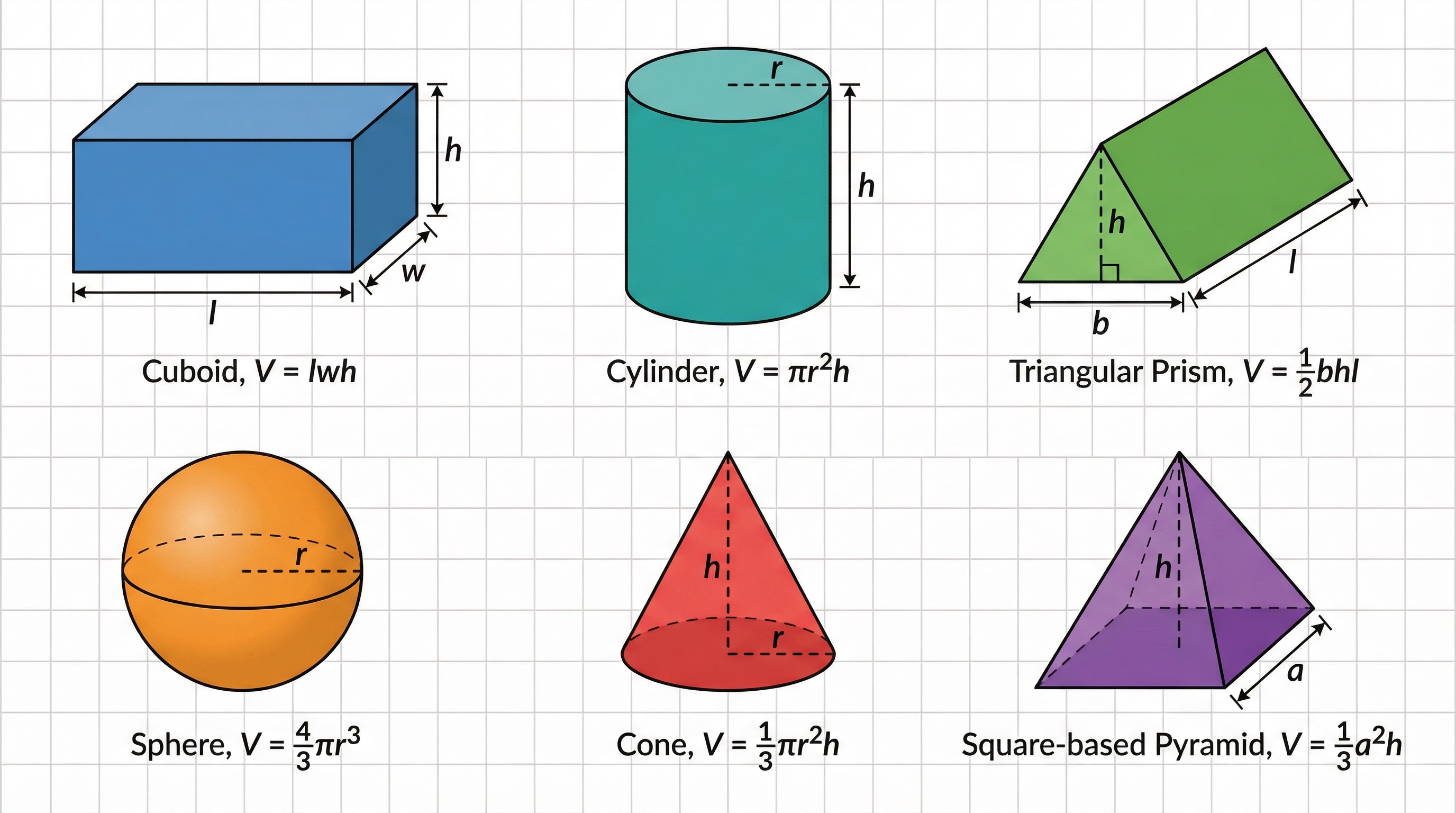
- Cuboid: The cross-section is a rectangle (Area = length × width). So, Volume = (l × w) × h.
- Cylinder: The cross-section is a circle (Area = πr²). So, Volume = πr² × h. This is a crucial formula you must memorise.
- Triangular Prism: The cross-section is a triangle (Area = ½ × base × height). So, Volume = (½ × b × h_triangle) × length_prism.
Candidates often lose marks by using the wrong formula for the cross-sectional area. Always identify the shape, write down its area formula, calculate it, and then multiply by the length.
Concept 2: Volume of Pyramids, Cones, and Spheres (Higher Tier)
These shapes are exclusively for Higher Tier candidates. The formulas are provided on the exam formula sheet, but you must know how to use them, including for reverse calculations (e.g., finding a radius from a given volume).
- Pyramid: A pyramid has a flat base and tapers to a point (the apex). Its volume is always one-third of the volume of a prism with the same base and height. Volume = ⅓ × Area of Base × Height. A common mistake is forgetting the ⅓ factor.
- Cone: A cone is a special type of pyramid with a circular base. Its volume is one-third of a cylinder's volume with the same radius and height. Volume = ⅓πr²h. Again, candidates frequently forget the ⅓.
- Sphere: A sphere is a perfectly round 3D object. Its volume is Volume = ⁴⁄₃πr³. Note the use of radius cubed (r³), not squared. This is a frequent slip-up in exams.

Concept 3: Composite Solids
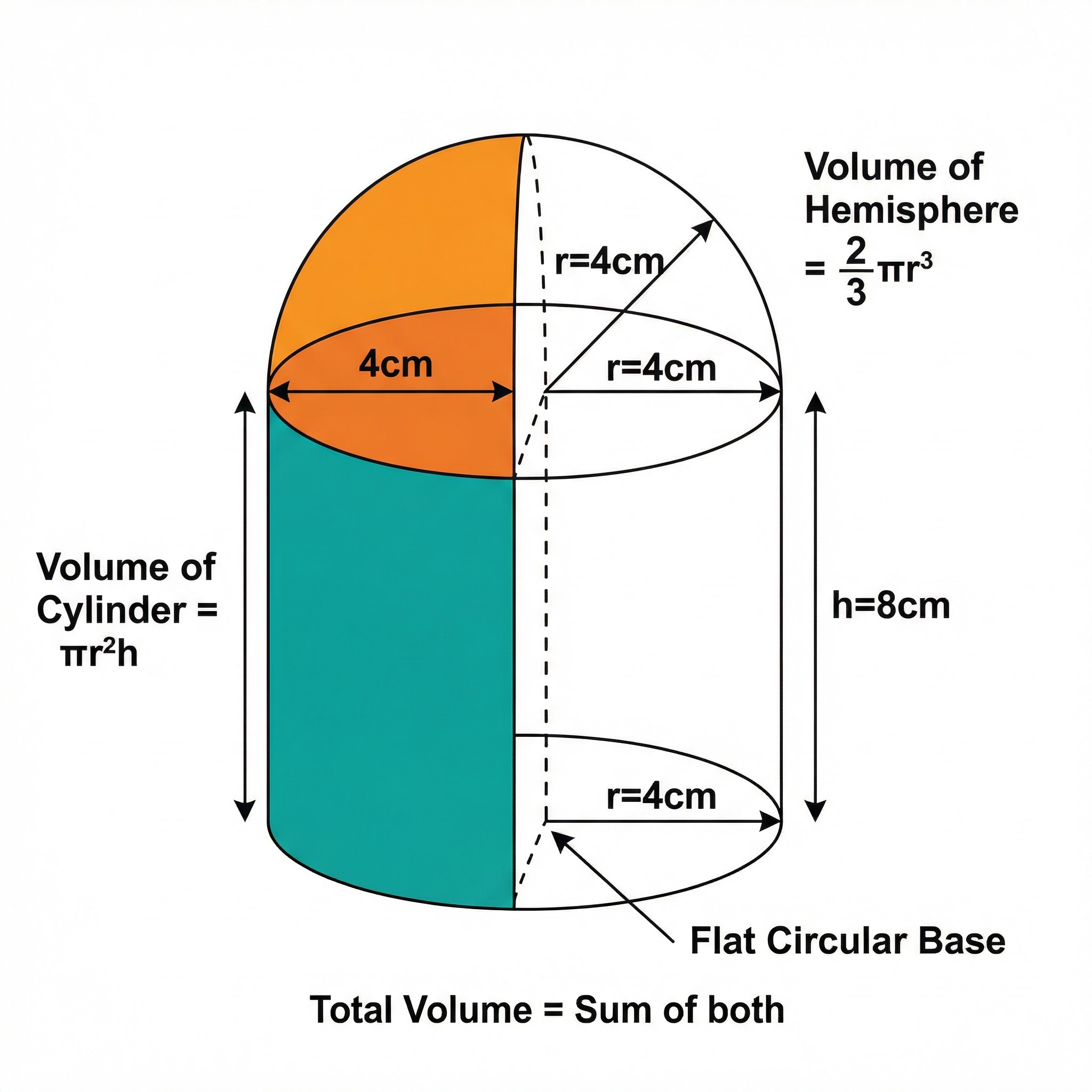
Composite solids are 3D shapes formed by combining two or more simpler shapes. These are common in AO3 problem-solving questions. The strategy is to break the complex shape down into its constituent parts.
- Identify the individual shapes (e.g., a cylinder and a hemisphere, or a cone and a cylinder).
- Calculate the volume of each part separately. Clearly label your working (e.g., "Volume of Cylinder", "Volume of Hemisphere"). This helps the examiner award method marks.
- Add or subtract the volumes as required by the problem. For example, a solid made from a cylinder with a cone on top would require you to add the two volumes. A solid cylinder with a hole drilled through it would require subtraction.

Concept 4: Unit Conversions
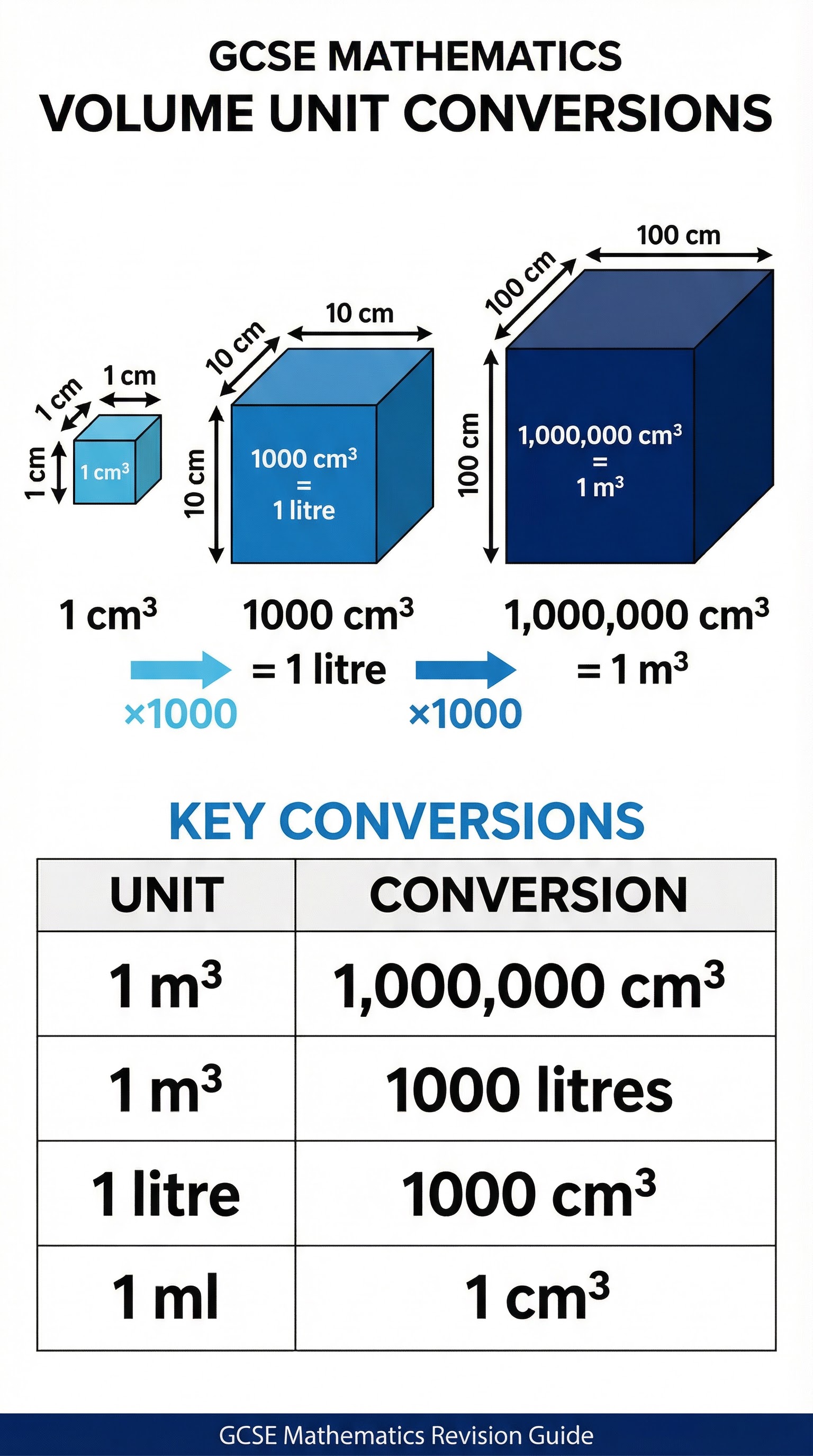
This is one of the biggest sources of lost marks. Volume is a three-dimensional measure, so the conversion factors are cubed.
- Length: 1 m = 100 cm
- Area: 1 m² = 100 cm × 100 cm = 10,000 cm²
- Volume: 1 m³ = 100 cm × 100 cm × 100 cm = 1,000,000 cm³
Similarly, for capacity:
- 1 litre = 1000 ml
- 1 litre = 1000 cm³
- 1 ml = 1 cm³
Examiners will often give dimensions in mixed units (e.g., a radius in cm and a height in m). You must convert all measurements to a consistent unit before substituting them into any formula.

Mathematical Relationships
Here are the key formulas you need to know. Be sure to understand which are given and which must be memorised.
| Shape | Formula | Status on Formula Sheet | Tier |
|---|---|---|---|
| Cuboid | V = lwh | Must memorise | Both |
| Prism | V = A × l | Must memorise | Both |
| Cylinder | V = πr²h | Must memorise | Both |
| Pyramid | V = ⅓ × Base Area × h | Given | Higher |
| Cone | V = ⅓πr²h | Given | Higher |
| Sphere | V = ⁴⁄₃πr³ | Given | Higher |
**Density-Mass-Volume Relationship:**This is a crucial synoptic link, often tested in AO3 questions.
- Density = Mass / Volume
- Mass = Density × Volume
- Volume = Mass / DensityYou can use a formula triangle to help remember this relationship.
Practical Applications
Volume calculations are used everywhere in the real world, which is why they are tested so heavily.
- Engineering & Construction: Calculating the amount of concrete needed for a foundation (volume of a cuboid) or the capacity of a cylindrical storage tank.
- Packaging: Designing boxes and containers to hold a specific volume of product while minimising material usage (linking to surface area).
- Medicine: Calculating the volume of organs or the dosage of medicine (often in ml, which is equivalent to cm³).
- Catering: Determining the amount of liquid a container can hold for cooking or serving.
Visual Resources
3 diagrams and illustrations
Interactive Diagrams
1 interactive diagram to visualise key concepts
Conceptual Flow Outline
A flowchart showing the logical steps to solve any GCSE Volume problem. Following this process ensures no steps are missed.
Worked Examples
3 worked examples — open one to explore the question and available guidance.
Practice Questions
Test your understanding — click to reveal model answers
A cuboid has a length of 10 cm, a width of 4 cm, and a height of 5 cm. Calculate its volume.
Hint: Remember the formula for the volume of a box-like shape.
A cylinder has a diameter of 8 cm and a height of 10 cm. Calculate its volume. Give your answer to 1 decimal place.
Hint: The formula uses radius, not diameter. What must you do first?
A triangular prism has a length of 15 cm. Its cross-section is a right-angled triangle with a base of 6 cm and a height of 8 cm. Calculate the volume of the prism.
Hint: First, find the area of the triangular face. Then, multiply by the prism's length.
(Higher Tier) A sphere has a volume of 288π cm³. Find the radius of the sphere.
Hint: Start with the sphere volume formula and rearrange it to solve for r.
A swimming pool is a cuboid of length 25 m, width 10 m, and depth 2 m. The pool is filled with water to 90% of its capacity. Water costs £1.50 per m³. Calculate the cost of filling the pool to 90% of its capacity.
Hint: Find the total volume first, then find 90% of it. Finally, calculate the cost.