OCR · GCSE · Physical Education
Lever Systems: Types and Application in Sport
This guide provides a comprehensive overview of Lever Systems for OCR GCSE Physical Education. It covers the three classes of levers, their application in sporting contexts, and the concepts of mechanical advantage and disadvantage, all tailored to help students excel in their exams.
- 4 min read
- 3 worked examples
- 4 practice questions
- 6 key terms
Study Notes

Overview
Lever systems are a fundamental concept in the biomechanics component of GCSE Physical Education. Understanding how the human body creates movement through levers is crucial for analysing sporting performance and is a topic frequently assessed by examiners. A lever is a rigid body (in the body, a bone) that rotates about a fixed point, known as a fulcrum (in the body, a joint). Muscles provide the force (Effort) to move a resistance (Load). The specific arrangement of the Fulcrum, Load, and Effort determines the lever's class and its effectiveness in terms of force or speed.
Key Knowledge & Theory
Core Concepts
The body uses a system of bones, joints, and muscles to create movement. This musculoskeletal system functions as a series of levers. To gain credit in an exam, candidates must be able to identify and explain the three classes of levers.
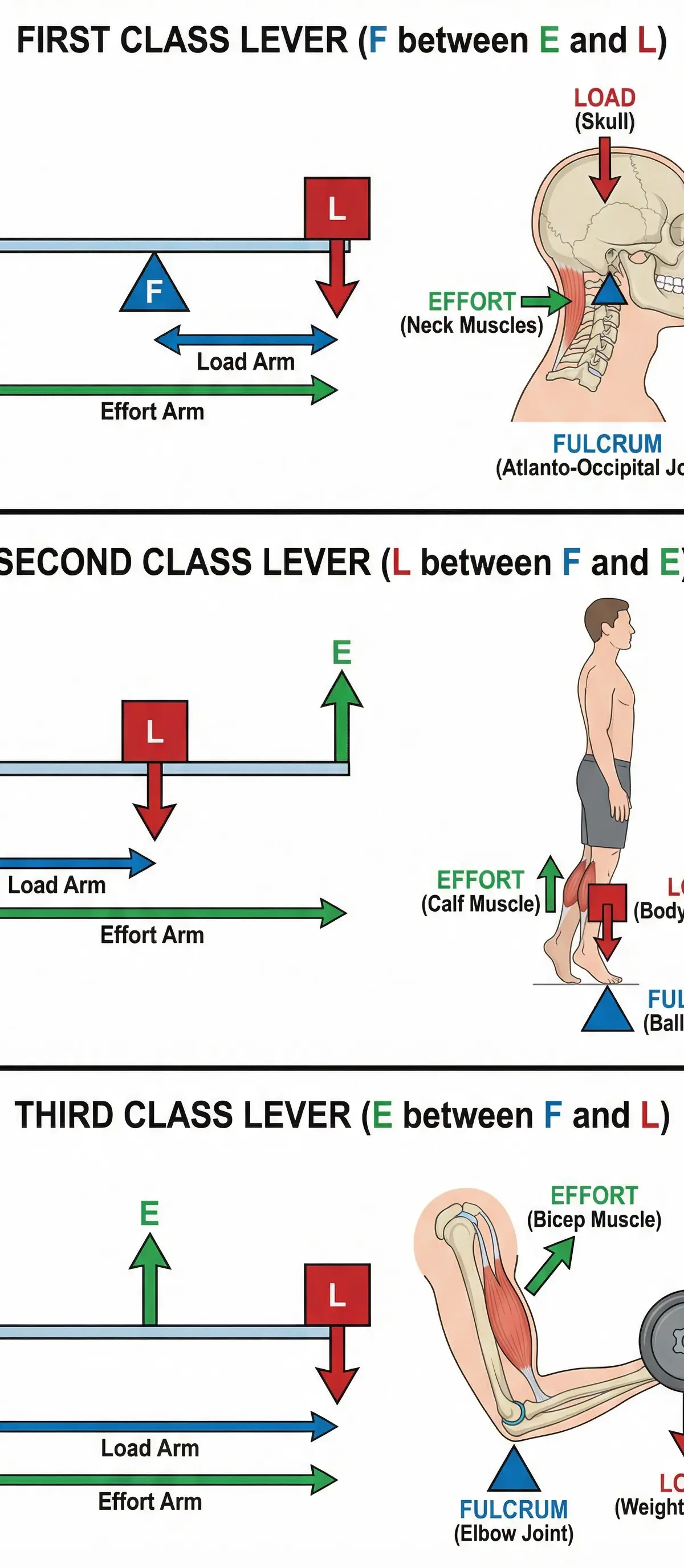
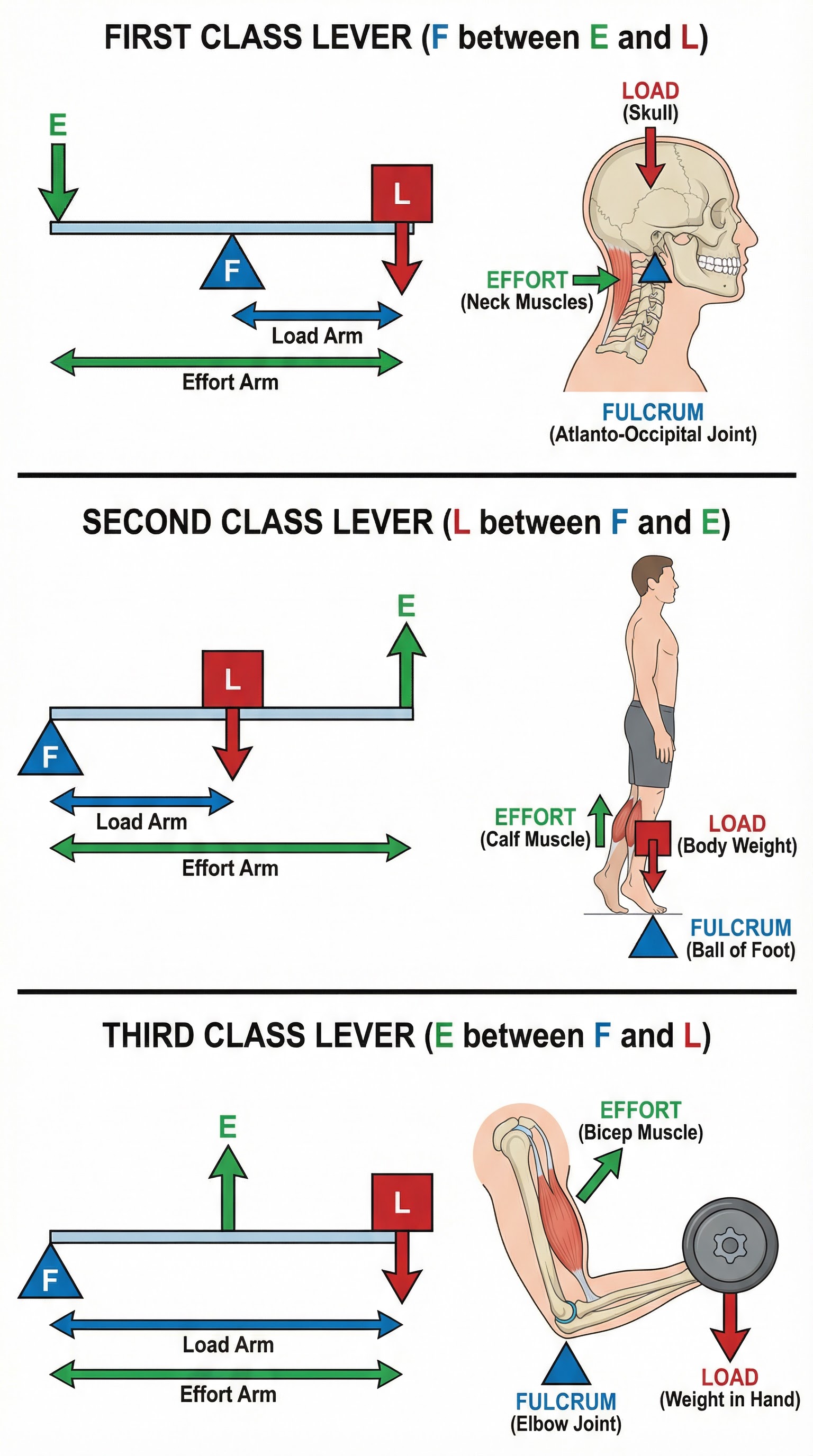
- First-Class Levers: The fulcrum is positioned between the effort and the load. Think of a seesaw. These levers are used for balanced movements or to change the direction of force.
- Second-Class Levers: The load is positioned between the fulcrum and the effort. Think of a wheelbarrow. These levers provide a mechanical advantage, meaning a smaller effort can move a larger load.
- Third-Class Levers: The effort is positioned between the fulcrum and the load. These are the most common levers in the human body. They operate at a mechanical disadvantage but provide a significant advantage in speed and range of motion.
Mechanical Advantage & Disadvantage
This is a key area where candidates can gain higher-level marks.
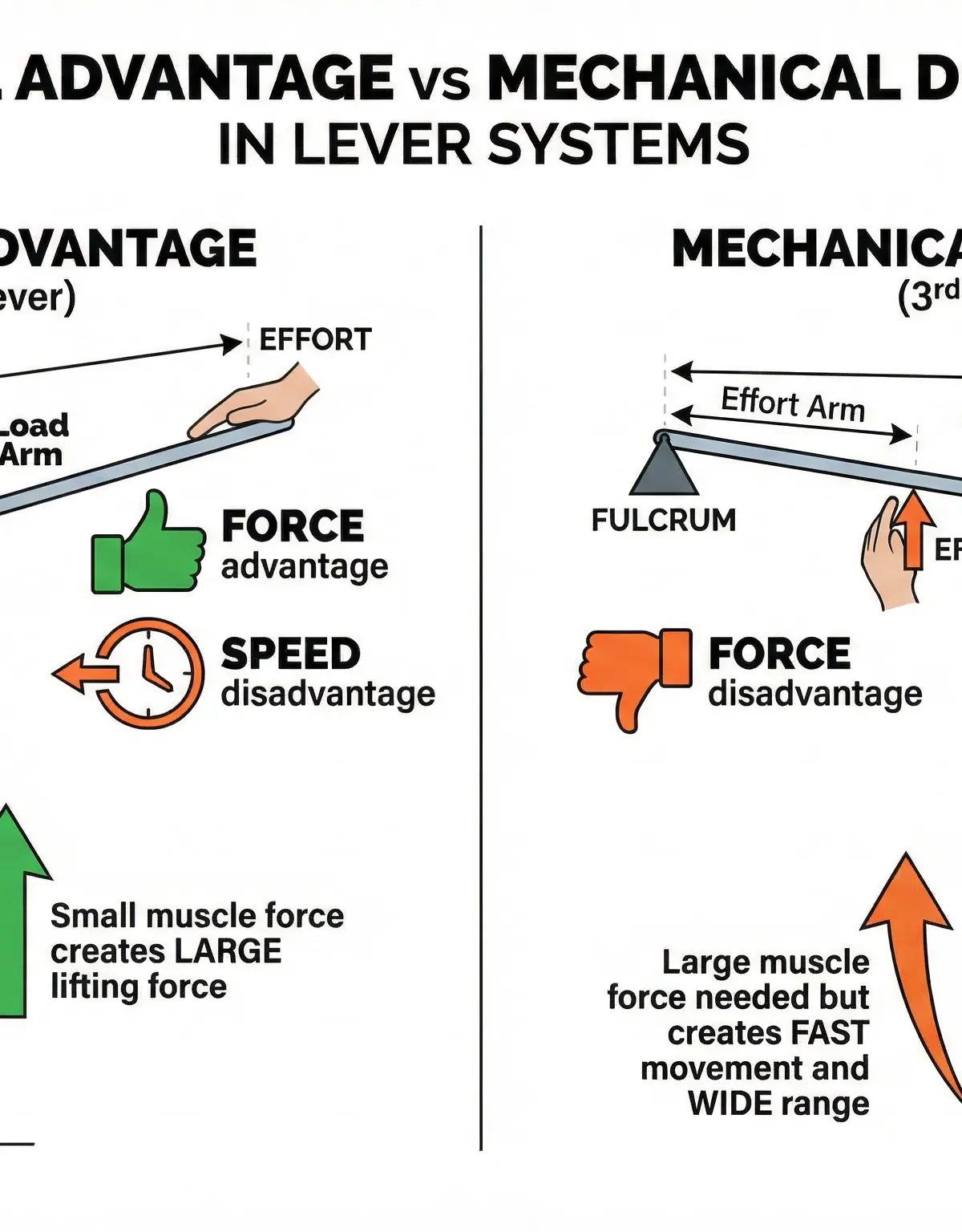
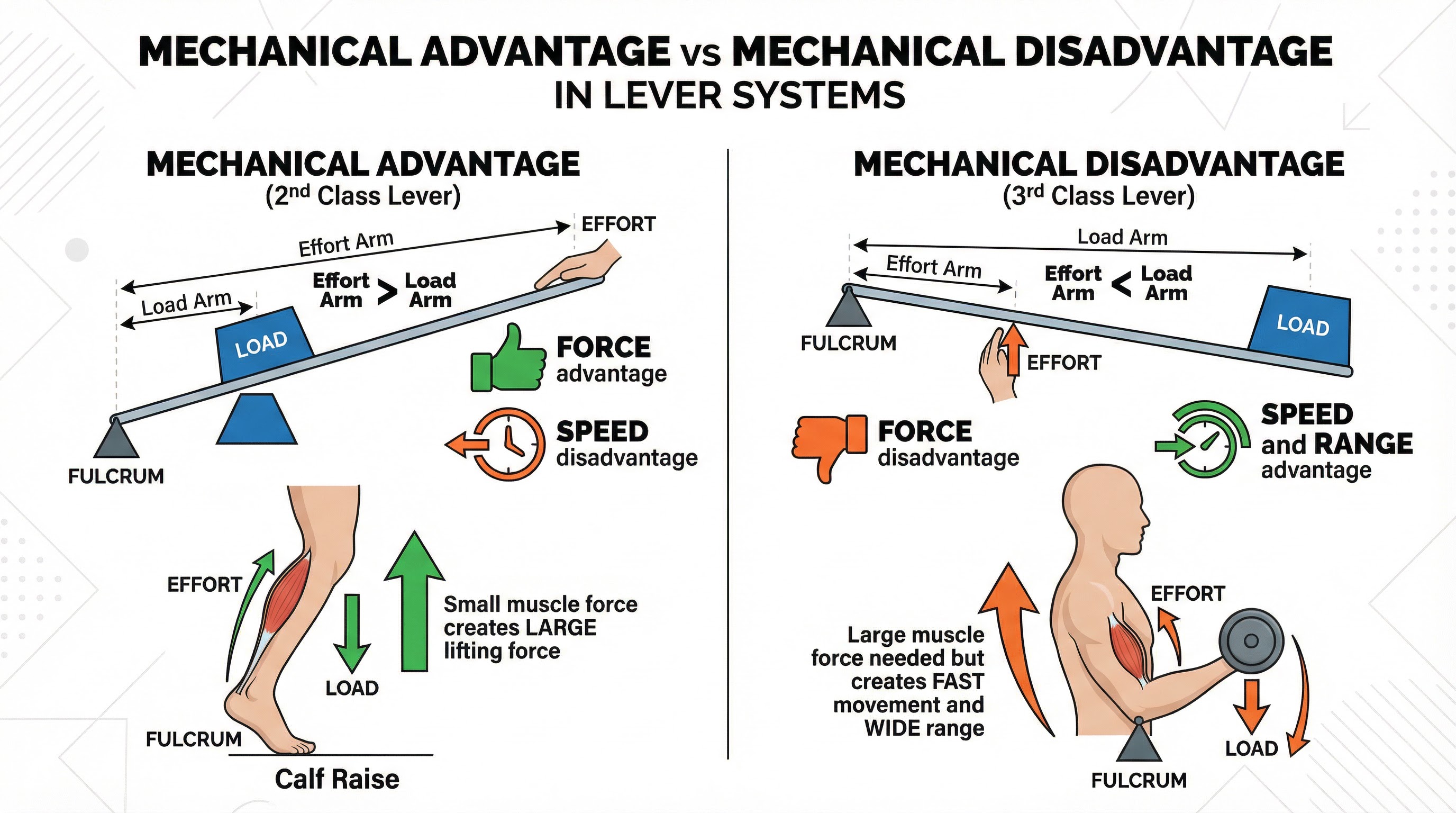
- Mechanical Advantage (MA): Occurs when the effort arm is longer than the load arm (Effort Arm > Load Arm). This is characteristic of second-class levers. It allows a large load to be moved with a relatively small amount of effort. The trade-off is a reduced range and speed of movement.
- Mechanical Disadvantage (MD): Occurs when the load arm is longer than the effort arm (Load Arm > Effort Arm). This is characteristic of third-class levers. It requires a large effort to move a smaller load, but the benefit is a significant increase in the speed at which the load can be moved and a wider range of motion. This is vital for most sporting actions like throwing, striking, and kicking.
Technical Vocabulary
Using precise terminology is essential for achieving high marks. Candidates should be familiar with and use the following terms in their answers:
- Fulcrum: The pivot point of the lever (e.g., the joint).
- Effort: The force applied by the muscle to move the lever (e.g., muscular contraction).
- Load/Resistance: The weight or force that the lever must move (e.g., body weight, a ball, a dumbbell).
- Effort Arm: The distance from the fulcrum to the point where the effort is applied.
- Load Arm: The distance from the fulcrum to the centre of the load.
- Plantar Flexion: Movement at the ankle joint that points the foot downwards (as in a calf raise).
- Dorsiflexion: Movement at the ankle joint that points the foot upwards.
- Flexion: Bending a joint to decrease the angle between two bones.
- Extension: Straightening a joint to increase the angle between two bones.
Exam Component
Written Exam Knowledge
In the written paper, candidates can expect questions ranging from 1-mark identification questions to 6-mark analysis questions. You must be able to:
- Identify the class of lever in a given sporting example.
- Draw a diagram representing each class of lever, correctly labelling the Fulcrum, Load, and Effort.
- Explain the mechanical advantage or disadvantage of a lever system.
- Analyse how the lever system is beneficial for the specific sporting action.

Visual Resources
2 diagrams and illustrations
Interactive Diagrams
1 interactive diagram to visualise key concepts
Conceptual Flow Outline
A flowchart for identifying the correct lever class in an exam.
Worked Examples
3 worked examples — open one to explore the question and available guidance.
Practice Questions
Test your understanding — click to reveal model answers
Identify the class of lever operating at the ankle during plantar flexion. (1 mark)
Hint: Think about the action of standing on your tiptoes. What is the pivot, what is the weight, and where is the muscle force?
Describe the arrangement of a third-class lever, using a sporting example. (3 marks)
Hint: Use the F-L-E rule and think of a fast action like throwing or kicking.
Explain why a third-class lever system is advantageous for a tennis player hitting a forehand. (4 marks)
Hint: Focus on the trade-off between force and speed. What is more important for a tennis forehand?
Compare a second-class lever and a third-class lever used in the body. (5 marks)
Hint: Discuss similarities and differences. Think about the arrangement (F-L-E), mechanical advantage, and resulting type of movement (force vs. speed).