Arousal: Inverted-U Theory
This guide provides a comprehensive overview of the Inverted-U Theory of arousal for OCR GCSE Physical Education. It explores how arousal levels impact athletic performance and how factors like task type, skill level, and personality shift the optimal zone for success, providing essential knowledge for the written exam.
Study Notes
Overview
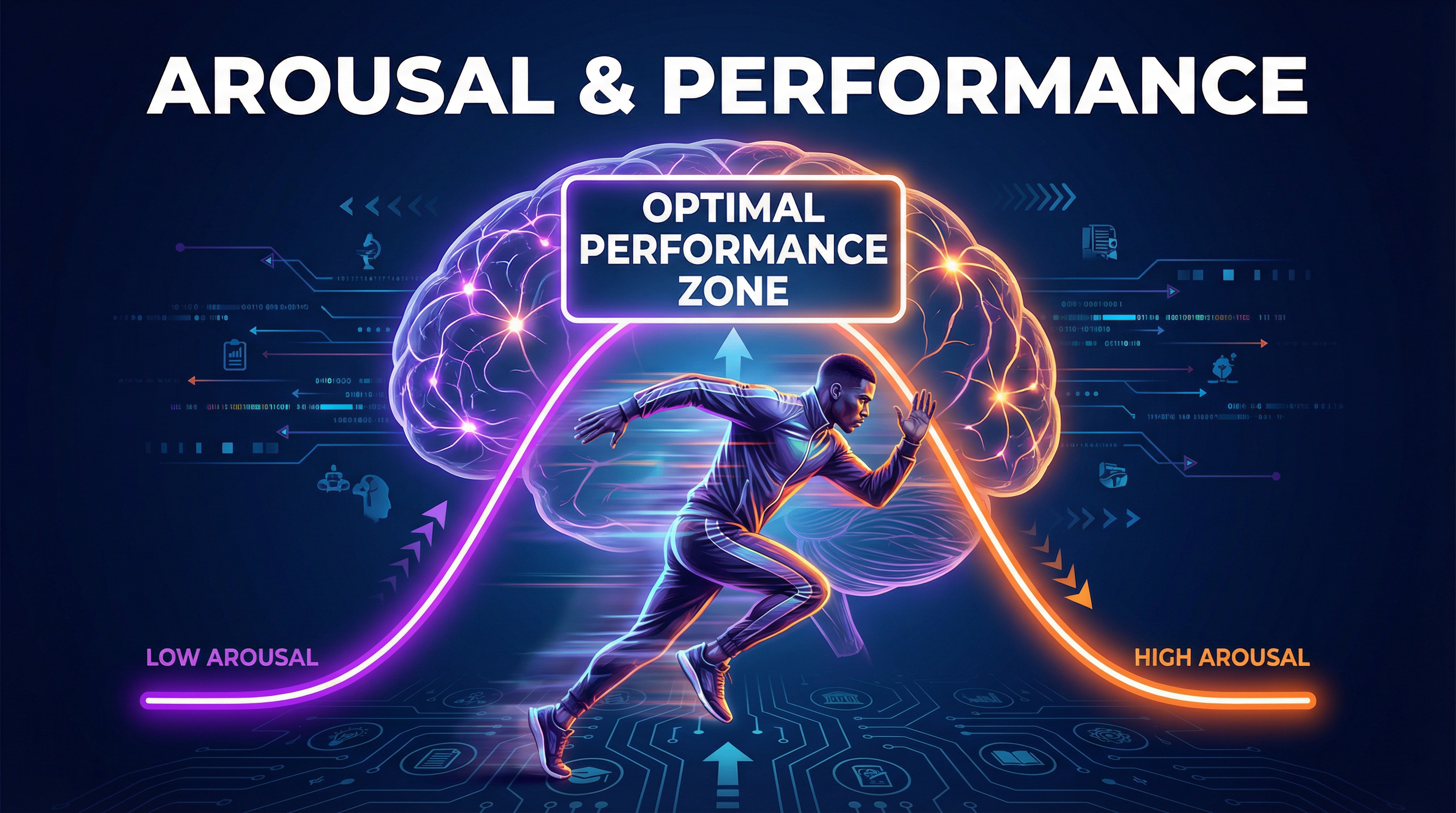
Arousal is a fundamental concept in sports psychology, representing a state of physiological and psychological readiness. For GCSE PE candidates, understanding how to manage arousal is not just theoretical; it is key to explaining why some athletes thrive under pressure while others falter. The Inverted-U Theory provides a model for this relationship, demonstrating that performance improves with increasing arousal, but only up to a specific point. Beyond this 'optimal zone', further arousal leads to a gradual decline in performance quality. Mastering this topic is crucial for earning marks in AO1 (knowledge), AO2 (application), and AO3 (analysis) questions.
Key Knowledge & Theory
Core Concepts
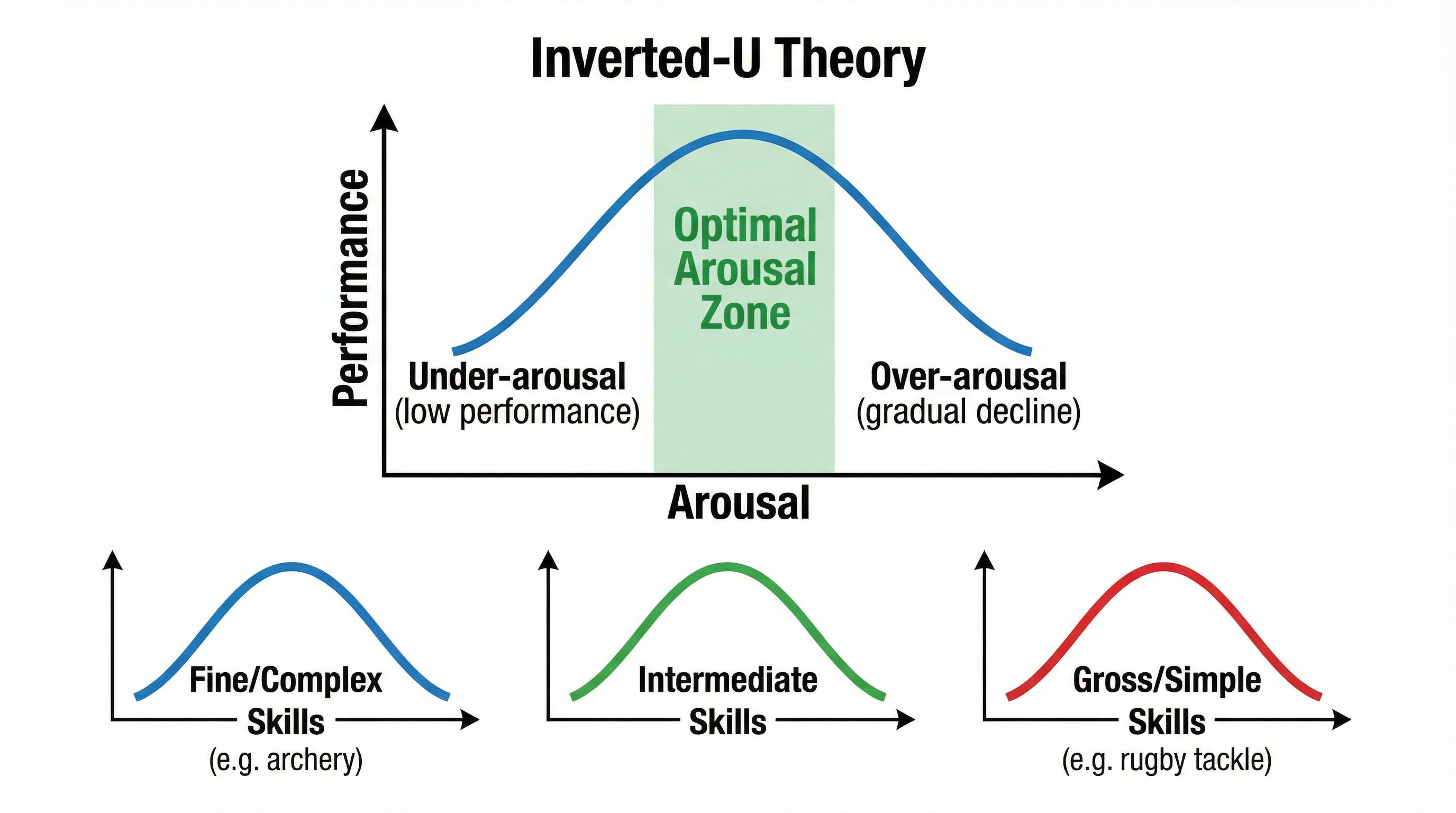
The Inverted-U Theory, first proposed by psychologists Yerkes and Dodson in 1908, is the primary model used at GCSE level to explain the arousal-performance relationship. Its central tenet is that performance quality is lowest at both very low and very high levels of arousal, and highest at a moderate, optimal level.
- Under-Arousal: Characterised by low motivation, lack of focus, and lethargy. The athlete is not sufficiently 'psyched-up' to perform. Attention is broad and information from the environment can be missed.
- Optimal Arousal: This is the 'peak performance zone'. The athlete is alert, focused, and motivated. Concentration is high, and the performer can effectively process environmental cues to make good decisions.
- Over-Arousal: Characterised by anxiety, tension, and a loss of fine motor control. The performer becomes hyper-vigilant, and their attention narrows excessively (attentional narrowing), causing them to miss important cues. This leads to a breakdown in technique and decision-making.
Crucially, the optimal point of arousal is not fixed. It shifts based on three key variables:
-
Task Type (Skill Complexity):
- Fine/Complex Skills: These require precision, control, and high levels of concentration (e.g., an archery shot, a golf putt, a snooker shot). They are best performed at lower levels of arousal. High arousal causes tension and tremors, which destroy the fine muscle control needed.
- Gross/Simple Skills: These involve large muscle groups, power, and aggression (e.g., a rugby tackle, a weightlift, a sprint start). They are best performed at higher levels of arousal. The increased physiological activation provides the necessary power and drive.
-
Skill Level (Novice vs. Expert):
- Novice/Beginner: A novice performer has not yet automated the skill. They need to consciously process information and think about their technique. High arousal disrupts this cognitive processing. Therefore, novices perform best at lower levels of arousal.
- Expert/Autonomous Performer: An expert has practised the skill to the point where it is automatic. They do not need to consciously think about the movement, freeing up their attention to focus on strategy and tactics. They can handle, and often require, higher levels of arousal to achieve peak performance.
-
Personality (Introvert vs. Extrovert):
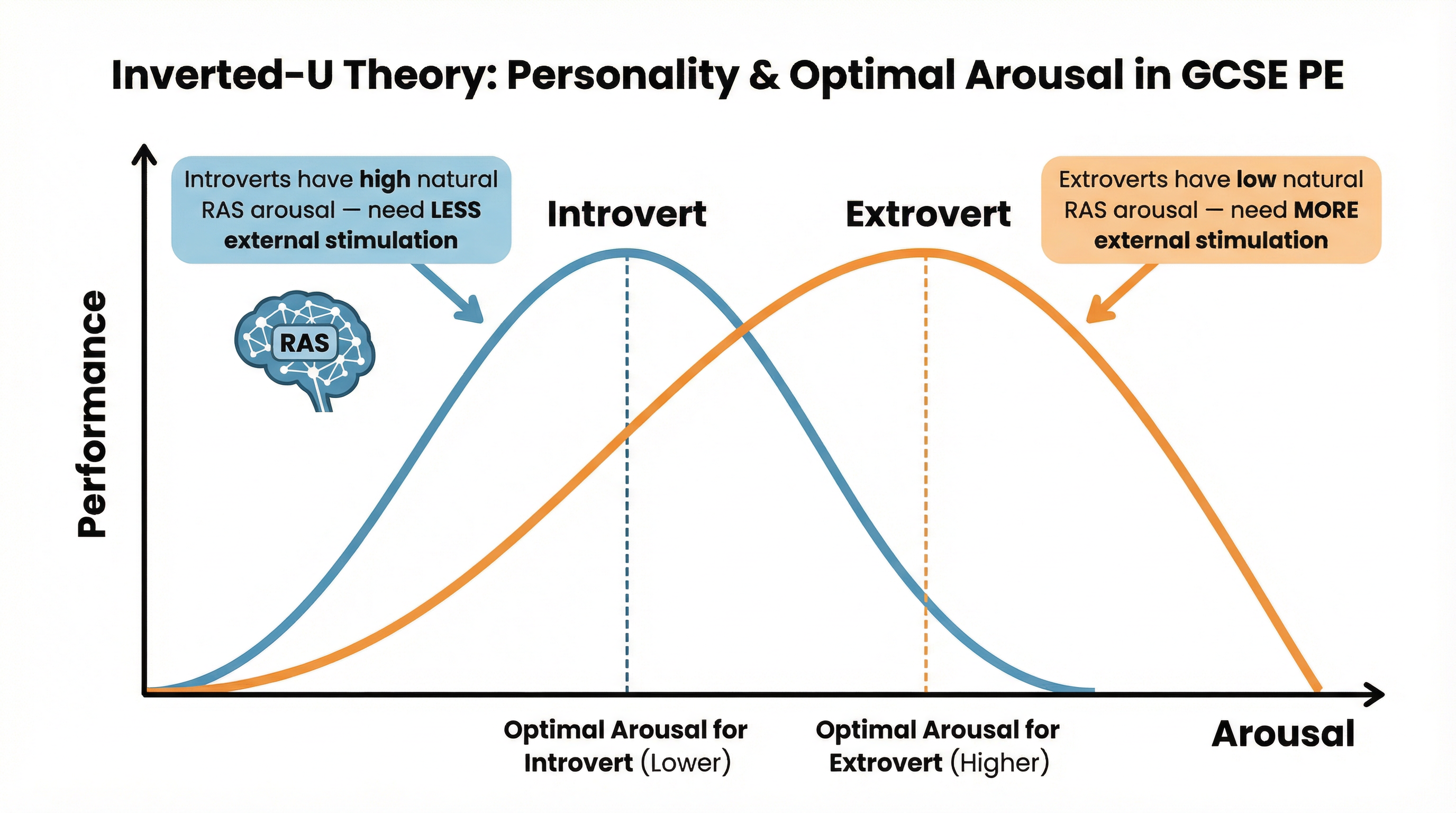
- Introvert: Introverts have a naturally high level of activation in their Reticular Activating System (RAS). This means their baseline arousal is already high. They require less external stimulation to reach their optimal zone and can easily become over-aroused in high-pressure situations. They perform best at lower levels of arousal.
- Extrovert: Extroverts have a naturally low level of RAS activation. They need more external stimulation from the environment (e.g., a loud crowd, competition) to reach their optimal arousal level. They perform best at higher levels of arousal.
Technical Vocabulary
To gain full credit in exams, candidates must use precise terminology. Key terms include: Arousal, Performance, Inverted-U Theory, Optimal Arousal, Under-aroused, Over-aroused, Fine Skill, Gross Skill, Novice, Expert, Introvert, Extrovert, Reticular Activating System (RAS), Attentional Narrowing, Gradual Decline.
Visual Resources
2 diagrams and illustrations
Interactive Diagrams
1 interactive diagram to visualise key concepts
Conceptual Flow Outline
Flowchart showing the relationship between arousal level and performance quality according to the Inverted-U Theory.
Worked Examples
3 detailed examples with solutions and examiner commentary
Practice Questions
Test your understanding — click to reveal model answers
Identify the optimal level of arousal (high or low) for a golfer taking a putt. (1 mark)
Hint: Is a golf putt a fine or a gross skill?
Describe the Inverted-U theory. (3 marks)
Hint: Think about the shape of the graph. What happens to performance as arousal changes?
Explain why an expert basketball player can perform well in front of a large, loud crowd, whereas a novice may not. (4 marks)
Hint: Link skill level (expert vs. novice) to the effect of the crowd (a source of arousal).
Analyse the different arousal requirements for an introverted archer compared to an extroverted rugby player. (6 marks)
Hint: Combine two variables: personality (introvert/extrovert) and task type (fine/gross).