AQA · A-Level · Physical Education
Personality and Attitudes
This guide provides a comprehensive breakdown of Personality and Attitudes for AQA A-Level PE, focusing on the core psychological theories and their application in sporting contexts. It is designed to equip candidates with the knowledge and exam technique required to achieve high marks by critically evaluating Trait Theory, Social Learning Theory, and the Interactionist Approach.
- 7 min read
- 3 worked examples
- 4 practice questions
- 6 key terms
Study Notes

Overview
Welcome to the A-Level PE study guide for Topic 5.1: Personality and Attitudes. This is a critical area of sport psychology that seeks to explain why performers behave in certain ways. A strong grasp of this topic is essential for earning high marks, as it requires candidates to move beyond simple descriptions and engage in detailed application (AO2) and critical evaluation (AO3). This guide will break down the key theories, provide practical exam advice, and offer tools to help you master the content.

Key Knowledge & Theory
Core Concepts
The study of personality in sport revolves around three main theoretical perspectives. It is crucial that candidates can not only describe these theories but also compare them and evaluate their limitations.
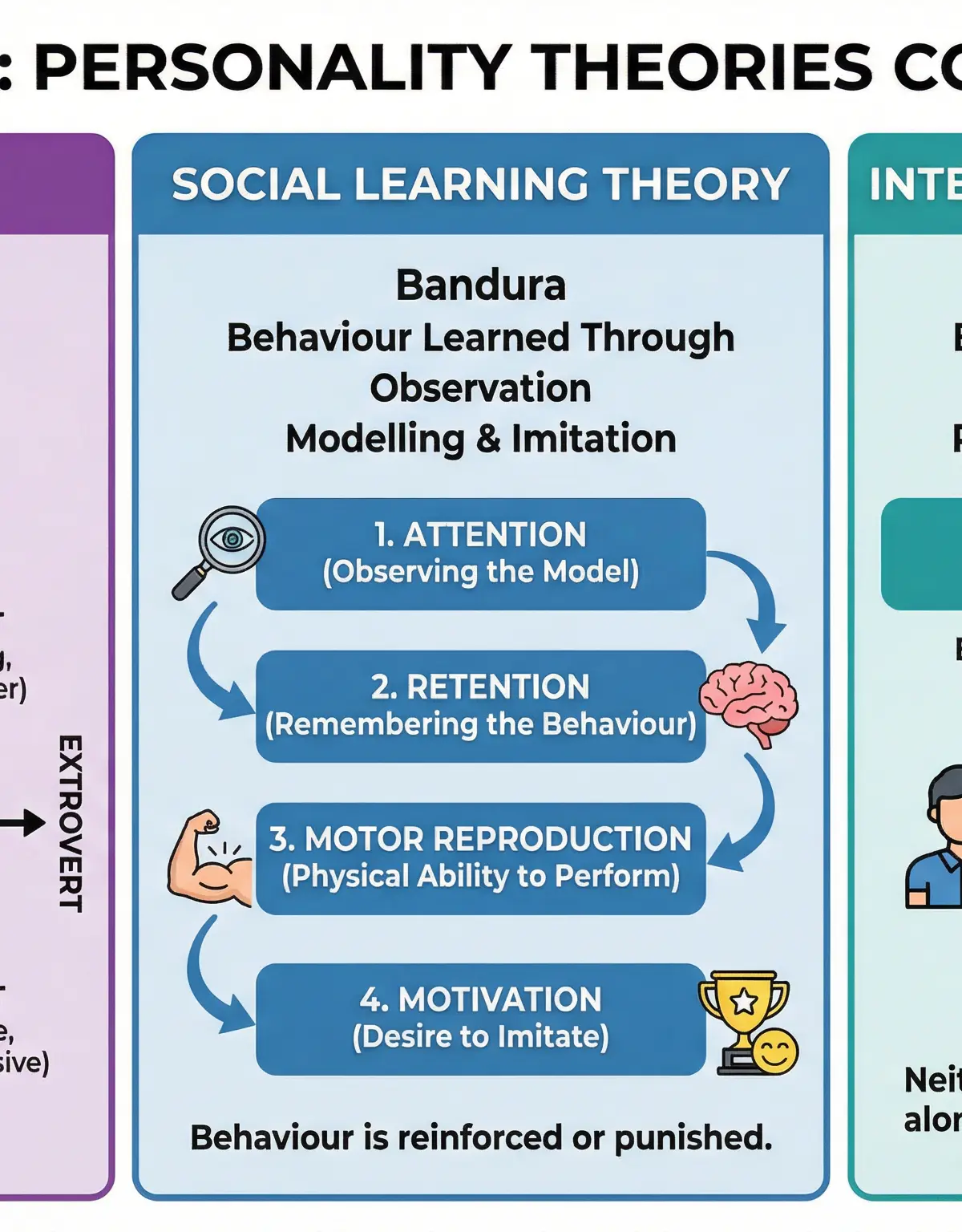
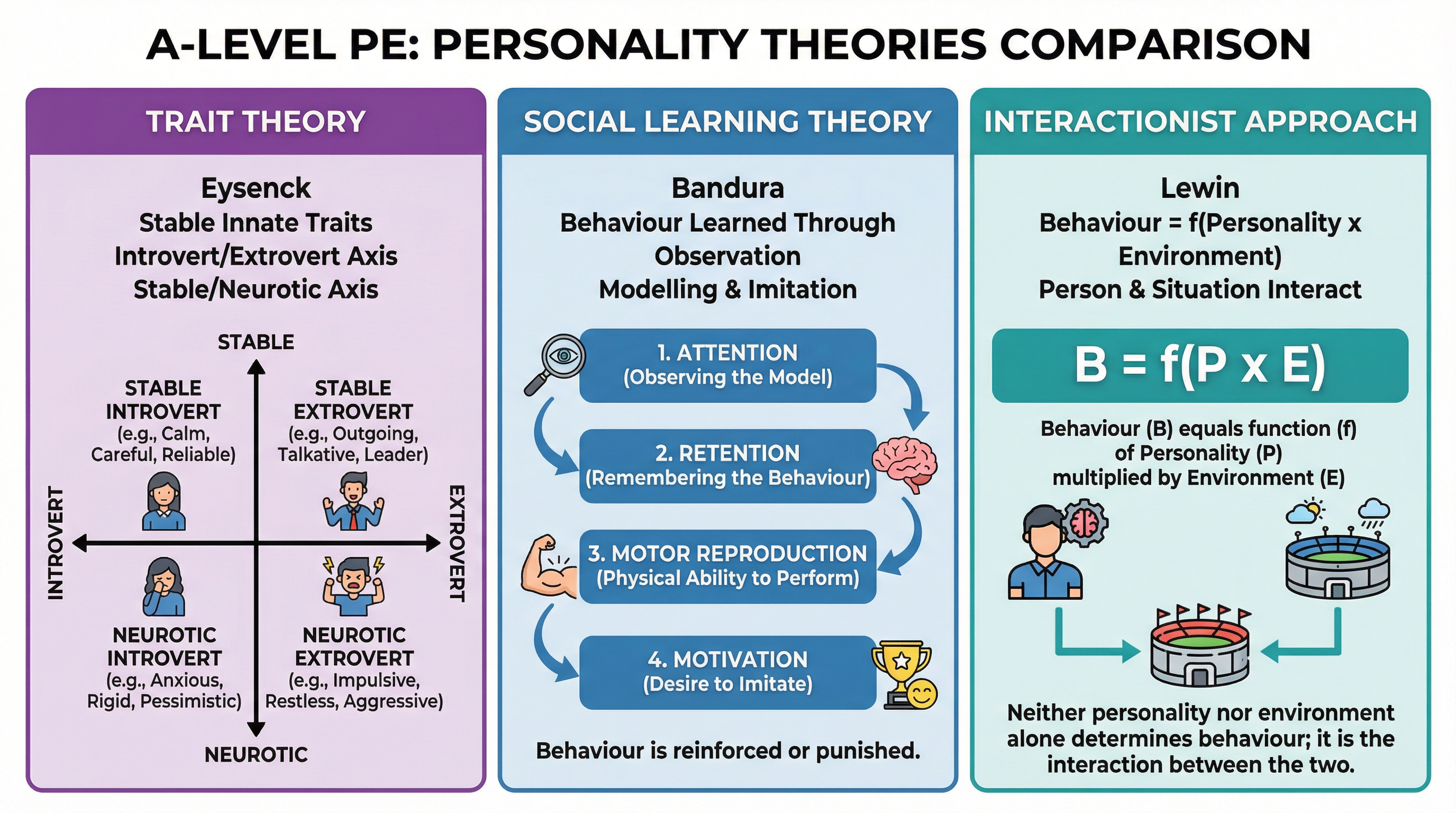
1. Trait Theory: Associated with psychologists like Eysenck and Cattell, this perspective suggests that personality is composed of innate, stable characteristics (traits) that are genetically determined. These traits are believed to be consistent across all situations. Eysenck’s model is a key focus, proposing two primary dimensions:
- Introvert-Extrovert: This dimension relates to a person's need for social stimulation. Extroverts have a low level of internal arousal and seek external stimulation, often thriving in team sports. Introverts have a high level of internal arousal and tend to prefer individual sports requiring concentration and fine motor control (e.g., archery, snooker).
- Stable-Neurotic: This dimension relates to emotionality and reliability. Stable individuals are predictable and calm, whereas neurotic individuals are anxious, moody, and unpredictable.
2. Social Learning Theory: Championed by Albert Bandura, this theory posits that personality is not innate but is learned through observing and imitating the behaviour of others, a process known as modelling. Behaviour is reinforced through praise or success. For modelling to be effective, four processes must occur: Attention, Retention, Motor Reproduction, and Motivation.
3. Interactionist Approach: This is the most widely accepted theory in modern sport psychology. Proposed by Kurt Lewin, it argues that behaviour is a product of the interaction between a person's innate personality traits and the specific environment or situation. This is summarised by the formula: B = f(P x E) (Behaviour is a function of Personality x Environment). This theory explains why even a naturally calm athlete might become aggressive in a high-stakes competitive situation.
Attitudes
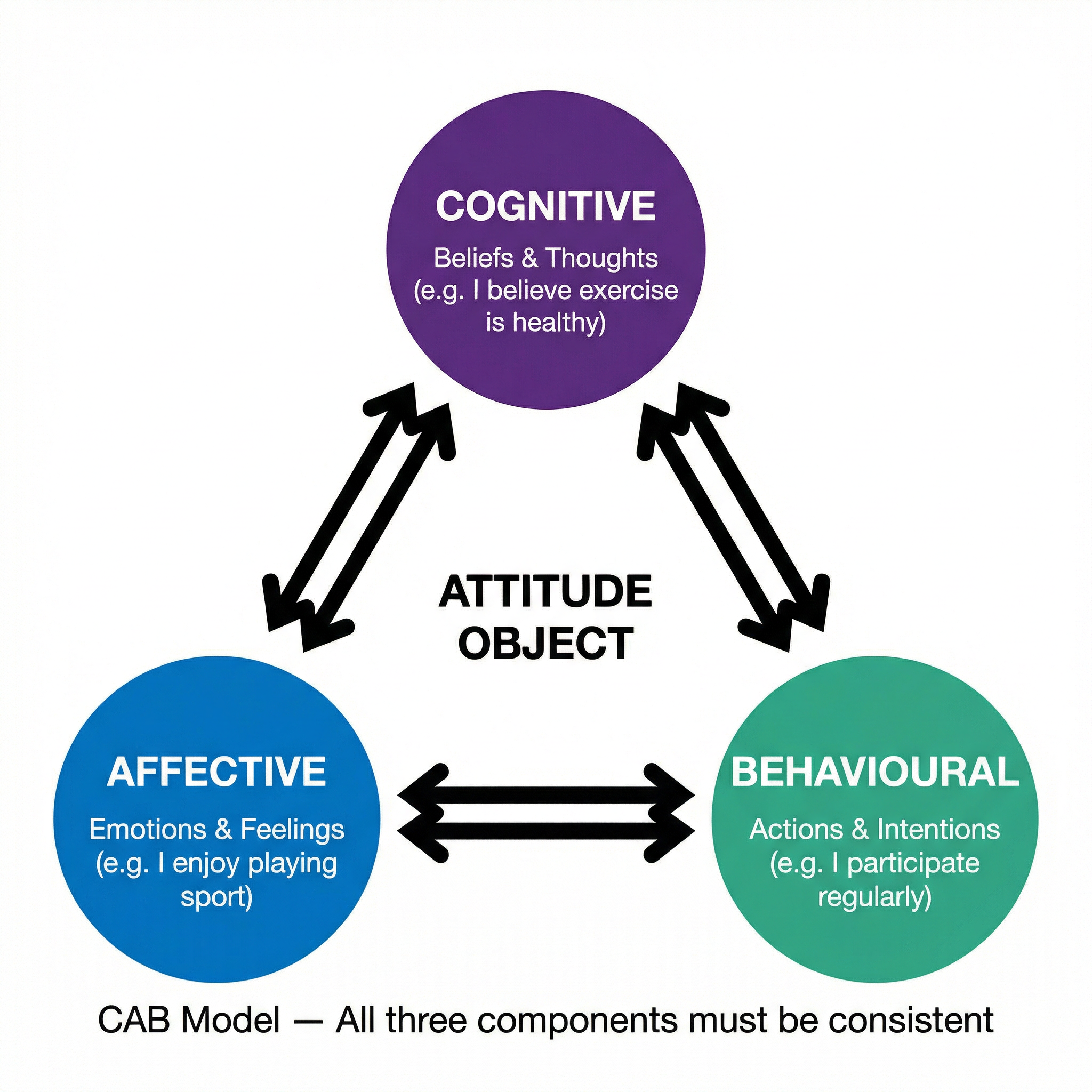
An attitude is defined as a learned predisposition towards an attitude object (e.g., a sport, a coach, a training method). The most important model to understand is the Triadic Model, which proposes that attitudes are formed from three components.
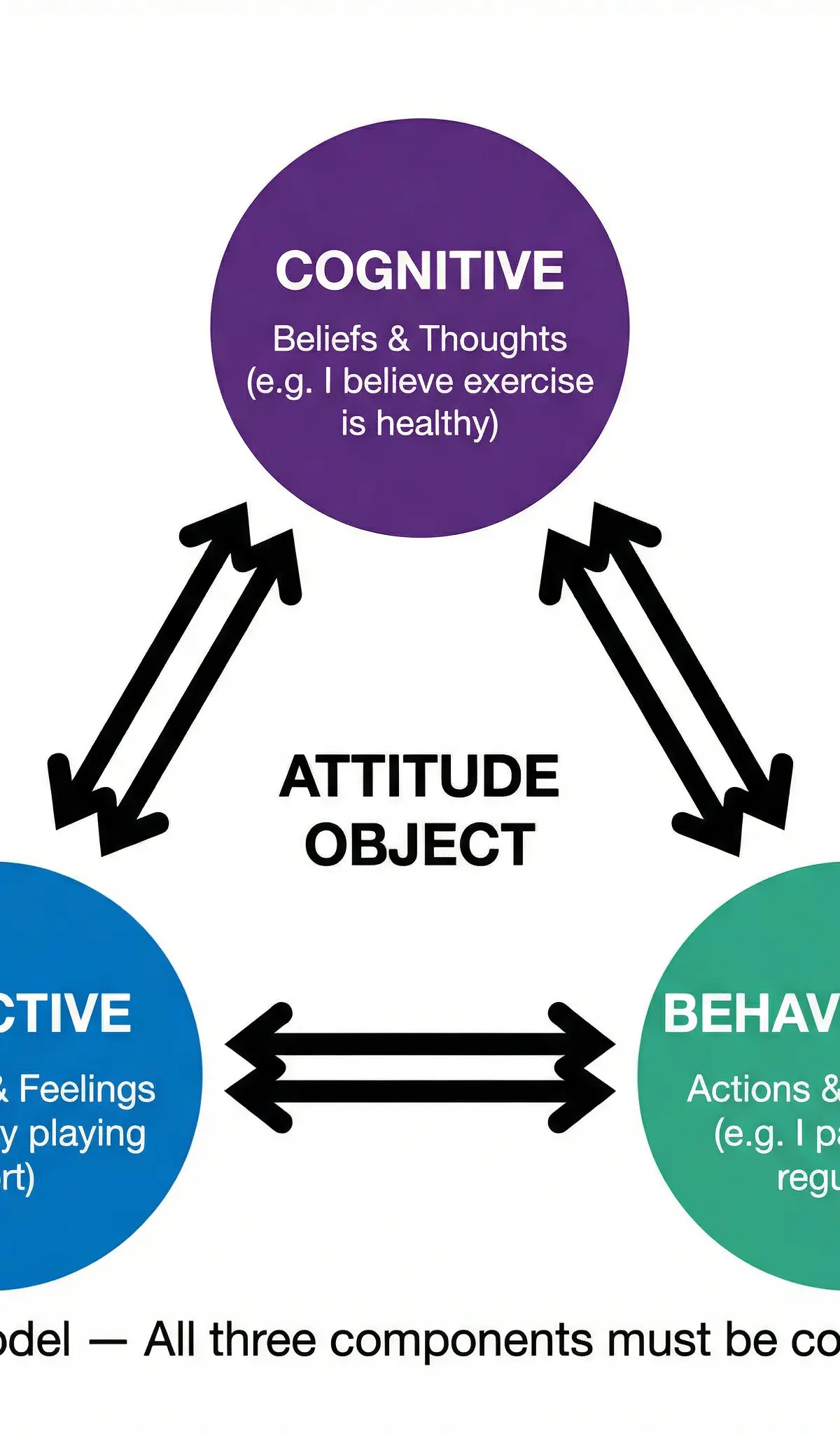
- Cognitive (Beliefs): What you think or believe about the attitude object. Example: "I believe that running is an effective way to improve my cardiovascular fitness."
- Affective (Emotions): How you feel about the attitude object. Example: "I enjoy the feeling of accomplishment after a long run."
- Behavioural (Actions): Your intended or actual actions towards the attitude object. Example: "I run three times a week."
For a stable attitude to exist, these three components (the 'CAB' model) are typically consistent. When they are not, it creates Cognitive Dissonance, a state of psychological tension that can be used to change attitudes. For instance, making a boring drill fun (changing the Affective component) can create dissonance with the belief that the drill is dull (Cognitive), potentially leading to a change in attitude.
Key Practitioners
| Name | Perspective | Key Idea | Relevance to PE |
|---|---|---|---|
| Hans Eysenck | Trait Theory | Personality is innate and can be measured on Introvert-Extrovert and Stable-Neurotic scales. | Provides a basis for discussing how personality types might be suited to different sports, but must be evaluated critically. |
| Albert Bandura | Social Learning | Behaviour is learned through observation and imitation of significant others (modelling). | Explains how young athletes pick up skills and behaviours (both positive and negative) from role models like coaches and elite performers. |
| Kurt Lewin | Interactionist | Behaviour is a function of the interaction between personality and environment (B = f(P x E)). | The most accepted modern theory, explaining why athletes' behaviour can change depending on the competitive situation. |
| Leon Festinger | Attitude Change | Cognitive Dissonance: inconsistency between attitude components creates discomfort, motivating change. | A key strategy for coaches to change a performer's negative attitude towards training or a particular aspect of performance. |
Technical Vocabulary
- Personality: The unique, relatively stable and enduring patterns of thought, feeling, and behaviour that characterise an individual.
- Trait: A stable, genetically determined characteristic that predisposes an individual to behave in a certain way.
- Attitude: A learned predisposition to respond in a consistently favourable or unfavourable manner towards a specific object, person, or situation.
- Attitude Object: The specific focus of an attitude.
- Cognitive Dissonance: A state of psychological tension that occurs when an individual holds two conflicting beliefs, or when their beliefs and actions are inconsistent.
- Persuasive Communication: A method of attitude change that involves influencing an individual through a message.
Exam Component
Written Exam Knowledge
This topic is a staple of the AQA A-Level PE Paper 2: Psychological factors affecting performance. Candidates can expect a range of questions, from short-answer definitions (1-4 marks) to extended essay questions (8 or 15 marks) that require detailed application and evaluation.
For 8 and 15-mark questions, a balanced structure is essential. Credit is awarded across three Assessment Objectives:
- AO1 (Knowledge): Accurately describing the theories (e.g., Trait, Social Learning, Interactionist, Triadic Model).
- AO2 (Application): Applying these theories to a specific sporting example. You MUST provide a concrete example when the question asks for it.
- AO3 (Evaluation): Critically analysing the strengths and weaknesses of the theories. For example, critiquing Trait Theory for its lack of ecological validity or its deterministic nature.
Visual Resources
2 diagrams and illustrations
Interactive Diagrams
1 interactive diagram to visualise key concepts
Conceptual Flow Outline
Flowchart showing how Cognitive Dissonance can change a negative attitude.
Worked Examples
3 worked examples — open one to explore the question and available guidance.
Practice Questions
Test your understanding — click to reveal model answers
Identify the three components of the Triadic Model of attitude. (3 marks)
Hint: Remember the acronym C-A-B.
Describe the difference between the Trait and Social Learning perspectives on personality. (4 marks)
Hint: Focus on the origin of personality: is it innate or learned?
A talented young cricketer is often described as an introvert. Explain how this personality trait might affect their performance. (4 marks)
Hint: Link the characteristics of an introvert to the specific demands of cricket.
Evaluate the Interactionist approach as a theory for explaining performance in sport. (8 marks)
Hint: Discuss the strengths of the theory, particularly in comparison to Trait and Social Learning theories.