OCR · GCSE · Physical Education
Aggression: Types of Aggression and Strategies for Managing Aggression
This guide provides a comprehensive breakdown of Aggression in Sport (OCR GCSE PE, 5.4), focusing on the crucial distinction between Direct and Indirect aggression. It details exam-focused strategies for managing arousal and aggression, ensuring candidates can apply theoretical knowledge to practical sporting contexts to maximise their marks.
- 8 min read
- 3 worked examples
- 4 practice questions
- 6 key terms
Study Notes
Overview
Aggression is a critical topic within the Sport Psychology component of the OCR GCSE PE specification. It explores why performers sometimes act aggressively and, crucially, how they can manage these impulses to maintain optimal performance. Examiners are looking for candidates to demonstrate a precise understanding of the key definitions and to apply this knowledge to varied sporting scenarios. This guide will equip you with the core knowledge, practical application skills, and exam technique required to confidently tackle questions on this topic.

Key Knowledge & Theory
Core Concepts
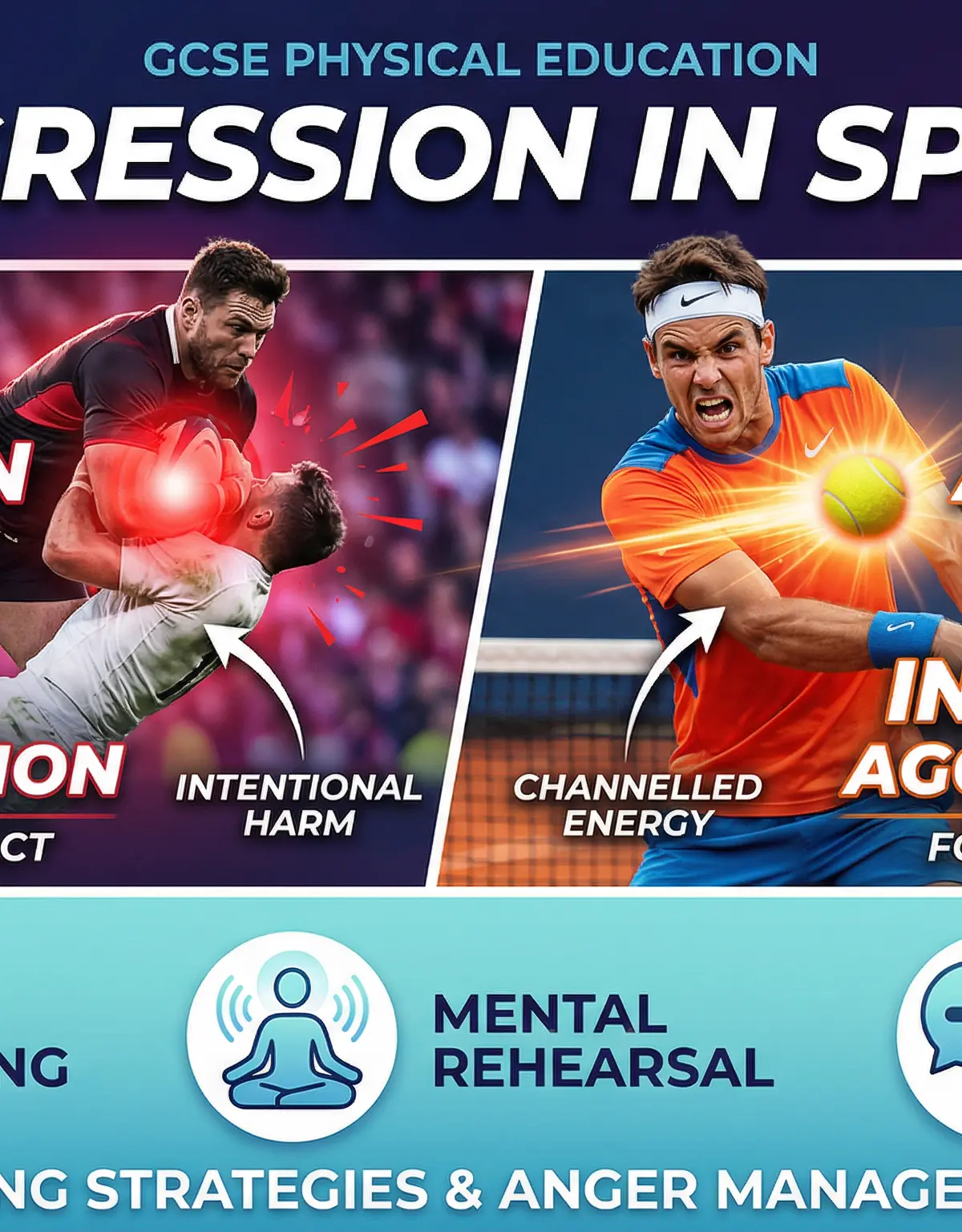
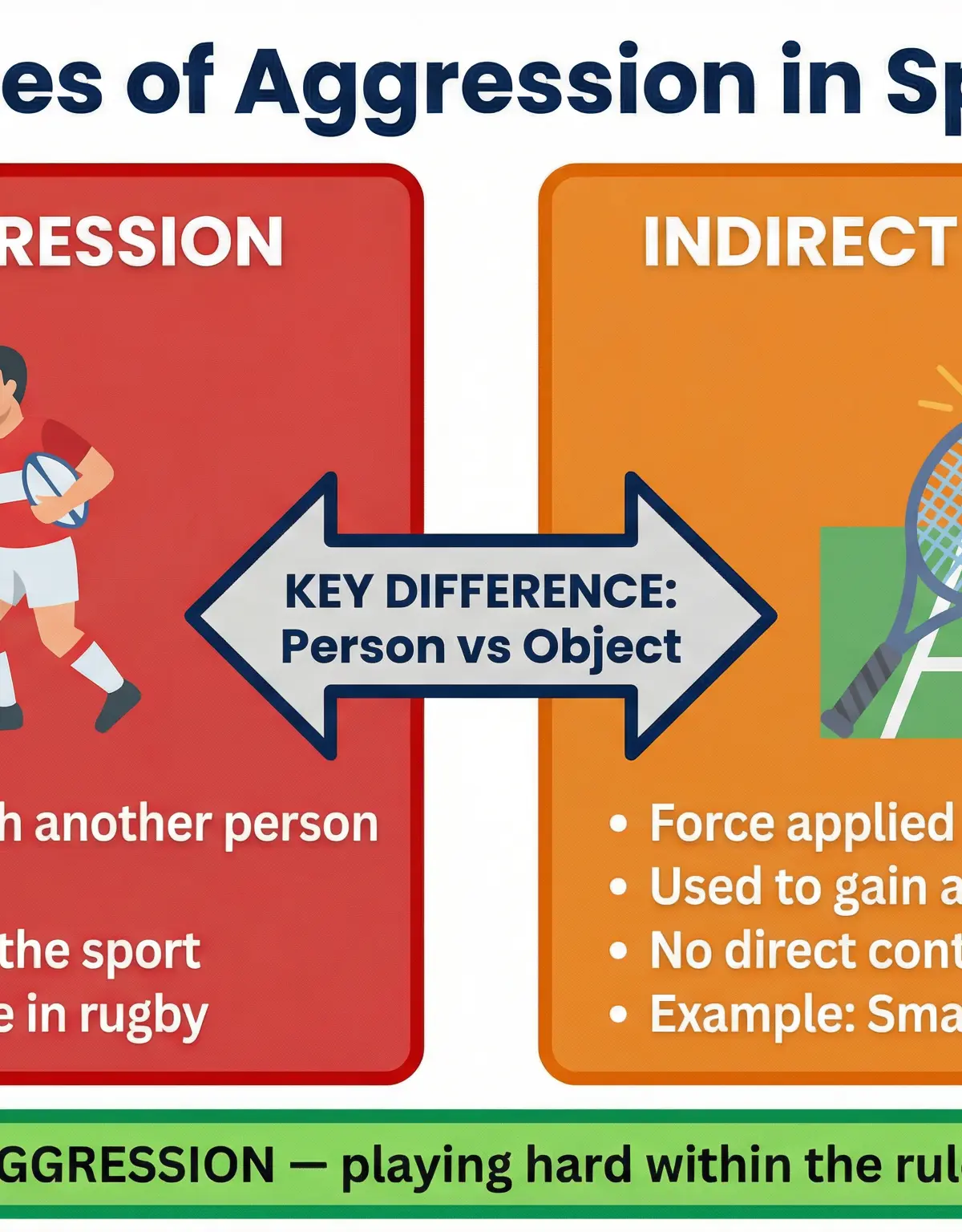
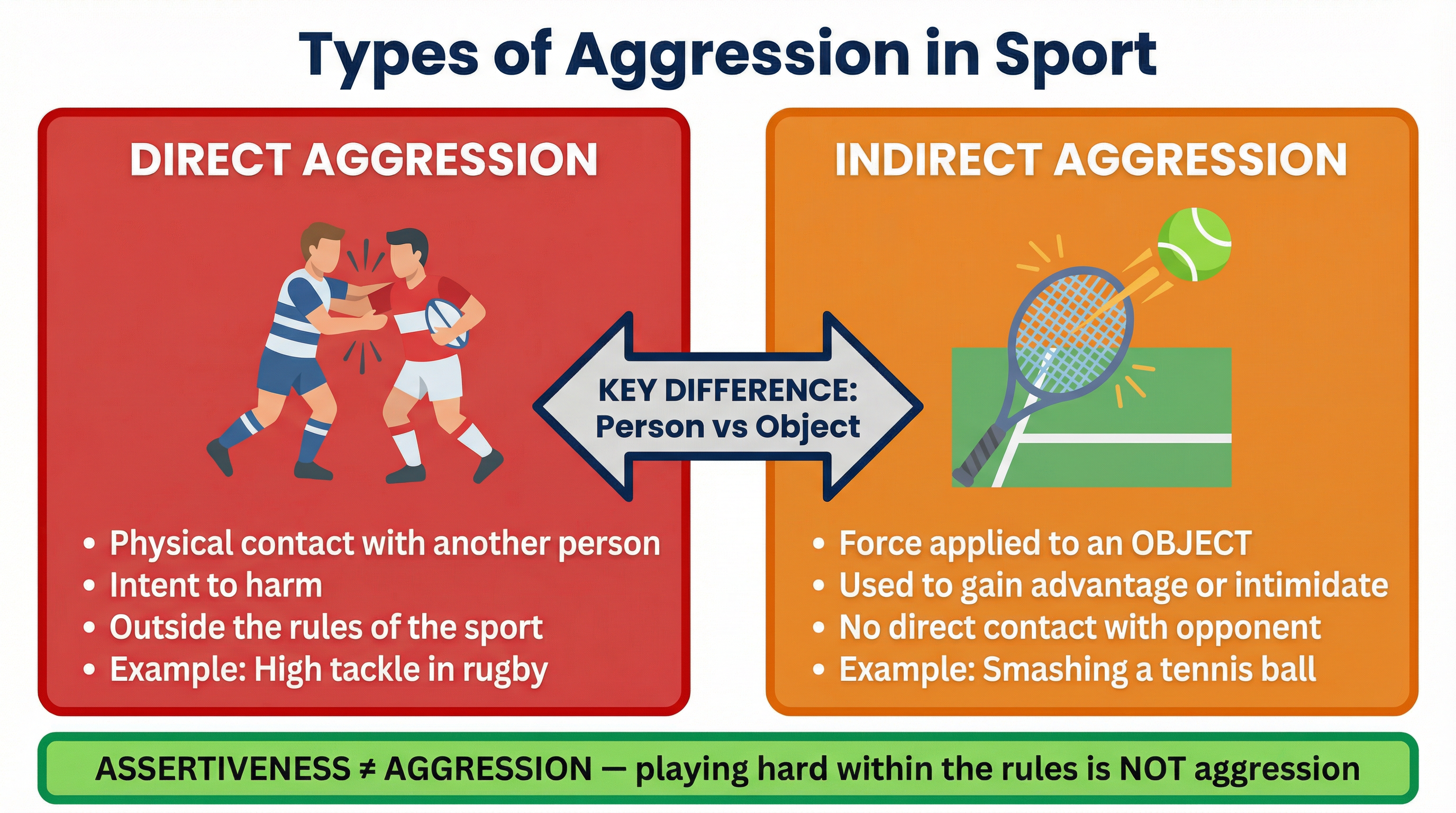
The central concept is the differentiation between two specific types of aggression. It is vital that candidates do not confuse aggression with assertiveness. Assertiveness is forceful, goal-directed behaviour within the rules of the sport; aggression involves an intent to harm and often falls outside the rules.
**1. Direct Aggression:**This is physical contact directed at another performer with the intent to cause harm. The action is deliberate and aimed at an opponent. For example, a boxer punching an opponent or a footballer performing a dangerous, two-footed tackle are both clear instances of direct aggression. The key components are the physical act and the intention behind it.
**2. Indirect Aggression:**This form of aggression does not involve physical contact with another person. Instead, the aggressive impulse is directed towards an object to gain an advantage, intimidate an opponent, or relieve frustration. The force is still present, but it is channelled. For instance, a tennis player smashing a powerful shot into the ground after losing a point, or a cricketer angrily throwing their bat after being dismissed. The act is aggressive, but the target is an object.
Key Practitioners/Artists/Composers
In Sport Psychology, we refer to theorists rather than artists. The concepts of aggression are built on foundational psychological theories.
| Name | Period/Style | Key Works | Relevance |
|---|---|---|---|
| Dollard et al. | 1939 | Frustration-Aggression Hypothesis | Proposed that aggression is always a consequence of frustration. If a performer is blocked from achieving their goal, this leads to a build-up of frustration that can be released through aggression. This is a foundational, though now considered simplistic, theory. |
| Berkowitz | 1969 | Aggressive Cue Hypothesis | Developed the Frustration-Aggression theory. Berkowitz suggested that frustration creates a readiness for aggression, but aggressive acts will only occur if socially learned 'cues' are present. For example, a frustrated rugby player is more likely to be aggressive if they see an opponent acting aggressively (the cue). |
| Bandura | 1977 | Social Learning Theory | Argued that aggression is a learned behaviour, observed and imitated from role models (e.g., senior players, coaches, or famous athletes). If a young footballer sees their hero reacting aggressively and being praised for it, they are more likely to copy that behaviour. |
Technical Vocabulary
Using precise terminology is essential for gaining marks. Candidates should be fluent in the following terms:
- Aggression: Behaviour with the intent to harm another individual, either physically or emotionally.
- Direct Aggression: Aggressive behaviour involving physical contact with another person.
- Indirect Aggression: Aggressive behaviour channelled through an object to harm or intimidate.
- Assertiveness: Goal-directed, forceful behaviour that is within the rules of the sport.
- Intent: The crucial factor that separates aggression from accidental harm.
- Arousal: A state of physiological and psychological activation, varying on a continuum from deep sleep to intense excitement.
- Somatic Anxiety: The physiological (physical) symptoms of anxiety, such as increased heart rate and muscle tension.
- Cognitive Anxiety: The psychological (mental) symptoms of anxiety, such as worry, negative thoughts, and loss of concentration.
Practical Skills
Techniques & Processes for Managing Aggression
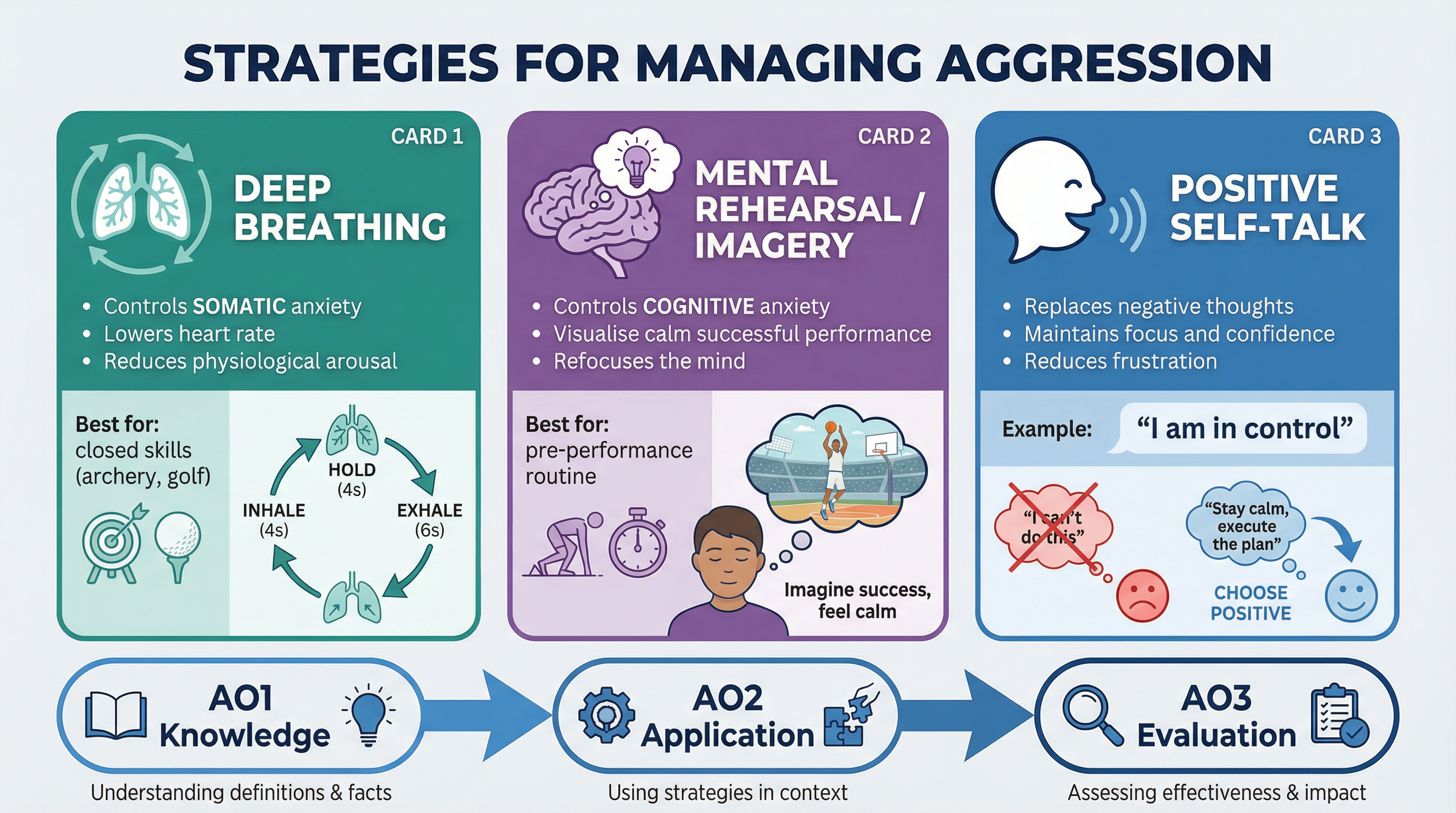
Candidates must be able to describe and apply specific stress management techniques to control arousal and aggression. These are practical skills for any athlete.
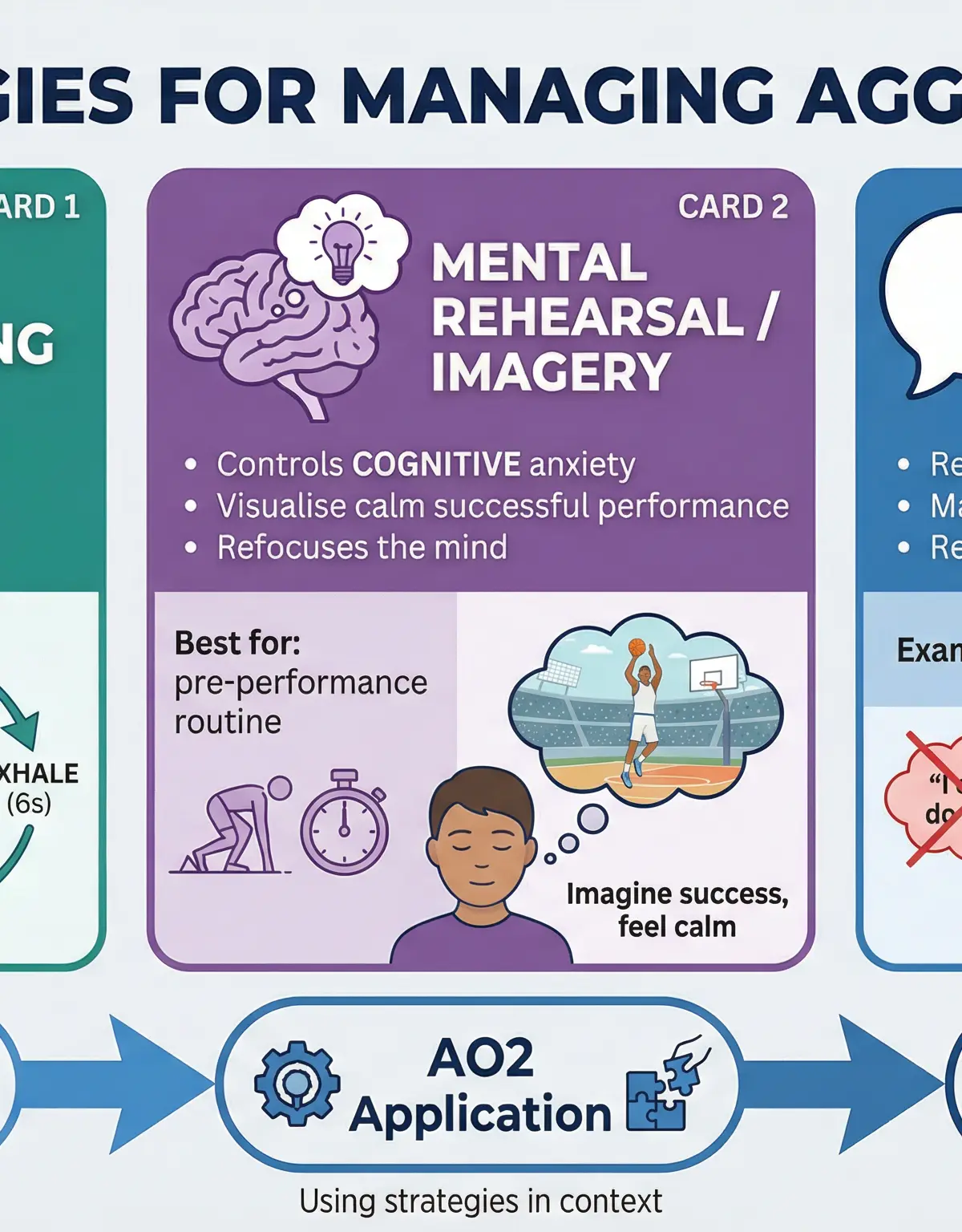
**1. Deep Breathing:**This is a somatic technique used to control physiological arousal.
- Process: The performer finds a quiet moment (e.g., between points in tennis, before a free throw in basketball). They take a slow, deep breath in through the nose (for a count of 4), hold it (for a count of 4), and then exhale slowly through the mouth (for a count of 6).
- Mechanism: This process stimulates the parasympathetic nervous system, which actively lowers the heart rate, reduces blood pressure, and decreases muscle tension. It directly counters the body's 'fight or flight' response.
- Application: Best used in sports with natural pauses (e.g., golf, archery, diving) where the performer has time to reset.
**2. Mental Rehearsal / Imagery:**This is a cognitive technique used to control the mental aspects of anxiety and focus the mind.
- Process: The performer visualises themselves successfully and calmly executing a skill or navigating a high-pressure situation. They imagine the sights, sounds, and feelings of a perfect performance. For example, a footballer might visualise scoring a penalty, feeling the confident strike of the ball.
- Mechanism: It works by replacing negative, anxious, or aggressive thoughts with a positive and successful mental blueprint. This improves concentration and confidence, reducing the likelihood of frustration boiling over into aggression.
- Application: Often used as part of a pre-performance routine or during breaks in play.
**3. Positive Self-Talk:**This cognitive technique involves the performer consciously changing their internal dialogue.
- Process: The athlete identifies negative thoughts (e.g., "I can't do this," "I'm going to lose control") and replaces them with positive, instructional, or motivational statements (e.g., "I am in control," "Focus on the next play," "I have trained for this").
- Mechanism: It breaks the cycle of negative thinking that can lead to increased frustration and aggression. It helps maintain self-confidence and keeps the performer focused on the task rather than their emotional state.
- Application: Can be used at any point during performance, making it highly versatile for dynamic, open-skill sports like football or hockey.
Materials & Equipment
No specific equipment is needed for the management techniques themselves, but understanding the context of equipment in relation to aggression is important. For example, in Indirect Aggression, the equipment (a racket, a bat, a ball) becomes the tool through which aggression is expressed.
Exam Component
Written Exam Knowledge
For the written paper, you will be tested on AO1 (knowledge), AO2 (application), and AO3 (evaluation).
- AO1: You must be able to give precise definitions of Direct and Indirect Aggression and the three management techniques.
- AO2: You must be able to apply this knowledge to a given sporting scenario. For example, identifying an act in a picture as Direct Aggression and explaining why.
- AO3: You must be able to evaluate the effectiveness of the management strategies. This involves discussing their strengths and weaknesses in different sporting contexts (e.g., why Deep Breathing is less suitable for a fast-paced game like basketball).
Visual Resources
2 diagrams and illustrations
Interactive Diagrams
1 interactive diagram to visualise key concepts
Conceptual Flow Outline
Flowchart showing the pathway from frustration to an aggressive act, and how management strategies can intervene.
Worked Examples
3 worked examples — open one to explore the question and available guidance.
Practice Questions
Test your understanding — click to reveal model answers
Identify one example of direct aggression in sport.
Hint: Think of an action that involves physical contact with intent to harm.
Describe positive self-talk as a method to control aggression.
Hint: What does the performer do? What kind of thoughts are they replacing? What is the effect?
A hockey player is often penalised for arguing with the umpire. Explain how mental rehearsal could help them manage this behaviour.
Hint: Think about what the player would visualise. How does this change their likely reaction on the pitch?
Compare the effectiveness of deep breathing and positive self-talk for a basketball player to manage their aggression during a game.
Hint: This is an AO3 question. You need to evaluate. Consider the strengths and weaknesses of EACH strategy within the specific context of a basketball game.