OCR · GCSE · Physical Education
Application of Rules and Regulations
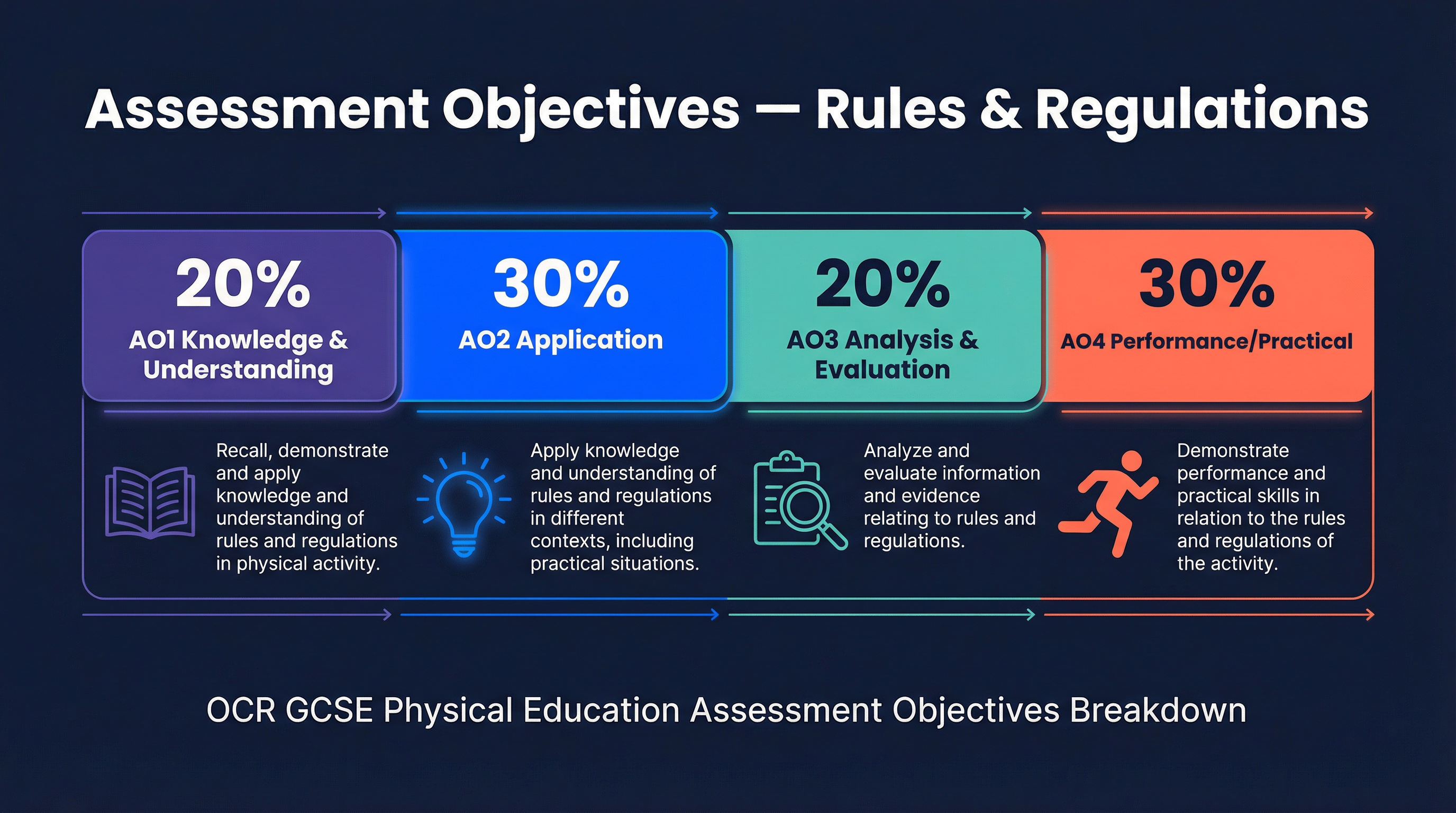
This guide provides a comprehensive overview of the OCR GCSE PE topic 'Application of Rules and Regulations' (7.2). It covers the roles of officials, the distinction between rules and regulations, and the impact of technology, all designed to help candidates maximise their marks in both written and practical assessments.
- 8 min read
- 3 worked examples
- 4 practice questions
- 6 key terms
Study Notes
Overview
Welcome to the definitive guide for OCR GCSE PE, Topic 7.2: Application of Rules and Regulations. A solid understanding of this topic is crucial for success, as it underpins both your practical performance (NEA) and your theoretical knowledge for the written exams. Examiners are looking for candidates who can not only recall rules but also apply them to specific scenarios, analyse their impact, and evaluate their effectiveness. This guide will break down the key concepts, provide practical exam strategies, and give you the tools to approach this topic with confidence.

Key Knowledge & Theory
Core Concepts
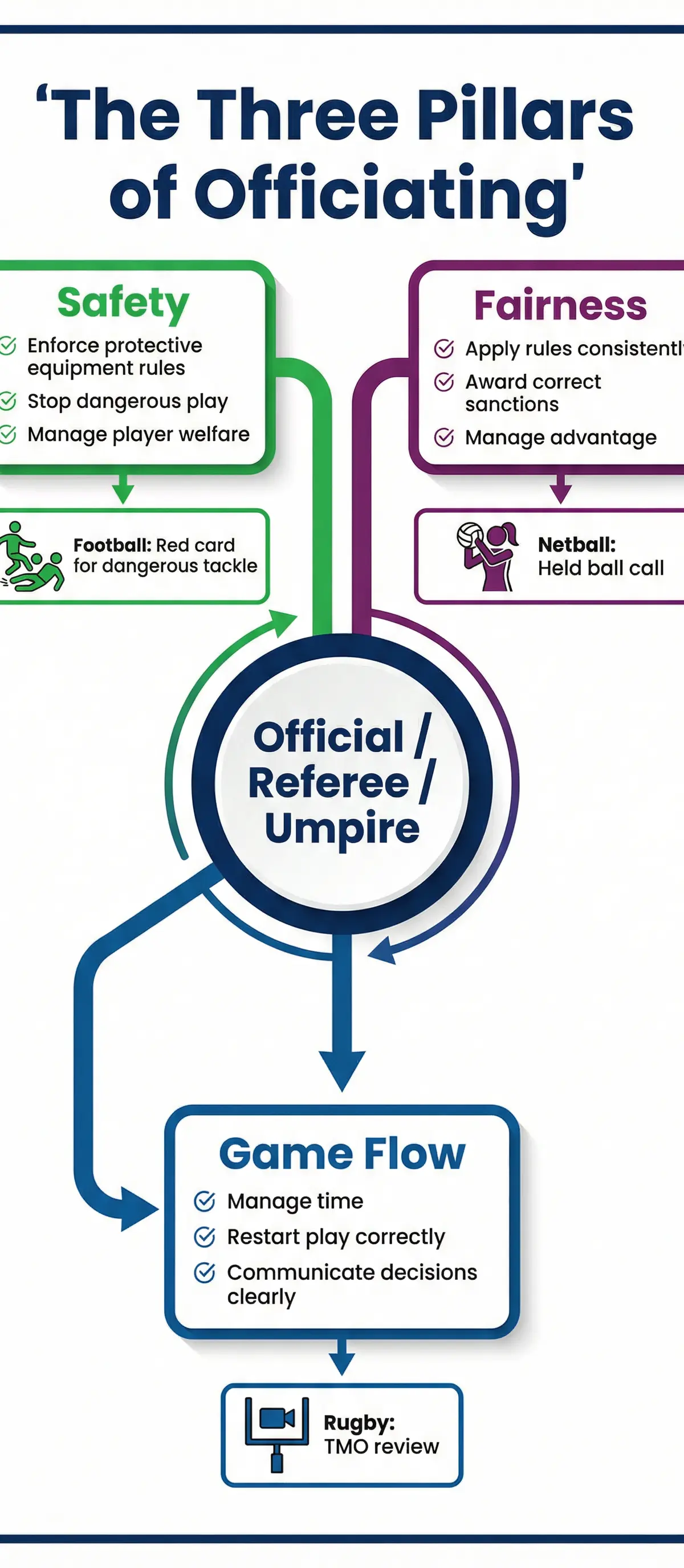
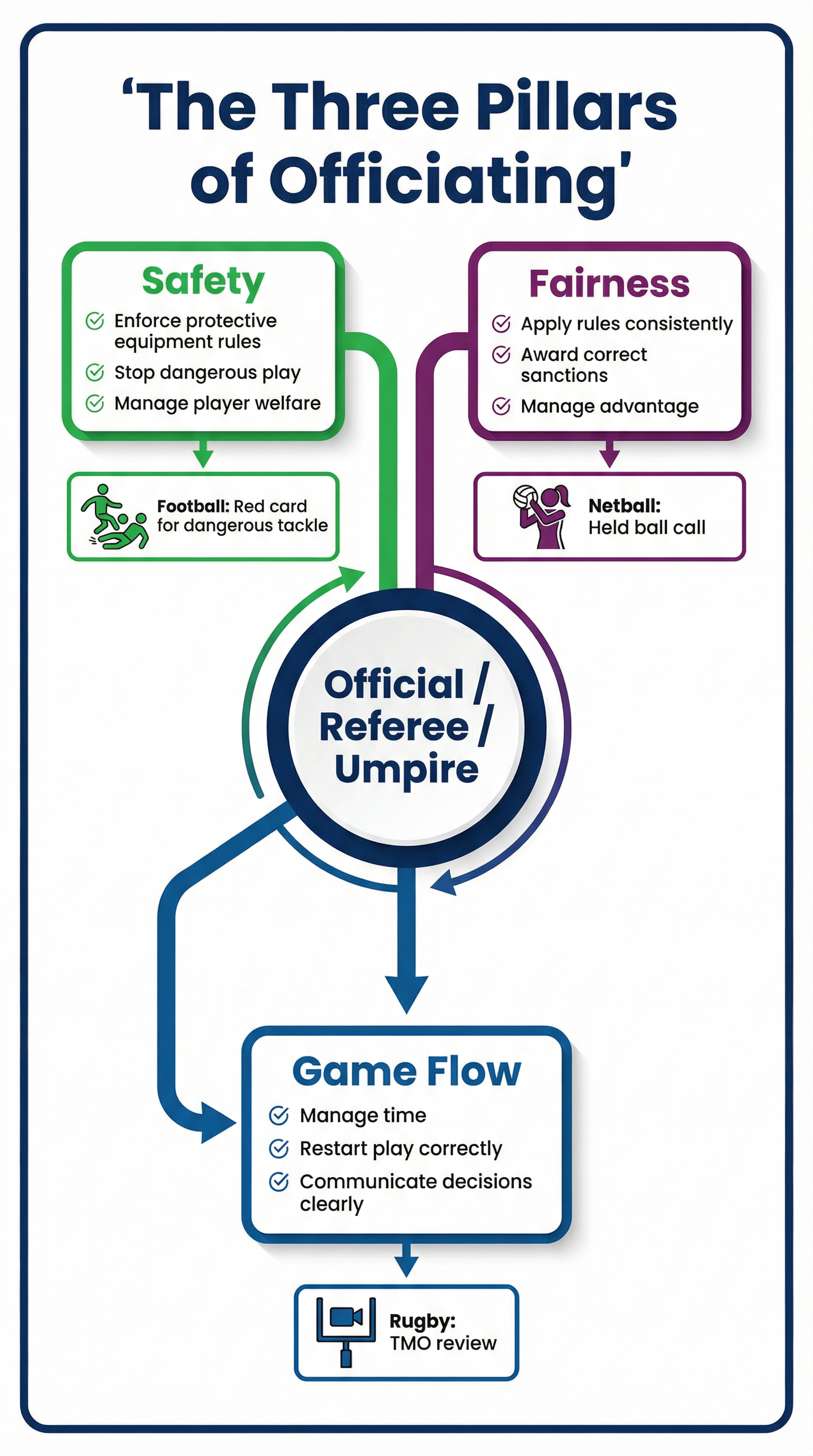
The entire topic of rules and regulations is built on three fundamental pillars. Every action an official takes, and every rule that exists, serves one or more of these purposes:
- Safety: Protecting participants, officials, and spectators from harm. This includes rules on dangerous play, required protective equipment, and procedures for managing injuries.
- Fairness: Ensuring that all participants have an equal opportunity to succeed. This involves consistent application of rules, awarding correct sanctions, and preventing any individual or team from gaining an unfair advantage.
- Game Flow: Maintaining the momentum and structure of the activity. This includes managing time, restarting play correctly, and communicating decisions effectively to ensure the game is not unnecessarily disrupted.
A critical distinction that many candidates miss is the difference between rules and regulations. Getting this right is an easy way to pick up AO1 marks.
- Rules: These are the laws of the game itself, governing how it is played. Examples include the offside rule in football, the footwork rule in netball, or a knock-on in rugby.
- Regulations: These are the specifications and requirements that surround the game. Examples include the dimensions of the playing area, the weight and size of equipment (e.g., a javelin), or the eligibility criteria for a competition.
Key Practitioners/Artists/Composers
In the context of PE, our 'practitioners' are the National Governing Bodies (NGBs) that create and enforce the rules and regulations for their respective sports. Referencing the correct NGB demonstrates a deeper understanding of sports governance.
| Name | Sport | Key Works | Relevance |
|---|---|---|---|
| The Football Association (The FA) | Football | 'Laws of the Game' (in conjunction with IFAB) | Governs all aspects of football in England, from grassroots to the Premier League. Sets rules on everything from fouls to player conduct. |
| England Netball | Netball | 'Official Rules of Netball' | Sets the rules for all levels of netball in England, including key concepts like footwork, obstruction, and held ball. |
| Rugby Football Union (RFU) | Rugby Union | 'World Rugby Laws' | Implements the global laws of rugby in England, covering complex areas like the scrum, ruck, and offside lines. |
| England Hockey | Hockey | 'Rules of Hockey' (FIH) | Governs hockey in England, with a strong focus on safety rules regarding stick height and dangerous play. |
Technical Vocabulary
Using precise, sport-specific terminology is essential for accessing the higher mark bands. Avoid colloquialisms and use the official terms.
- Sanction: The punishment or penalty given for an infringement (e.g., a free kick, a penalty corner, a yellow card).
- Infringement: A breach or violation of a rule.
- Officiating: The act of applying the rules of a sport as a referee, umpire, or judge.
- NGB (National Governing Body): The organisation responsible for managing and promoting a specific sport within a country.
- TMO (Television Match Official): An official who uses video replays to assist the on-field referee in making decisions, primarily in rugby.
- VAR (Video Assistant Referee): A similar system to the TMO, used in elite-level football to review key decisions.
- Advantage: A rule that allows an official to let play continue after an infringement if the non-offending team is in a better position than they would be if play were stopped.
Practical Skills
Techniques & Processes
In your NEA performance, you are assessed on your ability to apply rules under pressure. This means your knowledge must be automatic.
- Instinctive Application: You must know the rules so well that you react instantly without needing to be told by an official. For example, immediately setting a free pass in netball or retreating 10 metres for a penalty in rugby.
- Tactical Exploitation: Advanced performers use the rules to their advantage. For instance, a footballer holding their run to stay onside, or a hockey player using their body legally to shield the ball.
- Self-Officiating: In many competitive situations, especially at school level, you may be required to officiate your own game. This requires a deep understanding of the rules and the ability to apply them impartially.
Materials & Equipment
Understanding regulations related to equipment is crucial for both safety and fairness.
- Protective Equipment: Candidates must know the mandatory protective equipment for their sport (e.g., shin pads in football, gum shield in rugby/hockey) and understand that an official can prevent them from playing if it is not worn.
- Equipment Specifications: You should be aware that equipment is regulated. For example, the weight of a discus, the length of a tennis racket, or the air pressure in a football are all subject to NGB regulations to ensure fairness.
- Safe Use: Officials are responsible for ensuring equipment is used safely. This includes checking studs on football boots or ensuring goalposts are secure before a match begins.
Portfolio/Coursework Guidance
Assessment Criteria
For the NEA (Component 03), your performance is assessed against criteria that include your application of rules. Examiners and teachers are looking for:
- Consistency: Do you adhere to the rules throughout the entire performance?
- Fluency: Is your application of rules seamless and integrated into your play, or is it hesitant?
- Decision Making: Do you make correct tactical decisions that are compliant with the rules?
Building a Strong Portfolio
In your written coursework or controlled assessment, you must evidence your understanding.
- Analysis of Performance: When analysing your strengths and weaknesses, refer to the rules. For example: 'A weakness is my tendency to be caught offside, which breaks down attacks. To improve, I will work on timing my runs in accordance with the offside rule.'
- Action Plans: Your plans for improvement should be linked to rules. 'My training plan will include drills where I practise receiving a netball and releasing it within the three-second 'held ball' rule to improve my speed of play.'
Exam Component

Written Exam Knowledge
The written papers (Components 01 and 02) will test your theoretical knowledge. Expect questions on:
- The role and responsibilities of officials.
- The application of specific rules in different scenarios.
- The impact of technology on officiating.
- The distinction between rules and regulations.
Practical Exam Preparation
For your NEA performance, preparation is key:
- Know Your Sport Inside-Out: Read the official NGB rulebook for your main sport. Don't just rely on what your coach tells you.
- Practise Officiating: Offer to umpire or referee a training game. It is the fastest way to learn the nuances of the rules.
- Scenario Training: Ask your coach to set up specific game scenarios, such as defending a short corner in hockey or executing a lineout in rugby, to test your rule application under pressure.
Visual Resources
2 diagrams and illustrations
Interactive Diagrams
1 interactive diagram to visualise key concepts
Conceptual Flow Outline
Flowchart of an Official's Decision-Making Process
Worked Examples
3 worked examples — open one to explore the question and available guidance.
Practice Questions
Test your understanding — click to reveal model answers
Identify two different types of officials in sport. (2 marks)
Hint: Think about different sports and the names given to the person in charge.
Describe the role of a referee in maintaining safety in a game of rugby union. (4 marks)
Hint: Think about specific, dangerous situations in rugby and what the referee does to manage them.
Explain how the introduction of Hawk-Eye technology has affected officiating in tennis. (4 marks)
Hint: Consider the impact on both the officials and the fairness of the game.
Analyse how the rules of a sport you have studied are designed to promote positive sporting ethics and behaviour. (6 marks)
Hint: Think beyond just fouls. Consider rules around respect for officials, opponents, and the spirit of the game. Link specific rules to specific ethical behaviours.