OCR · GCSE · Physical Education
Axes of Movement: Sagittal, Frontal, Transverse
This guide provides a comprehensive breakdown of the Axes of Movement for OCR GCSE Physical Education (2.3). It covers the crucial relationship between the sagittal, frontal, and transverse planes and their corresponding axes, providing exam-focused advice to help candidates secure top marks.
- 5 min read
- 3 worked examples
- 4 practice questions
- 6 key terms
Check what you remember
Read the wording for your board, then hide it and explain Sagittal Plane in your own words. Rough notes are fine. This is a self-check, with no mark or grade.
Reference: OCR
A vertical plane that divides the body into left and right sides.
Study Notes
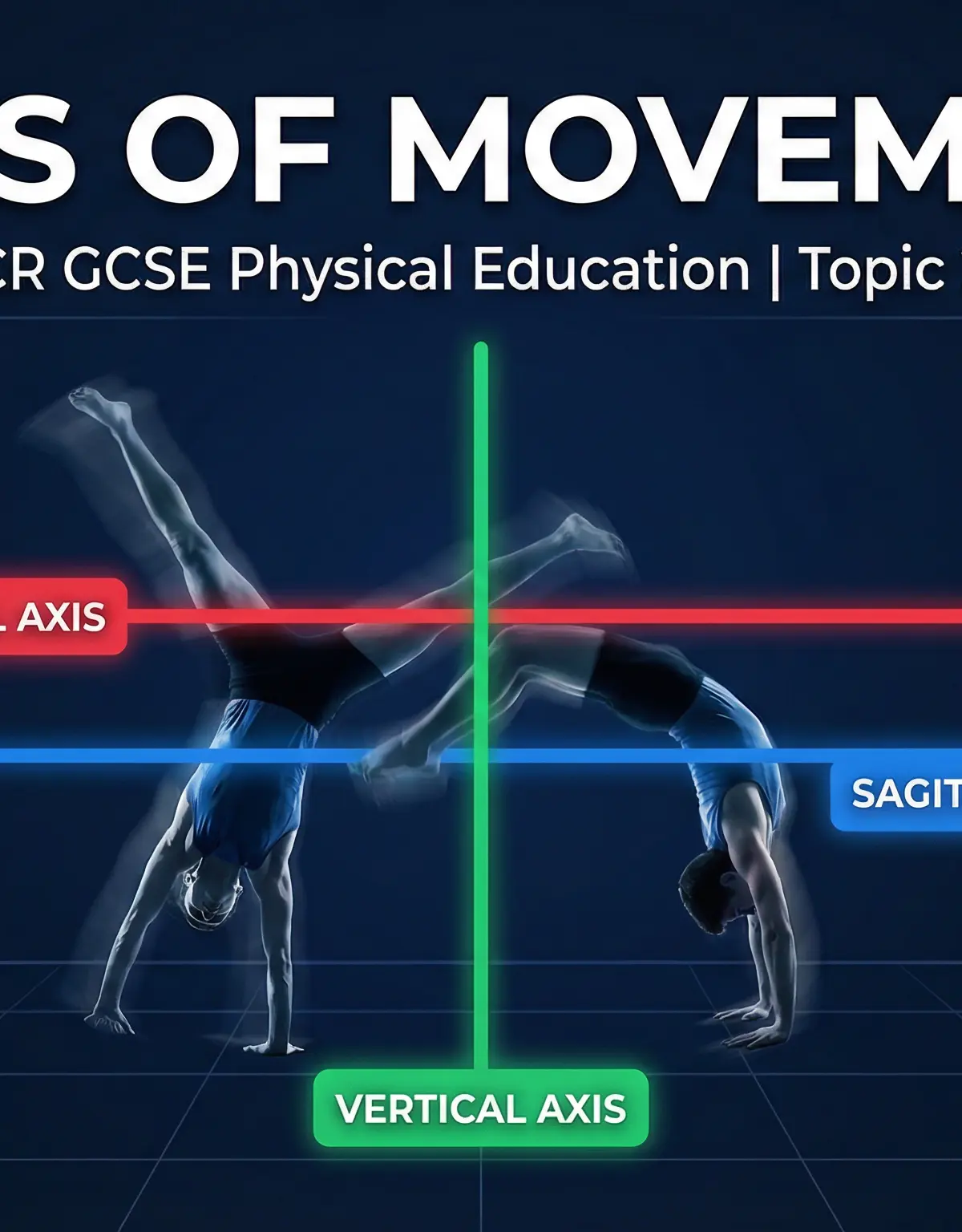
Overview
Understanding how the body moves is fundamental to the study of Physical Education. The concepts of planes and axes of movement provide a precise framework for analysing sporting actions. For the OCR GCSE PE exam, candidates are required to demonstrate a clear understanding of the three anatomical planes and the three axes of rotation, correctly pairing them and applying them to practical examples. Mastery of this topic is essential for answering questions in the 'Physical factors affecting performance' section of Paper 1, and it frequently appears in both short-answer (AO1) and extended analysis (AO2/AO3) questions.
This guide will break down the core concepts, provide memory hooks to solidify your knowledge, and give you the exam technique needed to turn that knowledge into marks.
Key Knowledge & Theory
Core Concepts
The human body moves in three dimensions. To describe this movement accurately, we use three imaginary 'planes' that slice through the body, and three imaginary 'axes' around which the body rotates. The key to success is understanding that for any given movement, there is a specific plane-axis pairing.
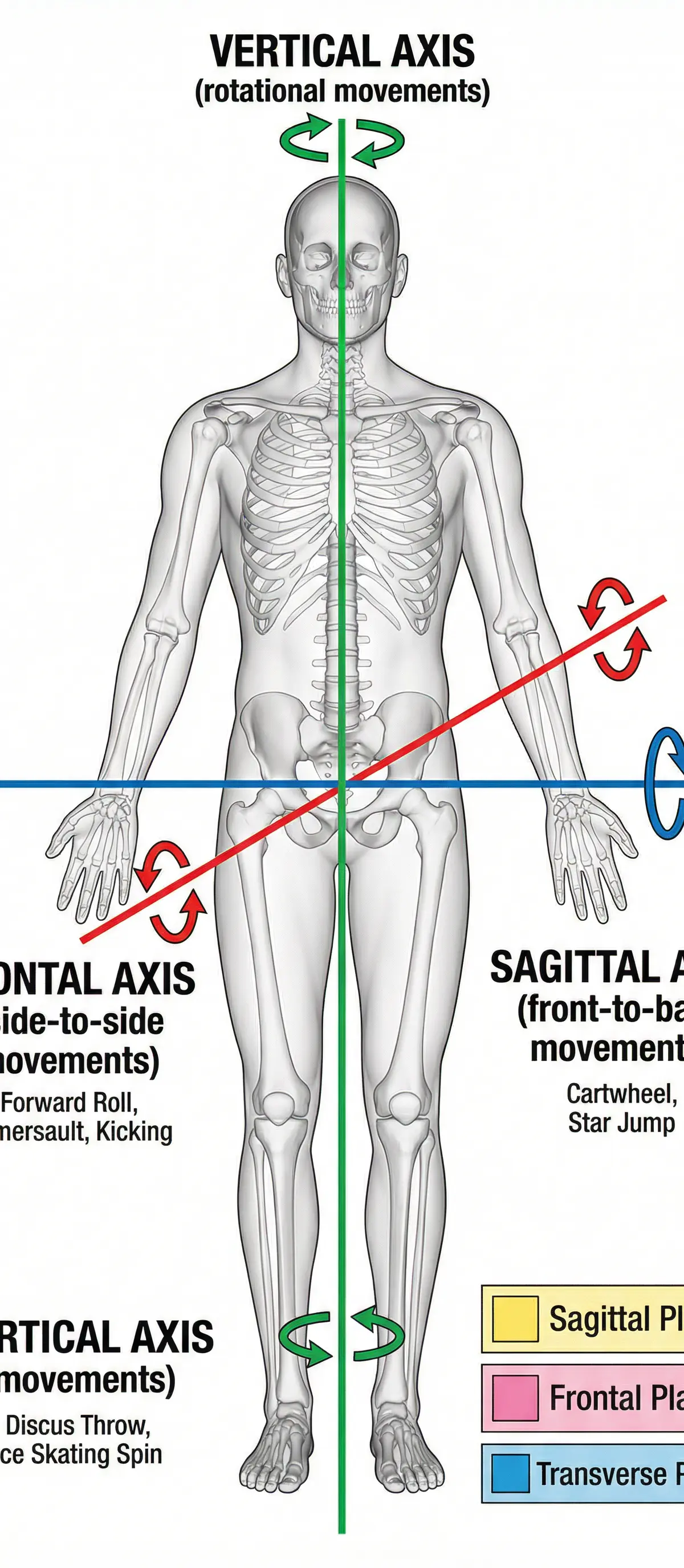
-
Planes of Movement: These are flat surfaces that divide the body.
- Sagittal Plane: Divides the body vertically into left and right sides. Movements in this plane are forwards and backwards (e.g., running, a forward roll).
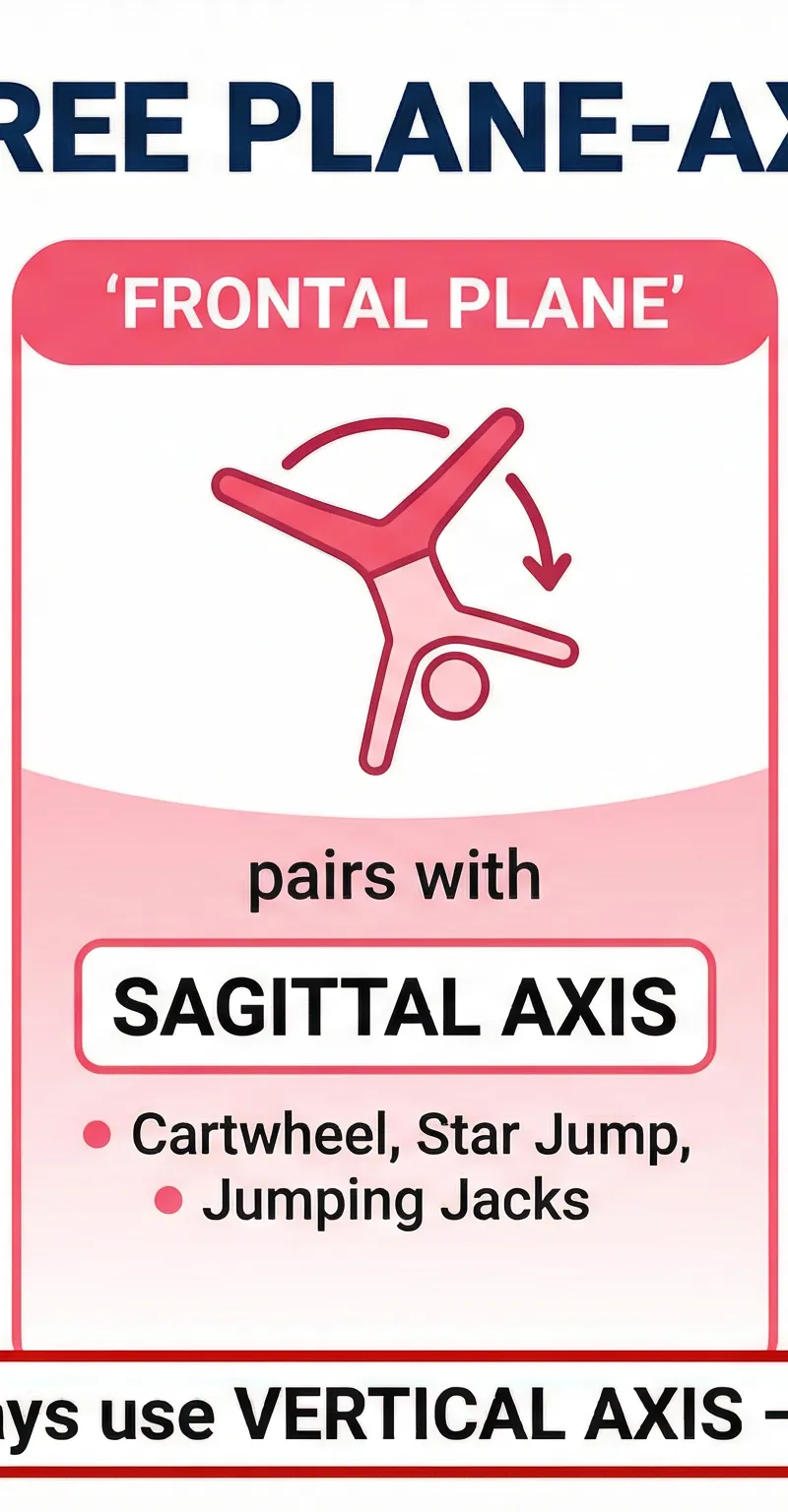
- Frontal Plane: Divides the body vertically into front and back sides. Movements in this plane are side-to-side (e.g., a cartwheel, star jump).
- Transverse Plane: Divides the body horizontally into top and bottom sections. Movements in this plane are rotational (e.g., a discus thrower spinning).
-
Axes of Movement: These are imaginary lines that pass through a joint, around which rotation occurs.
- Frontal Axis: Runs horizontally from side to side (left to right). Rotation around this axis causes forward and backward movement.
- Sagittal Axis: Runs horizontally from front to back (anterior to posterior). Rotation around this axis causes sideways movement.
- Vertical Axis: Runs vertically from head to toe. Rotation around this axis causes spinning or twisting movements.
The Unbreakable Pairing Rule
The most crucial, and often most confusing, part of this topic is the relationship between planes and axes. The axis of rotation is always perpendicular (at a 90-degree angle) to the plane of movement. This leads to the following essential pairings:
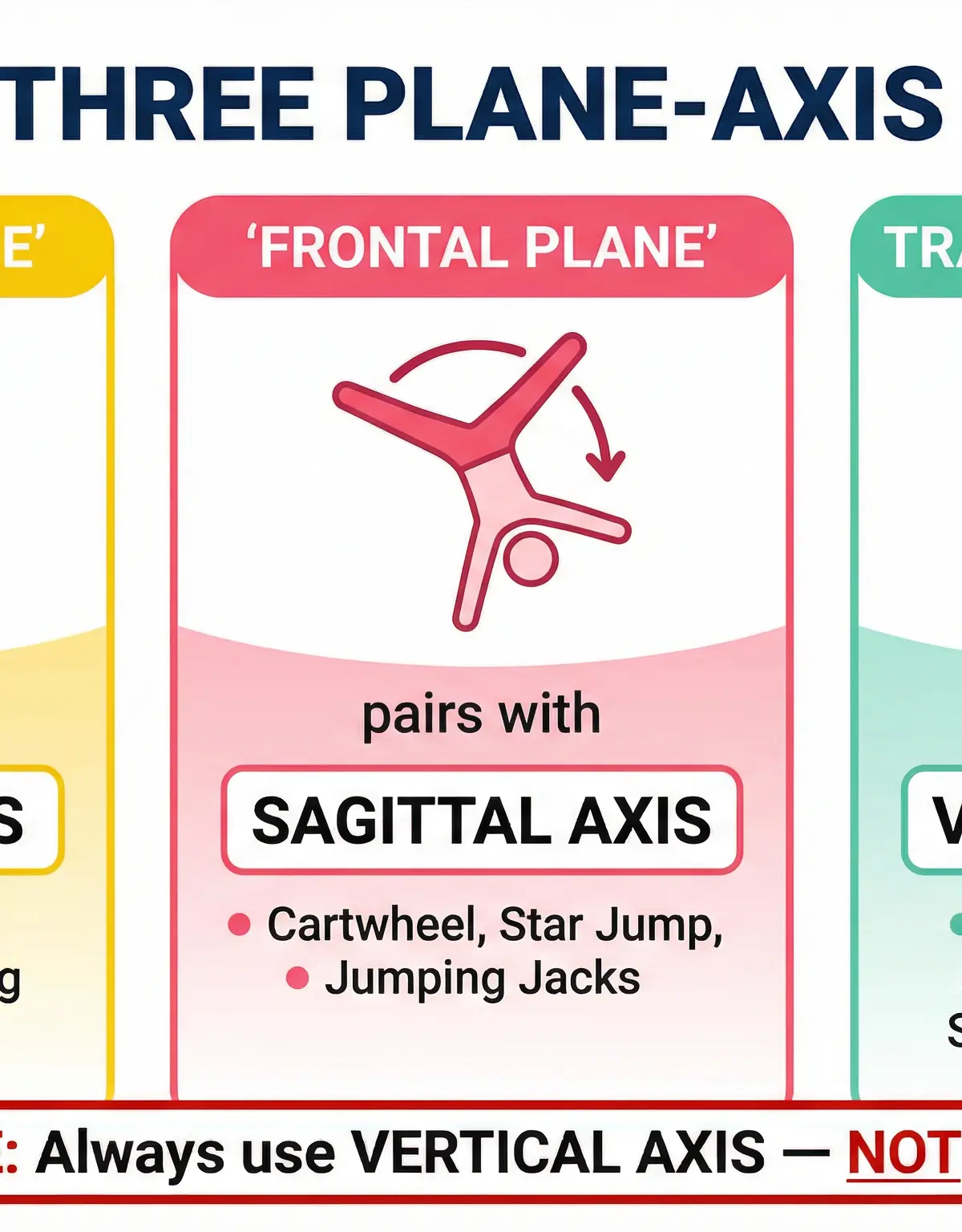
| Plane | Paired Axis | Type of Movement | Sporting Examples |
|---|---|---|---|
| Sagittal | Frontal | Forwards & Backwards (Flexion/Extension) | Running, Kicking a ball, Somersault, Cycling |
| Frontal | Sagittal | Sideways (Abduction/Adduction) | Cartwheel, Star Jump, Side-stepping in defence |
| Transverse | Vertical | Rotational (Twisting) | Discus throw spin, Ice skating pirouette, Golf swing |
Technical Vocabulary
To gain full marks, candidates must use precise anatomical language.
- Anterior/Posterior: Front/Back
- Superior/Inferior: Top/Bottom
- Medial/Lateral: Towards the midline/Away from the midline
- Flexion/Extension: Decreasing the angle at a joint / Increasing the angle at a joint.
- Abduction/Adduction: Moving a limb away from the midline / Moving a limb towards the midline.
- Rotation: Movement around a central axis.
Podcast Guide
For an in-depth audio breakdown of this topic, including exam tips and a recall quiz, listen to our dedicated podcast episode.
Exam Component
Written Exam Knowledge
In the written exam (Paper 1: Physical factors affecting performance), questions on this topic can range from 1-mark definitions (AO1) to 6-mark analysis questions (AO3).
- AO1 (Knowledge): You will be asked to define a plane or an axis. E.g., "Define the sagittal axis." (1 mark).
- AO2 (Application): You will be given a sporting action and asked to identify the plane and/or axis. E.g., "Identify the plane and axis used to perform a cartwheel." (2 marks).
- AO3 (Analysis): You will be asked to analyse a movement in detail, justifying your choice of plane and axis and explaining the movement. E.g., "Analyse the movement at the hip joint of a footballer kicking a ball, in relation to the planes and axes of movement." (6 marks).
Visual Resources
2 diagrams and illustrations
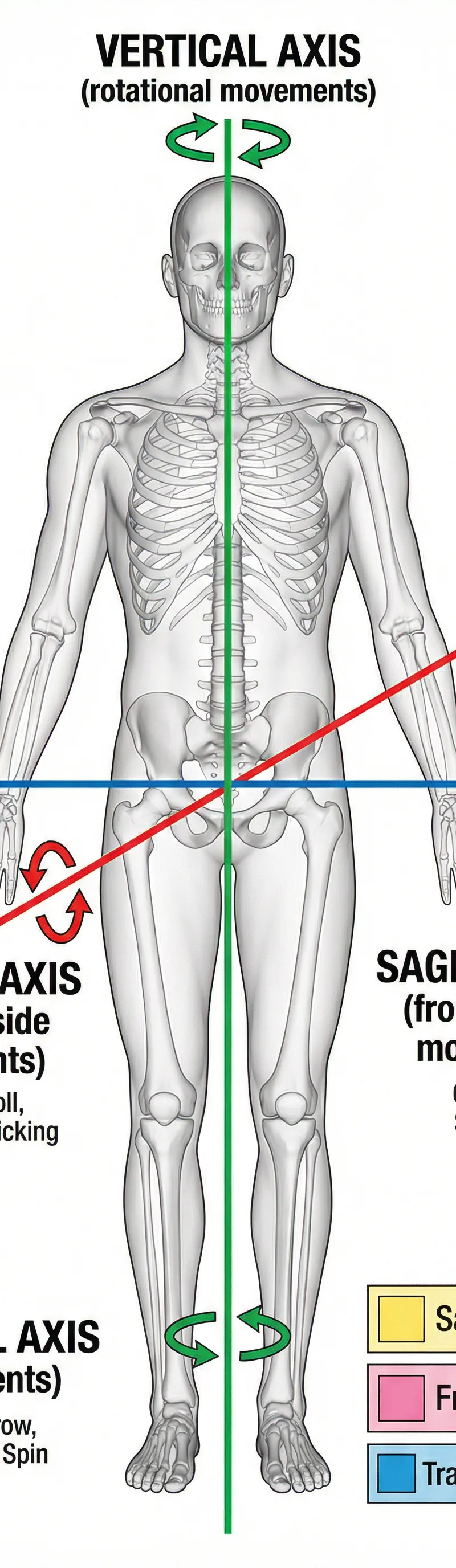
Interactive Diagrams
1 interactive diagram to visualise key concepts
Conceptual Flow Outline
Decision-making flowchart for identifying the correct plane and axis.
Worked Examples
3 worked examples — open one to explore the question and available guidance.
Practice Questions
Try the question, then reveal an answer plan or example response
Identify the axis of rotation for a star jump. (1 mark)
Hint: A star jump is a sideways movement. Which axis is paired with the frontal plane?
Describe the movement of a cyclist in relation to a plane of movement. (2 marks)
Hint: Think about the main direction of travel for a cyclist.
A tennis player hits a powerful forehand, rotating their torso. Analyse this rotational movement, referring to the correct plane and axis. (3 marks)
Hint: The rotation of the torso is a twisting motion. What plane and axis does this use? Remember the OCR-specific term.
Compare the planes and axes of movement used in a forward somersault and a cartwheel. (6 marks)
Hint: Structure your answer with two clear sections: one for the somersault, one for the cartwheel. Then, add a concluding sentence to summarise the comparison.
Exam technique
How to turn what you know into marks
How to approach the question
1. Identify the command word (Identify, Describe, Explain, Analyse). 2. Identify the sporting action. 3. Visualise the movement: is it forwards/backwards, sideways, or rotational? 4. Recall the correct plane-axis pairing using SF-FS-TV. 5. Structure your answer to match the marks available.
How to structure your answer
For extended 6-mark analysis questions: 1. **Identify**: State the plane and axis clearly. 2. **Describe**: Describe the path of the axis through the body (e.g., 'side to side through the hips'). 3. **Explain**: Explain HOW the body rotates around this axis. Use terms like flexion, extension, abduction, adduction, rotation. 4. **Justify**: Link your answer back to the plane (e.g., 'This flexion is characteristic of movement in the sagittal plane').
Timing
Approximately 1.5 minutes per mark in the written paper. A 6-mark question should take around 9 minutes.
Common pitfalls
- Confusing the Frontal and Sagittal axes.
- Using the term 'Transverse Axis' instead of the OCR-required 'Vertical Axis'.
- Describing the movement of the limb (e.g., 'the leg swings') instead of the rotation around the stationary axis.
- Failing to justify WHY a movement is in a certain plane.
What the command words want
- Analyse
- Break the movement down into its components. Discuss the joint action, the plane, and the axis, and how they interrelate.
- Compare
- Identify similarities and differences, e.g., between the axes used in a somersault and a pirouette.
- Explain
- Say HOW or WHY. E.g., 'The forward roll occurs in the sagittal plane BECAUSE it is a forward-and-backward movement involving flexion.'
- Describe
- Say what happens. E.g., 'The frontal axis passes horizontally from left to right through the hips.'
- Evaluate
- Not commonly used for this topic, but would involve judging the efficiency of the movement.
- Identify
- Name or recognise — brief factual answer. E.g., 'Frontal Axis'.
Watch or listen (optional)
Test your understanding of Axes of Movement: Sagittal, Frontal, Transverse
Active recall beats re-reading. Take an instant quiz now to test what you’ve learned and lock it into long-term memory.
A week of Premium from your first lesson · Then the free plan continues · No card, no charge