OCR · GCSE · Physical Education
Components of Fitness: Strength, Speed, Stamina, Flexibility, Agility, Power, Coordination
This guide provides a comprehensive overview of the ten Components of Fitness for OCR GCSE Physical Education (3.1). It covers the precise definitions, practical application in sport, and exam technique required to achieve top marks in AO1, AO2, and AO3 questions.
- 6 min read
- 3 worked examples
- 4 practice questions
- 6 key terms
Study Notes

Overview
Understanding the Components of Fitness is fundamental to success in OCR GCSE PE. This topic requires candidates to not only memorise ten key definitions but also to apply them to sporting contexts (AO2) and analyse performance data (AO3). This guide will break down each component, provide clear examples, and offer examiner-led advice on how to secure every mark available.

Key Knowledge & Theory
Core Concepts
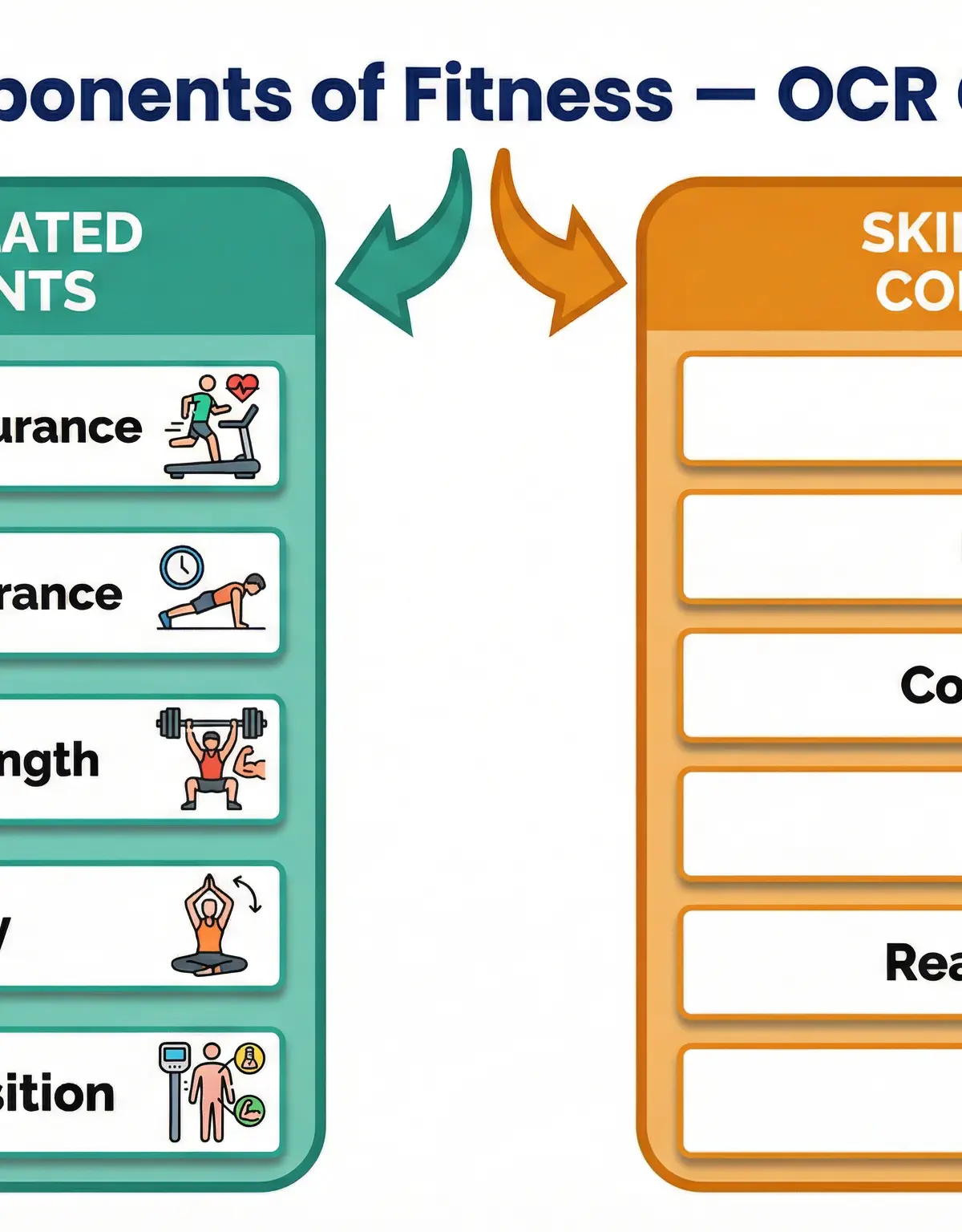
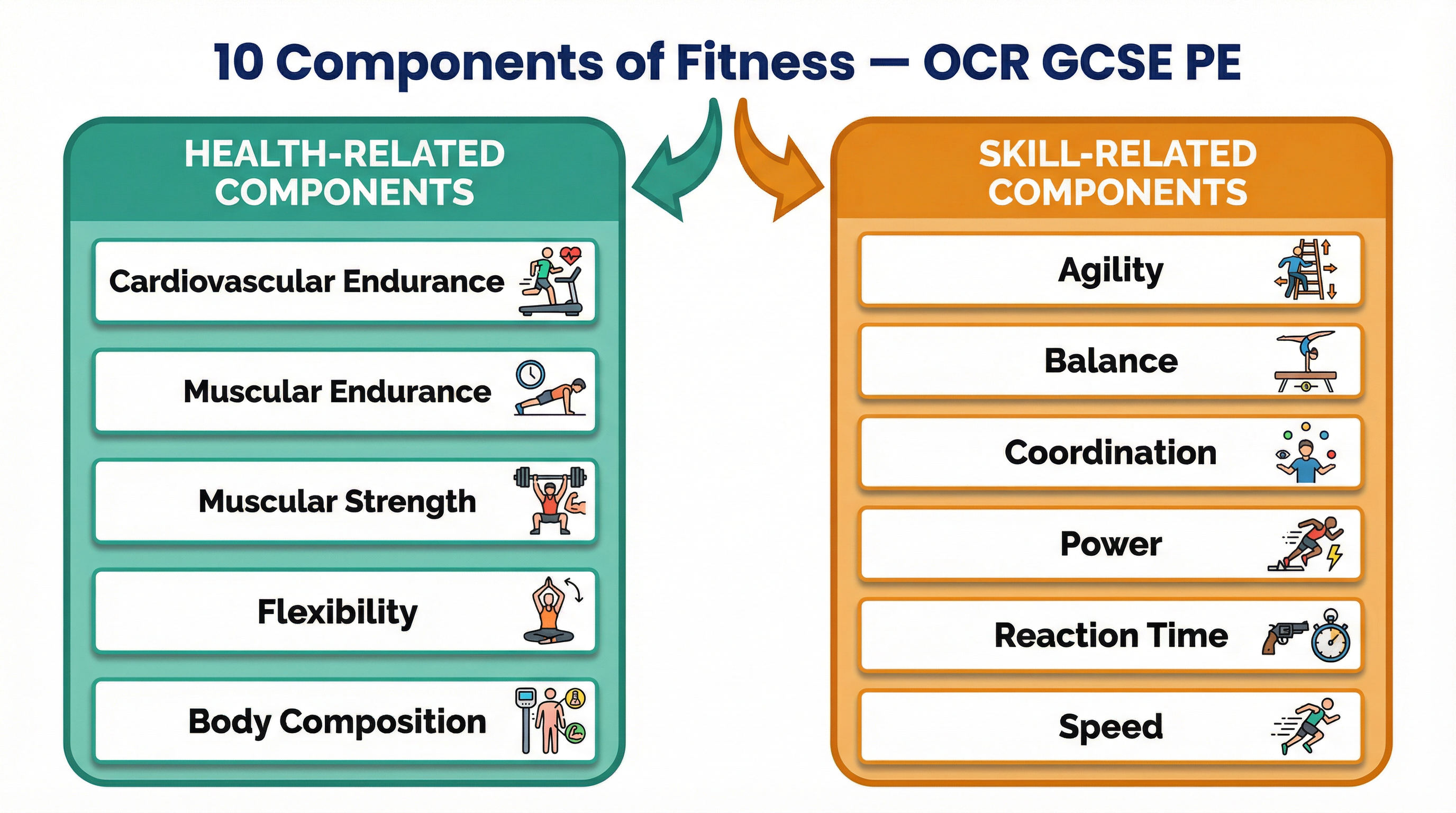
The ten components are divided into two distinct categories: Health-Related Fitness and Skill-Related Fitness. Examiners expect candidates to know which components belong to which category.
Health-Related Components: These are essential for general health and daily life. They are not specific to any particular sport but form the foundation of a healthy lifestyle.
- Cardiovascular Endurance: The ability of the heart and lungs to supply oxygen to the working muscles during sustained physical activity. Do NOT use the term 'Stamina'.
- Muscular Endurance: The ability of a muscle or muscle group to undergo repeated contractions against a resistance without fatiguing.
- Muscular Strength: The maximum force a muscle or muscle group can exert in a single contraction.
- Flexibility: The range of movement possible at a joint.
- Body Composition: The relative ratio of fat mass to fat-free mass (muscle, bones, organs) in the body.
Skill-Related Components: These are more associated with athletic performance and specific sporting skills.
- Agility: The ability to change direction at speed, with control.
- Balance: The ability to maintain the centre of mass over the base of support. This can be static (still) or dynamic (moving).
- Coordination: The ability to use two or more body parts together smoothly and efficiently.
- Power: The ability to exert maximum muscular contraction instantly in an explosive burst of movement. It is a combination of two other components.
- Reaction Time: The time taken to initiate a response to a stimulus.
- Speed: The time taken to cover a set distance.
The Power Formula
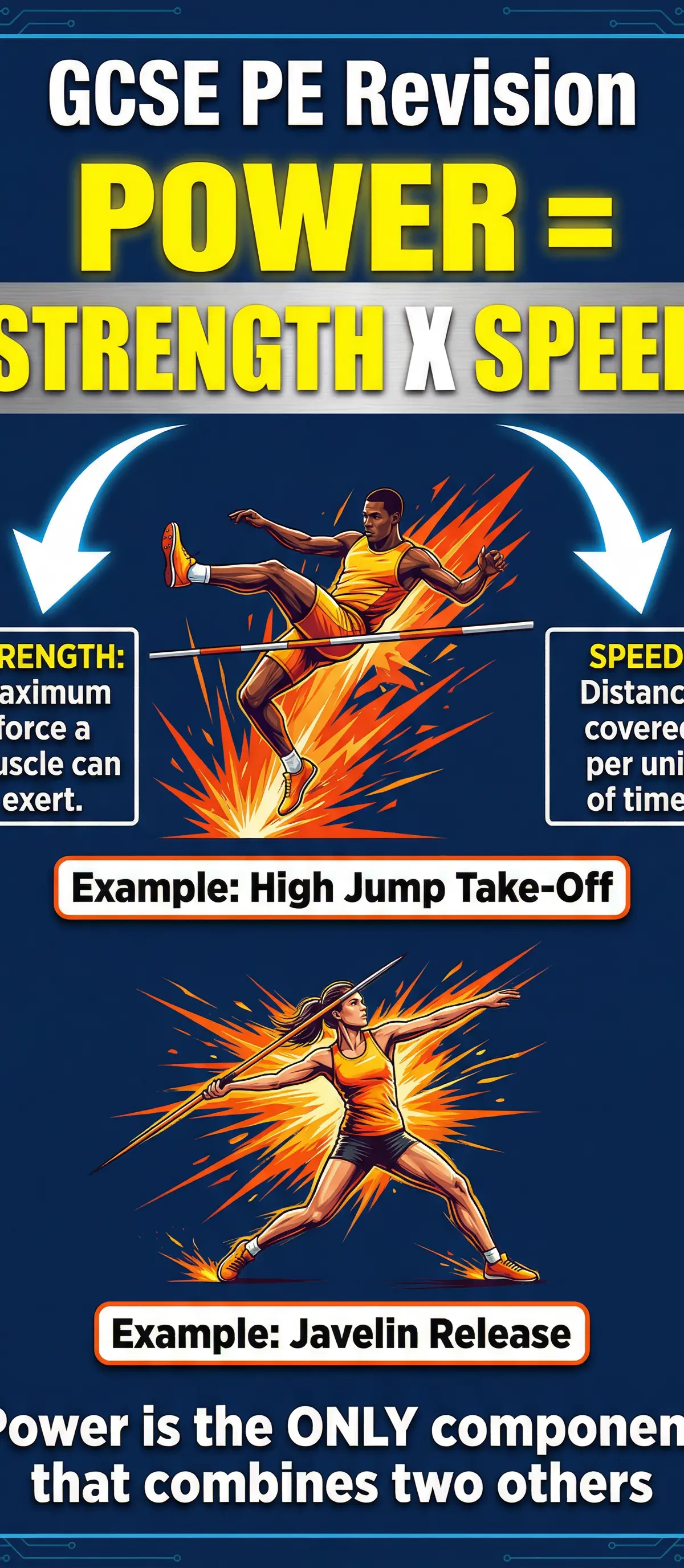
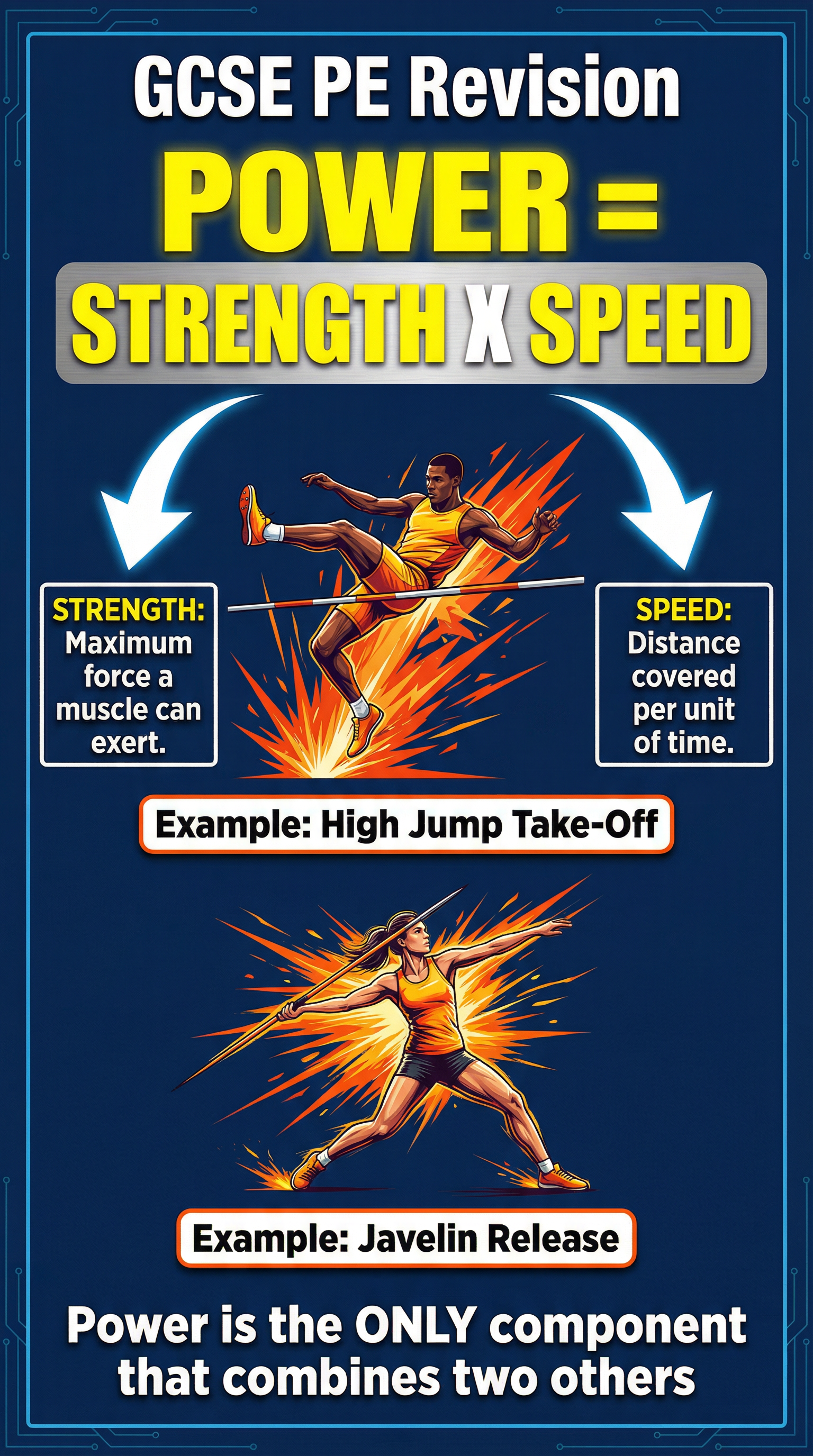
A guaranteed way to gain credit in an exam is to state the formula for Power. It is the only component that is a product of two others.
Power = Strength x SpeedThis concept is crucial for understanding explosive events. For example, a shot putter requires immense strength to hold the shot, but it is the speed at which they move across the circle and release the shot that generates the power for a long throw.
Technical Vocabulary
Using precise, specification-specific language is critical for achieving AO1 marks. Candidates should use the following terms accurately in their written responses:
| Term | Definition | Example of Use in Exam Answer |
|---|---|---|
| Cardiovascular Endurance | Ability of the heart and lungs to supply oxygen to working muscles. | 'A marathon runner requires excellent cardiovascular endurance to supply their leg muscles with oxygen for over two hours.' |
| Agility | Ability to change direction at speed with control. | 'A netballer uses agility to dodge a defender and receive a pass.' |
| Power | Strength × Speed. | 'A high jumper uses power (a combination of strength and speed) to explode upwards from the take-off board.' |
| Dynamic Balance | Maintaining balance while in motion. | 'A snowboarder uses dynamic balance to stay upright while travelling down a slope.' |
| Fat-free Mass | The body's non-fat tissues (muscle, bone, water, organs). | 'An athlete may aim to decrease fat mass while maintaining fat-free mass to improve their power-to-weight ratio.' |
Practical Skills
Techniques & Processes: Fitness Testing
Candidates must be familiar with standard fitness tests for each component. These tests provide the data used in AO3 analysis questions.
| Component | Common Fitness Test | How it Works |
|---|---|---|
| Cardiovascular Endurance | Multi-Stage Fitness Test (Bleep Test) | Perform continuous 20m shuttle runs at progressively faster speeds until exhaustion. |
| Agility | Illinois Agility Test | A timed run involving weaving through cones and changing direction quickly. |
| Muscular Strength | One-Rep Max (e.g., Bench Press) | Find the heaviest weight that can be lifted just once. |
| Flexibility | Sit and Reach Test | Measure the distance you can reach forward with straight legs, testing hamstring and lower back flexibility. |
| Speed | 30-Metre Sprint Test | Time taken to sprint a 30-metre distance from a standing start. |
Materials & Equipment
Safe and correct use of equipment is vital for both fitness testing and training. This includes:
- Cones and markers: For setting up agility runs and sprint tracks.
- Measuring tapes: For accurately marking out distances for tests.
- Stopwatches: For timing speed, agility, and reaction time tests.
- Free weights (dumbbells, barbells): For strength training and testing.
- Sit and reach box: For standardised flexibility testing.
Exam Component
Written Exam Knowledge
The written paper (Component 01 and 02) accounts for 60% of the final grade. Questions on the Components of Fitness are frequent and can be worth anywhere from 1 to 9 marks. Candidates must be prepared to:
- Define each of the ten components (AO1).
- Apply each component to a specific action in a named sport (AO2).
- Analyse fitness test data to identify strengths and weaknesses for a performer (AO3).
- Evaluate the importance of different components for different sports (AO3).
Practical Exam Preparation
While the components are theoretical knowledge, they directly underpin the practical performance (Component 03, 40% of the grade). A performer with high levels of the relevant components for their sport will perform more effectively and achieve higher marks. For example, a trampolinist with excellent balance and coordination will be able to execute complex routines with greater precision and control, leading to higher marks from the moderator.
Visual Resources
2 diagrams and illustrations
Interactive Diagrams
1 interactive diagram to visualise key concepts
Conceptual Flow Outline
Classification of the Components of Fitness
Worked Examples
3 worked examples — open one to explore the question and available guidance.
Practice Questions
Test your understanding — click to reveal model answers
Identify the main component of fitness being used when a goalkeeper dives to save a penalty. (1 mark)
Hint: Think about the time between seeing the ball kicked and starting to move.
Describe how a gymnast uses balance during a floor routine. (2 marks)
Hint: Consider both static and dynamic balance.
Explain why cardiovascular endurance is important for a games player, such as a footballer. (3 marks)
Hint: Link the definition of cardiovascular endurance to the demands of a full game.
A trampolinist needs to perform a complex routine. Evaluate the importance of coordination for their success. (6 marks)
Hint: Define coordination, explain its role in trampolining, and make a judgement on its importance relative to other components.