Goal Setting: SMART Principles
This guide provides a comprehensive overview of the SMART principles of goal setting for OCR GCSE Physical Education (J587). It covers the core theory, practical application, and exam technique required to achieve top marks, focusing on how to construct and evaluate effective performance goals.
Study Notes
Overview
Goal setting is a fundamental psychological skill in Physical Education, crucial for optimising training, maintaining motivation, and maximising performance. For the OCR GCSE PE course, candidates are required to understand and apply the SMART principles of goal setting. This framework is not just theoretical; it is a practical tool used by athletes and coaches at all levels. Mastering this topic will enable you to construct effective goals for your own performance and critically evaluate the goals of others, which are key skills assessed in the written exam.
This guide will break down each component of the SMART acronym, provide examples of its application in different sporting contexts, and highlight the specific language and concepts that examiners expect to see. Pay close attention to the distinction between the different assessment objectives (AOs), as this topic is frequently used to test AO1 (knowledge), AO2 (application), and AO3 (evaluation) skills.
Key Knowledge & Theory
Core Concepts
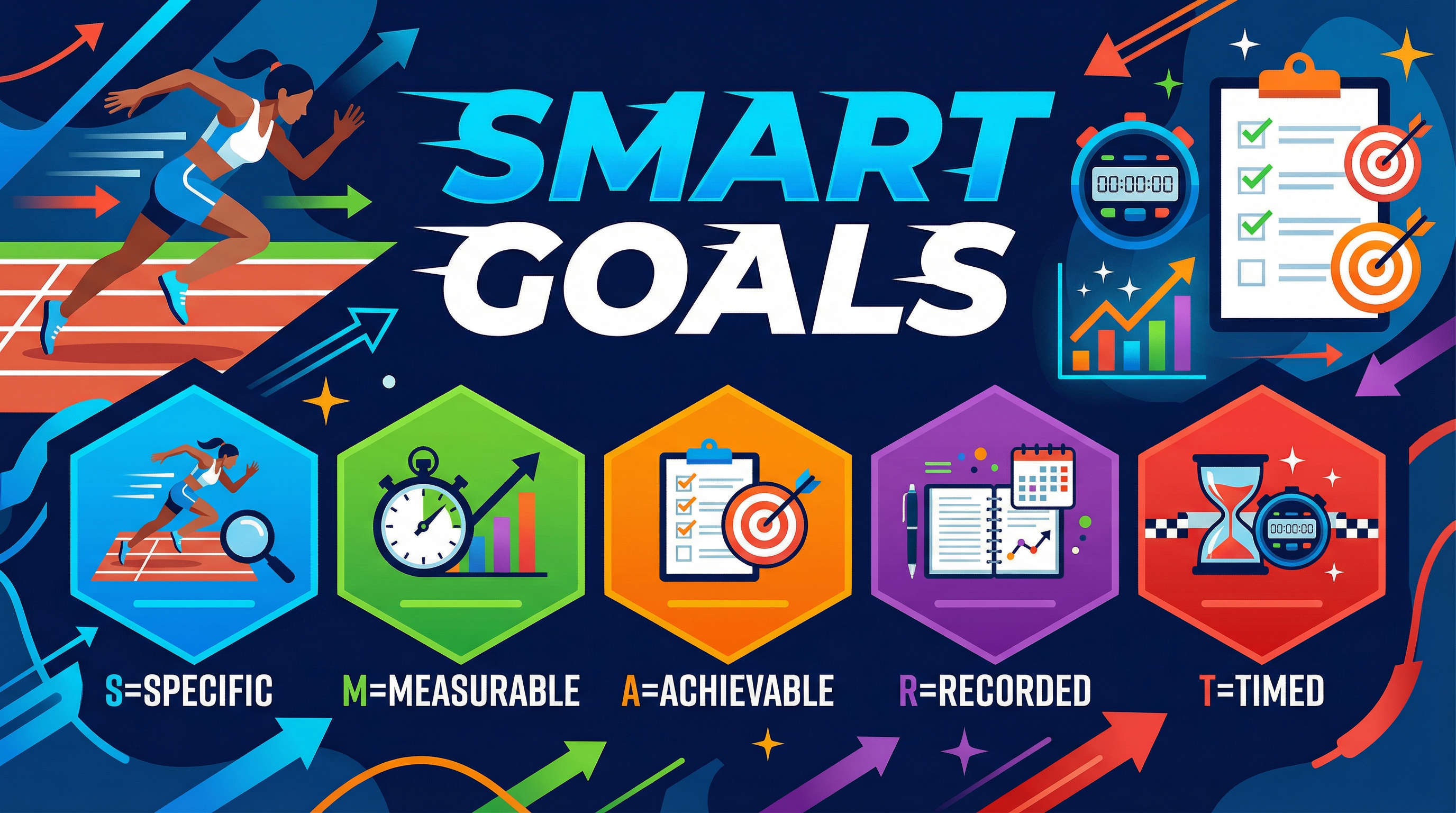
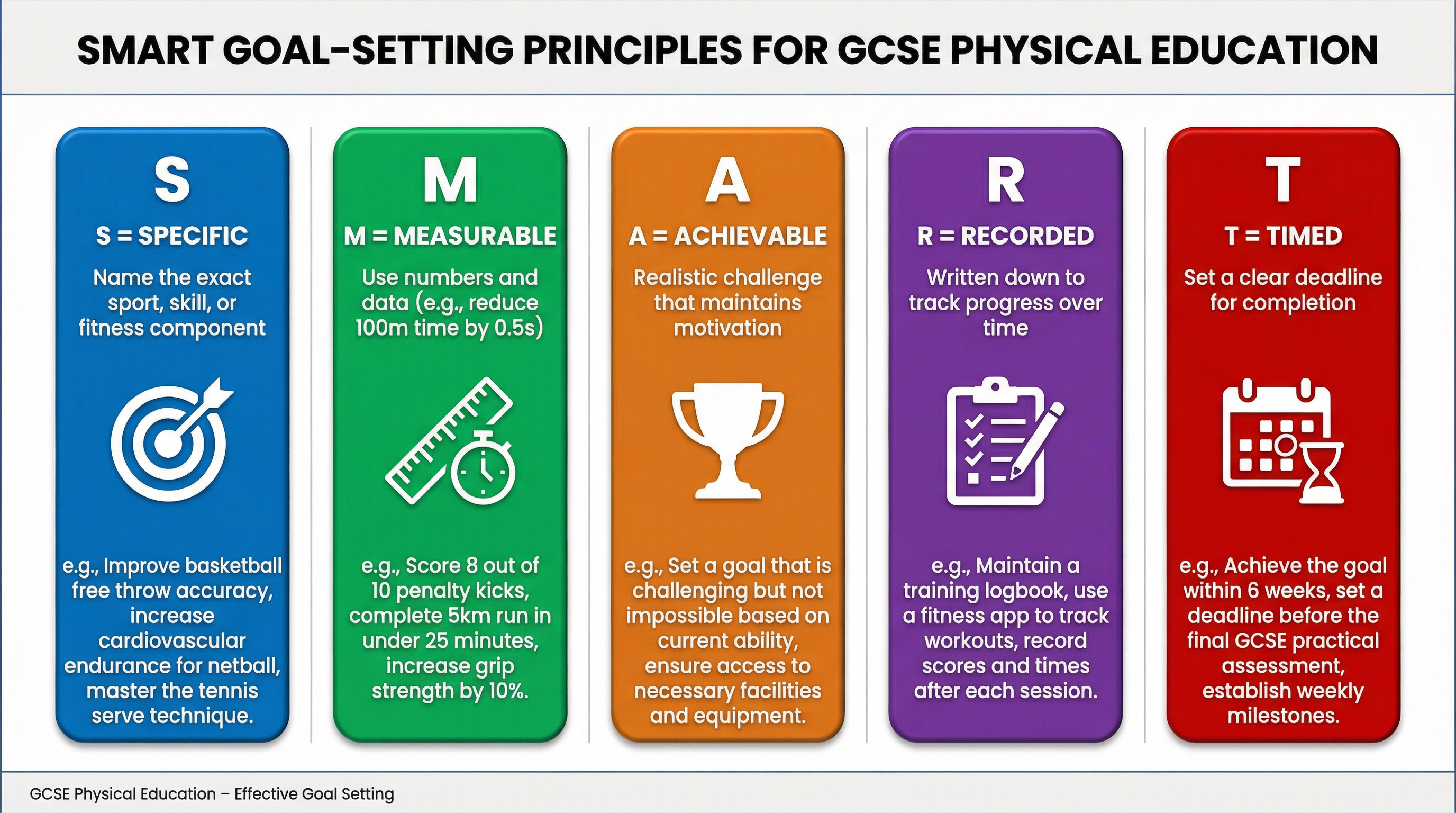
The SMART acronym provides a structure to ensure that goals are well-defined and trackable. According to the OCR specification, the principles are:
- S - Specific: The goal must be clear and unambiguous, identifying the precise area for improvement. It should relate to a specific sport, skill, or component of fitness.
- M - Measurable: The goal must be quantifiable. This allows progress to be objectively tracked using data, such as times, distances, or scores.
- A - Achievable: The goal must be realistic given the performer's current ability and circumstances. It should be challenging enough to be motivating but not so difficult that it causes anxiety or demotivation.
- R - Recorded: The goal must be written down. This is crucial for monitoring progress over time, maintaining accountability, and allowing for adjustments to be made to the training plan. Crucially for OCR, 'R' stands for Recorded, not Realistic.
- T - Timed: The goal must have a defined deadline or timeframe for completion. This creates urgency and provides a clear point for evaluation.
Key Practitioners/Artists/Composers
While this topic doesn't focus on specific practitioners in the same way as Art or Music, the principles of goal setting were popularised by management consultant Peter Drucker and further developed by sports psychologists. The application of these theories is seen in the work of elite coaches.
| Name | Period/Style | Key Works | Relevance |
|---|---|---|---|
| Sir Dave Brailsford | 2003-2014 | Head of British Cycling | Famed for his 'aggregation of marginal gains' philosophy, which relies on setting highly specific, measurable goals for every aspect of performance, from aerodynamics to hand-washing, to achieve a cumulative improvement. |
| Sir Clive Woodward | 1997-2004 | England Rugby Head Coach | Implemented detailed player performance plans with specific, measurable targets for skills and fitness, which were recorded and reviewed regularly, contributing to the 2003 Rugby World Cup victory. |
Technical Vocabulary
Using precise terminology is essential for gaining marks. You MUST use these terms in your exam answers:
- Goal Setting: The process of identifying something you want to accomplish and establishing measurable goals and timeframes.
- Performance Goals: Focus on the athlete's personal standards and performance, independent of other competitors (e.g., improving a sprint time). This is the most effective type of goal for athletes to set.
- Outcome Goals: Focus on the end result of an event, often involving comparison with others (e.g., winning a match). These are less reliable as they depend on factors outside your control.
- Motivation: The internal drive to succeed or achieve something. Can be intrinsic (for personal satisfaction) or extrinsic (for external rewards like trophies).
- Anxiety: A feeling of worry, nervousness, or unease, typically about an imminent event or something with an uncertain outcome. Unachievable goals can increase performance anxiety.
- Adherence: The extent to which an individual sticks to a training programme or goal. SMART goals improve adherence.
Practical Skills
Techniques & Processes
Constructing a SMART goal is a practical skill. Follow this process:
- Identify the Area for Improvement: Start by analysing performance. Is the issue a specific skill (e.g., tennis serve), a component of fitness (e.g., agility), or a tactical element (e.g., decision-making)?
- Make it Specific: Name the component of fitness and the sport. Instead of 'get better at netball', choose 'improve shooting accuracy in netball'.
- Quantify it (Measurable): How will you measure it? Use numbers. 'Improve shooting accuracy from 50% to 65%'.
- Check if it's Achievable: Is a 15% increase realistic in the timeframe? Consider the athlete's current level, training time, and resources. A 50% increase might be unachievable and demotivating.
- Record It: Write the goal down in a training diary, on a whiteboard, or in a fitness app. Plan to log every training session's results.
- Set the Deadline (Timed): When must it be achieved by? 'Achieve 65% shooting accuracy by the end of the 6-week pre-season training block'.
Materials & Equipment
To effectively set and monitor SMART goals, athletes use various tools:
- Training Diary/Logbook: The primary tool for recording goals and tracking progress. It provides a written record that can be reviewed.
- Fitness Apps (e.g., Strava, MyFitnessPal): Digital tools that automatically record data (e.g., distance, pace, calories), making the 'Measurable' and 'Recorded' aspects easier to manage.
- Video Analysis Software (e.g., Hudl, Coach's Eye): Allows athletes to visually analyse technique, providing specific, measurable feedback on technical goals.
- Measurement Tools: Stopwatches, tape measures, heart rate monitors, and grip dynamometers provide the quantitative data needed for measurable goals.
Portfolio/Coursework Guidance
While PE doesn't have a traditional portfolio, your practical performance is assessed, and goal setting is key to your Personal Exercise Programme (PEP) coursework.
Assessment Criteria
In your PEP, examiners look for:
- Clear Rationale: You must justify why you have chosen your specific goal.
- Application of SMART Principles: Your goal must be explicitly stated and meet all five SMART criteria.
- Monitoring and Recording: You must provide evidence that you have tracked your progress over the course of the programme.
- Evaluation: At the end, you must evaluate the success of your programme in relation to your starting goal.
Building a Strong Portfolio
To get top marks in your PEP:
- State Your Goal Clearly: Have a dedicated section at the start: "My SMART goal is..."
- Show Your Records: Include copies of your training diary, screenshots from apps, or tables of results showing your progress over time. This is your evidence for the 'Recorded' principle.
- Annotate Your Progress: Don't just show the data. Explain it. "As you can see in week 3, my sprint times plateaued, so I adjusted my training in week 4 by adding plyometrics."
- Link Back to the Goal: In your conclusion, explicitly state whether you achieved your goal and use the data you recorded to prove it.
Exam Component
Written Exam Knowledge
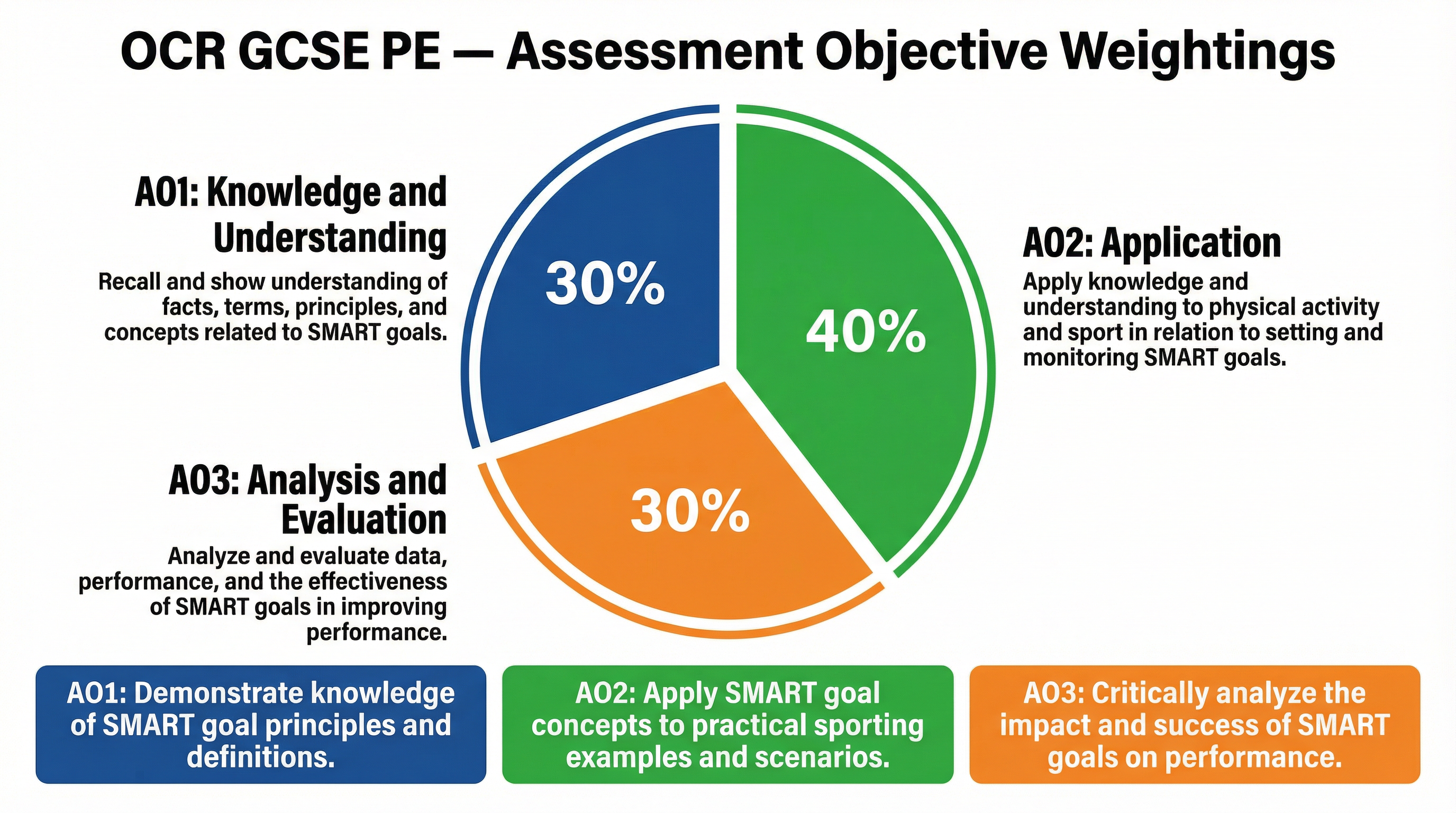
In the written paper, you will be tested on your theoretical knowledge of the SMART principles. Questions will require you to:
- Define each of the SMART principles (AO1).
- Apply the principles to a given sporting scenario (AO2).
- Analyse the strengths and weaknesses of a given goal (AO3).
- Evaluate the importance of goal setting for performance and motivation (AO3).
Practical Exam Preparation
Your practical performance is your final exam. The goals you set throughout your training will directly impact your performance on the day. Leading up to the practical assessment, you should have a clear, timed goal for each of your chosen sports. For example: "To achieve a score of at least 8/10 for my badminton serve technique in the final moderation in May." This gives your training purpose and focus.
Visual Resources
2 diagrams and illustrations
Interactive Diagrams
1 interactive diagram to visualise key concepts
Conceptual Flow Outline
The cyclical process of setting and acting on a SMART goal for a runner.
Worked Examples
3 detailed examples with solutions and examiner commentary
Practice Questions
Test your understanding — click to reveal model answers
Identify the SMART principle that is missing from the following goal: 'I want to improve my long jump distance from 4.50m to 4.75m by the end of the season.'
Hint: Think about how the athlete will track their progress over time.
A swimmer sets a goal to 'get better at swimming'. Describe two reasons why this is not an effective SMART goal.
Hint: Focus on the 'S' and 'M' principles. How could you make this goal more precise and quantifiable?
Create a new, fully SMART goal for the swimmer mentioned in the previous question who wants to 'get better at swimming'.
Hint: Address all five principles: S, M, A, R, T. Be precise with your details.
An elite trampolinist sets a goal to add a triple somersault to their routine, a move no one has ever landed in competition. Evaluate this goal using the SMART principles.
Hint: Focus your evaluation on the 'Achievable' principle and its psychological impact. Is it always good to aim for the impossible?