OCR · GCSE · Physical Education
Skill Execution and Technique
This guide provides a comprehensive overview of Skill Execution and Technique for OCR GCSE Physical Education. It covers the theoretical principles of skill classification and acquisition, alongside practical guidance for analysing performance and succeeding in both written and practical assessments."
- 8 min read
- 3 worked examples
- 4 practice questions
Study Notes

Overview
Welcome to your deep dive into Topic 7.1: Skill Execution and Technique. This topic is fundamental to your success in both Component 01 (the written exam) and Component 03 (your practical performance). Mastering this area means you can not only perform skills with precision but also analyse and deconstruct them like an expert. Examiners are looking for candidates who can bridge the gap between doing (the practical) and understanding (the theory). This guide will equip you with the knowledge and techniques to do just that, helping you secure top marks.

Key Knowledge & Theory
Core Concepts
Understanding how skills are defined, classified, and learned is essential for the written exam. Credit is given for using precise terminology and applying these concepts to specific sporting examples.
**1. Skill Classification:**Skills are not all the same. We classify them using four continua to understand their unique demands. Candidates must be able to place a skill on each continuum and justify their decision.
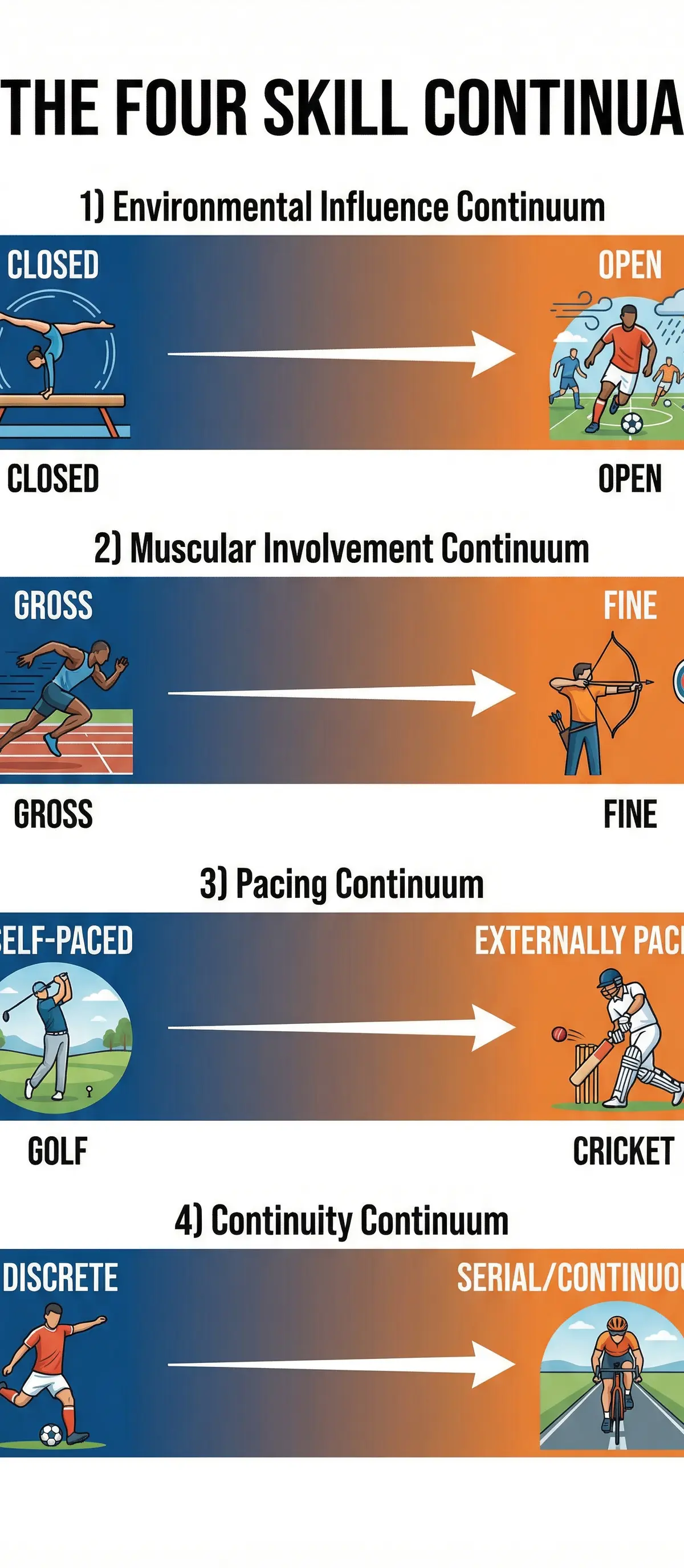
- Environmental Influence (Open/Closed): This continuum considers how much the environment affects the skill. Closed skills are performed in stable, predictable environments (e.g., a gymnastics vault, a basketball free throw). The performer dictates the pace. Open skills are performed in changing, unpredictable environments, requiring the performer to adapt (e.g., a rugby tackle, a pass in football). The environment dictates the pace.
- Muscular Involvement (Gross/Fine): This relates to the size of the muscle groups involved. Gross skills involve large muscle groups and powerful movements (e.g., a rugby tackle, a shot put). Fine skills involve small muscle groups and precise, intricate movements (e.g., an archery release, a dart throw).
- Pacing (Self-paced/Externally-paced): This concerns the timing of the skill. Self-paced skills are controlled by the performer (e.g., a tennis serve, a golf drive). Externally-paced skills are controlled by external factors, such as an opponent or the environment (e.g., returning a tennis serve, a cricket batsman reacting to a bowler).
- Continuity (Discrete/Serial/Continuous): This describes how well-defined the beginning and end of the skill are. Discrete skills have a clear start and finish (e.g., a penalty kick). Continuous skills have no obvious beginning or end and are cyclical (e.g., running, cycling). Serial skills are a series of discrete skills linked together to form a more complex movement (e.g., a triple jump, a gymnastics floor routine).
**2. Information Processing:**Examiners frequently ask questions on this model. It explains how we take in information from our environment and use it to produce a skilled response.
- Input: The performer receives information from their senses (sight, sound, touch). This is often called the display.
- Decision Making: The brain processes this information, compares it to past experiences stored in memory, and selects an appropriate response.
- Output: The brain sends signals to the muscles to carry out the selected response.
- Feedback: The performer receives information about the outcome of their action, both internally (kinaesthesis) and externally (seeing the result, hearing a coach). This feedback is used to adjust future performance.
**3. Practice Structures:**How you practice is just as important as what you practice. Marks are awarded for suggesting and justifying appropriate practice types for different skills and performers.
| Practice Type | Description | Best For... | Sporting Example |
|---|---|---|---|
| Fixed | Repeating the same skill in the same way. | Closed skills, building motor programmes. | A golfer practicing 100 putts from the exact same spot. |
| Variable | Practicing the skill in a variety of different situations. | Open skills, developing decision-making. | A basketball player practicing shots from different positions on the court. |
| Massed | Practicing with very short or no rest intervals. | Simple skills, experienced athletes. | A fit tennis player practicing 50 serves consecutively. |
| Distributed | Practicing with rest intervals included. | Complex or physically demanding skills, beginners. | A beginner learning the triple jump, with rest and coaching feedback between attempts. |
Technical Vocabulary
Using the correct language is a direct route to marks. Integrate these terms into your written answers and AEP.
- Kinaesthesis: The internal feeling or sense of movement and body position.
- Motor Programme: A stored plan of movement in the long-term memory.
- Fluency: The smooth, flowing quality of a movement.
- Biomechanics: The science of movement and the forces acting on the body.
- Plantarflexion: Pointing the toes downwards, away from the shin.
- Dorsiflexion: Bending the foot upwards, towards the shin.
- Lever: A rigid bar (bone) that turns about a fixed point (joint).
Practical Skills
Techniques & Processes
In Component 03, you are assessed on your ability to perform skills under competitive pressure. The key is to demonstrate control, precision, and fluency.
- Preparation Phase: Get your body in the optimal position to start the movement. This might involve foot placement, body alignment, or a pre-movement routine.
- Execution Phase: The main action. This needs to be efficient and technically sound. Focus on the correct sequence of muscle contractions and joint movements.
- Follow-through/Recovery Phase: The movements after the main action. A good follow-through helps to ensure the skill is completed accurately and safely, and prepares you for the next movement.
Portfolio/Coursework Guidance (AEP)
Assessment Criteria
Your Analysing and Evaluating Performance (AEP) task is a major part of your non-examined assessment. Examiners award marks for:
- AO1 (Knowledge): Using correct biomechanical and technical terminology.
- AO2 (Application): Applying your knowledge to a specific performance, explaining the impact of weaknesses.
- AO3 (Analysis/Evaluation): Accurately identifying faults and proposing suitable corrective measures.

Building a Strong AEP
- Choose a Clear Weakness: Don't pick something too complex. Focus on a clear, identifiable technical fault.
- Use the OIEC Framework: Observe, Identify, Explain, Correct. Structure your analysis logically.
- Be Specific: Avoid vague terms like 'bad form'. Instead of saying 'bad shooting technique', say 'insufficient elbow extension at the point of release'.
- Propose Progressive Drills: Your corrective measures should start simple (fixed drills) and build towards the full, competitive skill (variable drills).
Exam Component
Written Exam Knowledge
Component 01 will test your theoretical understanding. Expect questions that require you to:
- Classify a given skill on one or more of the continua.
- Explain the information processing model in the context of a sport.
- Justify the use of a particular practice method for a specific performer.
- Analyse a performance and suggest improvements (a theoretical AEP).
Practical Exam Preparation (Component 03)
- Full Competitive Context: Your video evidence MUST show you performing in a competitive game or situation. Isolated drills will not receive top marks.
- Show the Outcome: Ensure your video shows the result of the skill (e.g., the ball going in the net, the shuttlecock landing in court). Without this, the examiner cannot validate the success of the technique.
- Core vs Advanced Skills: Demonstrate a range of skills. Show that you can perform core skills consistently and that you can execute advanced, more complex skills with precision under pressure."
Worked Examples
3 worked examples — open one to explore the question and available guidance.
Practice Questions
Test your understanding — click to reveal model answers
Identify the two ends of the environmental influence continuum. [2 marks]
Hint: Think about how predictable the setting is.
Describe a sporting example of a serial skill. [3 marks]
Hint: Think of a skill that is a chain of smaller, distinct parts.
Explain why a coach would use variable practice to improve the performance of a hockey player. [4 marks]
Hint: Link the practice type to the demands of the game.
Evaluate the effectiveness of the information processing model in explaining the performance of a skilled athlete compared to a novice. [6 marks]
Hint: Consider how each stage of the model might differ between a beginner and an expert.