WJEC · A-Level · Physical Education
Biomechanical Principles
This guide delves into WJEC A-Level PE Biomechanical Principles (2.3), breaking down the physics of human movement. It focuses on applying core concepts like Newton's Laws, lever systems, and fluid dynamics to sporting contexts to maximise marks in the exam."
- 8 min read
- 3 worked examples
- 4 practice questions
Study Notes
Overview
Welcome to Biomechanical Principles, a critical component of the A-Level Physical Education specification. This topic applies the laws of mechanics and physics to human performance. A strong grasp of biomechanics allows candidates to analyse movement, explain how skills are optimised, and understand the causes of injury. Examiners are looking for your ability to move beyond simple descriptions and provide detailed, evidence-based explanations for why athletes move the way they do. This guide will equip you with the core knowledge, practical application skills, and exam technique required to achieve top marks.
Key Knowledge & Theory
Core Concepts
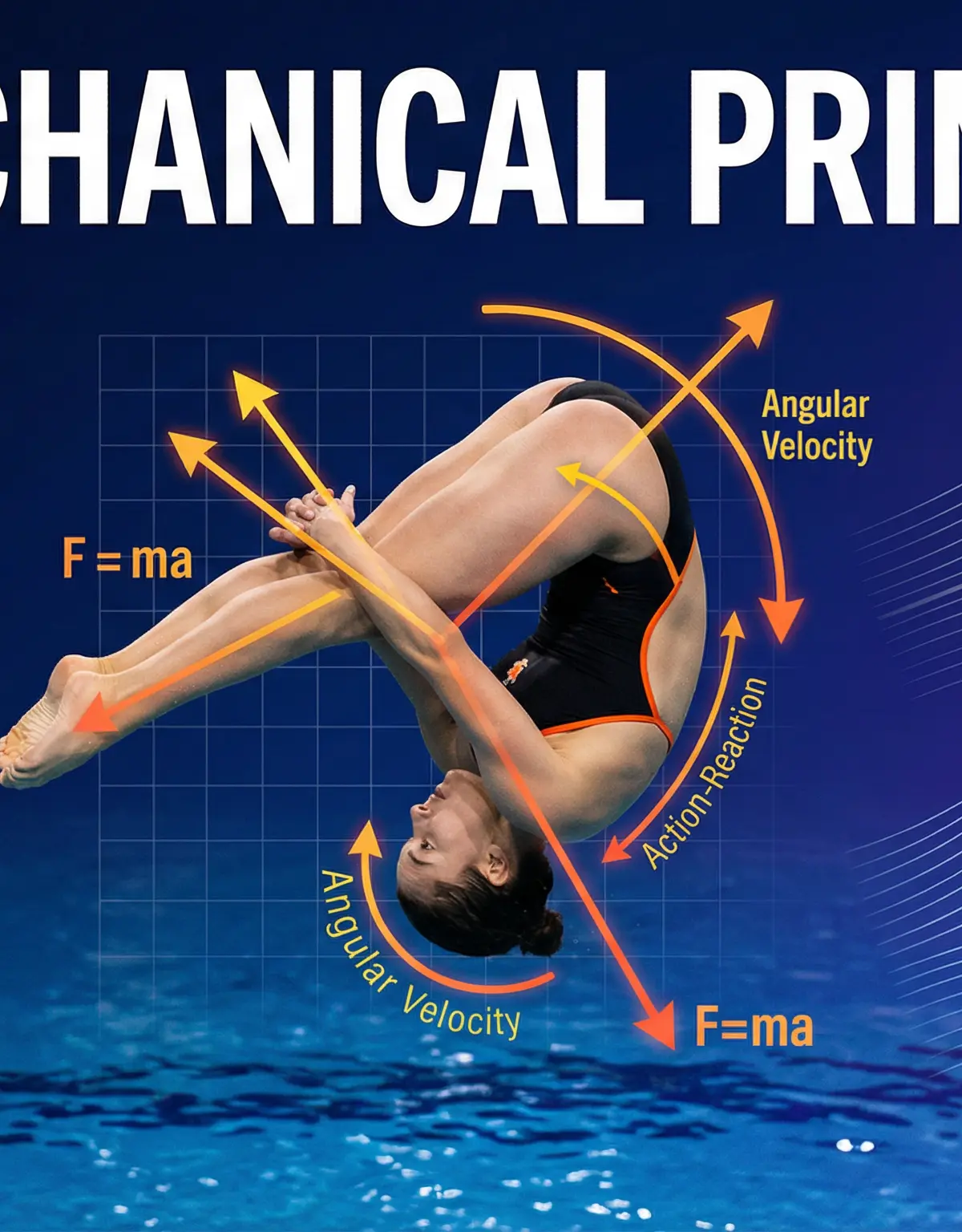
Newton's Laws of Motion: These three laws form the bedrock of mechanics and are essential for analysing any movement.
- Newton's First Law (Law of Inertia): An object will remain at rest or continue in a state of constant motion unless acted upon by an external force. In sport, this explains why a sprinter remains in the blocks until the force from their muscles is applied, or why a curling stone continues to slide across the ice.
- Newton's Second Law (Law of Acceleration): The acceleration of an object is directly proportional to the force causing it and inversely proportional to the mass of the object (Force = Mass x Acceleration). This is the basis for all calculations involving force. For example, a larger force from a shot putter results in greater acceleration of the shot.
- Newton's Third Law (Law of Action-Reaction): For every action, there is an equal and opposite reaction. This is most clearly seen in Ground Reaction Force (GRF), where an athlete pushes down and back on the ground, and the ground pushes them up and forward with an equal force.
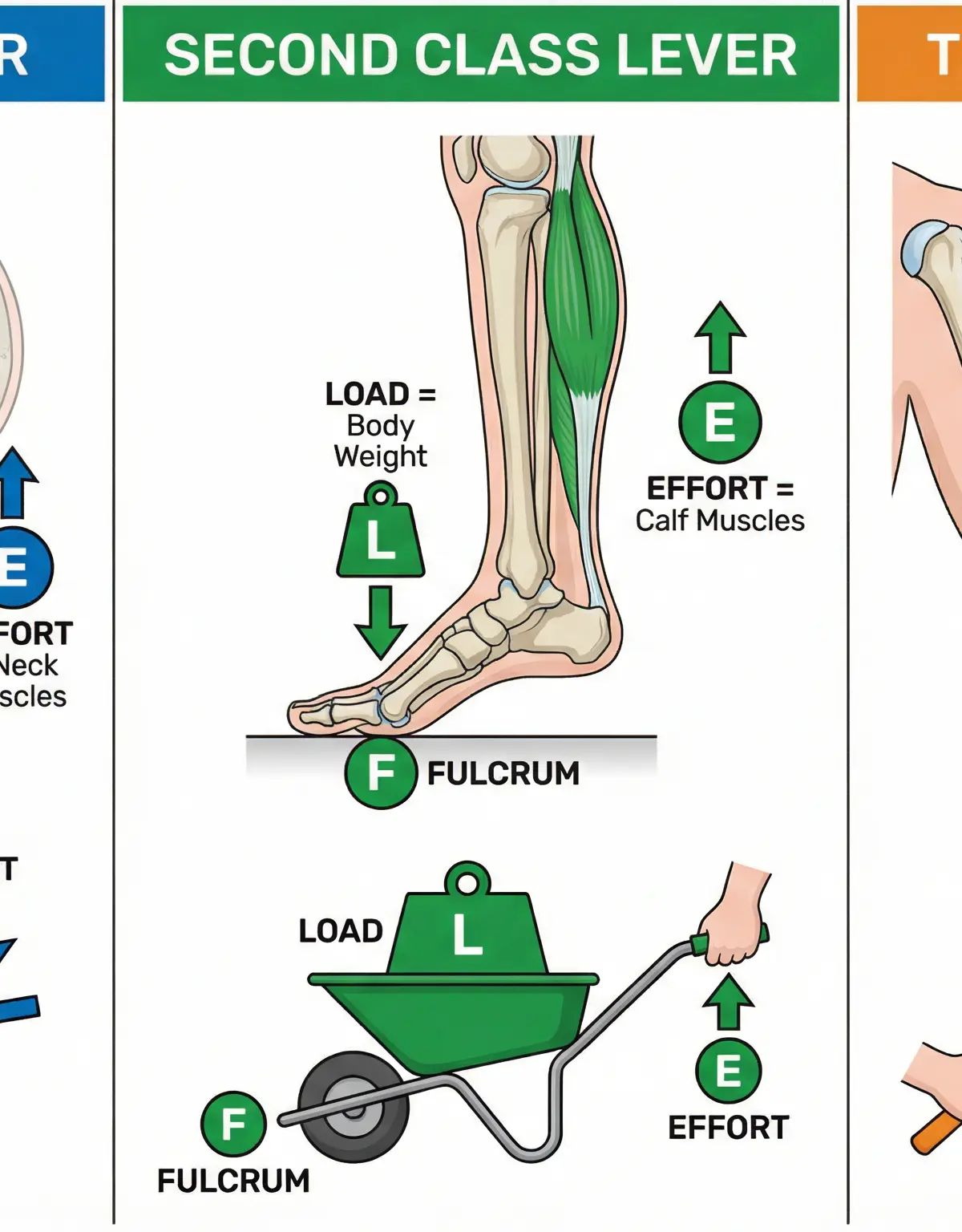
Lever Systems: The human body is a system of levers that create movement. Understanding them is crucial for analysing technique.
- Components: Fulcrum (the pivot, i.e., a joint), Effort (the force applied by muscles), Load (the resistance to be overcome).
- Classes of Lever: See the diagram below for a full breakdown. The key is identifying which component is in the middle.
Linear and Angular Motion: Motion can be in a straight line (linear) or rotational (angular).
- Scalar vs. Vector: Scalar quantities have magnitude only (e.g., speed, distance). Vector quantities have magnitude and direction (e.g., velocity, displacement, force). A common exam trap is to confuse distance (scalar) with displacement (vector).
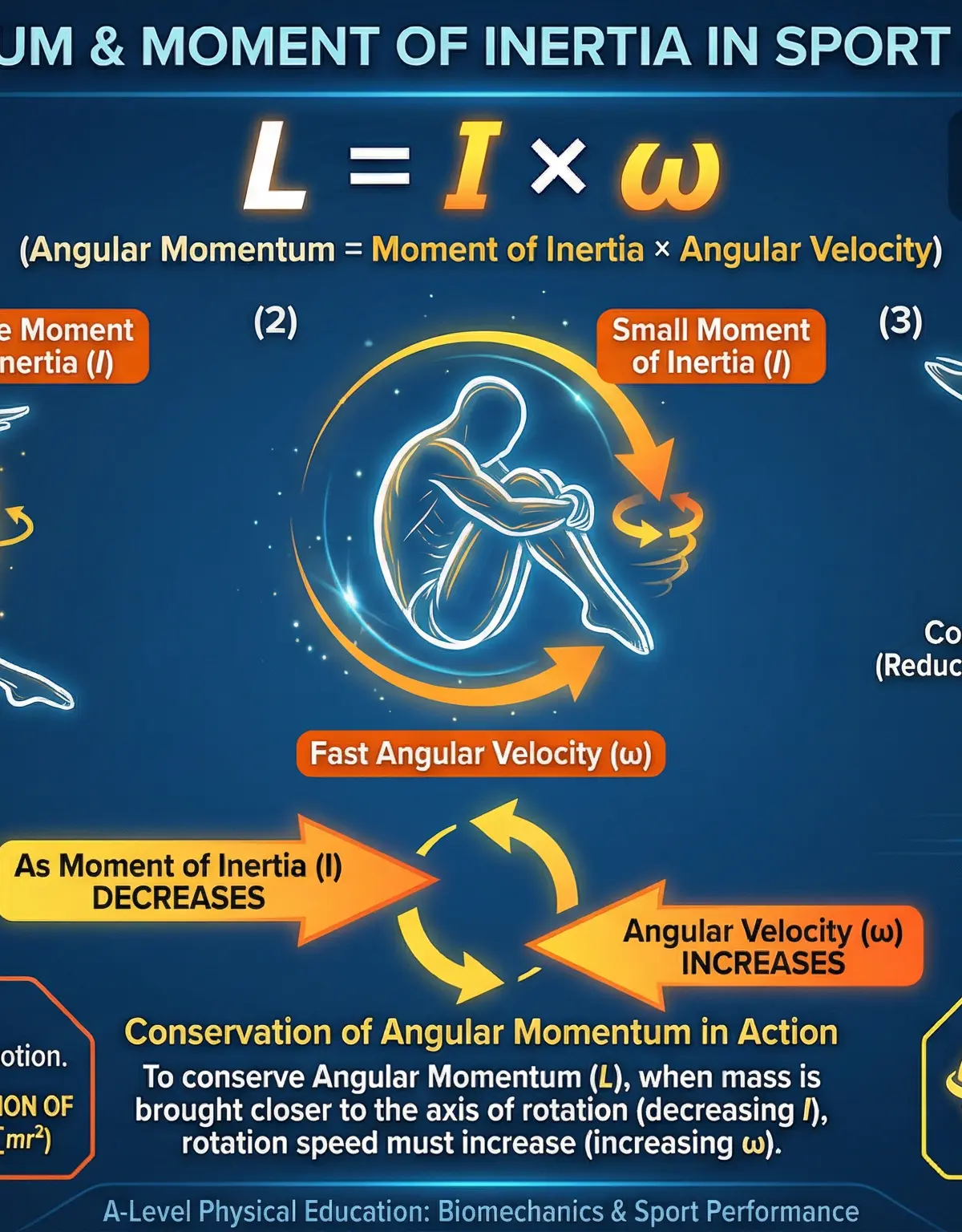
- Angular Motion: Movement around an axis. The key principle is the Conservation of Angular Momentum. Angular Momentum (L) = Moment of Inertia (I) x Angular Velocity (ω). When a performer is airborne (e.g., a diver), their angular momentum is constant. By changing their body shape, they can alter their moment of inertia, which in turn changes their angular velocity.
Fluid Mechanics: This explores the forces acting on a body moving through a fluid (air or water).
- Drag: The force that opposes motion through a fluid. It can be reduced by streamlining (adopting a crouched cycling position) or using specialist equipment (aerodynamic helmets).
- Lift & Bernoulli's Principle: An object can generate lift due to its shape and velocity. Bernoulli's Principle states that where fluid velocity is high, pressure is low, and vice-versa. This pressure differential creates a net force (lift). This is applied in the Magnus Effect, which explains why a spinning ball (e.g., a curling free-kick in football) deviates in flight.
Key Practitioners/Artists/Composers
| Name | Period/Style | Key Works | Relevance |
|---|---|---|---|
| Sir Isaac Newton | 17th Century | Philosophiæ Naturalis Principia Mathematica | Formulated the three Laws of Motion and the law of universal gravitation, which are the foundation of classical mechanics and biomechanics. |
| Archimedes | Ancient Greece | On the Equilibrium of Planes | Developed the principle of levers, famously stating, "Give me a lever long enough and a fulcrum on which to place it, and I shall move the world." |
| Daniel Bernoulli | 18th Century | Hydrodynamica | Outlined the relationship between fluid velocity and pressure, which is fundamental to understanding lift in aerodynamics and hydrodynamics. |
| Giovanni Borelli | 17th Century | De Motu Animalium | Considered the father of modern biomechanics, he was the first to apply the principles of mechanics to analyse animal and human movement. |
Technical Vocabulary
- Inertia: The resistance of any physical object to any change in its state of motion.
- Force: A push or pull upon an object resulting from the object's interaction with another object.
- Vector: A quantity that has both magnitude and direction.
- Moment of Inertia (I): The resistance of a body to angular acceleration. It depends on mass and the distribution of that mass around the axis of rotation.
- Angular Velocity (ω): The rate of change of angular displacement; how fast an object is rotating.
- Ground Reaction Force (GRF): The force exerted by the ground on a body in contact with it.
- Bernoulli's Principle: The principle that for an inviscid flow, an increase in the speed of the fluid occurs simultaneously with a decrease in pressure.
- Magnus Effect: The commonly observed effect in which a spinning ball (or cylinder) curves away from its principal flight path.
Practical Skills
Techniques & Processes
- Qualitative Analysis: The ability to observe a performance and identify the key biomechanical principles at play. This involves breaking down a movement into phases (e.g., preparation, execution, follow-through) and analysing the forces, levers, and motion in each phase.
- Quantitative Analysis: Using measurements and calculations to analyse performance. This includes calculating force (F=ma), velocity (displacement/time), and momentum. Candidates must be comfortable with basic calculations and always remember to include the correct units (N, m/s, kg.m/s).
Materials & Equipment
- Video Analysis Software: Tools like Kinovea or Dartfish allow for frame-by-frame analysis of movement, angle measurement, and velocity tracking. Familiarity with these tools can enhance coursework and understanding.
- Force Plates: Used in elite sport and biomechanics labs to measure Ground Reaction Forces. Understanding what they measure is key to applying Newton's Third Law.
Portfolio/Coursework Guidance
Assessment Criteria
- AO2 (Application): Marks are awarded for correctly applying biomechanical principles to a chosen sporting performance. You must not just state the principle but explain how it affects the outcome.
- AO3 (Analysis & Evaluation): Top-band responses will analyse the relative importance of different principles and evaluate the effectiveness of the technique shown. For example, evaluating whether a change in technique to increase force might compromise speed.
Building a Strong Portfolio
- Annotated Diagrams: Use still images from a video of your performance and overlay them with diagrams showing force vectors, lever systems, and axes of rotation. This provides clear evidence for AO2.
- Data-Driven Analysis: Where possible, include quantitative data. For example, measure your sprint times over 20m with and without starting blocks and use biomechanical principles to explain the difference.
Exam Component
Written Exam Knowledge
- The written paper will test all theoretical concepts. Expect a mix of short-answer questions (e.g., "Define inertia") and extended-answer questions requiring you to analyse a sporting scenario (e.g., "Explain how a gymnast uses the conservation of angular momentum to perform a somersault").
- Calculation questions are common. Ensure you are confident with the F=ma formula and can rearrange it if necessary.
Practical Exam Preparation
- While the practical exam assesses performance, your understanding of biomechanics is crucial for optimising your technique. Use the principles in this guide to analyse and refine your own movements to demonstrate a higher level of technical proficiency.
"
Worked Examples
3 worked examples — open one to explore the question and available guidance.
Practice Questions
Try the question, then reveal an answer plan or example response
Identify the class of lever operating at the ankle during plantar flexion (a calf raise).
Hint: Think about the position of the Load (body weight) relative to the Fulcrum (ball of the foot) and Effort (calf muscle).
A cyclist and their bike have a combined mass of 80kg. They accelerate from rest at 2 m/s². Calculate the net force being applied.
Hint: Use Newton's Second Law: F = m x a.
Explain why a streamlined position is advantageous for a competitive swimmer.
Hint: Discuss the different types of drag and how a streamlined shape affects them.
Analyse how a footballer uses the Magnus effect to score from a curling free-kick.
Hint: This question requires you to apply Bernoulli's Principle to a spinning projectile.
Watch or listen (optional)
Test your understanding of Biomechanical Principles
Active recall beats re-reading. Take an instant quiz now to test what you’ve learned and lock it into long-term memory.
A week of Premium from your first lesson · Then the free plan continues · No card, no charge