Pearson Edexcel · A-Level · Psychology
Cognitive Psychology
This guide provides a comprehensive, exam-focused breakdown of Cognitive Psychology for Edexcel A-Level. It unpacks the core models of memory, key studies, and provides specific techniques to help candidates maximise their marks in AO1, AO2, and AO3 questions.
- 6 min read
- 3 worked examples
- 3 practice questions
- 6 key terms
Study Notes
Overview
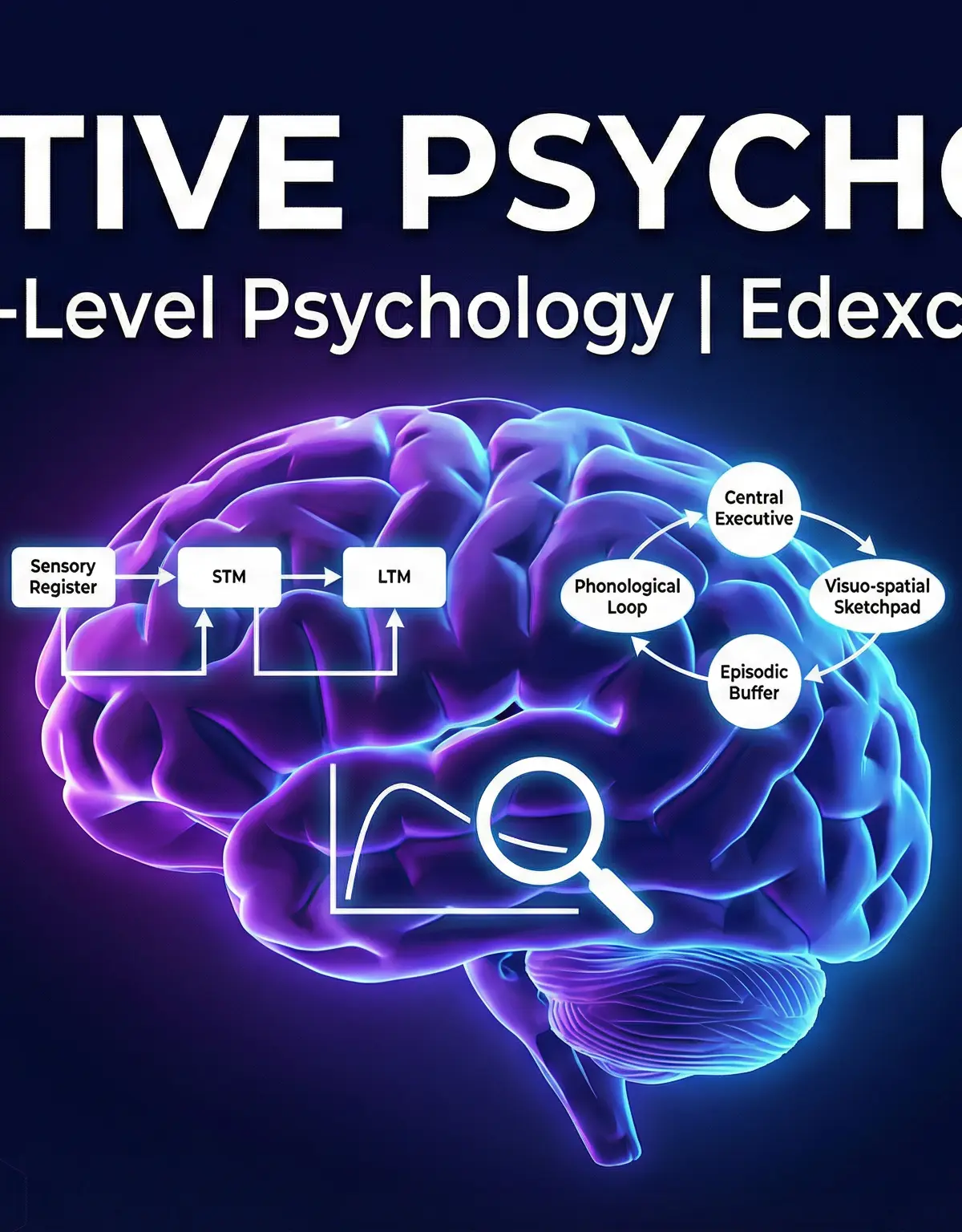
Cognitive Psychology is the scientific study of the mind as an information processor. For the Edexcel A-Level, this topic requires candidates to demonstrate precise knowledge of key memory models, apply this knowledge to novel scenarios, and critically evaluate the theories and research. Examiners expect a firm grasp of the Multi-Store Model (MSM) and the Working Memory Model (WMM) as contrasting explanations of memory architecture. Furthermore, a detailed understanding of Tulving’s types of long-term memory is essential for explaining different memory functions and impairments. The classic study by Baddeley (1966b) provides the foundational evidence for coding differences between STM and LTM, while the contemporary study by Schmolck et al. (2002) offers a neuropsychological perspective on the biological basis of semantic memory. Mastery of this topic involves not just memorising facts, but understanding the scientific process, the limitations of research, and the ongoing debates within the field, such as reductionism versus holism.

Key Theories & Models
The Multi-Store Model of Memory (Atkinson & Shiffrin, 1968)

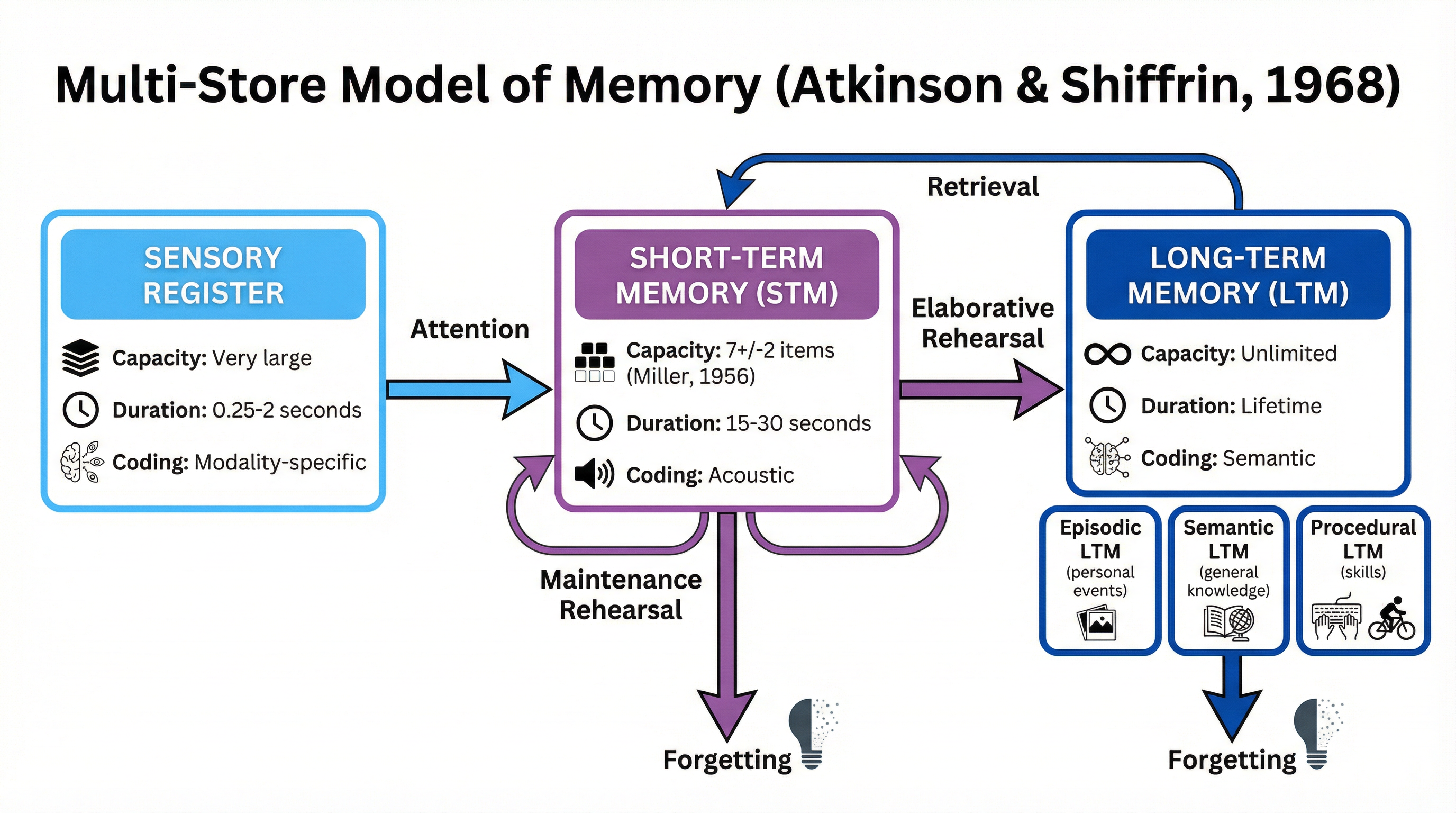
What it is: A structural model proposing that memory consists of three separate, unitary stores through which information flows in a linear sequence.
Why it matters: This was the first major cognitive model of memory and it provides a simple framework for understanding the different characteristics of memory stores. It is a cornerstone of the specification and frequently appears in questions requiring description (AO1) and evaluation (AO3).
Specific Knowledge: Candidates must know the capacity, duration, and coding of each store:
- Sensory Register: Capacity is very large, duration is 0.25-2 seconds, coding is modality-specific.
- Short-Term Memory (STM): Capacity is 7+/-2 items (Miller, 1956), duration is 15-30 seconds, coding is primarily acoustic.
- Long-Term Memory (LTM): Capacity is unlimited, duration is a lifetime, coding is primarily semantic.
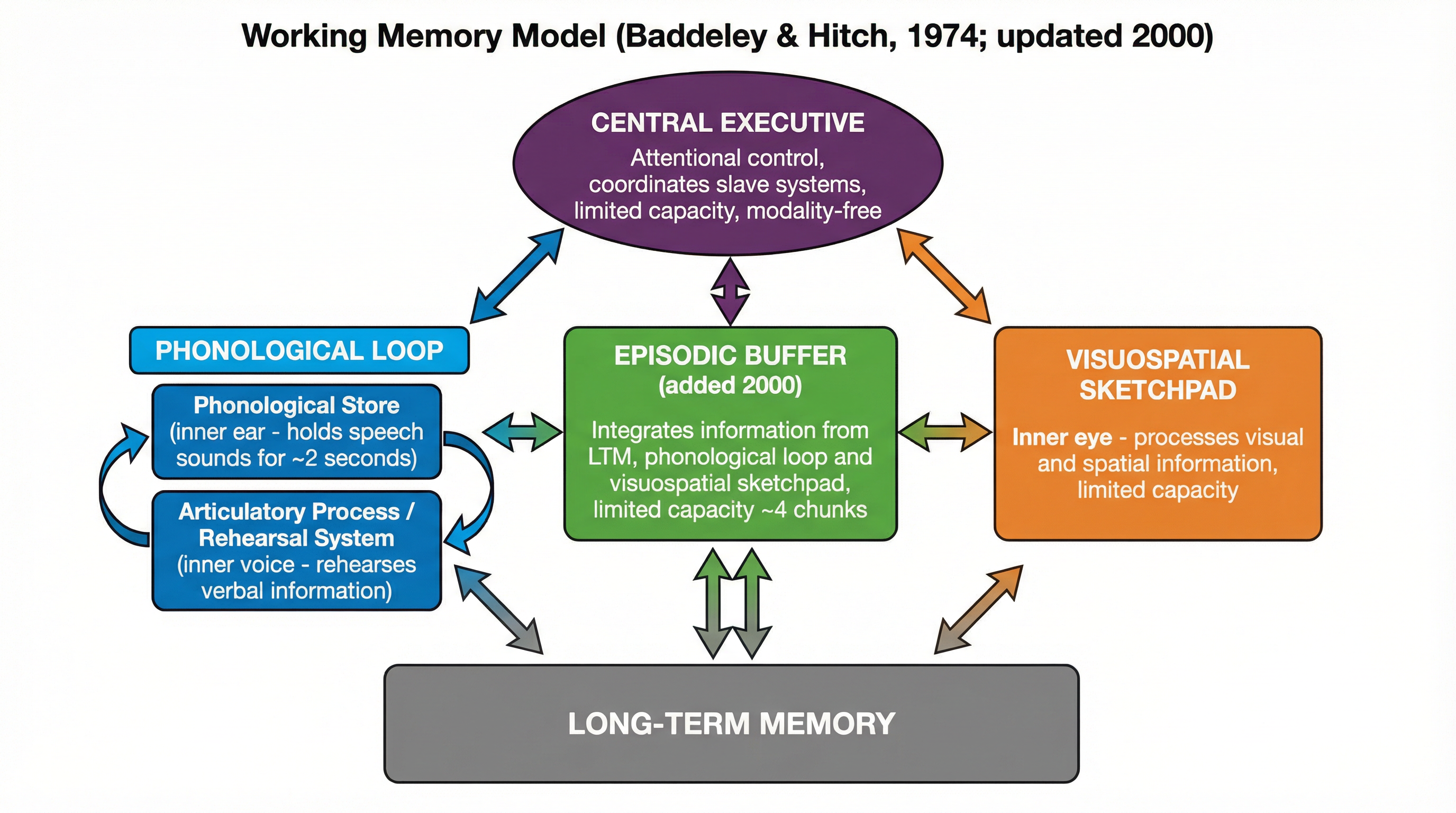
The Working Memory Model (Baddeley & Hitch, 1974)
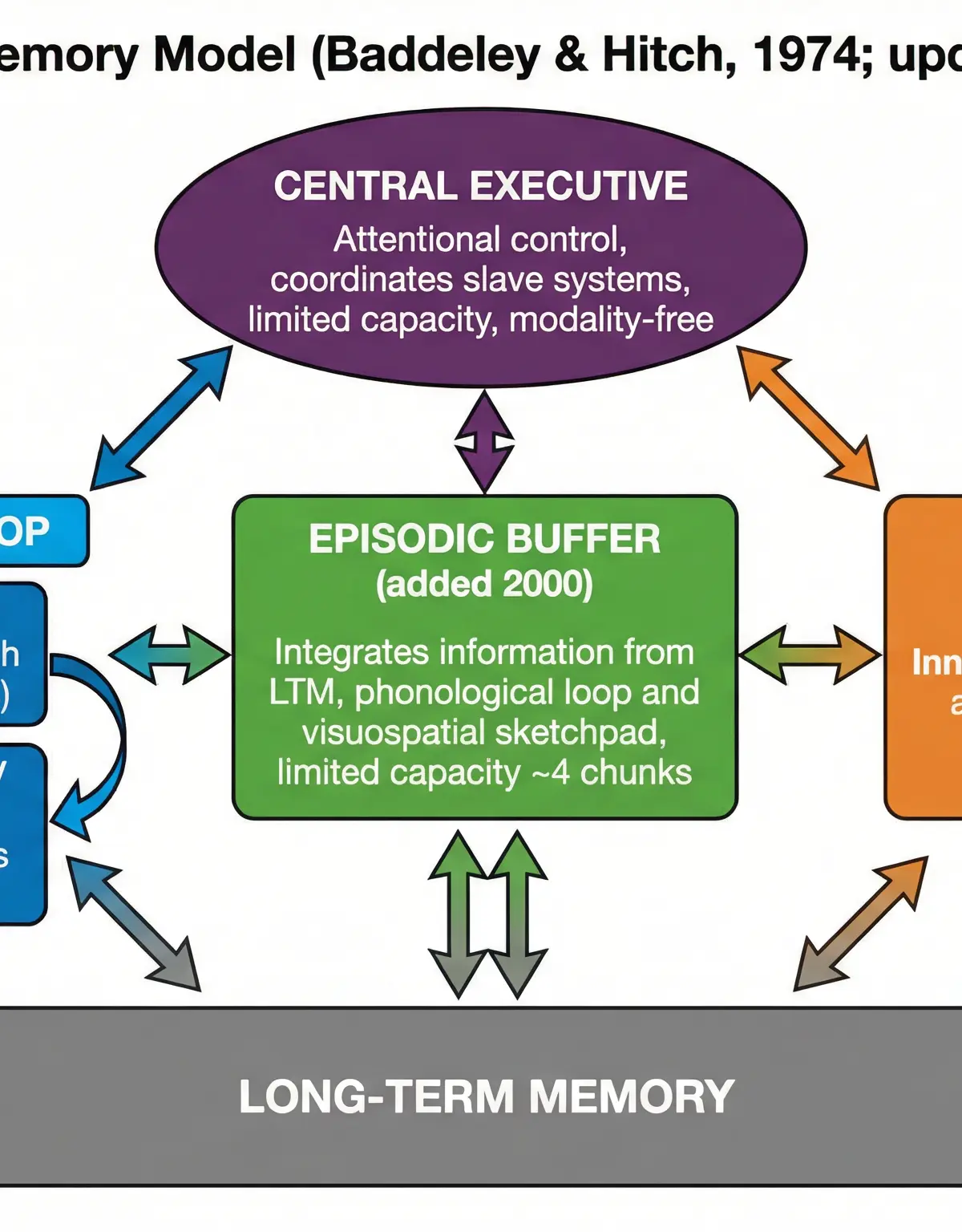
What it is: A model of short-term memory that replaced the idea of a single, passive STM store with an active, multi-component system.
Why it matters: The WMM provides a more detailed and accurate explanation of short-term memory, particularly its active processing capabilities. It is often used in comparison questions with the MSM and for applying to scenarios involving multi-tasking.
Specific Knowledge: Candidates must be able to describe the role of each component:
- Central Executive: The attentional controller. It coordinates the slave systems, has limited capacity, and is modality-free.
- Phonological Loop: Processes auditory information. Consists of the Phonological Store (inner ear) and the Articulatory Process (inner voice).
- Visuospatial Sketchpad: Processes visual and spatial information (the inner eye).
- Episodic Buffer: Added in 2000. Integrates information from all other components and LTM into a coherent episode. It has a limited capacity of about 4 chunks.
Tulving’s Types of Long-Term Memory (1972)
What it is: A theory proposing that LTM is not a single store but is divided into at least three distinct types.
Why it matters: This theory provides a more nuanced understanding of LTM and is crucial for explaining memory loss in patients like H.M. and those with dementia. It is often tested in application (AO2) questions.
Specific Knowledge:
- Episodic Memory: Memory for personal events, like a diary. It is time-stamped.
- Semantic Memory: Memory for general knowledge and facts, like an encyclopedia. It is not time-stamped.
- Procedural Memory: Memory for skills and actions, like how to ride a bike. This memory is implicit (unconscious).
Key Studies
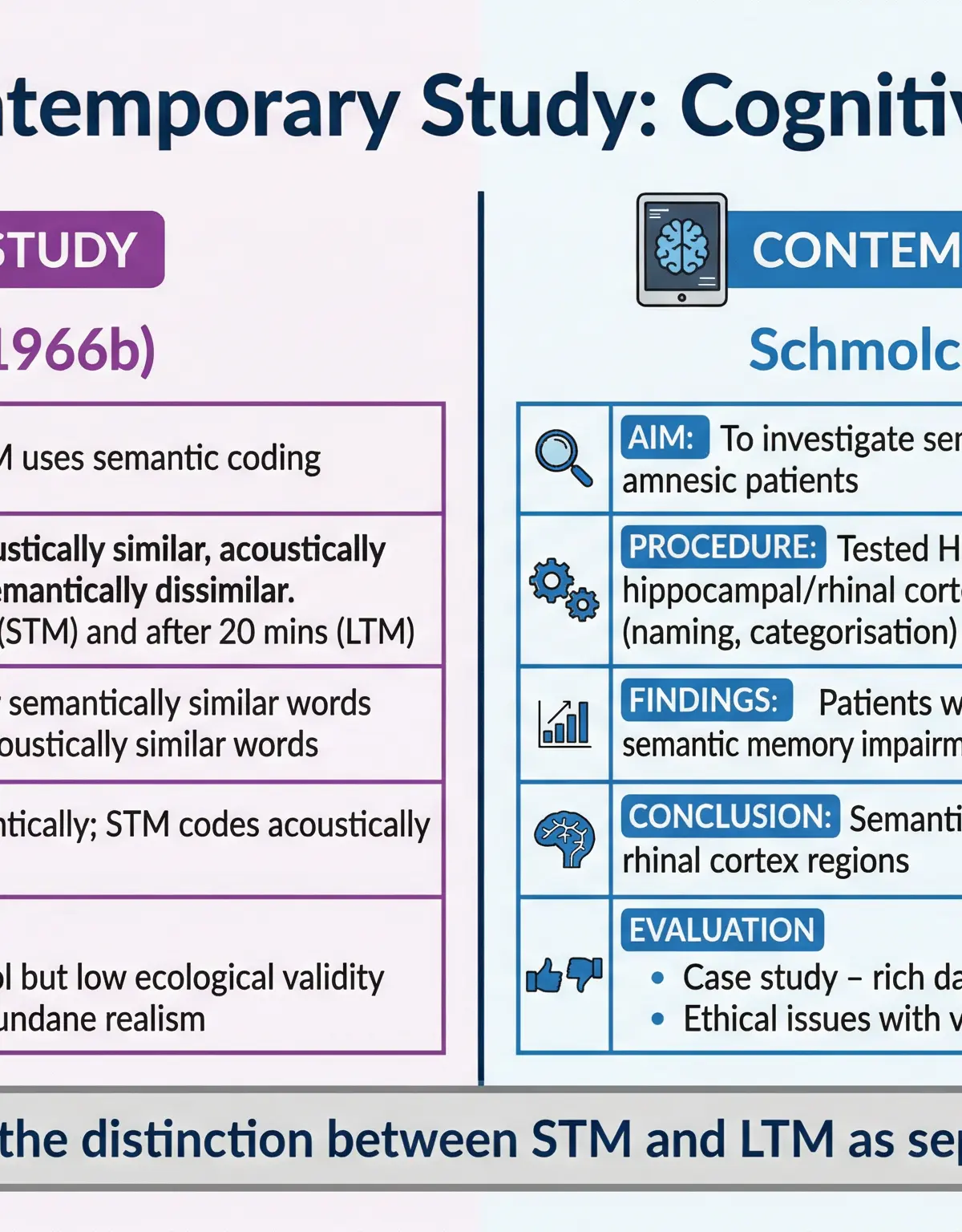
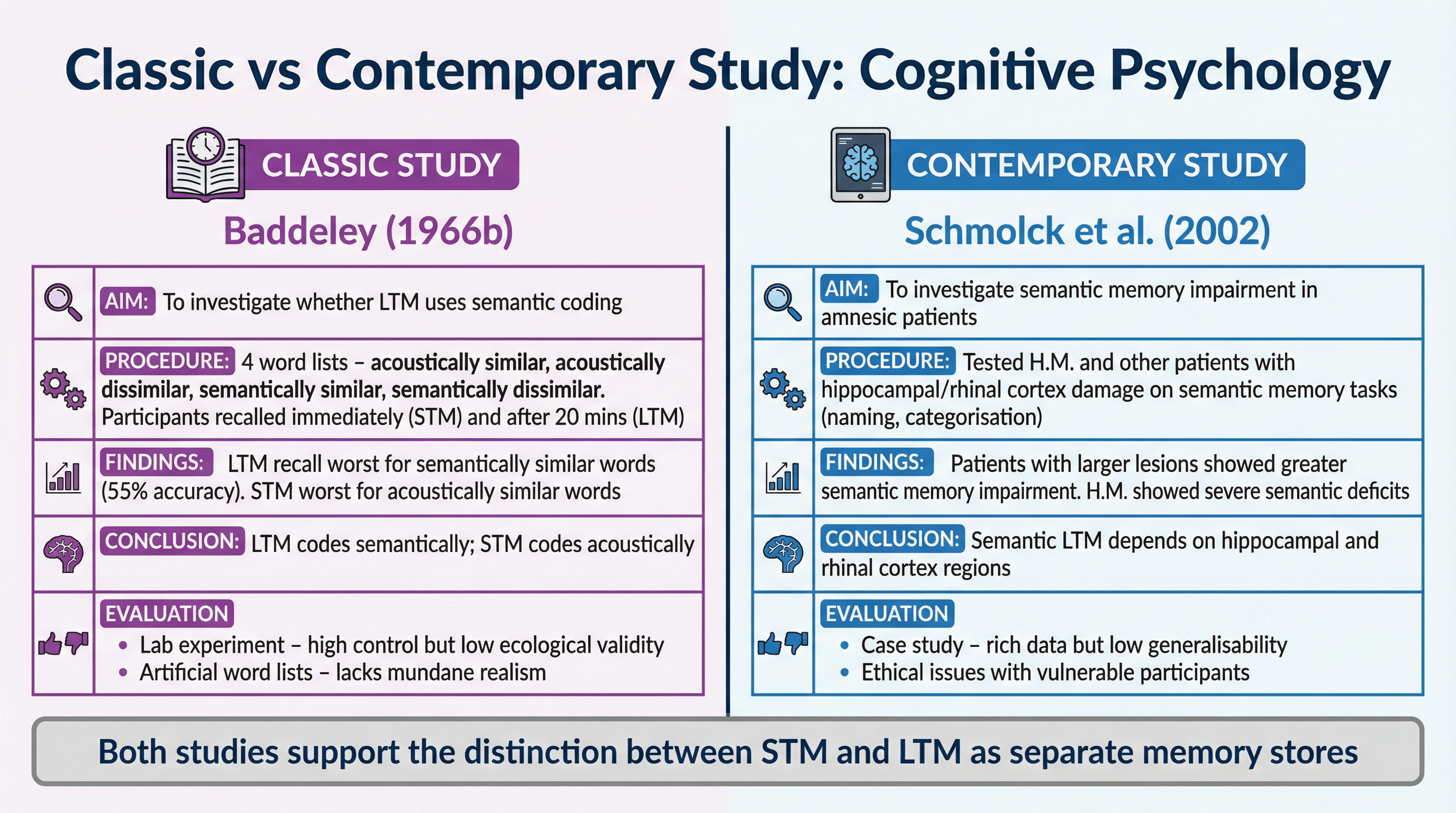
Classic Study: Baddeley (1966b)
Role: To investigate coding in STM and LTM.
Key Actions: Presented participants with four sets of word lists to recall either immediately or after a 20-minute delay: acoustically similar, acoustically dissimilar, semantically similar, and semantically dissimilar.
Impact: The findings—that immediate recall was worst for acoustically similar words, while delayed recall was worst for semantically similar words—provided strong evidence that STM codes acoustically and LTM codes semantically. This supports the MSM's claim of separate memory stores.
Contemporary Study: Schmolck et al. (2002)
Role: To investigate the biological basis of semantic memory.
Key Actions: Studied patients with varying degrees of medial temporal lobe damage, including the famous patient H.M. They were given a series of semantic memory tests.
Impact: The study found a strong correlation between the extent of damage to the hippocampal and rhinal cortex regions and the degree of semantic memory impairment. This provided powerful neuropsychological evidence that semantic memory is linked to these specific brain regions, supporting Tulving’s theory of separate LTM systems.
Visual Resources
3 diagrams and illustrations
Interactive Diagrams
1 interactive diagram to visualise key concepts
Conceptual Flow Outline
Flowchart of the Multi-Store Model of Memory
Worked Examples
3 worked examples — open one to explore the question and available guidance.
Practice Questions
Test your understanding — click to reveal model answers
A witness sees a car speed away from a crime scene. They try to remember the number plate by repeating it to themselves. Explain how the Working Memory Model would account for this process. (4 marks)
Hint: Think about which components of the WMM are involved in visual and verbal information.
Compare the Multi-Store Model with the Working Memory Model as explanations of memory. (16 marks)
Hint: Focus on similarities and differences regarding the structure and function of short-term memory.
Describe and evaluate the classic study by Baddeley (1966b). (12 marks)
Hint: Split your answer roughly 50/50 between description (AO1) and evaluation (AO3). Use GRAVE for evaluation.