OCR · GCSE · Psychology
The Role of Education
Unlock top marks in OCR GCSE Psychology by mastering the theories of Dweck and Willingham. This guide breaks down how mindset and cognitive science shape learning, providing examiner insights and multi-modal tools to turn complex theory into exam success."
- 5 min read
- 3 worked examples
- 5 practice questions
Study Notes
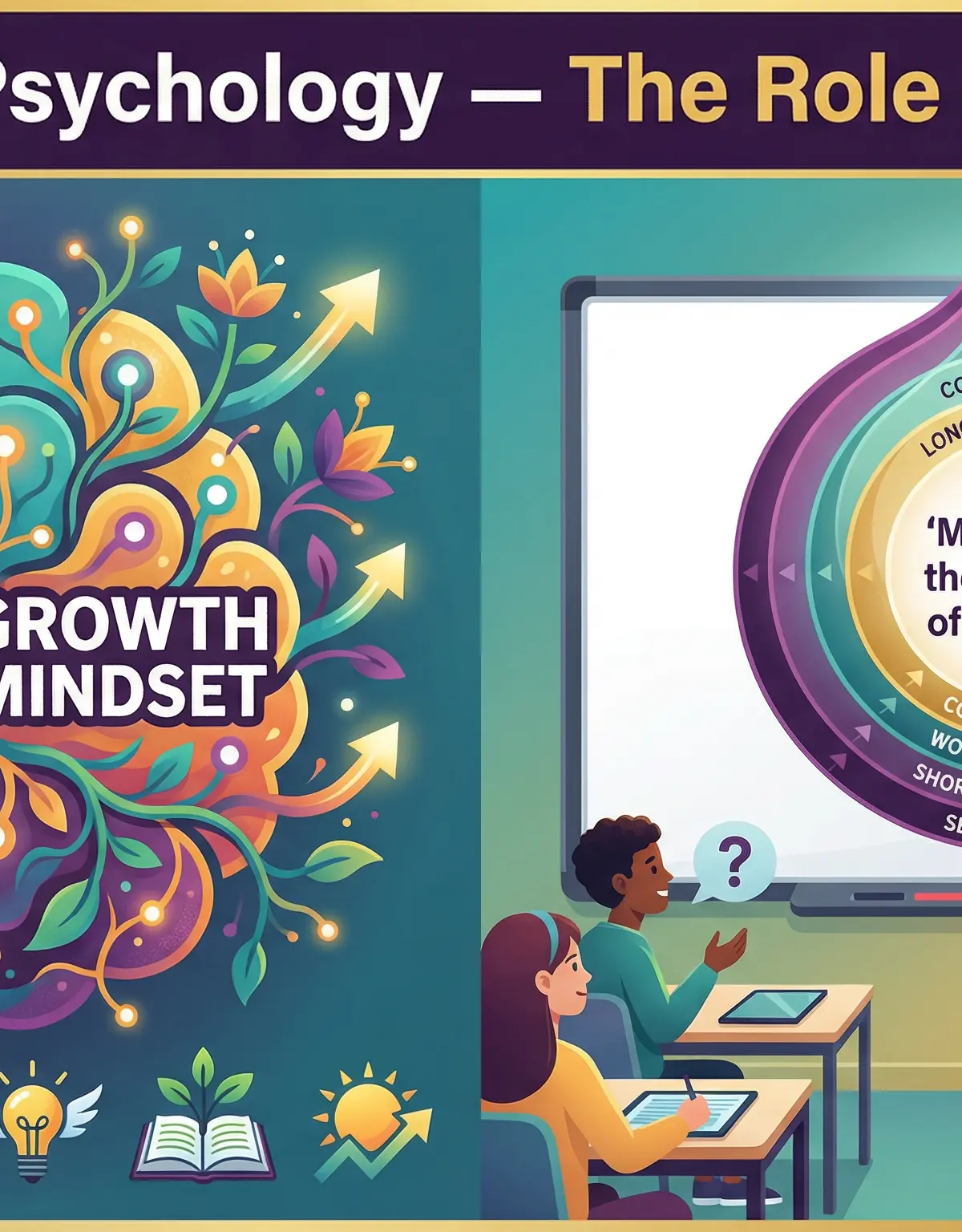
Overview
This study guide focuses on the application of psychological theories to education, a key component of the OCR GCSE Psychology specification (J203), specifically within the 'Development' topic. Examiners expect candidates to demonstrate a robust understanding of two primary theories: Carol Dweck's Mindset Theory and Daniel Willingham's Learning Theory. This is not just about rote learning definitions; it is about applying these concepts to classroom scenarios, critically evaluating their strengths and weaknesses (AO3), and understanding their practical implications for both students and teachers. This topic is significant as it bridges theoretical psychology with real-world practice, and questions often require candidates to analyse a scenario and provide evidence-based recommendations. A strong performance here signals to the examiner that a candidate can think like a psychologist.
Key Individuals & Theories
Carol Dweck: Mindset Theory
Role: A leading researcher in motivation and personality psychology from Stanford University.
Key Actions: Dweck proposed that our beliefs about our own intelligence profoundly impact our motivation and achievement. She identified two core mindsets:
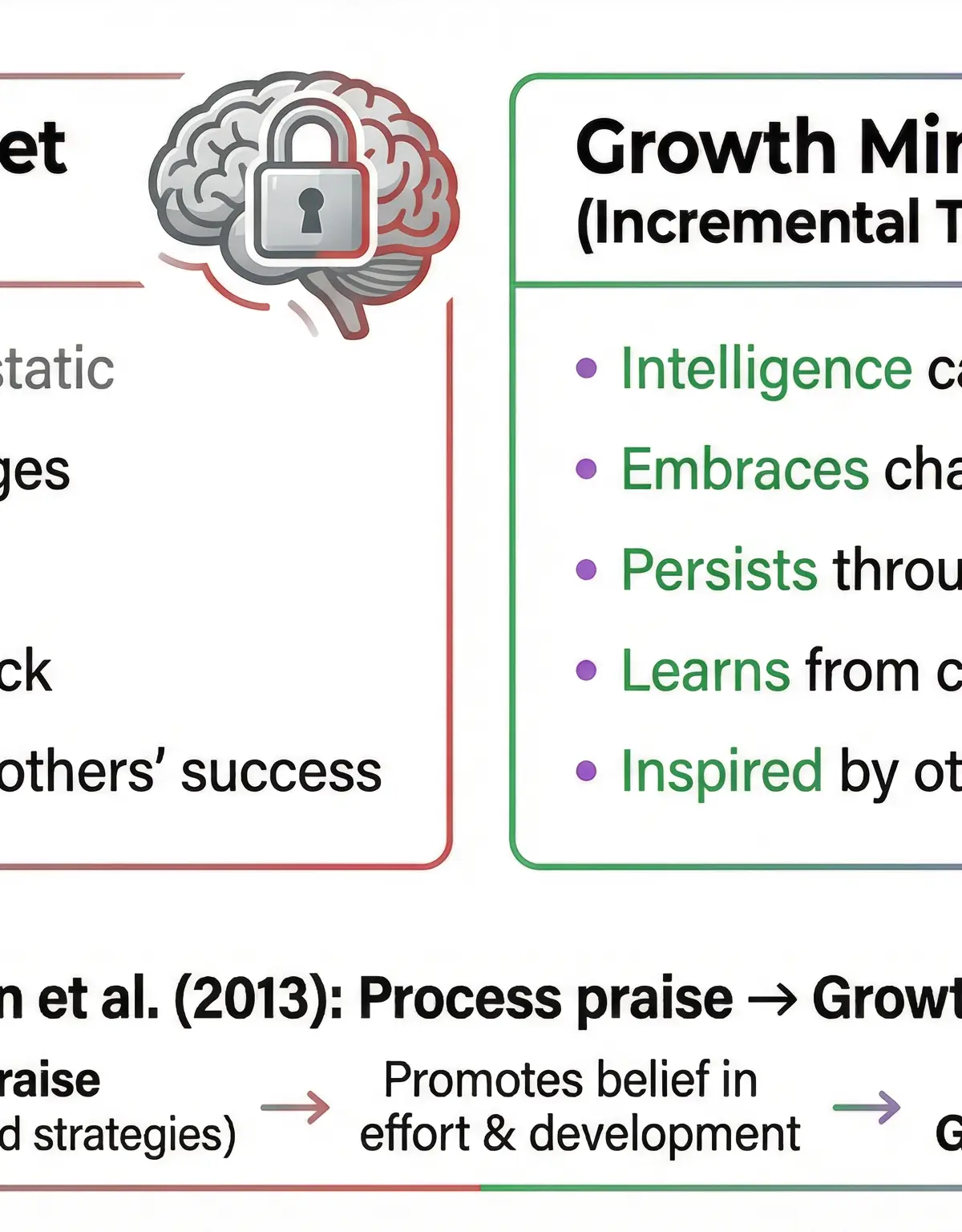
- Fixed Mindset (Entity Theory): The belief that intelligence is a static, unchangeable trait. Individuals with this mindset tend to avoid challenges to prevent potential failure, which they see as a reflection of their innate ability.
- Growth Mindset (Incremental Theory): The belief that intelligence can be developed through effort, effective strategies, and persistence. These individuals embrace challenges as opportunities for learning and growth.
Impact: Dweck's work has heavily influenced educational practices, particularly regarding the use of praise. The distinction between 'person praise' (e.g., "You're so clever") and 'process praise' (e.g., "You worked so hard on that") is critical. Research, such as Gunderson et al. (2013), provides evidence that process praise fosters a growth mindset in children, leading to greater resilience and motivation. For the exam, credit is given for accurately applying this distinction.
Daniel Willingham: Learning Theory
Role: A cognitive scientist and professor of psychology at the University of Virginia.
Key Actions: Willingham applies findings from cognitive science to improve teaching and learning. His key principles include:
- "Memory is the residue of thought": This central idea posits that students remember what they think about meaningfully. Passive activities like re-reading are less effective than active cognitive engagement, such as problem-solving or explaining a concept to someone else.
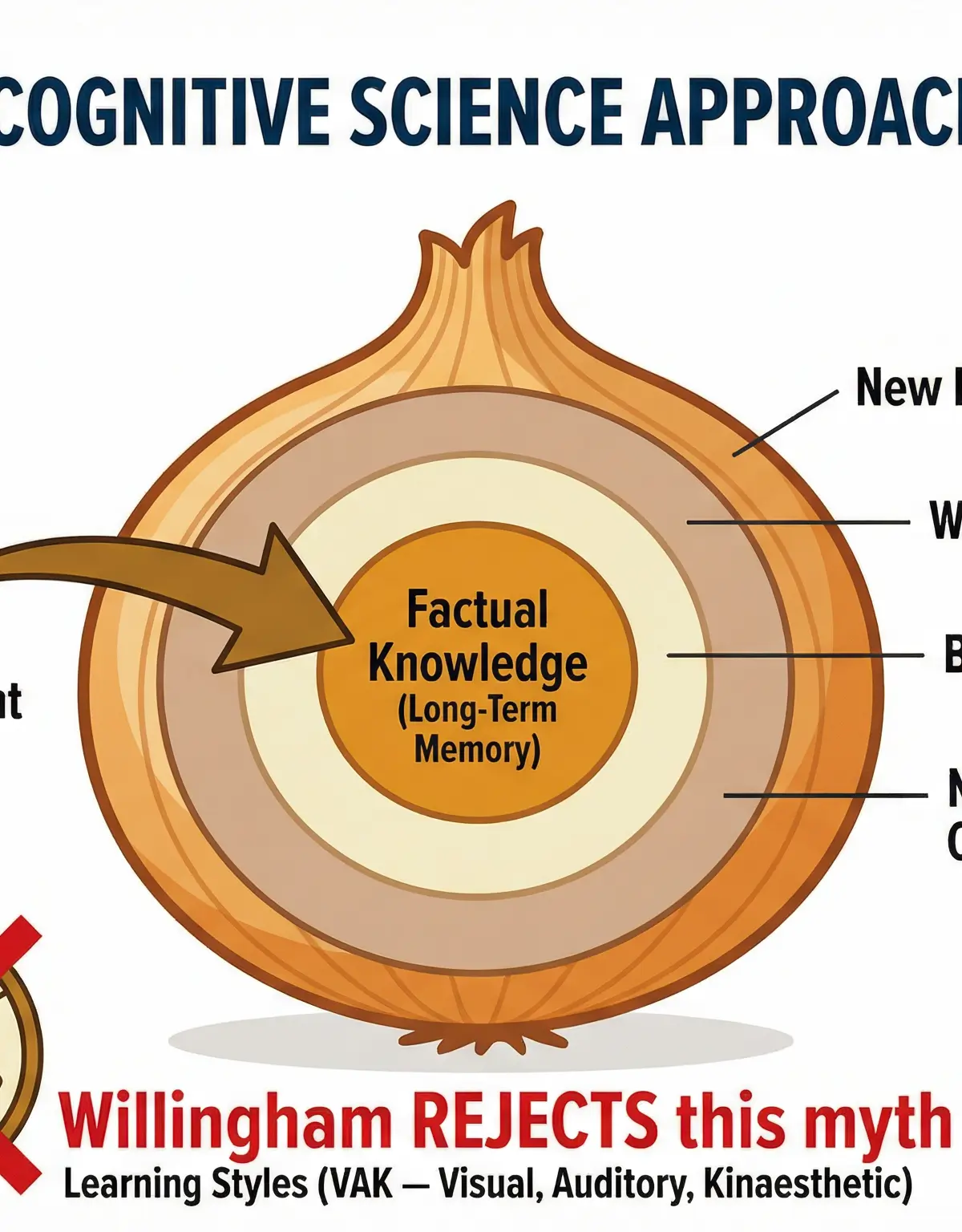
- The Importance of Factual Knowledge: Willingham argues that factual knowledge stored in long-term memory is a prerequisite for higher-order skills like critical thinking and analysis. Without a solid foundation of facts, students lack the necessary context to comprehend and evaluate new information.
- Rejection of Learning Styles: Willingham is a vocal critic of the 'learning styles' (VAK) myth. He argues there is no credible scientific evidence that tailoring instruction to a student's supposed visual, auditory, or kinaesthetic preference improves learning outcomes. Candidates MUST state this rejection to gain full credit for knowledge of his theory.
Impact: Willingham's work encourages teachers to focus on the meaning of content and to build a curriculum that systematically develops factual knowledge. His famous 'onion' analogy illustrates how new learning depends on the layers of background knowledge already in place.
Second-Order Concepts
Causation
- Dweck: The cause of a student's academic resilience or brittleness can be traced to their underlying mindset. This mindset, in turn, is often caused by the type of praise they received from parents and teachers.
- Willingham: Poor academic performance is often caused not by a lack of ability, but by a lack of relevant background knowledge or by teaching methods that do not make students think deeply about meaning.
Consequence
- Fixed Mindset: The consequence is a fear of failure, avoidance of challenges, and a tendency to give up easily, limiting academic potential.
- Growth Mindset: The consequence is persistence, a willingness to embrace challenges, and the ability to learn from feedback, leading to higher achievement.
- Willingham's Approach: The consequence of applying his principles is a classroom focused on building knowledge and ensuring students are cognitively active, which should lead to better long-term retention and understanding.
Change & Continuity
- Change: Dweck's theory prompted a significant change in educational policy, moving away from praising innate ability towards praising effort and process. Willingham's work is driving a change away from skills-based curricula towards knowledge-rich curricula.
- Continuity: The debate about the best way to teach has been continuous for centuries. While these theories offer new perspectives, the fundamental goal of education—to impart knowledge and skills—remains the same."
Worked Examples
3 worked examples — open one to explore the question and available guidance.
Practice Questions
Test your understanding — click to reveal model answers
Describe what is meant by a 'growth mindset'. (4 marks)
Hint: Make two distinct points. What is the core belief, and how does it affect behaviour?
A teacher wants to use Willingham's theory to improve her students' reading comprehension. Explain one way she could do this. (3 marks)
Hint: Think about Willingham's views on factual knowledge.
Evaluate Dweck's mindset theory. (9 marks)
Hint: Use the PEEL structure. Think about supporting evidence (strength) and any potential criticisms or alternative explanations (limitations).
Distinguish between person praise and process praise, using an example for each. (4 marks)
Hint: Define each term and then give a clear, distinct example for both.
Explain why Willingham is critical of the idea of 'learning styles'. (4 marks)
Hint: Focus on the lack of scientific evidence.