OCR · GCSE · Psychology
Forgetting
This study guide delves into the psychology of forgetting, a core topic for OCR GCSE Psychology (J203). It explores why we fail to recall information, focusing on Interference Theory and Context-Dependent Forgetting, and unpacks the crucial Godden and Baddeley (1975) study that examiners love to test."
- 10 min read
- 2 worked examples
Study Notes
Overview
Forgetting is a fundamental aspect of human memory, and for the OCR GCSE Psychology exam, candidates are expected to demonstrate a precise understanding of its theoretical explanations. This guide focuses on two key theories: Interference Theory and Context-Dependent Forgetting. We will explore the distinction between proactive and retroactive interference, and analyse the seminal research by Godden and Baddeley (1975) on the role of environmental cues in memory retrieval. A strong grasp of this material is essential for tackling both short-answer and extended-response questions, as it tests your ability to define, apply, and evaluate psychological concepts. Examiners will award credit for specific knowledge of these theories and for the ability to critique the research that supports them. This topic also provides a foundation for understanding the fallibility of memory, linking to concepts like false memories studied in Loftus and Pickrell (1995).

Key Theories of Forgetting
Interference Theory
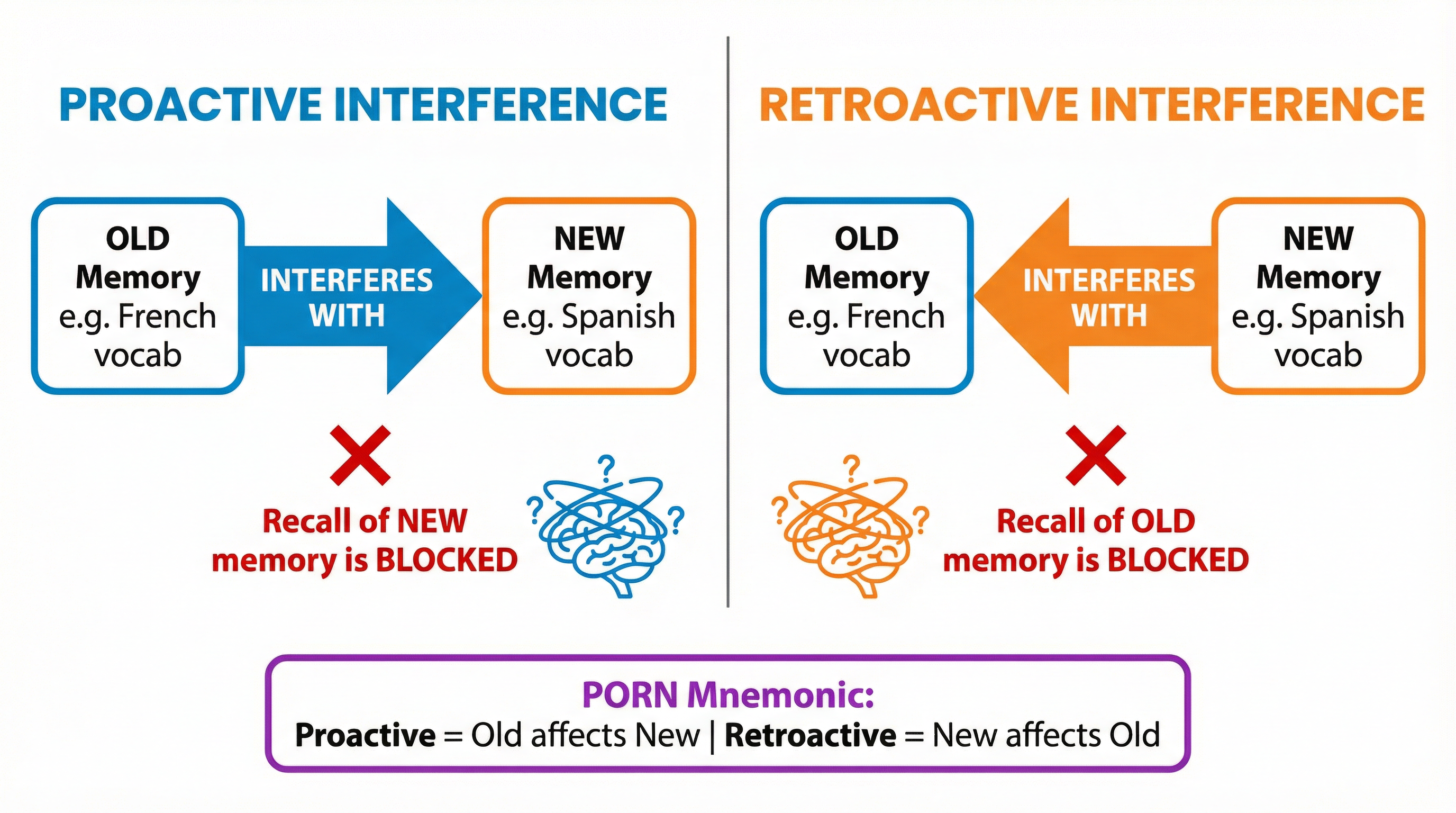
What it is: Interference theory proposes that forgetting occurs when two pieces of information conflict with each other, resulting in one or both memories being distorted or forgotten. It's not that the memory is gone, but that it has become confused with another. This is an explanation based on accessibility failure.
Why it matters: This is a primary explanation for forgetting in long-term memory that the OCR specification requires you to know in detail. You will be expected to distinguish between the two types of interference and apply them to novel scenarios (an AO2 skill).
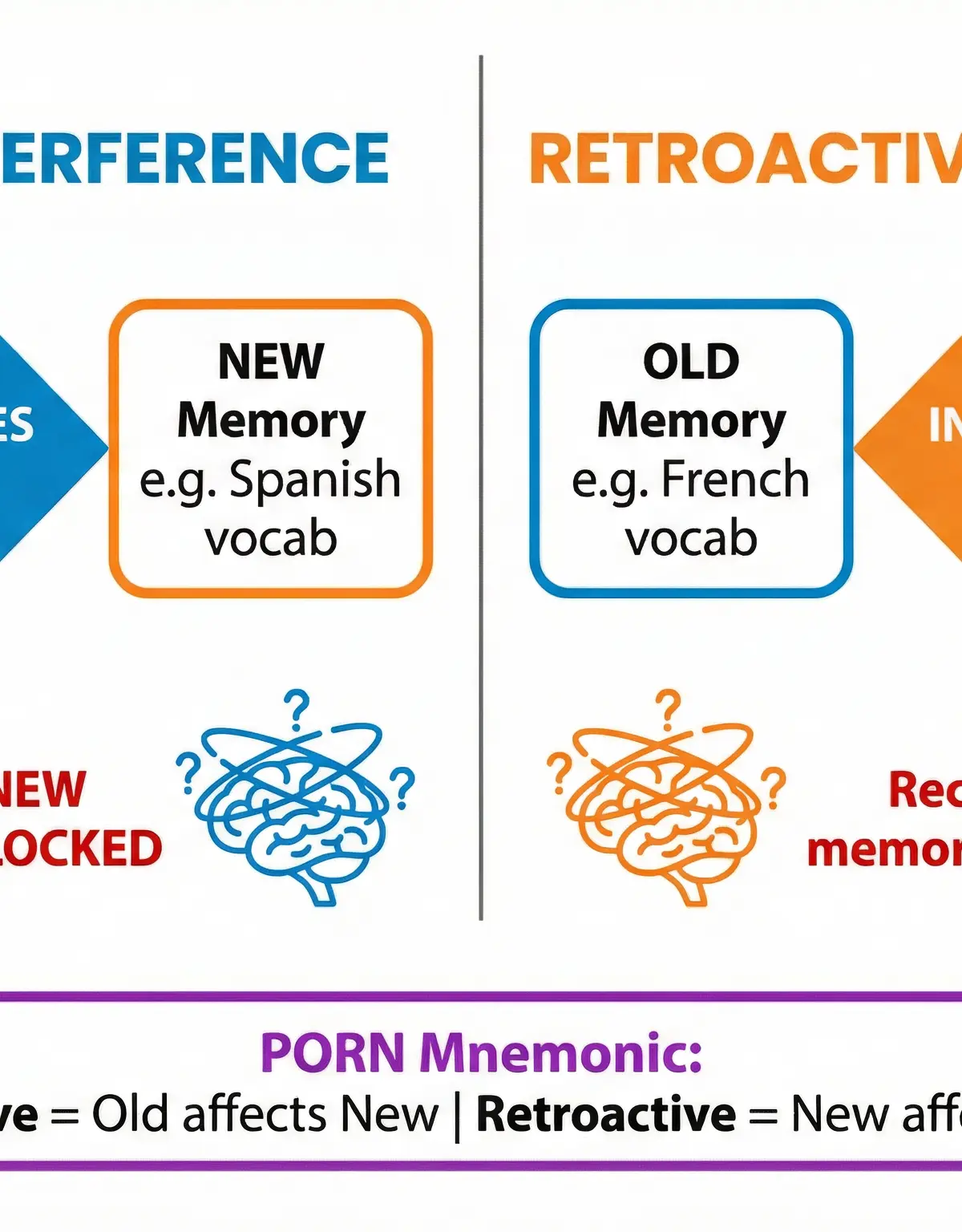
Specific Knowledge: Candidates must be able to define and give examples of both Proactive and Retroactive Interference.
Context-Dependent Forgetting
What it is: This theory states that forgetting occurs when the external environmental cues that were present when a memory was encoded are absent during retrieval. These cues, such as the room, the sounds, or even the weather, act as triggers to help us access the memory.
Why it matters: This is the second major explanation of forgetting you need to know. It highlights the importance of the environment in memory and is supported by a key study you must be able to describe and evaluate in detail.
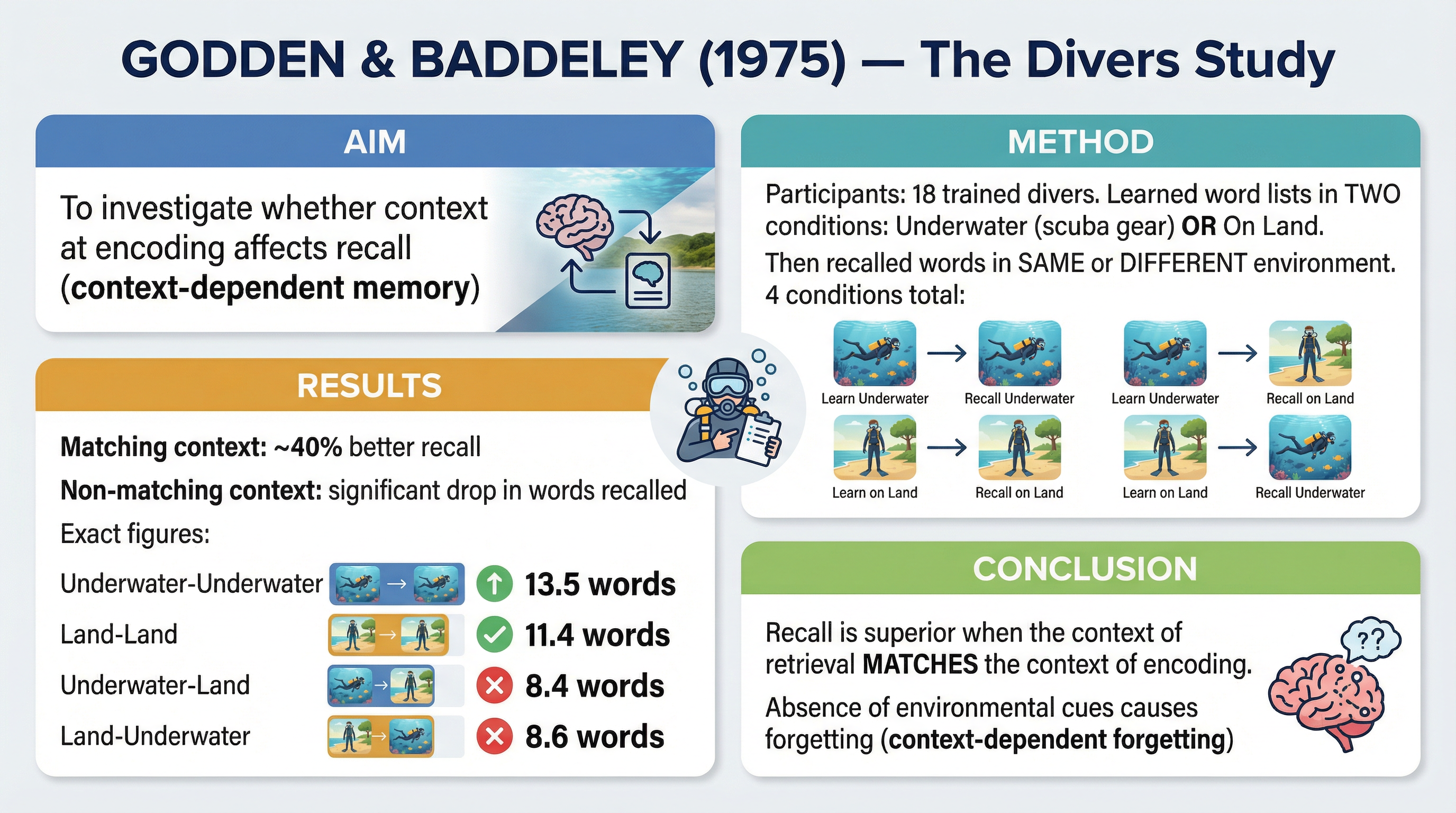
Specific Knowledge: Godden and Baddeley (1975) is the core study. You need to know the aim, method, results, and conclusion of their research with the divers.
Key Individuals & Studies
Godden & Baddeley (1975)
Role: Psychologists who provided key evidence for Context-Dependent Forgetting.
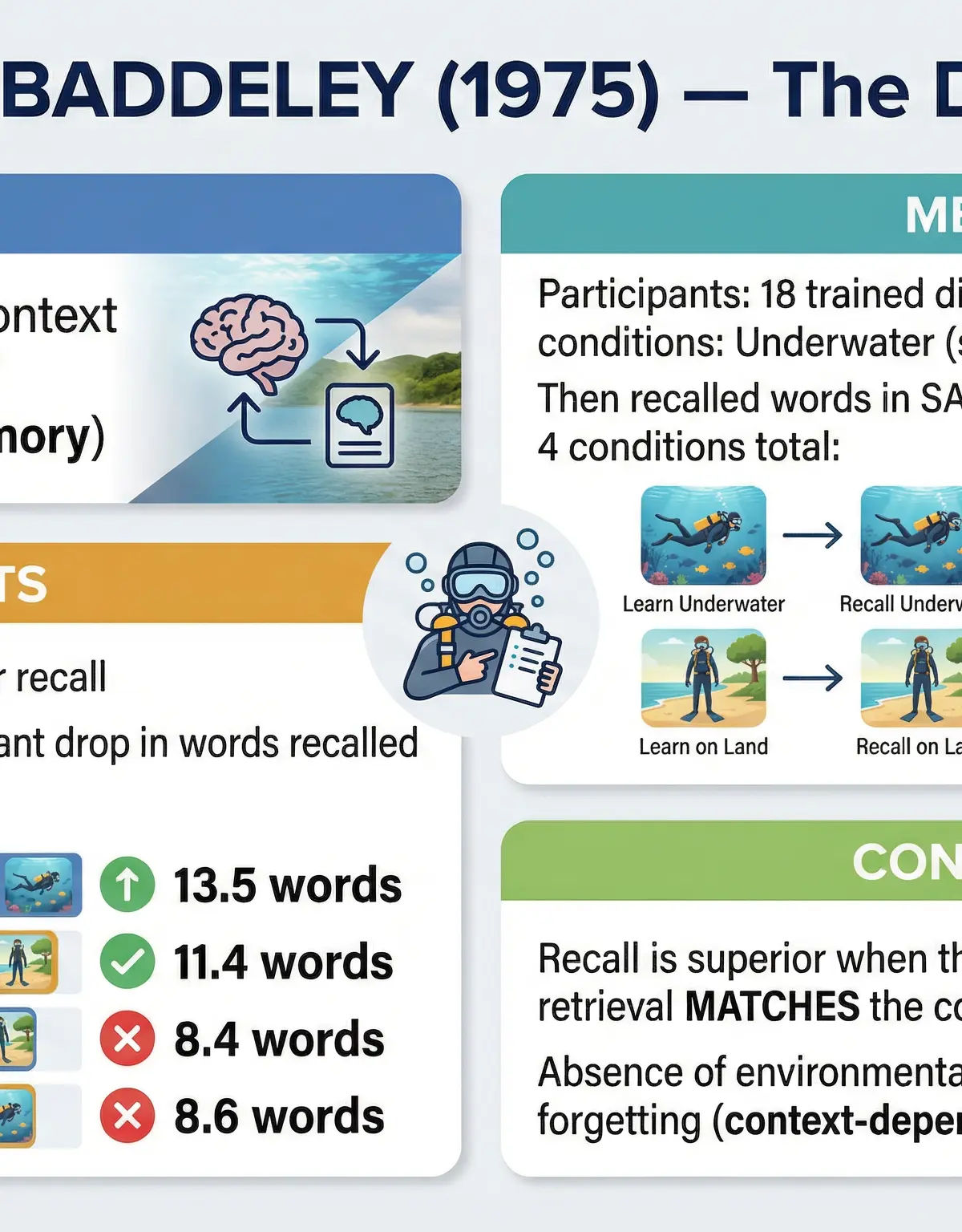
Key Actions: Conducted a study with deep-sea divers who learned and recalled lists of words in different environments (underwater and on land). They found that recall was significantly better when the learning and recall conditions matched.
Impact: Their study is the primary piece of evidence for context-dependent forgetting on the OCR specification. It provides strong support for the idea that external cues are crucial for memory retrieval. Candidates must be able to evaluate this study's methodology, including its strengths (e.g., controlled design) and weaknesses (e.g., artificial task, unrepresentative sample).
Loftus & Pickrell (1995)
Role: Researchers who investigated the creation of false memories.
Key Actions: In their 'Lost in the Mall' study, they demonstrated that it is possible to implant a completely false memory of being lost in a shopping mall into a person's mind. They did this by presenting participants with several true childhood stories alongside one plausible but false story, which was corroborated by a relative.
Impact: While not a direct study of forgetting, it is highly relevant. It shows that memory is not a perfect recording but is reconstructive and fallible. This links to the idea of interference, where memories can become distorted, and provides a powerful counterpoint to the idea that all memories are stored perfectly and just need the right cue. It's a great synoptic link to make in an essay.",
"podcast_script": "# OCR GCSE Psychology - Forgetting: The Ultimate Revision Podcast
Speaker: A knowledgeable and enthusiastic female educator.
(Intro - 1 min)
(Upbeat, engaging music fades in and then fades to background)
Host: Hello and welcome to the ultimate revision podcast for OCR GCSE Psychology! I’m your host, and today we’re diving deep into a topic that, ironically, you’ll want to remember: Forgetting. Ever revised for hours, only to find your mind goes blank in the exam hall? You’re not alone. In the next 10 minutes, we’ll break down exactly why that happens, focusing on the key theories and studies you need to know to smash your exam. We’ll cover interference theory, context-dependent forgetting, and the crucial Godden and Baddeley study. So grab a pen, and let’s get started!
(Core Concepts - 5 mins)
Host: So, why do we forget? Is the information gone forever, or is it just temporarily lost? Psychologists talk about two main ideas: availability versus accessibility. Forgetting isn't always about the memory disappearing completely (an availability issue). More often, it's an accessibility issue – the memory is still stored, but you can't get to it. The OCR spec wants you to focus on two key explanations for this: Interference Theory and Context-Dependent Forgetting.
Let's start with Interference Theory. This is when two memories get mixed up, usually because they are similar. There are two types, and you absolutely must know the difference. The first is Proactive Interference. Think 'pro' as in 'forwards'. This is when an old memory interferes with your ability to recall a new memory. Imagine you've learned French for years, and now you're trying to learn Spanish. You might find yourself accidentally using French words in your Spanish class. The old information (French) is disrupting the new (Spanish).
The second type is Retroactive Interference. Think 'retro' as in 'backwards'. This is the opposite: a new memory interferes with your ability to recall an old one. Let's stick with the language example. After a year of learning Spanish, you might find it difficult to remember the French you learned before. The new information (Spanish) is disrupting the old (French). An easy way to remember this is the mnemonic PORN: Proactive - Old affects New; Retroactive - New affects Old. It's a bit cheeky, but it works!
Now for our second explanation: Context-Dependent Forgetting. This theory suggests that we forget because the external cues present when we learned the information are missing when we try to recall it. Think of it like a filing system. The context – the room, the sounds, the smells – acts like a label on your memory file. If you try to find that file in a completely different library with a different labelling system, you'll struggle.
The key study here, and you must know it inside out, is Godden and Baddeley's 1975 'Divers' study. They wanted to see if this context effect was real. They had 18 divers learn a list of 36 words in one of two environments: either underwater or on a beach. Then, they were asked to recall those words in either the same environment they learned them in, or the opposite one. This created four conditions. The results were clear: recall was nearly 40% higher when the learning and recall context matched! For example, those who learned underwater and recalled underwater remembered significantly more than those who learned underwater and recalled on land. This provides powerful support for the idea that external cues are vital for memory retrieval.
(Exam Tips & Common Mistakes - 2 mins)
Host: Right, let's talk exam technique. This is where marks are won and lost. A huge mistake candidates make is confusing proactive and retroactive interference. Use the PORN mnemonic we talked about. Write it down, drill it in. Another common error is mixing up 'context-dependent' forgetting with 'state-dependent' forgetting. State-dependent is about your internal state, like being drunk or sober. The OCR spec focuses on context, so stick to external, environmental cues like in the divers study.
When you're evaluating, be specific. Don't just say the divers study 'lacks ecological validity'. Explain why. Say something like: "The artificial task of learning and recalling word lists is not representative of how we use memory in everyday life, which limits the generalisability of the findings." Also, critique the sample. Can we really generalise the findings from 18 divers to the entire population? Probably not. For those big 13-mark 'Discuss' questions, you need a balanced argument. That means AO1 (description), AO2 (application), and AO3 (evaluation). A good structure is to describe the theory, apply it to a scenario, and then evaluate its strengths and weaknesses.
(Quick-Fire Recall Quiz - 1 min)
Host: Okay, time for a quick-fire quiz to get that retrieval practice in! I'll ask a question, pause for a second, and then give you the answer. Ready?
- What is it called when old information disrupts new information?
(pause) Proactive Interference. - Who were the participants in the 1975 context-dependent forgetting study?
(pause) 18 deep-sea divers. - What's the mnemonic to remember the two types of interference?
(pause) PORN: Proactive-Old-Retroactive-New. - True or False: Godden and Baddeley found that recall was better when the context matched.
(pause) True. - Forgetting because the environmental cues are missing is known as...?
(pause) Context-dependent forgetting.
How did you do? If you got them all right, fantastic! If not, just rewind and listen again.
(Summary & Sign-off - 1 min)
Host: So there we have it! We've covered the two main explanations of forgetting you need for your OCR exam: Interference Theory, with its proactive and retroactive types, and Context-Dependent Forgetting, supported by the classic Godden and Baddeley divers study. We've also looked at how to avoid common pitfalls and structure your exam answers for maximum marks.
Remember, the key to success is active recall, not passive reading. Test yourself, explain these concepts to a friend, and apply them to new scenarios. Thanks for listening to the ultimate revision podcast. Keep up the hard work, and good luck in your exams!
(Upbeat, engaging music fades in and then fades out)"
Worked Examples
2 worked examples — open one to explore the question and available guidance.