OCR · GCSE · Psychology
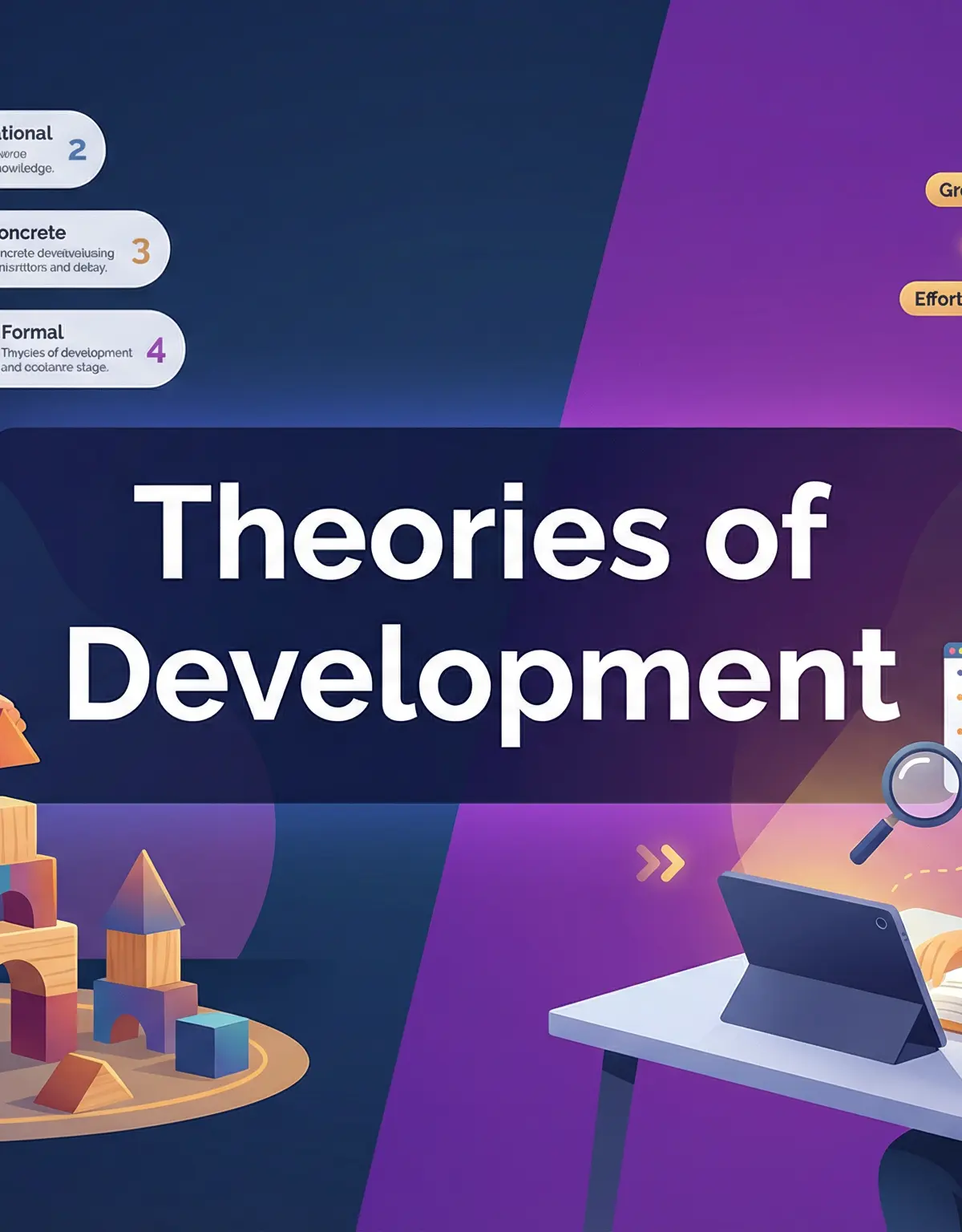
Theories of Development
This guide provides a comprehensive, exam-focused breakdown of key developmental theories for OCR GCSE Psychology. It covers Piaget's stages, Dweck's mindset theory, and Willingham's learning principles, complete with critical analysis of core studies like Piaget (1952) and Gunderson et al. (2013)."
- 18 min read
- 2 worked examples
- 2 practice questions
Study Notes
Overview
This study guide focuses on the core theories of development required for the OCR GCSE Psychology specification. Candidates are expected to demonstrate a detailed understanding of how our cognitive abilities and learning frameworks develop from infancy through to adolescence. The guide will deconstruct Jean Piaget's influential stage theory of cognitive development, exploring how concepts like object permanence, egocentrism, and conservation are acquired. We will then analyse the application of Carol Dweck's Mindset Theory and Daniel Willingham's Learning Theory to educational contexts, a key area for AO2 application marks. Finally, the guide provides a critical review of the methodologies and findings of two seminal studies: Piaget's (1952) work on conservation and Gunderson et al.'s (2013) research into the effects of parental praise. Examiners expect candidates to not only describe these theories (AO1) but also to apply them to novel scenarios (AO2) and evaluate their strengths and weaknesses with specific terminology (AO3).

Key Theories & Individuals
Jean Piaget: Theory of Cognitive Development
Role: A Swiss psychologist whose theory revolutionised our understanding of how children's minds develop.
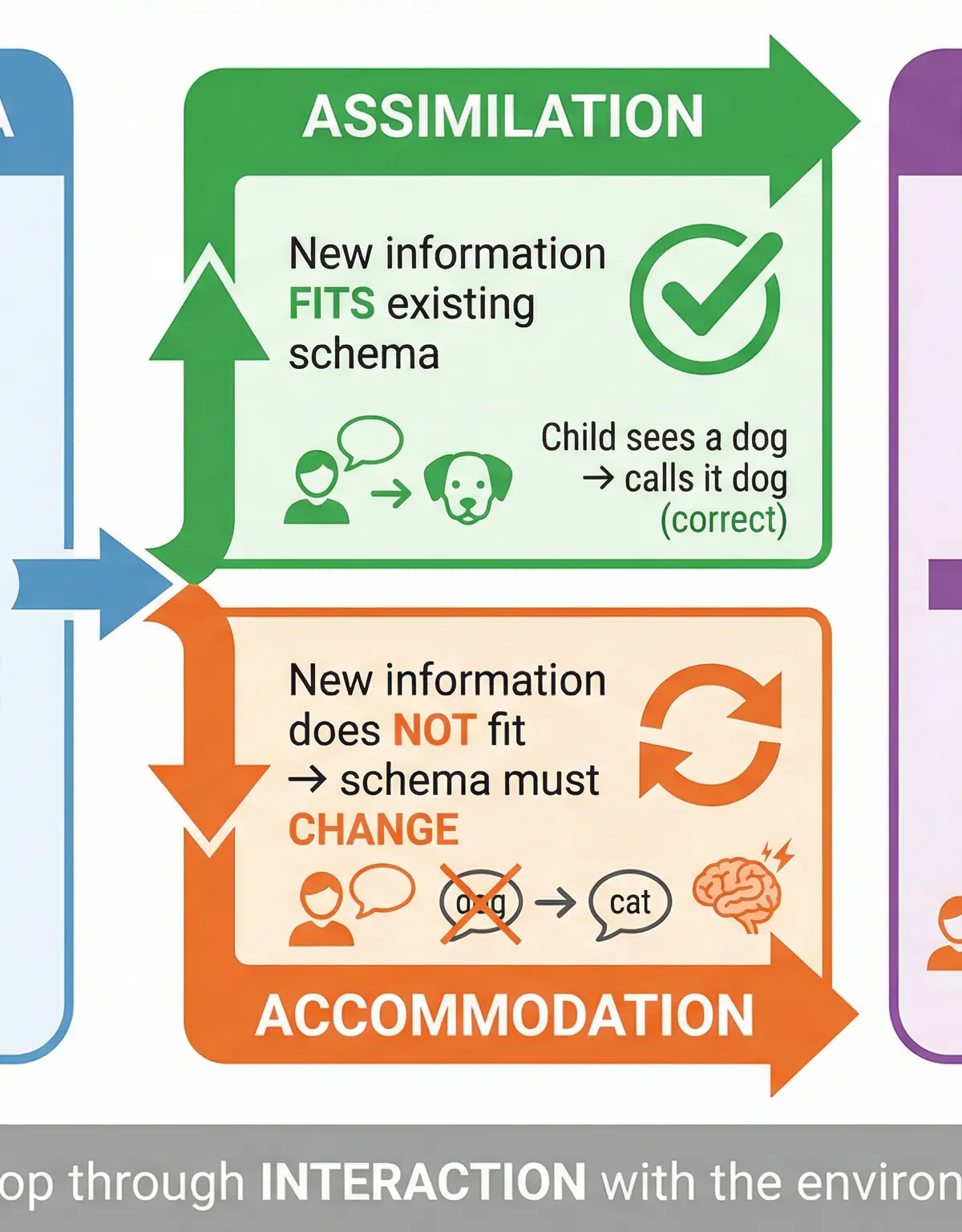
Key Concepts: Piaget proposed that children progress through four universal and invariant stages of cognitive development. Development is driven by the process of equilibration, where a child seeks a state of cognitive balance. This involves building mental frameworks, or schemas, through interaction with the environment. New information is either incorporated into existing schemas (assimilation) or requires the schema to be modified (accommodation).
Impact: Piaget's work shifted the view of children from passive learners to active 'scientists' who construct their own knowledge. His theories have had a profound impact on educational practices, emphasising discovery learning and readiness.
Piaget's Four Stages of Cognitive Development
- Sensorimotor Stage (0-2 years): The infant learns through senses and actions. Key achievement is object permanence – the understanding that objects exist even when not visible.
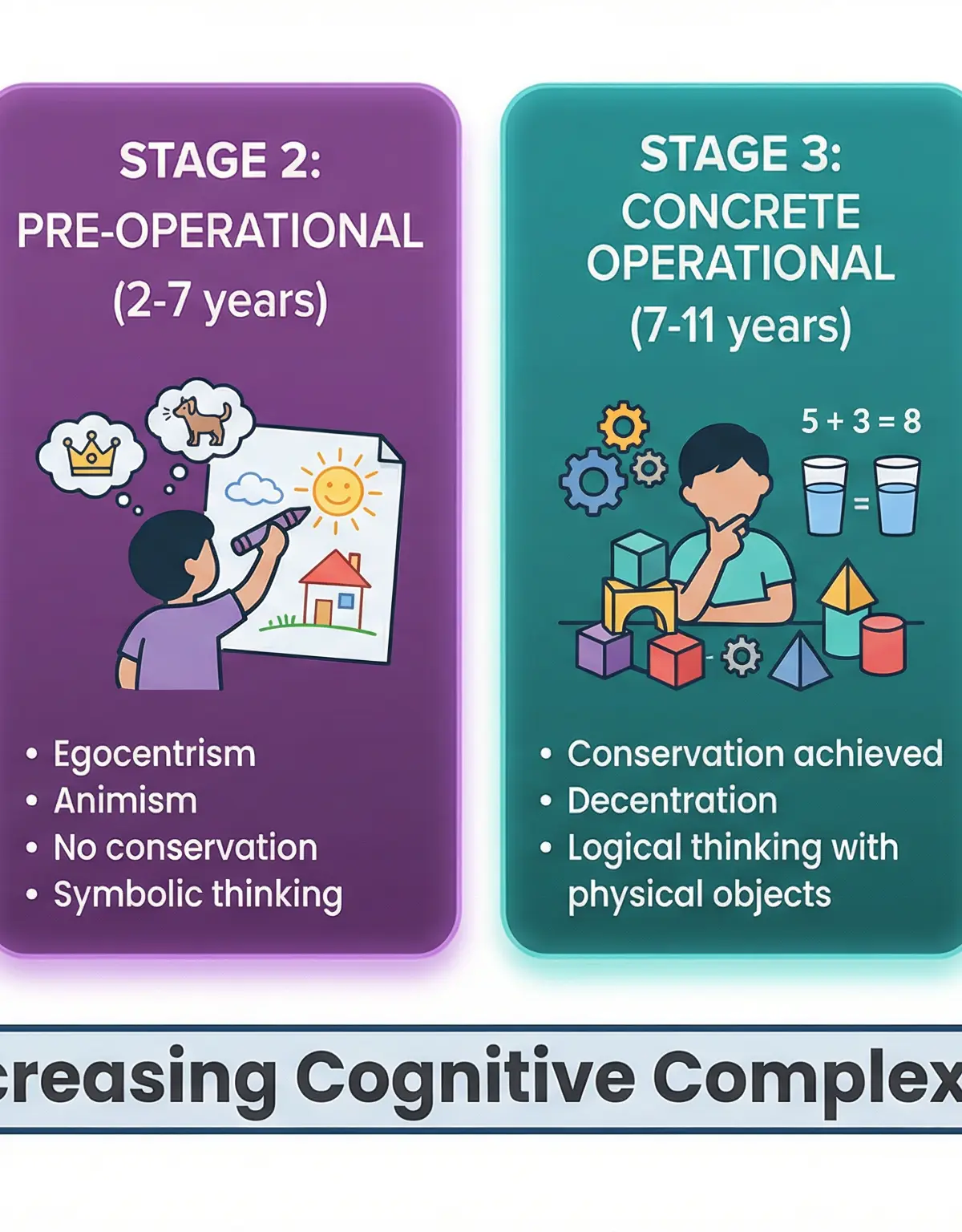
- Pre-operational Stage (2-7 years): The child uses symbols and language but their thinking is pre-logical. Key limitations are egocentrism (inability to see from another's perspective) and a lack of conservation (understanding that quantity is stable despite changes in appearance).
- Concrete Operational Stage (7-11 years): The child can think logically about concrete, physical objects and events. They achieve conservation and decentration (the ability to consider multiple aspects of a situation).
- Formal Operational Stage (11+ years): The adolescent can think abstractly, hypothetically, and systematically.
Carol Dweck: Mindset Theory
Role: A Stanford University psychologist known for her work on motivation and mindset.
Key Concepts: Dweck proposes two core mindsets about intelligence:
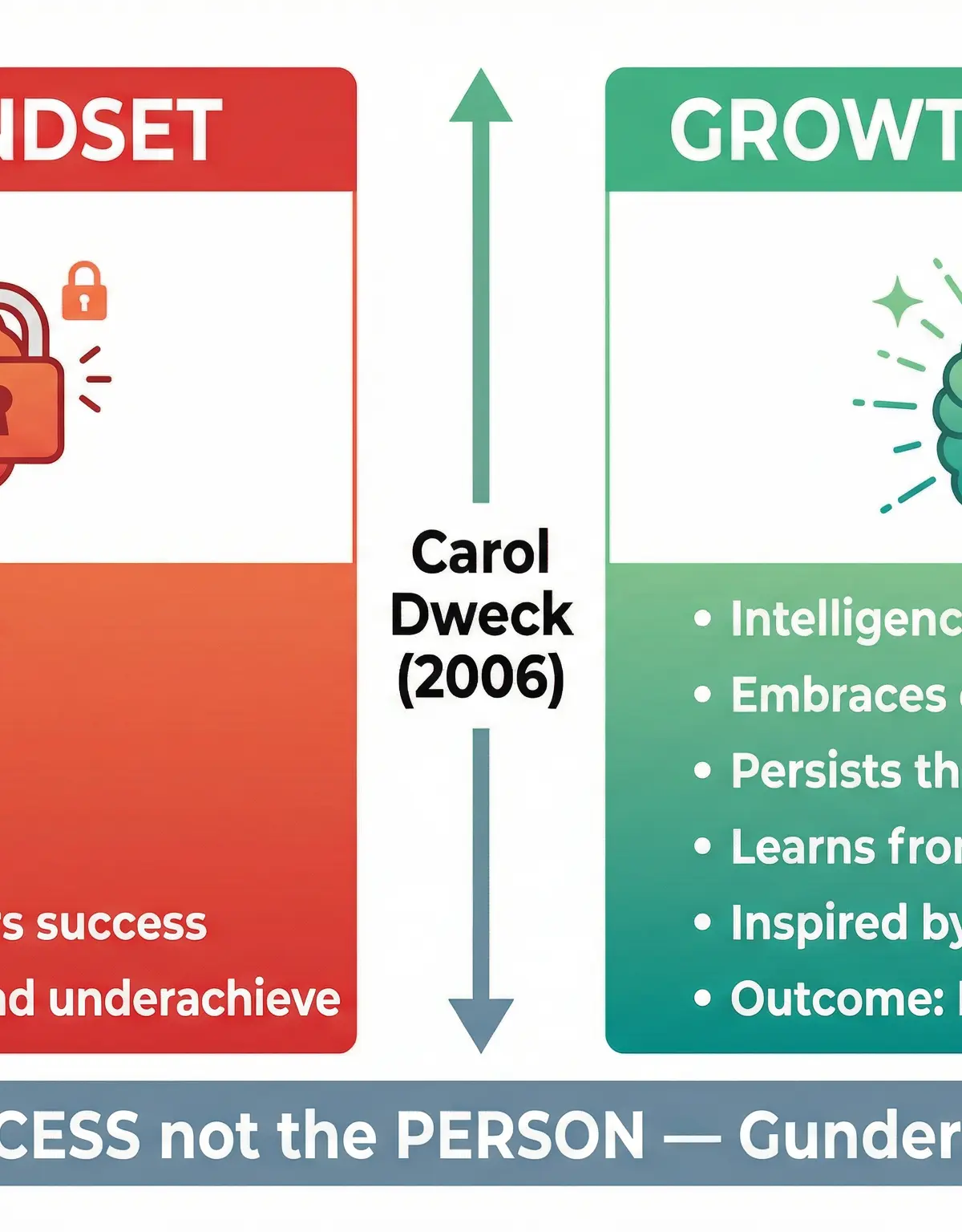
- Fixed Mindset: The belief that intelligence is an innate, unchangeable trait. This leads individuals to avoid challenges and give up easily.
- Growth Mindset: The belief that intelligence can be developed through effort, good strategies, and learning from mistakes. This fosters resilience and a love of learning.
Impact: Dweck's theory has been highly influential in education, promoting the use of 'process praise' (praising effort and strategy) over 'person praise' (praising innate ability) to foster a growth mindset in students.
Daniel Willingham: Learning Theory
Role: A cognitive psychologist who applies findings from cognitive science to education.
Key Concepts: Willingham argues that factual knowledge must precede skill. You cannot think critically about a topic without a well-stocked long-term memory of relevant facts. He also stresses the importance of practice and effort to make skills automatic, freeing up working memory for more complex tasks.
Impact: His work provides a scientific basis for traditional teaching methods that emphasise knowledge acquisition and practice, acting as a counterpoint to pure discovery-based learning.
Key Studies
Piaget (1952) - Conservation of Number
- Aim: To investigate when children develop the ability to conserve number.
- Procedure: Children were shown two identical rows of counters and agreed they had the same number. An adult then spread one row out and asked the child if the number of counters was still the same.
- Results: Pre-operational children (typically under 7) said the longer row now had more counters. Concrete operational children (over 7) correctly stated the number was the same.
- Conclusion: The ability to conserve number develops around the age of 7, supporting Piaget's stage theory.
- Evaluation: The task may have confused children (demand characteristics), as later studies like McGarrigle & Donaldson (1974) found higher success rates when the change was accidental ('Naughty Teddy'). The sample was also culturally biased.
Gunderson et al. (2013) - The Role of Parent Praise
- Aim: To investigate if the type of praise parents give to young children predicts their mindset five years later.
- Procedure: A longitudinal study observing 53 parent-child pairs in their homes at ages 1, 2, and 3. Researchers coded praise as either process praise (e.g., “You worked hard on that puzzle”) or person praise (e.g., “You’re so clever”). At age 7-8, the children’s mindsets were assessed.
- Results: A strong positive correlation was found between the amount of process praise received in early childhood and the likelihood of having a growth mindset at age 7-8.
- Conclusion: The type of praise parents use has a significant impact on a child's later motivational framework.
- Evaluation: The study has high ecological validity as it was conducted in a naturalistic setting. However, the sample was small and from a single US city (Chicago), limiting generalisability. The correlational nature means cause and effect cannot be definitively established.",
"podcast_script": "Hello and welcome to the OCR GCSE Psychology Revision Podcast. I'm your host, and today we're diving deep into one of the most fascinating topics on your specification: Theories of Development. Whether you're revising for the first time or doing a final polish before your exam, this episode has everything you need — clear explanations, exam tips, and a quick-fire quiz at the end. So grab your revision notes, get comfortable, and let's get started.
Today's episode covers three major theories: Piaget's Theory of Cognitive Development, Dweck's Mindset Theory, and Willingham's Learning Theory. We'll also look at two key studies you absolutely must know — Piaget's 1952 conservation study and Gunderson and colleagues' 2013 research on parent praise. By the end of this episode, you'll be able to explain these theories confidently, apply them to scenarios, and evaluate them like a top-grade candidate.
Let's begin with Jean Piaget, the Swiss psychologist who is arguably the most important figure in developmental psychology. Piaget proposed that children's thinking develops through four distinct stages, and this is non-negotiable knowledge for your exam — you need to know all four stages, their approximate age ranges, and their key characteristics.
Stage one is the Sensorimotor Stage, covering birth to around two years of age. At this stage, infants learn about the world entirely through their senses and physical actions — hence the name sensorimotor. The most important concept here is object permanence. This is the understanding that objects continue to exist even when they are out of sight. Before around eight months, Piaget argued, infants lack object permanence — if you hide a toy under a blanket, they simply stop looking for it, as if it has ceased to exist. After eight months, they will search for the hidden object, demonstrating that they now understand it still exists.
Stage two is the Pre-Operational Stage, from roughly two to seven years. This is the stage that generates the most exam questions, so pay close attention. Children at this stage are developing language and symbolic thinking — they can use words and images to represent objects. However, their thinking has several significant limitations. The first is egocentrism — the inability to see the world from another person's perspective. Piaget demonstrated this with his famous Three Mountains Task, where a child was asked to describe what a doll placed at a different position would see. Pre-operational children consistently described their own view, not the doll's. The second limitation is animism — the belief that inanimate objects have feelings and intentions. A child might say the sun is angry or the chair is being naughty. The third and perhaps most exam-critical limitation is the lack of conservation. Conservation is the understanding that quantity remains the same even when appearance changes. Pre-operational children fail conservation tasks — if you pour water from a short, wide glass into a tall, thin glass, they will say there is now more water in the tall glass because it looks higher.
Stage three is the Concrete Operational Stage, from seven to eleven years. At this stage, children acquire conservation — they understand that the amount of water hasn't changed despite the different appearance. They also develop decentration, which is the ability to focus on more than one aspect of a situation at a time. This is what allows conservation — they can consider both the height and width of the glass simultaneously. Logical thinking is now possible, but only when applied to concrete, physical objects. Abstract reasoning is still beyond them.
Stage four is the Formal Operational Stage, from eleven years onwards. This is when abstract and hypothetical thinking becomes possible. Adolescents can reason about things they haven't directly experienced, consider hypothetical scenarios, and think systematically about problems.
Now, underpinning all four stages is Piaget's concept of schema development. A schema is a mental framework or category of knowledge built up through experience. When we encounter new information, one of two things happens. Either the new information fits neatly into an existing schema — this is called assimilation. Or the new information doesn't fit, and we have to change or create a new schema — this is called accommodation. The drive to maintain balance between existing schemas and new experiences is called equilibration, and Piaget saw this as the engine of cognitive development.
Now let's move on to Piaget's 1952 conservation study, which you need to know in detail. The aim was to investigate whether children could conserve — that is, understand that quantity remains constant despite changes in appearance. The procedure involved showing children two identical rows of counters and asking if they had the same number. The child agreed they did. Then, one row was spread out so it appeared longer, and the child was asked again. Pre-operational children — typically under seven — said the spread-out row had more counters, demonstrating a failure of conservation. Concrete operational children correctly identified that the number remained the same. The conclusion was that conservation develops around age seven, supporting Piaget's stage theory.
For evaluation, you need to think critically. One strength is that the study has high ecological validity in the sense that it uses everyday objects children are familiar with. However, a significant criticism comes from later researchers, particularly McGarrigle and Donaldson in 1974, who argued that when children gave the wrong answer, it was because they thought the adult expected them to say something different when they rearranged the counters — not because they genuinely couldn't conserve. This suggests Piaget may have underestimated children's abilities. You should also consider issues of generalisability — Piaget's original samples were relatively small and drawn from European, middle-class backgrounds, which limits how far we can apply his findings to all children worldwide.
Now let's turn to Carol Dweck and her Mindset Theory, published in her influential 2006 book. Dweck proposed that people hold one of two fundamental beliefs about intelligence. Those with a fixed mindset believe that intelligence is a fixed, innate trait — you either have it or you don't. Those with a growth mindset believe that intelligence can be developed through effort, practice, and learning from mistakes. These beliefs have profound consequences for educational achievement. Students with a fixed mindset tend to avoid challenges for fear of looking unintelligent. They give up easily when faced with obstacles and see effort as pointless if you're not naturally talented. Students with a growth mindset, by contrast, embrace challenges as opportunities to grow, persist through difficulties, and see effort as the path to mastery.
For the exam, you need to be able to apply these concepts to novel scenarios. If a question describes a student who refuses to try a difficult maths problem because they say they're just not a maths person, that's a fixed mindset. If a student says they found the essay hard but they're going to keep practising until they improve, that's a growth mindset. The application is everything — don't just define the terms, show the examiner you can use them.
This connects directly to the Gunderson et al. 2013 study, which you must know in detail. The researchers — Gunderson, Gripshover, Romero, Dweck, Goldin-Meadow, and Levine — investigated whether the type of praise parents give to young children predicts the development of a growth or fixed mindset years later. The sample consisted of 53 children from Chicago, who were observed at ages one, two, and three. Researchers coded the type of praise parents used — process praise, which focused on effort and strategies, such as "you worked really hard on that", versus person praise, which focused on fixed traits, such as "you're so clever". The children were then followed up at ages seven to eight and assessed on their mindset beliefs and attitudes towards challenge.
The results showed that children who received more process praise at ages one to three were significantly more likely to display a growth mindset at ages seven to eight. They showed greater preference for challenging tasks and believed that intelligence could improve with effort. The conclusion was that the type of praise parents use in early childhood has a lasting impact on children's mindset development, supporting Dweck's theory.
For evaluation, you need to go beyond surface-level comments. A strength is that the longitudinal design allows researchers to establish a temporal relationship — the praise came before the mindset, which strengthens the case for a causal link. However, you should note that correlation does not equal causation — other variables, such as the child's school environment or peer relationships, could also influence mindset development. A key evaluation point for high marks is to question the ecological validity of the observation method — parents knew they were being observed, which may have caused them to modify their behaviour, a phenomenon known as demand characteristics. You should also consider the sample size of 53 children, which limits generalisability. Furthermore, the sample was drawn from Chicago, raising questions about whether findings apply cross-culturally.
Now let's look at Willingham's Learning Theory. Daniel Willingham, a cognitive psychologist, argued that factual knowledge must precede the development of skills. In other words, you cannot think critically about a topic unless you already have a solid base of factual knowledge about it. This has direct implications for classroom practice. Teachers should ensure students have a strong foundation of factual knowledge before asking them to engage in higher-order thinking tasks like analysis and evaluation. Willingham also emphasised the importance of practice — skills become automatic through repeated practice, freeing up cognitive resources for more complex thinking. For the exam, be ready to apply this to classroom scenarios — for example, a teacher who ensures students memorise key vocabulary before asking them to write analytical essays is applying Willingham's theory.
Now, let's talk exam technique. This is crucial. For OCR GCSE Psychology, you will encounter questions worth one, two, four, and nine marks. For one and two mark questions, be precise and use technical terminology. For four mark questions, make two clear points with elaboration. For nine mark questions — the big evaluation questions — you must use the PEEL structure: Point, Evidence, Explain, Link back to the question. Every paragraph should follow this structure. Examiners are looking for AO1 knowledge, AO2 application, and AO3 evaluation. The weightings for this topic are AO1 at 30%, AO2 at 35%, and AO3 at 35%, so application and evaluation are just as important as knowing the content.
The most common mistakes I see candidates make are, first, confusing the Pre-Operational and Concrete Operational stages — particularly the age ranges. Remember: Pre-Operational is two to seven, Concrete Operational is seven to eleven. Second, candidates describe the procedure of a study when the question asks for results or conclusions. Read the question carefully. Third, candidates give generic theoretical descriptions without contextualising them to the scenario in the question. If the question gives you a scenario about a child, you must refer back to that child in your answer. Fourth, candidates write evaluation points like "the study lacks validity" without explaining why or what this means for the conclusions. Always explain the significance of your evaluation point.
Now, here are some memory hooks to help you. For Piaget's four stages in order, use the mnemonic SPCF — Some People Can Fly. Sensorimotor, Pre-Operational, Concrete Operational, Formal Operational. For the key features of the Pre-Operational stage, remember EAC — Egocentrism, Animism, lack of Conservation. For Dweck's mindsets, think Fixed equals Frozen — a fixed mindset keeps you frozen in place. Growth equals Go — a growth mindset makes you go further. For Gunderson et al., remember the three Ps — Process Praise Predicts growth mindset.
Right, it's time for our quick-fire recall quiz. I'll ask the question, give you a few seconds to think, and then give the answer. Ready?
Question one: What is the term for a child's inability to see the world from another person's perspective? ... The answer is egocentrism.
Question two: In which of Piaget's stages does conservation first develop? ... The answer is the Concrete Operational Stage, at around age seven.
Question three: What type of praise did Gunderson et al. find was associated with a growth mindset? ... The answer is process praise — praise focused on effort and strategies.
Question four: According to Willingham, what must come before the development of skills? ... The answer is factual knowledge.
Question five: What is the term for the process by which a child changes an existing schema to accommodate new information? ... The answer is accommodation.
How did you do? If you got all five, excellent work. If you missed any, go back and review those sections — and use the cover-and-recall technique: cover your notes, try to recall the answer, then check. That active retrieval is far more effective than passive re-reading.
Let's wrap up. Today we covered Piaget's four stages of cognitive development and his schema theory, including assimilation and accommodation. We explored Piaget's 1952 conservation study and how to evaluate it effectively. We looked at Dweck's Mindset Theory and how to apply fixed and growth mindset concepts to exam scenarios. We examined Gunderson et al. 2013 in detail, including the sample, procedure, results, and evaluation. And we covered Willingham's Learning Theory and its classroom applications.
Remember: in your exam, precision is everything. Use the exact terms, name the exact studies, and always link back to the question. You've got this. Good luck, and I'll see you in the next episode."
Worked Examples
2 worked examples — open one to explore the question and available guidance.
Practice Questions
Test your understanding — click to reveal model answers
A 4-year-old child is shown two identical balls of clay. An adult then rolls one ball into a long, thin sausage shape and asks the child which piece has more clay. The child points to the sausage shape. Use your knowledge of Piaget's theory to explain this child's thinking. (4 marks)
Hint: Which of Piaget's stages is a 4-year-old in? What are the key limitations of this stage?
Describe Willingham's learning theory. (4 marks)
Hint: Think about the relationship between knowledge and skills.