OCR · A-Level · Psychology
Course version: H567 · Version from Sept 2015
Application: Learners should be able to relate the application to a novel…
Full specification wording
2c. Content of Applied psychology (Component 03): Application: Learners should be able to relate the application to a novel situation.
The last part of every topic asks you to take what you know and put it to work in a situation you have not seen before, which is where most marks are lost and gained.
- Point 3 of 4
- 4 key terms
Study notes
From the teaching notes for this specification point.
The idea
The last part of every topic asks you to take what you know and put it to work in a situation you have not seen before, which is where most marks are lost and gained. A scenario is given, and the answer has to be about that scenario: this child, this offender, this office, this athlete. Good answers name the principle, describe the procedure concretely and predict the effect, for example a graded hierarchy with relaxation for a specific fear, a token economy with a stated target behaviour and reward, a cognitive interview that asks a witness to recall in a different order, or a workplace redesigned to cut noise and give people control over their space. Weaker answers stay general, and the difference between the two is nearly always the amount of concrete detail attached to the person described.
What earns the marks
- Credit depends on the suggestion being usable, so include who does what, when and with what materials rather than naming a technique and moving on.
- The psychology has to be visible, so state the principle behind the action, for example reinforcement strengthening a behaviour that is followed by a valued consequence.
- Details from the scenario should appear in the answer, because an application that would read identically for any scenario is being marked as a general description.
- Saying what the suggestion would not fix, or who it would not suit, shows the judgement that the higher bands reward.
Common mistakes and how to put them right
Describing the key research instead of applying it, which is the single commonest way of losing application marks.
Offering an idea that could not be carried out by the people in the scenario, such as a programme needing constant supervision in a setting where nobody is available.
Writing one sentence of suggestion and then padding with evaluation, when the suggestion itself is where most of the credit sits.
Exam tips
- Underline two or three concrete details in the scenario and make sure each one is mentioned somewhere in your answer.
- Practise turning each topic into a ready made intervention, since the question usually asks you to suggest rather than to explain, and a rehearsed procedure is faster to adapt than to invent.
- If the item asks you to justify the suggestion, give the evidence and the reasoning in the same breath, naming the research and what it found.
Try the lesson
The start of the 2c. Content of Applied psychology (Component 03): Application: Learners should be able to relate the application to a novel situation. lesson, made from teaching notes for this specification point.
Have a go first
A local council wants to reduce vandalism in a block of flats by applying Newman's concept of 'defensible space'. Which modification would best achieve this?
Listen
The last part of every topic asks you to take what you know and put it to work in a situation you have not seen before, which is where most marks are lost and gained. A scenario is given, and the answer has to be about that scenario: this child, this offender, this office, this athlete. Good answers name the principle, describe the procedure concretely and predict the effect, for example a graded hierarchy with relaxation for a specific fear, a token economy with a stated target behaviour and reward, a cognitive interview that asks a witness to recall in a different order, or a workplace redesigned to cut noise and give people control over their space. Weaker answers stay general, and the difference between the two is nearly always the amount of concrete detail attached to the person described. A strong answer earns marks for these points. Credit depends on the suggestion being usable, so include who does what, when and with what materials rather than naming a technique and moving on. The psychology has to be visible, so state the principle behind the action, for example reinforcement strengthening a behaviour that is followed by a valued consequence. Details from the scenario should appear in the answer, because an application that would read identically for any scenario is being marked as a general description. Saying what the suggestion would not fix, or who it would not suit, shows the judgement that the higher bands reward. Exam tip: Underline two or three concrete details in the scenario and make sure each one is mentioned somewhere in your answer.
See it
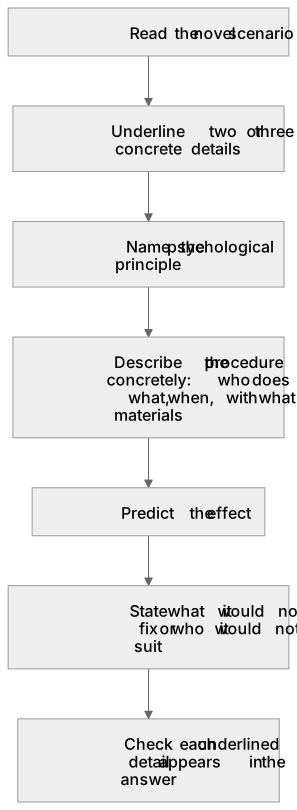
Put it in order
Put these steps in the order they happen.
- 1. Check each underlined detail appears in the answer
- 2. State what it would not fix or who it would not suit
- 3. Name the psychological principle
- 4. Predict the effect
- 5. Read the novel scenario
- 6. Underline two or three concrete details
- 7. Describe the procedure concretely: who does what, when, with what materials
Key words
Say what each word means before you turn the card.
novel scenario
Try answering aloud or in your head before turning the card.
practical intervention
Try answering aloud or in your head before turning the card.
applied reasoning
Try answering aloud or in your head before turning the card.
specificity of detail
Try answering aloud or in your head before turning the card.
See every definition
- novel scenario
- A situation you have not seen before, which the answer has to be about, such as this child, this offender, this office or this athlete.
- practical intervention
- A suggestion that is usable, including who does what, when and with what materials rather than naming a technique and moving on.
- applied reasoning
- Naming the principle, describing the procedure concretely and predicting the effect, with the psychology visible behind the action.
- specificity of detail
- The amount of concrete detail attached to the person described, which nearly always separates good answers from weaker ones that stay general.
Label the diagram
Some boxes have lost their names. Pick the right name for each number.
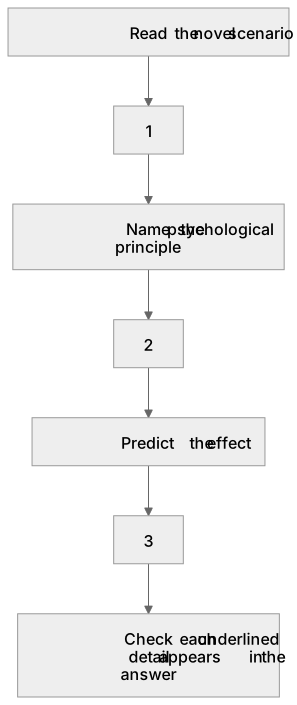
1Box 1
2Box 2
3Box 3
There is more to this lesson
The full lesson goes on to check your understanding and help you earn the marks. Create a free account to carry on, with your progress saved.
A week of Premium from your first lesson · Then the free plan continues · No card, no charge
Test your understanding of 2c. Content of Applied psychology (Component 03): Application: Learners should be able to relate the application to a novel situation.
Active recall beats re-reading. Take an instant quiz now to test what you’ve learned and lock it into long-term memory.
A week of Premium from your first lesson · Then the free plan continues · No card, no charge