OCR · A-Level · Psychology
Child Psychology
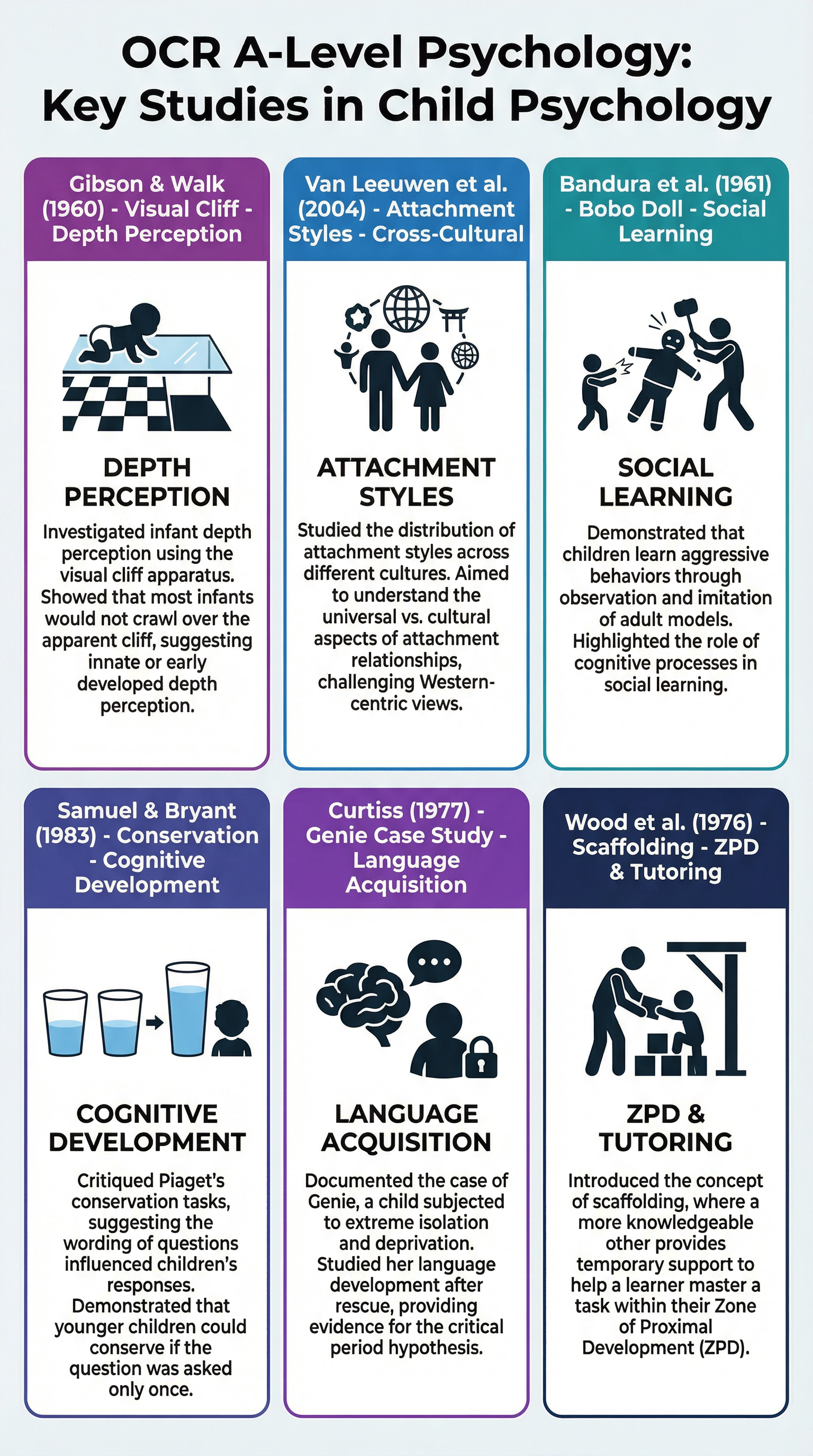
Master OCR A-Level Child Psychology by diving into the six core studies that define the course. This guide breaks down complex theories from Gibson & Walk's Visual Cliff to Wood et al.'s Scaffolding, providing the specific knowledge and evaluation skills needed to excel in Component 3.
- 9 min read
- 3 worked examples
- 5 practice questions
- 8 key terms
Study Notes

Overview
OCR A-Level Psychology Component 3, focusing on Child Psychology, is a deep dive into how we develop from infancy. It moves beyond broad theories to demand precise, critical knowledge of six foundational studies. Examiners expect candidates to not only recall the Aim, Method, Results, and Conclusion (AMRC) of each study but also to skilfully apply this knowledge to novel scenarios (AO2) and evaluate them using the core Issues and Debates of psychology (AO3). This guide is structured to build your confidence in handling everything from the innate perceptual abilities shown in Gibson & Walk's research to the complex social learning demonstrated by Bandura's Bobo Doll experiment. Success here isn't just about knowing what happened; it's about understanding why it matters and how to critique the research that shaped our understanding of child development. This topic carries significant weight, and mastering it is crucial for achieving top grades.

The Six Key Studies
Success in this component hinges on your detailed knowledge of the following six pieces of key research. You must be able to distinguish them from their background theories and cite specific details from their methodology and findings.
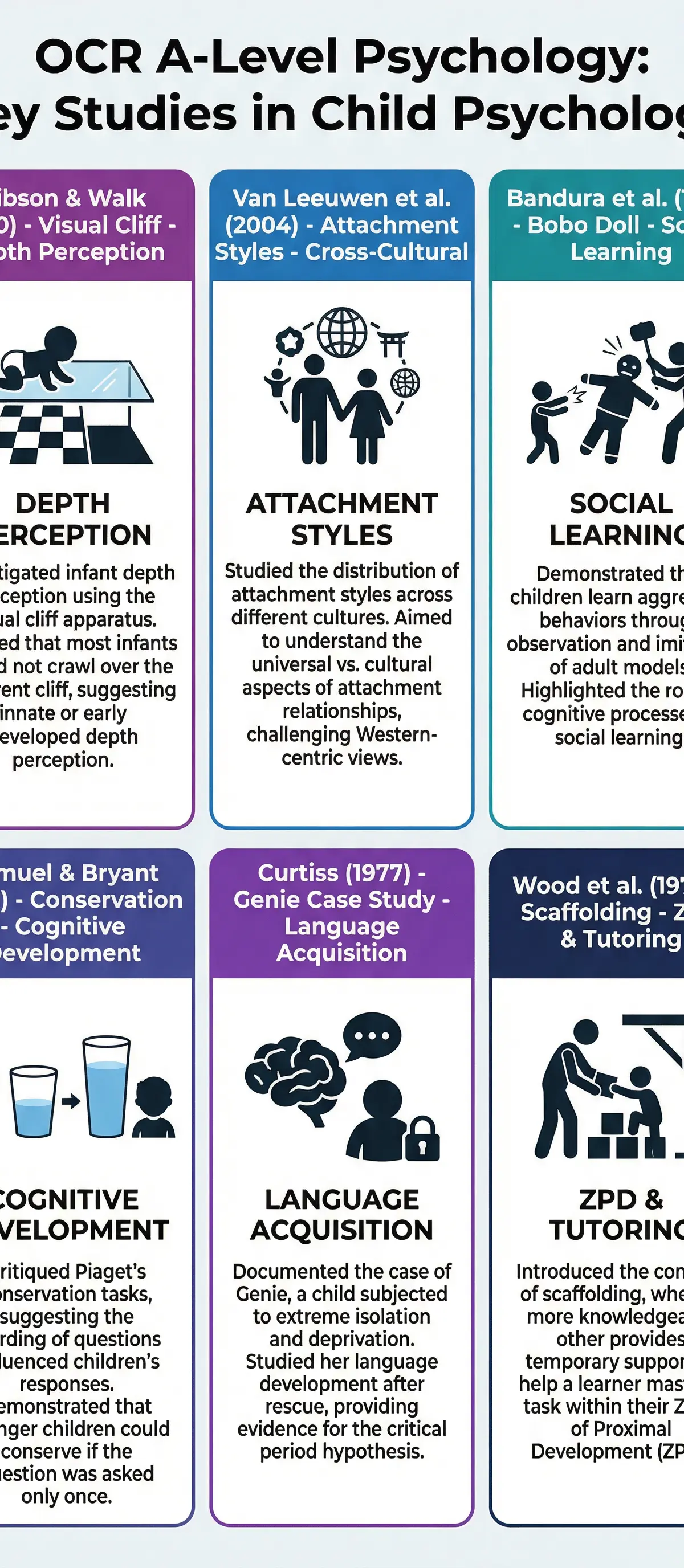
1. Gibson & Walk (1960) - The Visual Cliff
Background Theory: Nativist theories of perception, which argue that abilities like depth perception are innate rather than learned.
Key Research (AMRC):
- Aim: To investigate whether depth perception is an innate or learned ability in human infants and other young animals.
- Method: A lab experiment using the 'visual cliff' apparatus — a glass-topped table with a shallow checkerboard pattern on one side and a deep-looking checkerboard pattern on the other. 36 infants aged 6-14 months were placed on the central board and their mothers called them from either the deep or shallow side.
- Results: 27 of the 36 infants crawled onto the shallow side at least once, but only 3 crawled onto the deep side. Many became distressed when called from the deep side, indicating they could perceive the drop.
- Conclusion: The fact that infants as young as 6 months could perceive and avoid the visual cliff strongly suggests that depth perception is, at least to some extent, innate.
Examiner Tip: For AO3 marks, critique the age of the infants. Since they could already crawl, they had opportunities for learning through experience (e.g., from falling), meaning the behaviour might not be purely innate.
2. Bandura, Ross & Ross (1961) - Transmission of Aggression
Background Theory: Social Learning Theory, which posits that behaviour is learned from the environment through the process of observation and imitation.
Key Research (AMRC):
- Aim: To demonstrate that aggression can be learned through observation and imitation of an adult model.
- Method: A lab experiment with 72 children (36 boys, 36 girls) aged 3-6. Children were matched on pre-existing aggression levels and divided into groups. They observed an adult model behaving either aggressively or non-aggressively towards a Bobo doll. A control group saw no model.
- Results: Children who observed the aggressive model showed significantly more imitative aggressive behaviour. Boys were more likely to imitate physical aggression, while girls imitated more verbal aggression. The findings strongly supported the hypothesis.
- Conclusion: Aggression is a learned behaviour, acquired through observation and imitation, rather than being solely an innate drive.
Examiner Tip: Use this study to discuss the Nature vs. Nurture debate. Bandura provides powerful evidence for the 'Nurture' side. Also, evaluate the study's ecological validity — a lab is not a real-life setting, and a Bobo doll is designed to be hit.
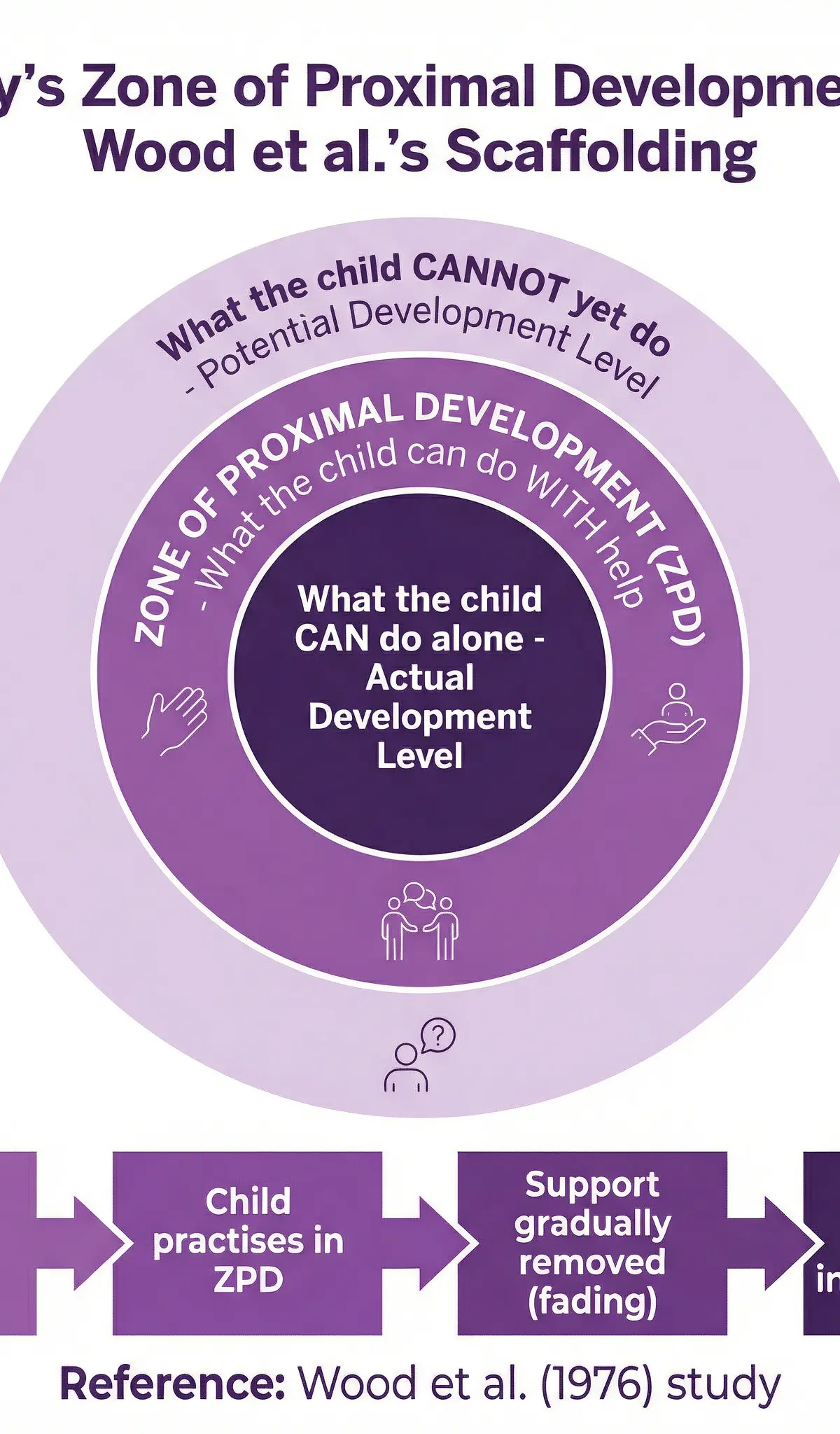
3. Wood, Bruner & Ross (1976) - The Role of Tutoring in Problem Solving
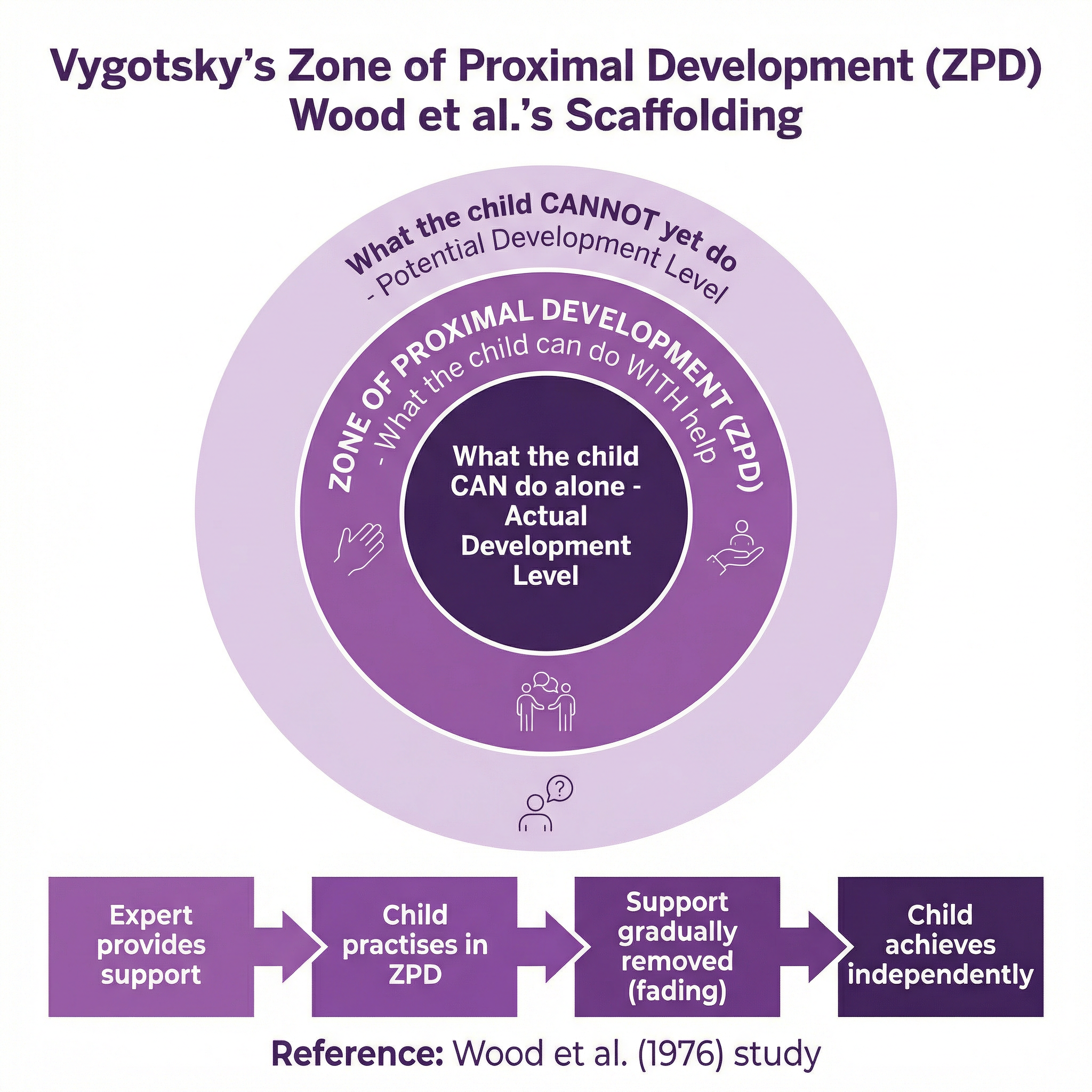
Background Theory: Vygotsky's theory of cognitive development, particularly the Zone of Proximal Development (ZPD).
Key Research (AMRC):
- Aim: To investigate how a tutor's support enables a child to solve a problem they could not solve alone.
- Method: A controlled observation where 30 children aged 3, 4, and 5 were asked to build a complex 3D pyramid puzzle with the help of a tutor. The tutor's interventions were recorded.
- Results: Tutors who were most effective used 'contingent' instruction — they adjusted their level of support based on the child's performance, providing more help when the child struggled and less when they succeeded. This responsive tutoring was termed 'scaffolding'.
- Conclusion: Children's learning is most effective when an expert provides tailored, responsive support to help them cross their ZPD. This demonstrates the social nature of learning.
Examiner Tip: Do not confuse Wood et al. with Piaget. Piaget saw development as a process of individual discovery through stages; Wood et al. and Vygotsky see it as a social process guided by more knowledgeable others.
4. Samuel & Bryant (1983) - Conservation
Background Theory: Piaget's theory of cognitive development, specifically the concrete operational stage and the concept of conservation.
Key Research (AMRC):
- Aim: To test whether Piaget's conservation tasks underestimated children's cognitive abilities due to a methodological flaw.
- Method: 252 children aged 5 to 8.5 years were tested on conservation tasks. Crucially, some were only asked the post-transformation question once (unlike Piaget's procedure where it was asked twice — before and after).
- Results: Children made significantly fewer errors in the one-question condition than the two-question condition, regardless of the type of conservation task.
- Conclusion: Piaget's methodology was flawed. Asking the question twice led children to believe their first answer was wrong, causing them to change it. This means Piaget underestimated children's cognitive abilities.
5. Curtiss (1977) - Genie: A Psycholinguistic Study
Background Theory: The Critical Period Hypothesis (Lenneberg, 1967), which proposes there is a biologically determined window for language acquisition.
Key Research (AMRC):
- Aim: To document the language development of a child who had been deprived of language input during the critical period.
- Method: A longitudinal case study of Genie, a 13-year-old girl discovered in 1970 after years of extreme isolation and abuse. Her linguistic abilities were assessed over several years.
- Results: Genie was able to acquire some vocabulary and basic communication skills, but never developed full grammatical competence. Her language remained telegraphic and lacked syntactic structure.
- Conclusion: The findings support the Critical Period Hypothesis. Because Genie was deprived of language input during the critical period (birth to puberty), she was unable to fully acquire grammar, suggesting this window is biologically determined.
Examiner Tip: Always discuss the ethical issues with this study. Genie could not give informed consent, and there are serious questions about whether the research process caused her additional harm.
6. Van Leeuwen et al. (2004) - Attachment Across Cultures
Background Theory: Bowlby's Attachment Theory, which proposes that attachment is a universal, biologically-based behaviour system.
Key Research (AMRC):
- Aim: To investigate whether attachment styles and their relationship to parenting behaviour are universal or culturally specific.
- Method: A cross-cultural study using the Strange Situation procedure with Dutch children, comparing attachment classifications with data from other cultures.
- Results: Secure attachment was the most common type across cultures, but the proportion of insecure attachment styles varied. Parenting behaviours linked to attachment styles also showed cultural variation.
- Conclusion: Attachment is both universal (secure attachment is predominant across cultures, supporting Bowlby) and culturally influenced (the distribution of insecure styles varies), supporting an interactionist view.
Issues & Debates Application
Nature vs. Nurture
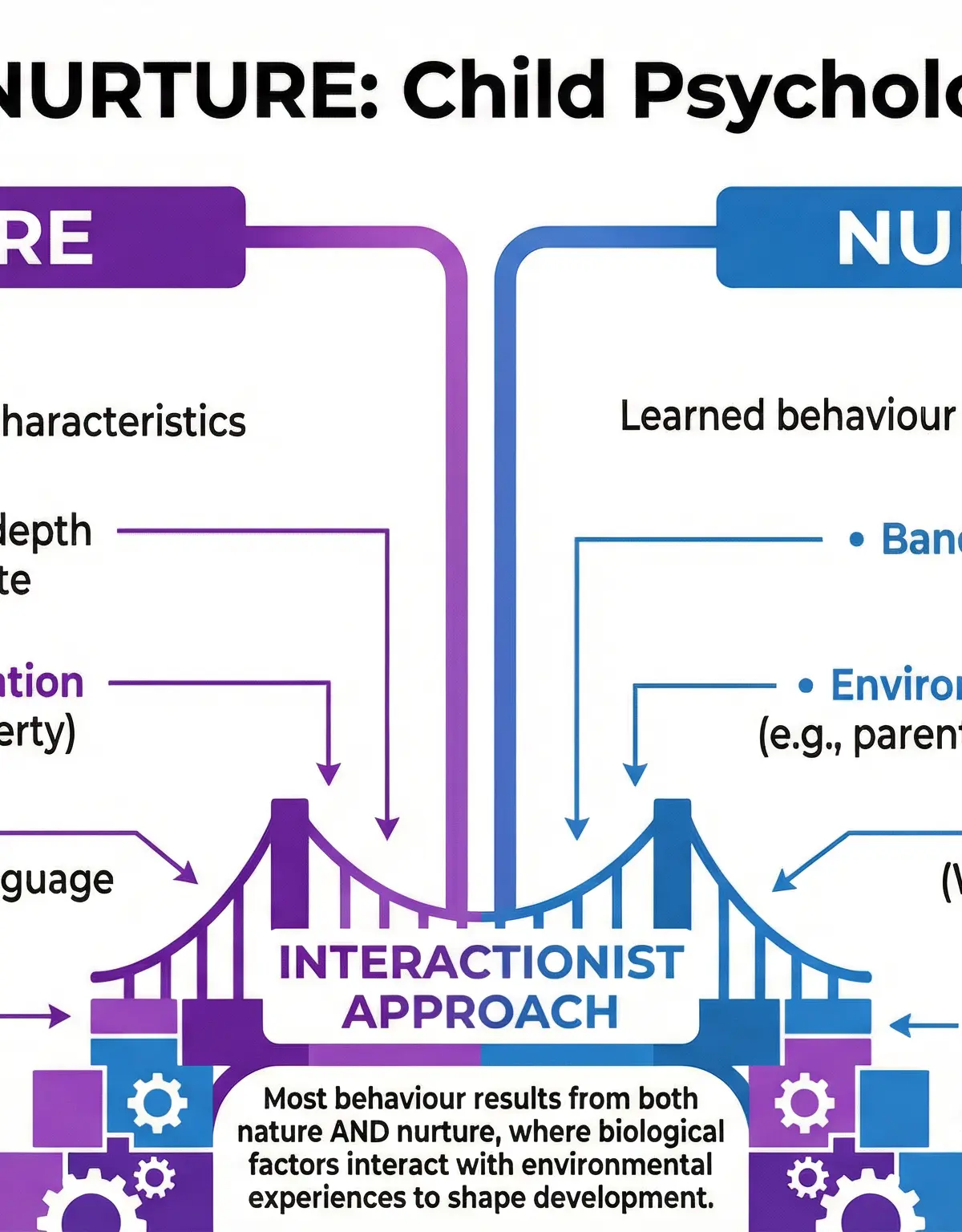
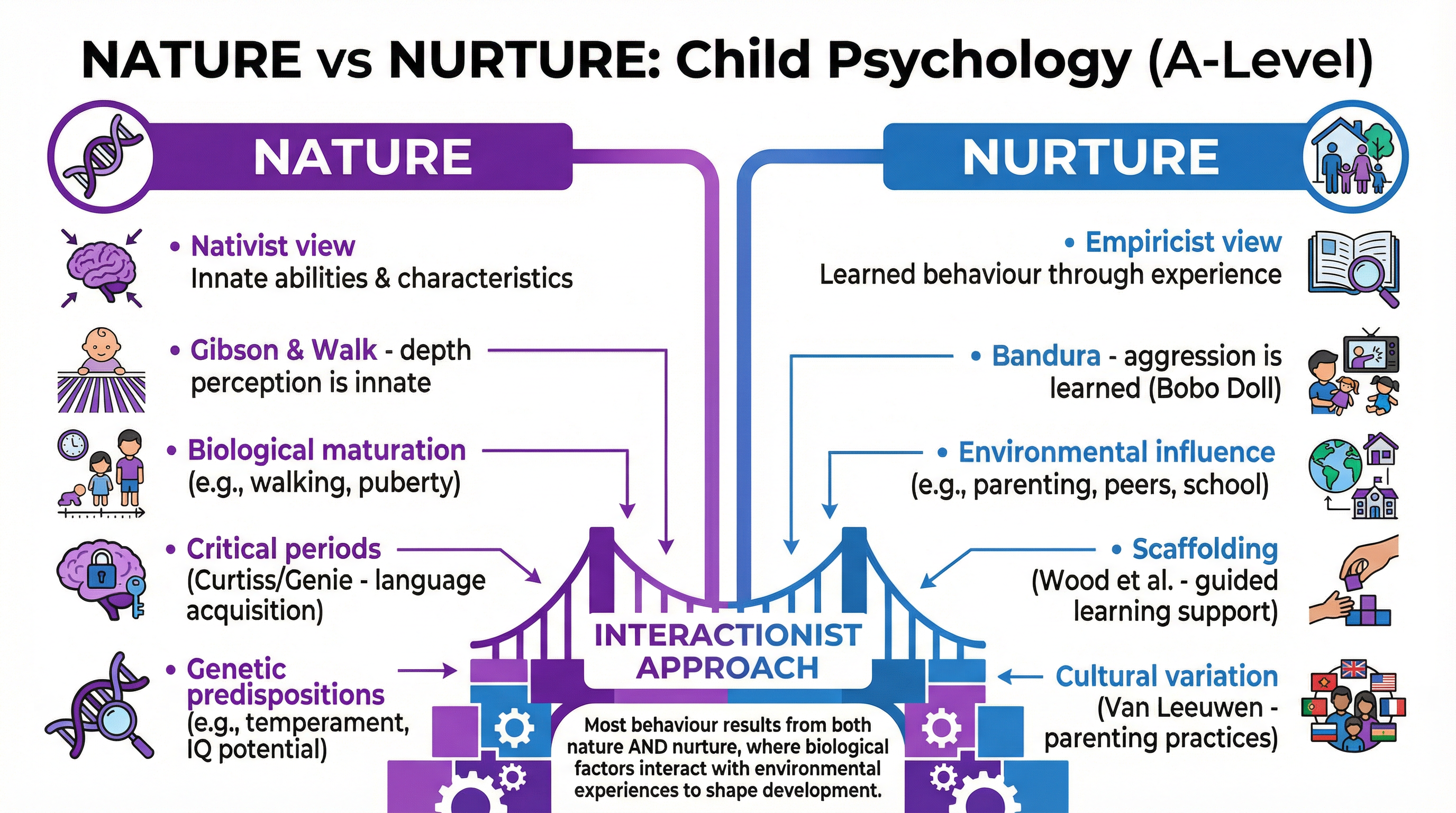
This is a central debate in child psychology. Use Gibson & Walk to argue for the 'Nature' side (innate abilities) and Bandura to argue for the 'Nurture' side (learned behaviours). Van Leeuwen and Wood et al. are best used to support an interactionist approach, showing how innate potentials are shaped by cultural and social environments.
Ethics
The case study of Genie (Curtiss, 1977) is the most significant for ethical discussion. While it provided invaluable data on the critical period for language acquisition, it raises questions about psychological harm, informed consent (Genie could not consent), and the right to withdraw. Candidates must weigh the scientific value against the potential exploitation of a vulnerable individual.
Reductionism
Samuel & Bryant's critique of Piaget is a good example of how reductionist methodology can lead to flawed conclusions. Piaget reduced complex cognitive ability to a single experimental task, which Samuel & Bryant showed was methodologically problematic.
Visual Resources
3 diagrams and illustrations
Interactive Diagrams
1 interactive diagram to visualise key concepts
Diagram could not be rendered
A timeline showing the publication dates of the six key studies for OCR A-Level Child Psychology.
Worked Examples
3 worked examples — open one to explore the question and available guidance.
Practice Questions
Test your understanding — click to reveal model answers
Describe the findings and conclusions of Bandura, Ross and Ross's (1961) study into the imitation of aggression. (8 marks)
Hint: Focus only on AO1 (knowledge). State the results and what Bandura concluded from them. Use specific details.
Explain what is meant by the 'Zone of Proximal Development'. Use an example from Wood et al. (1976) to support your answer. (4 marks)
Hint: Define the ZPD clearly, then link it directly to what Wood et al. found in their pyramid-building study.
Discuss the extent to which psychology supports the view that development is determined by nature. (15 marks)
Hint: This is a synoptic essay. Use evidence from Child Psychology (Gibson & Walk, Curtiss) but also consider counter-evidence from Bandura and Wood et al. Reach a clear, sustained judgement.
Outline one ethical issue raised by Curtiss's (1977) study of Genie and explain how it affects the conclusions we can draw. (4 marks)
Hint: Name a specific ethical issue, explain what it means in the context of the study, then explain the implication for the research conclusions.
Explain how Samuel and Bryant's (1983) study challenged Piaget's theory of conservation. (6 marks)
Hint: Describe Piaget's original claim, then explain the specific methodological change Samuel & Bryant made, and what their results showed about Piaget's conclusions.