OCR · A-Level · Psychology
Course version: H567 · Version from Sept 2015
Recognise and use expressions in decimal and standard form (to include:…
Full specification wording
D.0 – arithmetic and numerical computation: Recognise and use expressions in decimal and standard form (to include: converting data in standard form from a results table into decimal form in order to construct a pie chart)
Standard form writes a value as a number between one and ten multiplied by a power of ten, which is how journals print very small probabilities without a queue of zeros.
- Point 1 of 3
- 3 key terms
Study notes
From the teaching notes for this specification point.
The idea
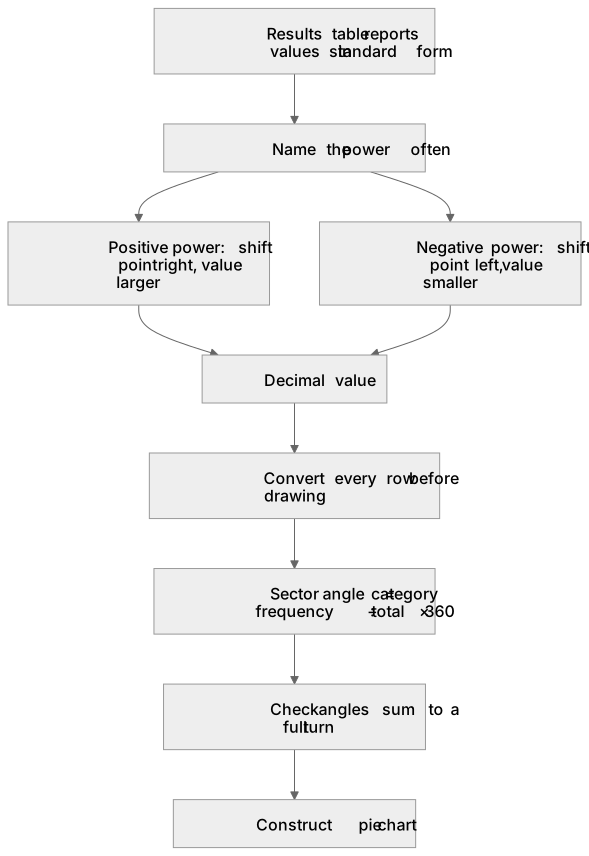
Standard form writes a value as a number between one and ten multiplied by a power of ten, which is how journals print very small probabilities without a queue of zeros. Converting back to decimal is a shift of the decimal point: a positive power shifts it right and makes the value larger, a negative power shifts it left and makes it smaller, and the size of the power is the number of places moved. Psychology needs this whenever a printed results table reports frequencies or proportions in powered notation and ordinary numbers are wanted before a chart can be drawn. The sector angle for each slice is that category's share of the grand total multiplied by three hundred and sixty degrees, so every category has to be converted first and the finished angles should sum to a full turn.
What earns the marks
- Credit is for the working as much as the value, so name the power, say which way the point moves, and give the decimal, writing 3.5 multiplied by ten to the power of minus three as 0.0035.
- A pie chart mark needs the angle calculation set out, which is the frequency for the category divided by the total and then multiplied by three hundred and sixty, with a check that the angles sum to a full circle.
- Markers reward the conversion being applied to every row of the table before anything is drawn, and the converted figures being quoted to a stated and sensible precision.
- Explaining why standard form is used at all, that it keeps very small probability values readable and comparable at a glance, earns the explanation mark.
Common mistakes and how to put them right
Shifting the point the wrong way, so a negative power produces a value larger than one.
Put it right: A negative index always makes the number smaller than the digits alone suggest.
Counting digits rather than places, which turns 2.5 multiplied by ten to the power of minus two into 0.0025 when it is 0.025.
Using the percentage as the angle, so a category holding a quarter of the observations is drawn as a sector of twenty five degrees instead of ninety.
Exam tips
- This is normally a low tariff calculation inside a longer research methods question, so write the converted values into a labelled table first, because the later marks depend on those figures being right.
- If the question states an accuracy, follow it exactly, since an unrounded string of decimals can lose the accuracy mark even when the conversion itself is correct.
- You may be asked to justify a pie chart over a bar chart, so have the reason ready: a pie chart shows each category as a share of one whole set of observations.
Try the lesson
The start of the D.0 – arithmetic and numerical computation: Recognise and use expressions in decimal and standard form (to include: converting data in standard form from a results table into decimal form in order to construct a pie chart) lesson, made from teaching notes for this specification point.
Have a go first
A researcher is preparing to construct a pie chart from an observation study. The results table shows the frequency of 'smiling' is recorded in standard form as 3.4 × 10³. What is this frequency written in decimal form?
Listen
Standard form writes a value as a number between one and ten multiplied by a power of ten, which is how journals print very small probabilities without a queue of zeros. Converting back to decimal is a shift of the decimal point: a positive power shifts it right and makes the value larger, a negative power shifts it left and makes it smaller, and the size of the power is the number of places moved. Psychology needs this whenever a printed results table reports frequencies or proportions in powered notation and ordinary numbers are wanted before a chart can be drawn. The sector angle for each slice is that category's share of the grand total multiplied by three hundred and sixty degrees, so every category has to be converted first and the finished angles should sum to a full turn. A strong answer earns marks for these points. Credit is for the working as much as the value, so name the power, say which way the point moves, and give the decimal, writing 3.5 multiplied by ten to the power of minus three as 0.0035. A pie chart mark needs the angle calculation set out, which is the frequency for the category divided by the total and then multiplied by three hundred and sixty, with a check that the angles sum to a full circle. Markers reward the conversion being applied to every row of the table before anything is drawn, and the converted figures being quoted to a stated and sensible precision. Explaining why standard form is used at all, that it keeps very small probability values readable and comparable at a glance, earns the explanation mark. Exam tip: This is normally a low tariff calculation inside a longer research methods question, so write the converted values into a labelled table first, because the later marks depend on those figures being right.
See it
Key words
Say what each word means before you turn the card.
standard form notation
Try answering aloud or in your head before turning the card.
decimal conversion
Try answering aloud or in your head before turning the card.
pie chart angles
Try answering aloud or in your head before turning the card.
See every definition
- standard form notation
- Writes a value as a number between one and ten multiplied by a power of ten, used to print very small probabilities without a queue of zeros.
- decimal conversion
- A shift of the decimal point, where a positive power shifts it right and makes the value larger and a negative power shifts it left and makes it smaller.
- pie chart angles
- Each category's share of the grand total multiplied by three hundred and sixty degrees, with the finished angles summing to a full turn.
Label the diagram
Some boxes have lost their names. Pick the right name for each number.
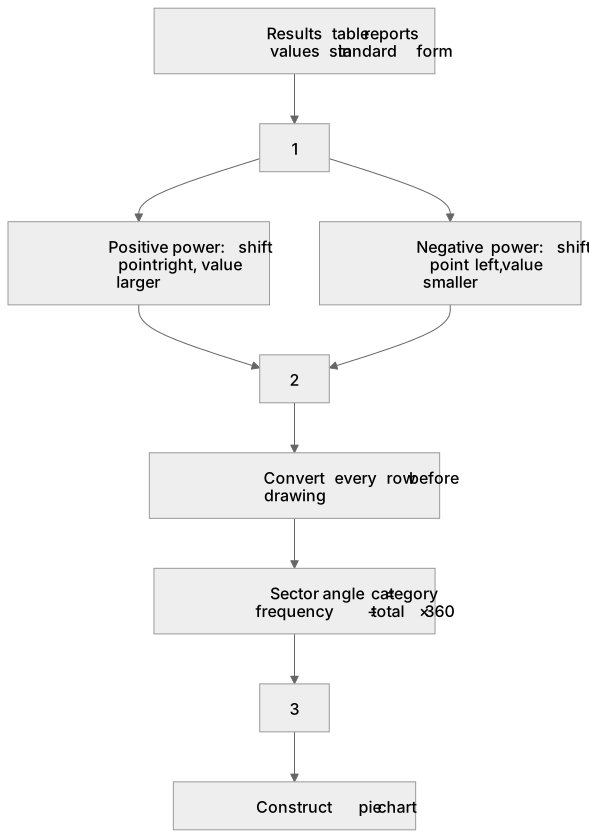
1Box 1
2Box 2
3Box 3
There is more to this lesson
The full lesson goes on to check your understanding and help you earn the marks. Create a free account to carry on, with your progress saved.
A week of Premium from your first lesson · Then the free plan continues · No card, no charge
Test your understanding of D.0 – arithmetic and numerical computation: Recognise and use expressions in decimal and standard form (to include: converting data in standard form from a results table into decimal form in order to construct a pie chart)
Active recall beats re-reading. Take an instant quiz now to test what you’ve learned and lock it into long-term memory.
A week of Premium from your first lesson · Then the free plan continues · No card, no charge