OCR · A-Level · Psychology
Course version: H567 · Version from Sept 2015
Learners are expected to conduct and analyse their own small-scale…
Full specification wording
Practical activities: Learners are expected to conduct and analyse their own small-scale research practicals, including appropriate risk assessment and management, (please see appendix 5d).
Running your own small-scale research practicals is where research methods stops being vocabulary.
- Point 1 of 2
- 4 key terms
Study notes
From the teaching notes for this specification point.
The idea
Running your own small-scale research practicals is where research methods stops being vocabulary. Before any data is gathered, you write a risk assessment and management plan: list the hazards, say who could be harmed and how seriously, then state the control measure and what risk remains. In a psychology practical, hazards are rarely physical. They include distress raised by the topic, breaches of confidentiality, safeguarding where participants are under sixteen, and approaching strangers. Ethical safeguards follow the British Psychological Society code: informed consent, right to withdraw, confidentiality, and a debrief. Finally, you must analyse the data you actually gathered rather than the pattern you hoped for, selecting appropriate descriptive and inferential statistics.
What earns the marks
- A risk assessment names the hazard, the person at risk, how likely and how severe the harm is, and the control measure; the control has to be attached to a specific hazard.
- Give ethical safeguards in the language of the code: informed consent or parental consent for participants under sixteen, right to withdraw stated at the start and honoured during, confidentiality, and a full debrief.
- Justify the analysis chosen by three things together: the level of measurement, whether the design is independent or repeated, and whether the study tests a difference or an association.
- Treat distress as a risk to be managed rather than merely mentioned; sensitive topics are avoided, participants are reminded they may stop, and anyone upset is debriefed and directed to support.
Common mistakes and how to put them right
Writing a risk assessment that lists only physical hazards such as trailing cables, and missing the psychological and safeguarding risks that actually apply to a classroom study.
Conflating confidentiality with anonymity.
Put it right: Confidentiality means keeping known identities secure and not disclosing them with the data, whereas anonymity means no identifying information is collected in the first place.
Gathering data first and choosing the analysis afterwards, which regularly leaves a student holding nominal data and planning to calculate a mean.
Exam tips
- Expect a scenario asking you to identify one risk in a described practical and suggest how the researcher would manage it, where two marks usually means one risk plus one specific control.
- Questions about your own practical work have to be answered generically in the exam, so rehearse one self-report, one observation, one experiment and one correlation that you genuinely ran.
Try the lesson
The start of the Practical activities: Learners are expected to conduct and analyse their own small-scale research practicals, including appropriate risk assessment and management, (please see appendix 5d). lesson, made from teaching notes for this specification point.
Have a go first
When psychology students carry out their own small-scale research practicals, which of the following must be included as part of the planning process?
Listen
Running your own small-scale research practicals is where research methods stops being vocabulary. Before any data is gathered, you write a risk assessment and management plan: list the hazards, say who could be harmed and how seriously, then state the control measure and what risk remains. In a psychology practical, hazards are rarely physical. They include distress raised by the topic, breaches of confidentiality, safeguarding where participants are under sixteen, and approaching strangers. Ethical safeguards follow the British Psychological Society code: informed consent, right to withdraw, confidentiality, and a debrief. Finally, you must analyse the data you actually gathered rather than the pattern you hoped for, selecting appropriate descriptive and inferential statistics. A strong answer earns marks for these points. A risk assessment names the hazard, the person at risk, how likely and how severe the harm is, and the control measure; the control has to be attached to a specific hazard. Give ethical safeguards in the language of the code: informed consent or parental consent for participants under sixteen, right to withdraw stated at the start and honoured during, confidentiality, and a full debrief. Justify the analysis chosen by three things together: the level of measurement, whether the design is independent or repeated, and whether the study tests a difference or an association. Treat distress as a risk to be managed rather than merely mentioned; sensitive topics are avoided, participants are reminded they may stop, and anyone upset is debriefed and directed to support. Exam tip: Expect a scenario asking you to identify one risk in a described practical and suggest how the researcher would manage it, where two marks usually means one risk plus one specific control.
See it
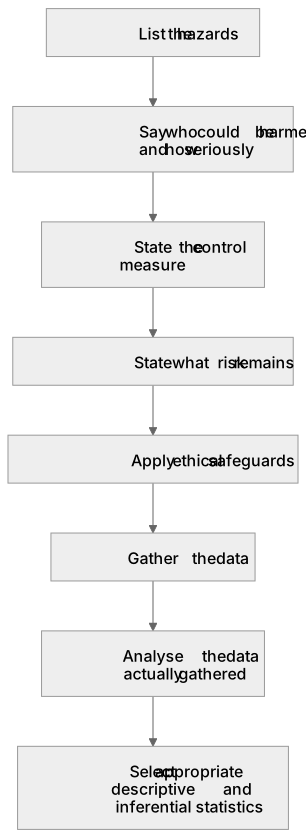
Put it in order
Put these steps in the order they happen.
- 1. Apply ethical safeguards
- 2. Select appropriate descriptive and inferential statistics
- 3. Gather the data
- 4. List the hazards
- 5. Say who could be harmed and how seriously
- 6. Analyse the data actually gathered
- 7. State the control measure
- 8. State what risk remains
Key words
Say what each word means before you turn the card.
risk assessment
Try answering aloud or in your head before turning the card.
ethical safeguards
Try answering aloud or in your head before turning the card.
choosing an analysis
Try answering aloud or in your head before turning the card.
small-scale practical work
Try answering aloud or in your head before turning the card.
See every definition
- risk assessment
- A plan that names the hazard, the person at risk, how likely and how severe the harm is, and the control measure attached to that specific hazard.
- ethical safeguards
- Following the British Psychological Society code: informed consent, right to withdraw, confidentiality, and a debrief.
- choosing an analysis
- Justified by the level of measurement, whether the design is independent or repeated, and whether the study tests a difference or an association.
- small-scale practical work
- Research practicals that learners conduct and analyse themselves, including appropriate risk assessment and management.
Label the diagram
Some boxes have lost their names. Pick the right name for each number.
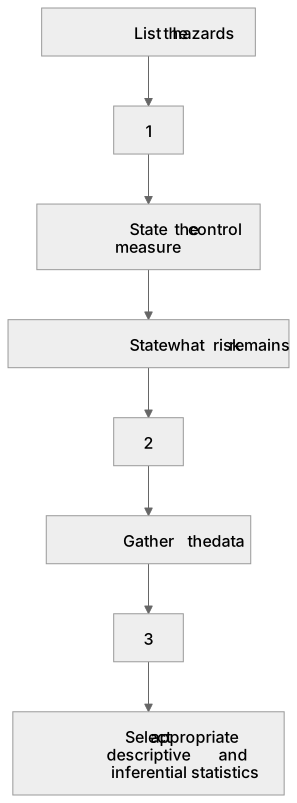
1Box 1
2Box 2
3Box 3
There is more to this lesson
The full lesson goes on to check your understanding and help you earn the marks. Create a free account to carry on, with your progress saved.
A week of Premium from your first lesson · Then the free plan continues · No card, no charge
Test your understanding of Practical activities: Learners are expected to conduct and analyse their own small-scale research practicals, including appropriate risk assessment and management, (please see appendix 5d).
Active recall beats re-reading. Take an instant quiz now to test what you’ve learned and lock it into long-term memory.
A week of Premium from your first lesson · Then the free plan continues · No card, no charge