OCR · A-Level · Psychology
Course version: H567 · Version from Sept 2015
Areas, perspectives and debates: Debates: Nature/nurture;…
Full specification wording
Section B: Areas, perspectives and debates: Debates: Nature/nurture; Freewill/determinism; Reductionism/holism; Individual/situational explanations; Usefulness of research; Ethical considerations; Conducting socially sensitive research; Psychology as a science – The defining principles and concepts of each debate. Different positions within each debate. Research to illustrate different positions within each debate. Applications of different positions within each debate. How each debate is different from and similar to other debates.
Learners must grasp the defining principles and concepts of each debate and the different positions within each debate.
- Point 4 of 4
- 2 key terms
Study notes
From the teaching notes for this specification point.
The idea
Learners must grasp the defining principles and concepts of each debate and the different positions within each debate. Nature/nurture contrasts innate with learned; freewill/determinism contrasts choice with caused actions; reductionism/holism contrasts breaking down with viewing the whole; individual/situational contrasts personal with environmental factors. Usefulness judges practical impact; ethical considerations weigh costs against benefits; conducting socially sensitive research examines societal impacts; psychology as a science evaluates falsifiability. Use research to illustrate different positions within each debate. Explore applications of different positions within each debate and analyse how each debate is different from and similar to other debates.
What earns the marks
- Use research to illustrate different positions within each debate: e.g., Blakemore and Cooper (1970) for nurture's effect on visual neurons, and Casey et al. (2011) for biological determinism.
Common mistakes and how to put them right
Calling a study deterministic just because the researcher controlled variables.
Put it right: Determinism is about what causes behaviour, not experimental control, which relates to psychology as a science.
Collapsing individual/situational into nature/nurture.
Put it right: A situational cause can be learned, and a dispositional one can be learned too; they are distinct debates with different positions within each debate.
Failing to provide applications for all debates.
Put it right: Ensure you can state applications of different positions within each debate, such as using socially sensitive research to shape public policy or ethical considerations to form guidelines.
Exam tips
- When discussing conducting socially sensitive research, name the affected group, the finding, and the resulting policy to clearly show applications of different positions within each debate.
- Create a matrix for all eight debates to revise how each debate is different from and similar to other debates, ensuring you can compare any pair, such as reductionism/holism and freewill/determinism.
Try the lesson
The start of the Section B: Areas, perspectives and debates: Debates: Nature/nurture; Freewill/determinism; Reductionism/holism; Individual/situational explanations; Usefulness of research; Ethical considerations; Conducting socially sensitive research; Psychology as a science – The defining principles and concepts of each debate. Different positions within each debate. Research to illustrate different positions within each debate. Applications of different positions within each debate. How each debate is different from and similar to other debates. lesson, made from teaching notes for this specification point.
Have a go first
Which of the following statements best describes the fundamental principle of the reductionist approach in psychology?
Listen
Learners must grasp the defining principles and concepts of each debate and the different positions within each debate. Nature/nurture contrasts innate with learned; freewill/determinism contrasts choice with caused actions; reductionism/holism contrasts breaking down with viewing the whole; individual/situational contrasts personal with environmental factors. Usefulness judges practical impact; ethical considerations weigh costs against benefits; conducting socially sensitive research examines societal impacts; psychology as a science evaluates falsifiability. Use research to illustrate different positions within each debate. Explore applications of different positions within each debate and analyse how each debate is different from and similar to other debates. A strong answer earns marks for these points. Define the defining principles and concepts of each debate and different positions within each debate: e.g., nature focuses on innate factors, nurture on learned influences; holism embraces complexity, reductionism simplifies. Use research to illustrate different positions within each debate: e.g., Blakemore and Cooper (1970) for nurture's effect on visual neurons, and Casey et al. (2011) for biological determinism. Detail applications of different positions within each debate: e.g., individual explanations apply to screening; situational to altering environments; determinism to drug therapies; freewill to counselling; nature to genetic testing; nurture to education. Explain how each debate is different from and similar to other debates: e.g., reductionism is similar to determinism (seeking singular causes); psychology as a science shares objectivity with usefulness but differs from the subjectivity of freewill; ethical considerations share cost-benefit analyses with usefulness. A common slip: Calling a study deterministic just because the researcher controlled variables. Instead, Determinism is about what causes behaviour, not experimental control, which relates to psychology as a science. Exam tip: When discussing conducting socially sensitive research, name the affected group, the finding, and the resulting policy to clearly show applications of different positions within each debate.
See it

Key words
Say what each word means before you turn the card.
nature and nurture
Try answering aloud or in your head before turning the card.
reductionism and holism
Try answering aloud or in your head before turning the card.
See every definition
- nature and nurture
- A debate contrasting innate factors with learned influences.
- reductionism and holism
- A debate contrasting breaking down with viewing the whole, where holism embraces complexity and reductionism simplifies.
Label the diagram
Some boxes have lost their names. Pick the right name for each number.
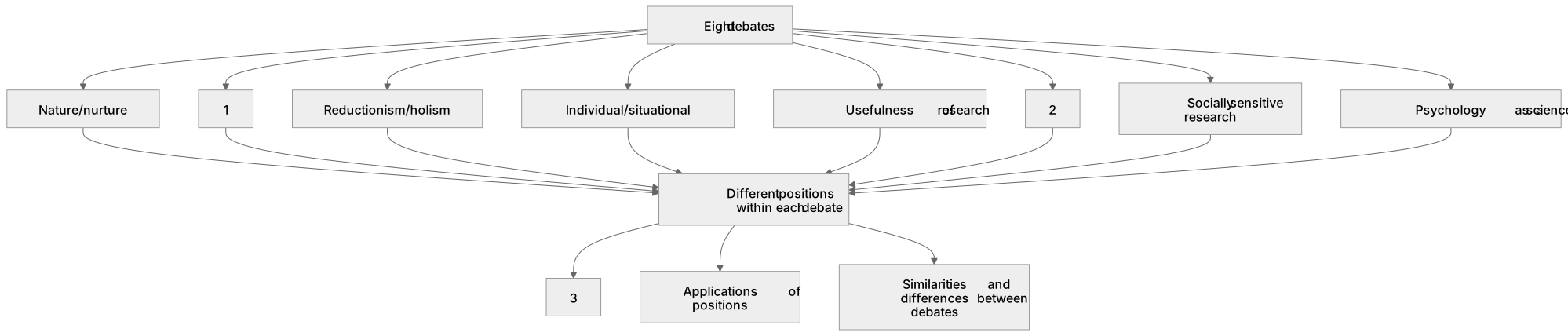
1Box 1
2Box 2
3Box 3
There is more to this lesson
The full lesson goes on to check your understanding and help you earn the marks. Create a free account to carry on, with your progress saved.
A week of Premium from your first lesson · Then the free plan continues · No card, no charge
Test your understanding of Section B: Areas, perspectives and debates: Debates: Nature/nurture; Freewill/determinism; Reductionism/holism; Individual/situational explanations; Usefulness of research; Ethical considerations; Conducting socially sensitive research; Psychology as a science – The defining principles and concepts of each debate. Different positions within each debate. Research to illustrate different positions within each debate. Applications of different positions within each debate. How each debate is different from and similar to other debates.
Active recall beats re-reading. Take an instant quiz now to test what you’ve learned and lock it into long-term memory.
A week of Premium from your first lesson · Then the free plan continues · No card, no charge