OCR · A-Level · Psychology
Course version: H567 · Version from Sept 2015
Areas, perspectives and debates: Studies that come from a behaviourist…
Full specification wording
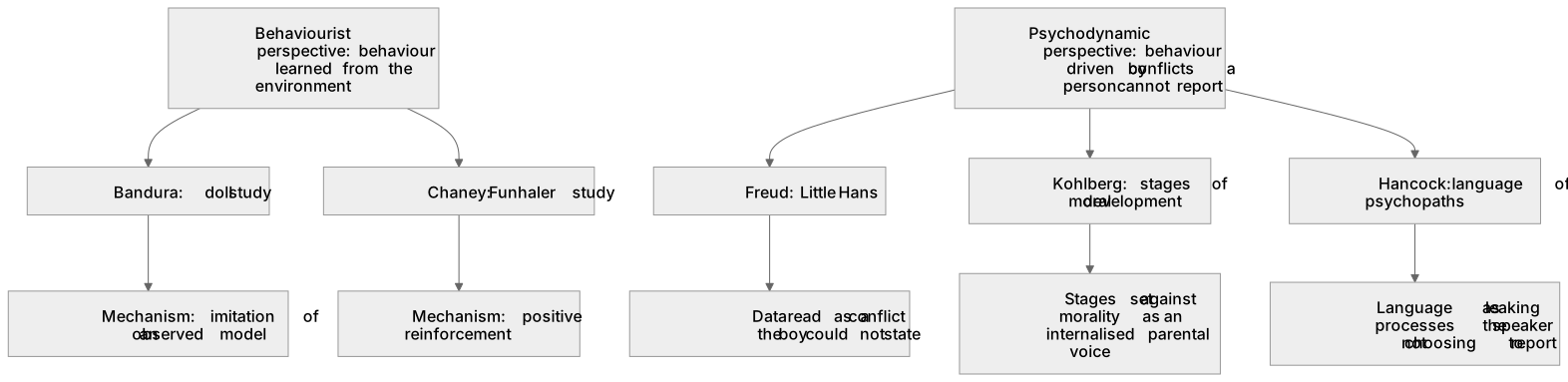
Section B: Areas, perspectives and debates: Studies that come from a behaviourist perspective include Bandura’s research into transmission of aggression and Chaney’s Funhaler study, while psychodynamic ideas are referred to in the research by Freud (Little Hans), Kohlberg (stages of moral development) and Hancock (language of psychopaths); however, learners may refer to other studies.
A perspective is a set of assumptions about where behaviour comes from, and these two disagree about almost everything.
- Point 1 of 4
- 4 key terms
Study notes
From the teaching notes for this specification point.
The idea
A perspective is a set of assumptions about where behaviour comes from, and these two disagree about almost everything. The behaviourist view treats behaviour as learned from the environment through association and consequence, which is why the inflatable doll work and the whistling inhaler belong to it: children who watched an adult attack the doll reproduced the same distinctive blows and phrases, and Chaney and colleagues (2004) found that asthmatic children given a spacer fitted with a spinner and a whistle completed the recommended breathing cycles far more often than with the plain device. The psychodynamic view treats behaviour as driven by conflicts a person cannot report, which is what was read into a boy's horse phobia and what a word pattern analysis claims to find in the way an offender narrates a killing.
What earns the marks
- Behaviourist credit depends on naming the mechanism, so say the inhaler works by positive reinforcement because the toy rewards the correct breathing pattern, while the doll study works by imitation of an observed model.
- For the psychodynamic perspective, quote the data and then the claim, such as the fantasies about giraffes and about being given a larger widdler, each read as a conflict the boy could not state.
- Kohlberg belongs here because his stages are set against the psychoanalytic idea that morality is an internalised parental voice, and Hancock treats language as leaking processes the speaker is not choosing to report.
Common mistakes and how to put them right
Calling the doll study an experiment in operant conditioning.
Put it right: Nobody rewarded the children for hitting the doll during the observation, so the learning was by imitation rather than by consequence.
Reading the inhaler result as evidence that the drug works better, when what improved was adherence, meaning how often and how correctly the children used the device.
Evaluating the psychodynamic perspective only as unscientific, when the sharper point is that its claims resist falsification because any outcome can be read as expressing or defending against the same conflict.
Exam tips
- The question usually asks how a named study illustrates a perspective, so lead with the assumption and follow with the evidence, in that order.
- Evaluation marks come from comparing the perspectives, for instance that both are deterministic but one locates the cause outside the person and the other inside.
- You may use studies the specification does not list, so choose ones whose findings you can actually quote rather than ones you know only by name.
Try the lesson
The start of the Section B: Areas, perspectives and debates: Studies that come from a behaviourist perspective include Bandura’s research into transmission of aggression and Chaney’s Funhaler study, while psychodynamic ideas are referred to in the research by Freud (Little Hans), Kohlberg (stages of moral development) and Hancock (language of psychopaths); however, learners may refer to other studies. lesson, made from teaching notes for this specification point.
Have a go first
Which of the following pairs of studies are categorised as coming from a behaviourist perspective?
Listen
A perspective is a set of assumptions about where behaviour comes from, and these two disagree about almost everything. The behaviourist view treats behaviour as learned from the environment through association and consequence, which is why the inflatable doll work and the whistling inhaler belong to it: children who watched an adult attack the doll reproduced the same distinctive blows and phrases, and Chaney and colleagues (2004) found that asthmatic children given a spacer fitted with a spinner and a whistle completed the recommended breathing cycles far more often than with the plain device. The psychodynamic view treats behaviour as driven by conflicts a person cannot report, which is what was read into a boy's horse phobia and what a word pattern analysis claims to find in the way an offender narrates a killing. A strong answer earns marks for these points. Behaviourist credit depends on naming the mechanism, so say the inhaler works by positive reinforcement because the toy rewards the correct breathing pattern, while the doll study works by imitation of an observed model. A strong evaluation notes that Bandura, Ross and Ross (1961) extends behaviourism rather than illustrating it, because attention, retention, reproduction and motivation are mental processes a strict behaviourist would not allow. For the psychodynamic perspective, quote the data and then the claim, such as the fantasies about giraffes and about being given a larger widdler, each read as a conflict the boy could not state. Kohlberg belongs here because his stages are set against the psychoanalytic idea that morality is an internalised parental voice, and Hancock treats language as leaking processes the speaker is not choosing to report. Exam tip: The question usually asks how a named study illustrates a perspective, so lead with the assumption and follow with the evidence, in that order.
See it
Key words
Say what each word means before you turn the card.
behaviourist perspective
Try answering aloud or in your head before turning the card.
psychodynamic perspective
Try answering aloud or in your head before turning the card.
social learning
Try answering aloud or in your head before turning the card.
reinforcement and adherence
Try answering aloud or in your head before turning the card.
See every definition
- behaviourist perspective
- A set of assumptions treating behaviour as learned from the environment through association and consequence.
- psychodynamic perspective
- A set of assumptions treating behaviour as driven by conflicts a person cannot report.
- social learning
- Learning that extends behaviourism by including mental processes such as attention, retention, reproduction and motivation.
- reinforcement and adherence
- Positive reinforcement works because the toy rewards the correct breathing pattern, and what improved was adherence, meaning how often and how correctly the children used the device.
Label the diagram
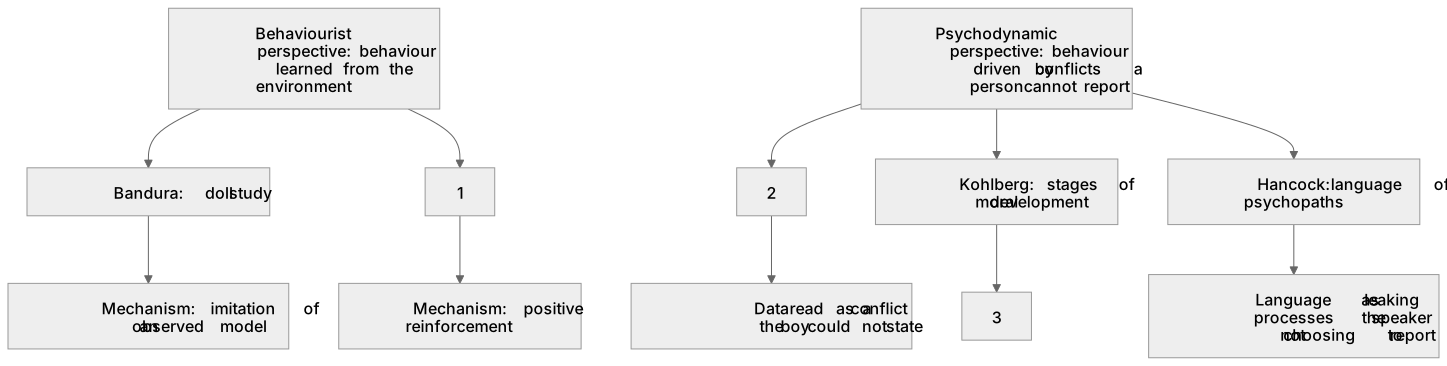
Some boxes have lost their names. Pick the right name for each number.
1Box 1
2Box 2
3Box 3
There is more to this lesson
The full lesson goes on to check your understanding and help you earn the marks. Create a free account to carry on, with your progress saved.
A week of Premium from your first lesson · Then the free plan continues · No card, no charge
Test your understanding of Section B: Areas, perspectives and debates: Studies that come from a behaviourist perspective include Bandura’s research into transmission of aggression and Chaney’s Funhaler study, while psychodynamic ideas are referred to in the research by Freud (Little Hans), Kohlberg (stages of moral development) and Hancock (language of psychopaths); however, learners may refer to other studies.
Active recall beats re-reading. Take an instant quiz now to test what you’ve learned and lock it into long-term memory.
A week of Premium from your first lesson · Then the free plan continues · No card, no charge