OCR · A-Level · Psychology
Course version: H567 · Version from Sept 2015
Option 4 Sport and exercise psychology: Audience effects (Social) – How an…
Full specification wording
Section B: Option 4 Sport and exercise psychology: Audience effects (Social) – How an audience can facilitate or inhibit sports performance; home advantage. Zajonc et al. (1969) Social enhancement and impairment of performance in the cockroach. At least one strategy for training for and playing spectator sports.
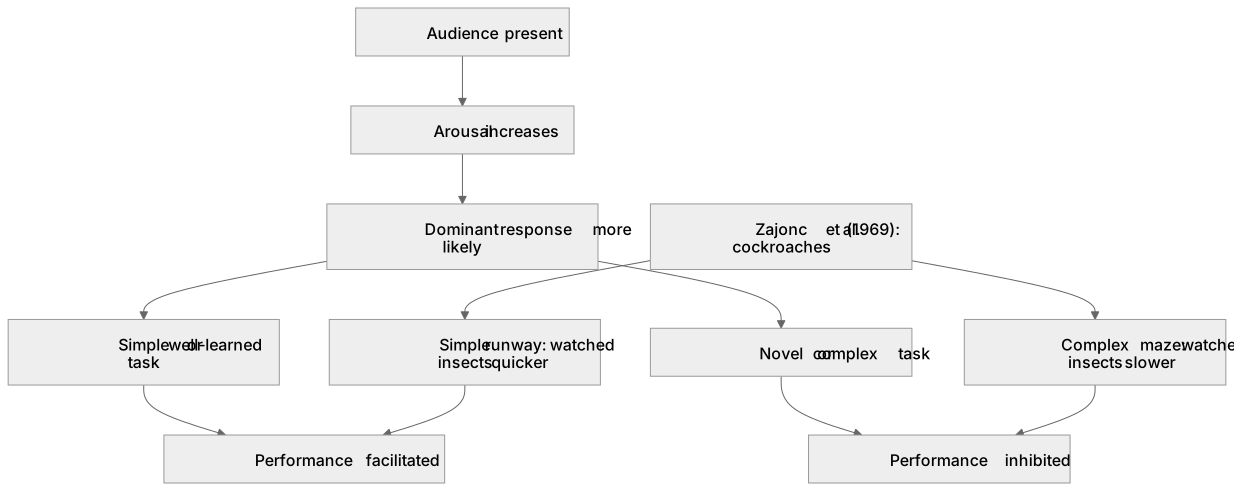
Drive theory explains audience effects: the presence of others raises arousal, strengthening the dominant response.
- Point 6 of 6
- 4 key terms
Study notes
From the teaching notes for this specification point.
The idea
Drive theory explains audience effects: the presence of others raises arousal, strengthening the dominant response. A well-learned skill is facilitated, while a novel one is inhibited. Zajonc et al. (1969) tested this on cockroaches fleeing a bright light along a simple runway or a complex maze, either alone or watched from clear side chambers by other cockroaches. Watched insects were quicker on the runway and slower in the maze. Because cockroaches cannot worry about being judged, this suggests mere presence drives the effect. Home advantage is another audience effect, often linked to crowd noise influencing referee bias. Strategies for spectator sports include training by overlearning skills until the correct response is dominant, and playing strategies like selective attention to block out crowd noise during competition.
What earns the marks
- State drive theory precisely: an audience increases arousal, and increased arousal increases the likelihood of the dominant response, which facilitates a simple or well-learned task and inhibits a novel or complex one.
- Naming the researchers and the design earns credit, so give the two tasks, the simple runway and the complex maze, and the two social conditions, alone or observed by other cockroaches in adjacent chambers.
- The finding is credited when it is directional: audience presence shortened runway times and lengthened maze times, so the same social condition helped one task and hindered the other.
- Home advantage answers gain marks for a named mechanism rather than an assertion, such as crowd noise raising arousal, familiarity with the venue, freedom from travel fatigue, and referee bias.
Common mistakes and how to put them right
Writing that an audience always improves performance.
Put it right: Drive theory predicts the opposite for a novice, and an answer that leaves out skill level cannot explain inhibition at all.
Reporting only that the cockroaches ran faster, or claiming the study shows insects prefer company.
Put it right: The maze half of the design is where impairment comes from, and dropping it loses the whole point.
Treating home advantage as proven by win percentages alone.
Put it right: That evidence is correlational, and Baumeister and Steinhilber found home teams faring worse in decisive championship games, which the simple version cannot accommodate.
Offering a strategy as vague as telling the athlete to stay calm, with no link to arousal level, the dominant response, or specific cognitive techniques.
Exam tips
- Option questions usually split this content, with one part asking you to outline the procedure or findings of the cockroach study and a later part asking you to explain a named athlete's performance.
- When the command is suggest, the marks are in the application: name the sport, say exactly what the athlete would do in training or playing, and say why that changes arousal or which response becomes dominant.
- Evaluation credit here comes from generalising from an insect to a human competitor, from the tight control of a laboratory runway against its low realism, and from the reductionism of explaining a crowd by arousal alone.
Try the lesson
The start of the Section B: Option 4 Sport and exercise psychology: Audience effects (Social) – How an audience can facilitate or inhibit sports performance; home advantage. Zajonc et al. (1969) Social enhancement and impairment of performance in the cockroach. At least one strategy for training for and playing spectator sports. lesson, made from teaching notes for this specification point.
Have a go first
In Zajonc et al.'s (1969) study on social enhancement and impairment, how did the presence of an audience of conspecifics affect the performance of cockroaches?
Listen
Drive theory explains audience effects: the presence of others raises arousal, strengthening the dominant response. A well-learned skill is facilitated, while a novel one is inhibited. Zajonc et al. (1969) tested this on cockroaches fleeing a bright light along a simple runway or a complex maze, either alone or watched from clear side chambers by other cockroaches. Watched insects were quicker on the runway and slower in the maze. Because cockroaches cannot worry about being judged, this suggests mere presence drives the effect. Home advantage is another audience effect, often linked to crowd noise influencing referee bias. Strategies for spectator sports include training by overlearning skills until the correct response is dominant, and playing strategies like selective attention to block out crowd noise during competition. A strong answer earns marks for these points. State drive theory precisely: an audience increases arousal, and increased arousal increases the likelihood of the dominant response, which facilitates a simple or well-learned task and inhibits a novel or complex one. Naming the researchers and the design earns credit, so give the two tasks, the simple runway and the complex maze, and the two social conditions, alone or observed by other cockroaches in adjacent chambers. The finding is credited when it is directional: audience presence shortened runway times and lengthened maze times, so the same social condition helped one task and hindered the other. Home advantage answers gain marks for a named mechanism rather than an assertion, such as crowd noise raising arousal, familiarity with the venue, freedom from travel fatigue, and referee bias. Exam tip: Option questions usually split this content, with one part asking you to outline the procedure or findings of the cockroach study and a later part asking you to explain a named athlete's performance.
See it
Key words
Say what each word means before you turn the card.
drive theory and arousal
Try answering aloud or in your head before turning the card.
dominant response
Try answering aloud or in your head before turning the card.
social facilitation and inhibition
Try answering aloud or in your head before turning the card.
home advantage and referee bias
Try answering aloud or in your head before turning the card.
See every definition
- drive theory and arousal
- The presence of others raises arousal, and increased arousal increases the likelihood of the dominant response.
- dominant response
- The response strengthened by increased arousal, which facilitates a simple or well-learned task and inhibits a novel or complex one.
- social facilitation and inhibition
- Audience presence facilitates a well-learned skill but inhibits a novel one, as the same social condition helps one task and hinders the other.
- home advantage and referee bias
- Another audience effect, often linked to crowd noise influencing referee bias.
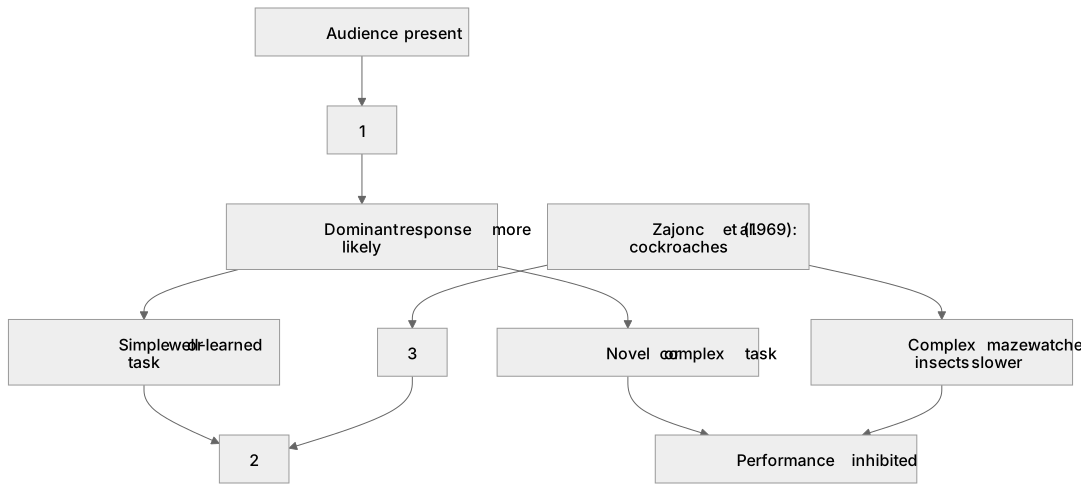
Label the diagram
Some boxes have lost their names. Pick the right name for each number.
1Box 1
2Box 2
3Box 3
There is more to this lesson
The full lesson goes on to check your understanding and help you earn the marks. Create a free account to carry on, with your progress saved.
A week of Premium from your first lesson · Then the free plan continues · No card, no charge
Test your understanding of Section B: Option 4 Sport and exercise psychology: Audience effects (Social) – How an audience can facilitate or inhibit sports performance; home advantage. Zajonc et al. (1969) Social enhancement and impairment of performance in the cockroach. At least one strategy for training for and playing spectator sports.
Active recall beats re-reading. Take an instant quiz now to test what you’ve learned and lock it into long-term memory.
A week of Premium from your first lesson · Then the free plan continues · No card, no charge