OCR · A-Level · Psychology
Course version: H567 · Version from Sept 2015
Option 4 Sport and exercise psychology: Exercise and mental health…
Full specification wording
Section B: Option 4 Sport and exercise psychology: Exercise and mental health (Biological) – Benefits of exercise to mental health. Lewis et al. (2014) Mood changes following social dance sessions in people with Parkinson’s Disease. At least one exercise strategy to improve mental health.
The biological explanations here are worth learning as competing accounts rather than as a list.
- Point 2 of 6
- 4 key terms
Study notes
From the teaching notes for this specification point.
The idea
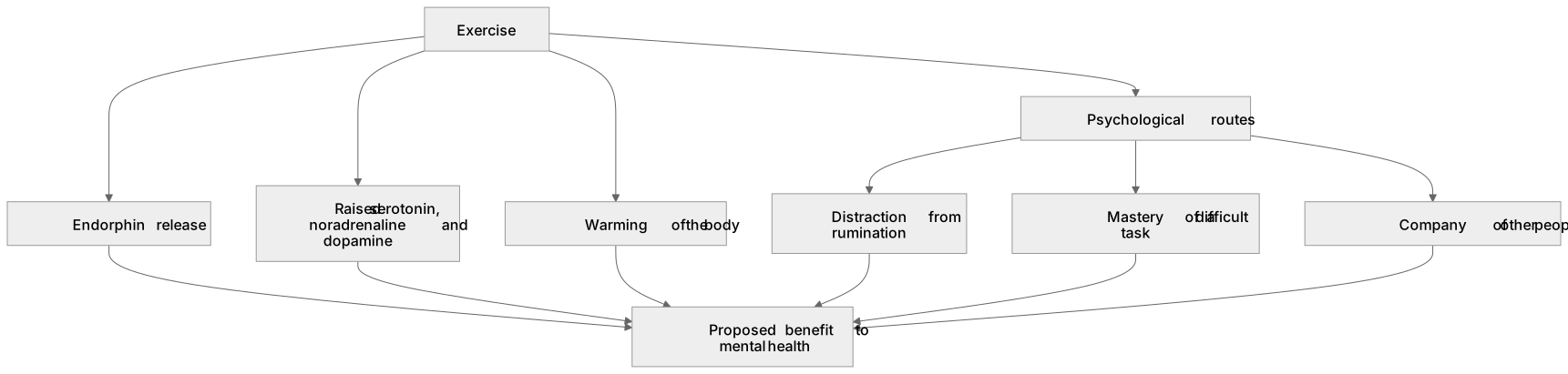
The biological explanations here are worth learning as competing accounts rather than as a list. Activity may lift mood through endorphin release, through raised availability of serotonin, noradrenaline and dopamine, through the warming of the body, or through psychological routes that have nothing to do with chemistry, namely distraction from rumination, mastery of a difficult task and the company of other people. The prescribed dance work matters because it takes a group whose condition is defined by a loss of dopamine and by social withdrawal and measures mood before and after sessions, which lets you argue about which of those routes is doing the work. Applications follow directly, from social prescribing of group activity to structured programmes for mild depression, and so do the limits.
Common mistakes and how to put them right
Writing that exercise releases endorphins and leaving it there, with no statement of how that would produce a lasting change in mood and no acknowledgement that the evidence for the endorphin route in humans is indirect.
Confusing correlation and cause when using population data, since people who are already well are more able to exercise.
Forgetting the demand characteristics in a before and after mood rating, when participants know the session was meant to cheer them up.
Presenting exercise as a cure for mental illness, which oversells a finding that is about improvement in symptoms in specific groups.
Exam tips
- Suggest questions want a programme, so include frequency, intensity, supervision and a way of measuring the outcome, not just the advice to take more exercise.
- Evaluation marks come easily from the absence of a control group in small before and after studies, so state what a control condition would have to hold constant.
- If a question asks you to discuss reductionism, this content is the clearest example available, because the same mood change has a chemical explanation and a social one.
Try the lesson
The start of the Section B: Option 4 Sport and exercise psychology: Exercise and mental health (Biological) – Benefits of exercise to mental health. Lewis et al. (2014) Mood changes following social dance sessions in people with Parkinson’s Disease. At least one exercise strategy to improve mental health. lesson, made from teaching notes for this specification point.
Have a go first
In the study by Lewis et al. (2014), which intervention was investigated for its effect on the mood of people with Parkinson’s Disease?
Listen
The biological explanations here are worth learning as competing accounts rather than as a list. Activity may lift mood through endorphin release, through raised availability of serotonin, noradrenaline and dopamine, through the warming of the body, or through psychological routes that have nothing to do with chemistry, namely distraction from rumination, mastery of a difficult task and the company of other people. The prescribed dance work matters because it takes a group whose condition is defined by a loss of dopamine and by social withdrawal and measures mood before and after sessions, which lets you argue about which of those routes is doing the work. Applications follow directly, from social prescribing of group activity to structured programmes for mild depression, and so do the limits. A strong answer earns marks for these points. Describing the key research with its design named: mood was rated by participants with Parkinson's disease immediately before and immediately after social dance sessions, a repeated measures comparison in which each person acts as their own baseline. Reporting the result, a significant improvement in self rated mood after dancing, and then doing something with it, namely noting that the design cannot separate the dancing from the music, the partner contact and the attention of the class. Naming supporting evidence from the wider literature, such as the trial comparing supervised aerobic exercise with an antidepressant in older adults with major depression, where exercise matched medication over the treatment period and the exercise group showed lower relapse at follow up. Saying what exercise does not do, since it is an adjunct and not a substitute in severe depression or psychosis, adherence collapses once a programme ends, and excessive training brings its own harms including exercise dependence. Exam tip: Suggest questions want a programme, so include frequency, intensity, supervision and a way of measuring the outcome, not just the advice to take more exercise.
See it
Key words
Say what each word means before you turn the card.
exercise and mood
Try answering aloud or in your head before turning the card.
endorphin and monoamine explanations
Try answering aloud or in your head before turning the card.
social and distraction explanations
Try answering aloud or in your head before turning the card.
repeated measures and control conditions
Try answering aloud or in your head before turning the card.
See every definition
- exercise and mood
- Activity may lift mood through endorphin release, raised availability of serotonin, noradrenaline and dopamine, warming of the body, or psychological routes that have nothing to do with chemistry.
- endorphin and monoamine explanations
- These biological accounts propose that activity lifts mood through endorphin release or through raised availability of serotonin, noradrenaline and dopamine.
- social and distraction explanations
- Psychological routes to lifted mood that have nothing to do with chemistry, namely distraction from rumination, mastery of a difficult task and the company of other people.
- repeated measures and control conditions
- A repeated measures comparison is one in which each person acts as their own baseline, and the absence of a control group in small before and after studies is a source of evaluation marks.
Label the diagram
Some boxes have lost their names. Pick the right name for each number.
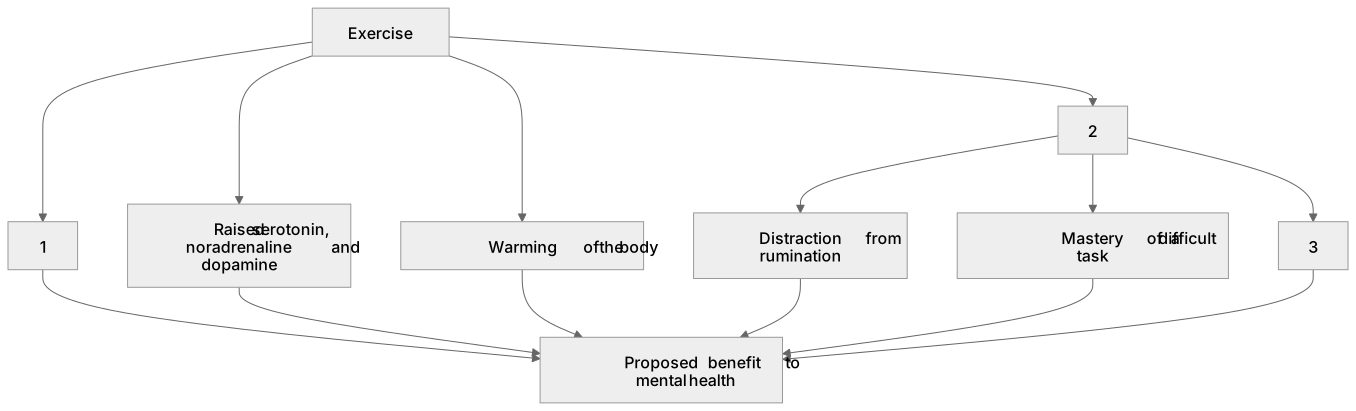
1Box 1
2Box 2
3Box 3
There is more to this lesson
The full lesson goes on to check your understanding and help you earn the marks. Create a free account to carry on, with your progress saved.
A week of Premium from your first lesson · Then the free plan continues · No card, no charge
Test your understanding of Section B: Option 4 Sport and exercise psychology: Exercise and mental health (Biological) – Benefits of exercise to mental health. Lewis et al. (2014) Mood changes following social dance sessions in people with Parkinson’s Disease. At least one exercise strategy to improve mental health.
Active recall beats re-reading. Take an instant quiz now to test what you’ve learned and lock it into long-term memory.
A week of Premium from your first lesson · Then the free plan continues · No card, no charge