OCR · A-Level · Psychology
Course version: H567 · Version from Sept 2015
Option 4 Sport and exercise psychology: Personality (Cognitive) –…
Full specification wording
Section B: Option 4 Sport and exercise psychology: Personality (Cognitive) – Personality, its measurement and its relationship to sport. Kroll and Crenshaw (1970) Multivariate personality profile analysis of four athletic groups. At least one strategy for using knowledge of personality to improve sports performance.
The question behind this topic is whether personality predicts sporting behaviour well enough to be useful, and the honest answer taught at this level is only weakly.
- Point 4 of 6
- 3 key terms
Study notes
From the teaching notes for this specification point.
The idea
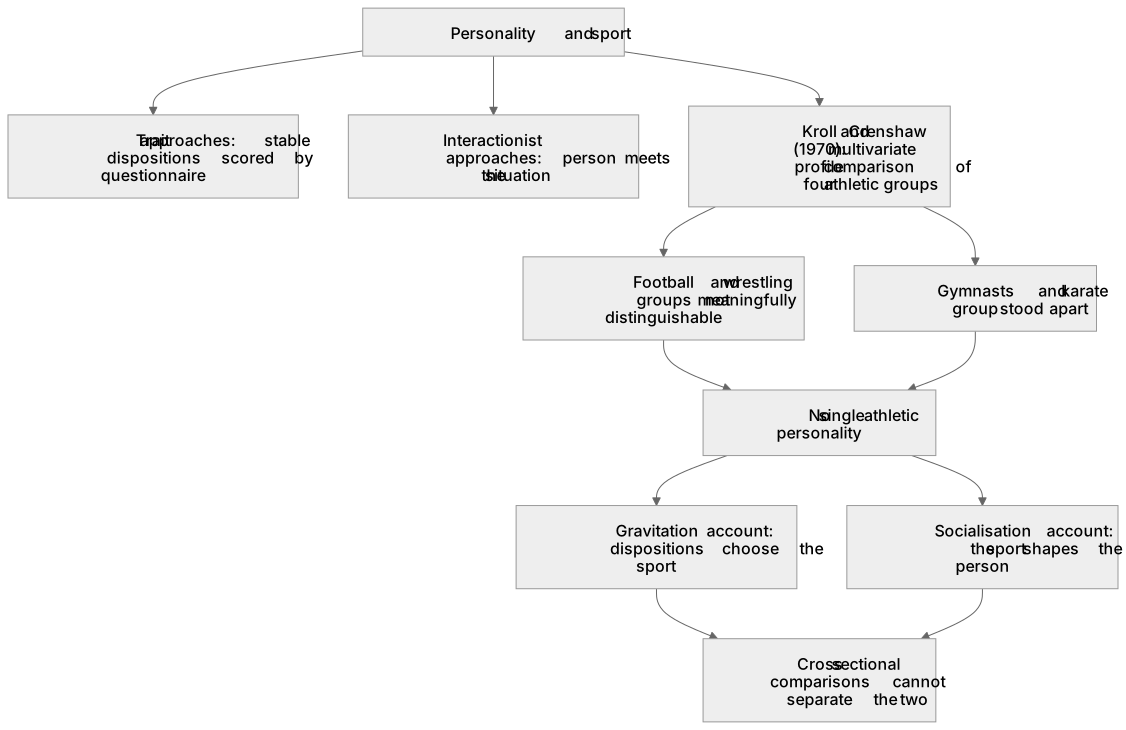
The question behind this topic is whether personality predicts sporting behaviour well enough to be useful, and the honest answer taught at this level is only weakly. Trait approaches assume stable dispositions such as extraversion, neuroticism and psychoticism that can be scored by questionnaire and compared across groups, while interactionist approaches insist behaviour comes from the person meeting the situation, which is why a mild club player becomes unrecognisable in a final. Two rival stories about any difference you find are worth memorising: the gravitation account says people with particular dispositions choose particular sports, and the socialisation account says the sport shapes them. Cross sectional comparisons of athletes cannot separate the two.
What earns the marks
- Treating the analysis as a strength, since comparing whole profiles avoids the problem of hunting through many single traits until one reaches significance.
Common mistakes and how to put them right
Reporting the study as showing that athletes have a different personality from non athletes, which is not the comparison it made.
Using personality tests as selection tools in an application answer without acknowledging that the evidence does not support that use and that it raises fairness and ethical problems.
Describing trait theory without ever mentioning the situation, then being unable to explain why the same person behaves differently in training and in competition.
Assuming causation from a group difference, when the gravitation and socialisation accounts both fit the same data.
Exam tips
- Where the question asks you to describe a way of measuring personality, name the instrument type and say what it produces, a profile of scores, and then give one problem with that output.
- Discussion items reward the nomothetic and idiographic debate here, since a profile averaged over a squad tells a coach very little about the individual in front of them.
- When asked to suggest a strategy, make it about how knowledge of personality changes what the coach does, and state how the effect would be evaluated.
Try the lesson
The start of the Section B: Option 4 Sport and exercise psychology: Personality (Cognitive) – Personality, its measurement and its relationship to sport. Kroll and Crenshaw (1970) Multivariate personality profile analysis of four athletic groups. At least one strategy for using knowledge of personality to improve sports performance. lesson, made from teaching notes for this specification point.
Have a go first
In their multivariate personality profile analysis, which two athletic groups did Kroll and Crenshaw (1970) find to have highly similar personality profiles?
Listen
The question behind this topic is whether personality predicts sporting behaviour well enough to be useful, and the honest answer taught at this level is only weakly. Trait approaches assume stable dispositions such as extraversion, neuroticism and psychoticism that can be scored by questionnaire and compared across groups, while interactionist approaches insist behaviour comes from the person meeting the situation, which is why a mild club player becomes unrecognisable in a final. Two rival stories about any difference you find are worth memorising: the gravitation account says people with particular dispositions choose particular sports, and the socialisation account says the sport shapes them. Cross sectional comparisons of athletes cannot separate the two. A strong answer earns marks for these points. Describing the key research as a comparison of personality profiles across four sports, gridiron footballers, wrestlers, gymnasts and karate participants, using a multi factor personality questionnaire and a multivariate analysis of whole profiles rather than one trait at a time. Reporting the finding at the right level: the football and wrestling groups were not meaningfully distinguishable from each other, while the gymnasts and the karate group stood apart, so there is no single athletic personality and differences run between sports. Treating the analysis as a strength, since comparing whole profiles avoids the problem of hunting through many single traits until one reaches significance. Naming a use for personality knowledge that is defensible, such as matching the coaching climate and the level of feedback to a performer's disposition, or monitoring mood profiles across a training block to detect overtraining, rather than selecting athletes by test score. Exam tip: Where the question asks you to describe a way of measuring personality, name the instrument type and say what it produces, a profile of scores, and then give one problem with that output.
See it
Key words
Say what each word means before you turn the card.
trait theories of personality
Try answering aloud or in your head before turning the card.
interactionist approach
Try answering aloud or in your head before turning the card.
gravitation and socialisation accounts
Try answering aloud or in your head before turning the card.
See every definition
- trait theories of personality
- Approaches assuming stable dispositions such as extraversion, neuroticism and psychoticism that can be scored by questionnaire and compared across groups.
- interactionist approach
- The view that behaviour comes from the person meeting the situation, which is why a mild club player becomes unrecognisable in a final.
- gravitation and socialisation accounts
- Two rival stories about any difference found: the gravitation account says people with particular dispositions choose particular sports, and the socialisation account says the sport shapes them.
Label the diagram
Some boxes have lost their names. Pick the right name for each number.
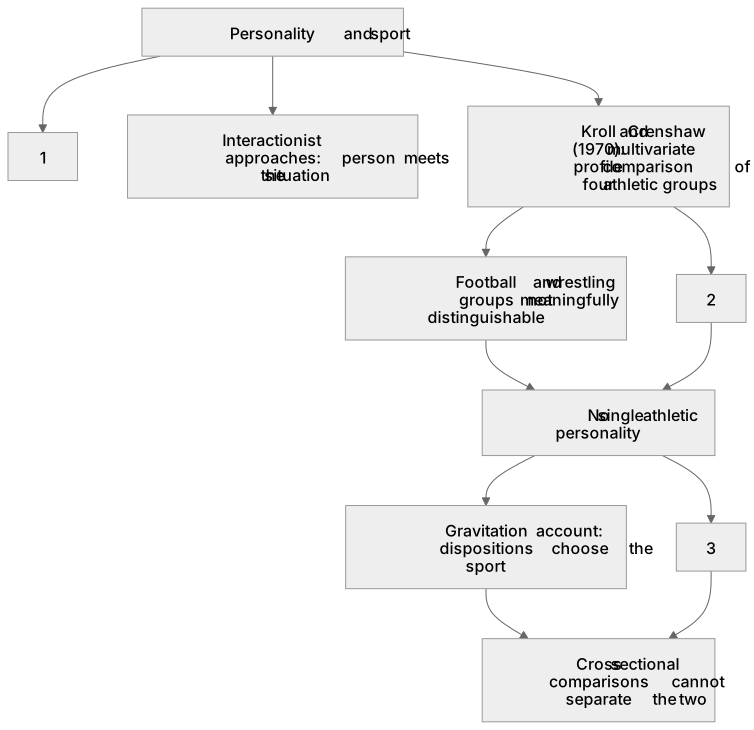
1Box 1
2Box 2
3Box 3
There is more to this lesson
The full lesson goes on to check your understanding and help you earn the marks. Create a free account to carry on, with your progress saved.
A week of Premium from your first lesson · Then the free plan continues · No card, no charge
Test your understanding of Section B: Option 4 Sport and exercise psychology: Personality (Cognitive) – Personality, its measurement and its relationship to sport. Kroll and Crenshaw (1970) Multivariate personality profile analysis of four athletic groups. At least one strategy for using knowledge of personality to improve sports performance.
Active recall beats re-reading. Take an instant quiz now to test what you’ve learned and lock it into long-term memory.
A week of Premium from your first lesson · Then the free plan continues · No card, no charge