OCR · GCSE · Psychology
Conformity
Solomon Asch's 1955 study on conformity is a cornerstone of social psychology, revealing the surprising power of group pressure to make us doubt our own eyes. For your OCR GCSE exam, mastering this study isn't just about learning facts; it's about understanding why we yield to the majority, even when we know they're wrong, and how to critically evaluate the evidence – skills that are heavily rewarded with AO2 and AO3 marks."
- 14 min read
- 3 worked examples
Study Notes

Overview
Conformity, a key topic in OCR's J203 specification (Paper 2, Section A), explores the powerful influence a group has on an individual's beliefs and behaviours. Examiners expect candidates to have a precise understanding of conformity as 'yielding to group pressure' and to be able to recall the specific procedures, findings, and conclusions of Solomon Asch's (1955) seminal study. This is not just a historical case study; it is a foundational concept used to explain real-world social phenomena. High-level responses will move beyond simple description (AO1) to apply knowledge to novel scenarios (AO2) and critically evaluate the research in terms of its methodology and ethical implications (AO3). A firm grasp of the distinction between social (situational) and dispositional (individual) factors affecting conformity is essential for achieving top marks, as is the ability to use specific terminology and statistical evidence accurately.

Key Study: Asch (1955) - Conformity in a Group Setting
The Aim
What was investigated: Asch wanted to investigate the extent to which social pressure from a majority group could affect a person to conform.
Why it matters: This was a direct test of how powerful a group can be in making an individual doubt their own judgement, even in an unambiguous situation. For the exam, you must be clear that this was a test of 'yielding to group pressure'.
The Procedure
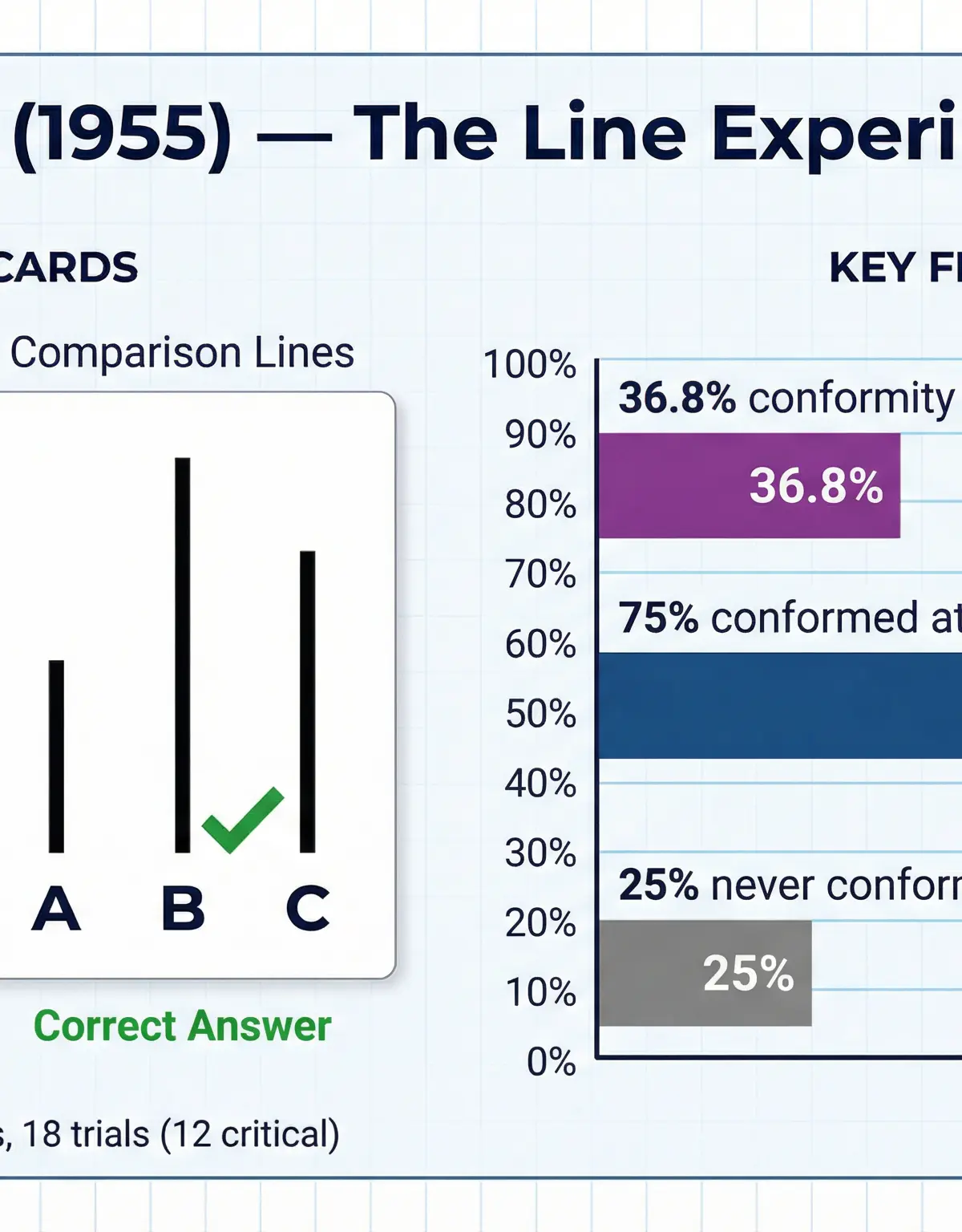
What happened: Asch recruited 123 male American undergraduate students. Each participant was placed in a group with 6 to 8 other people, who they believed were also real participants. In reality, they were all confederates (actors working for Asch). The group was shown two large white cards. On one card was a single 'standard' line. On the other card were three 'comparison' lines of different lengths. Participants were asked to state, one by one, which of the three comparison lines was the same length as the standard line. The real participant always answered last or second to last.
The Twist: On 12 out of the 18 trials (known as the 'critical trials'), the confederates all gave the same, obviously incorrect answer. Asch was measuring whether the real participant would conform to the majority's wrong answer or stick to their own judgement.
Specific Knowledge: Candidates must know: 123 participants, all male and from the USA; 18 trials in total, with 12 being 'critical trials'.
The Findings & Conclusion
What was found: The results were striking. On the 12 critical trials, the average conformity rate was 36.8%. This means that, on over a third of occasions, the real participants yielded to group pressure and gave the wrong answer. Furthermore, 75% of participants conformed at least once. Only 25% of participants never conformed at all.
Why it matters: This demonstrated that people will conform to a majority view even when that view is clearly wrong. When interviewed afterwards, most participants said they conformed to avoid rejection (Normative Social Influence), while a few said they genuinely doubted their own eyes (Informational Social Influence). Credit is given for knowing these two key statistics: 36.8% and 75%.
Factors Affecting Conformity
Asch conducted several variations of his study to identify the factors that increase or decrease conformity. Examiners frequently ask 'what if' questions based on these variations, so knowing them is crucial for AO2 application marks.
Social (Situational) Factors
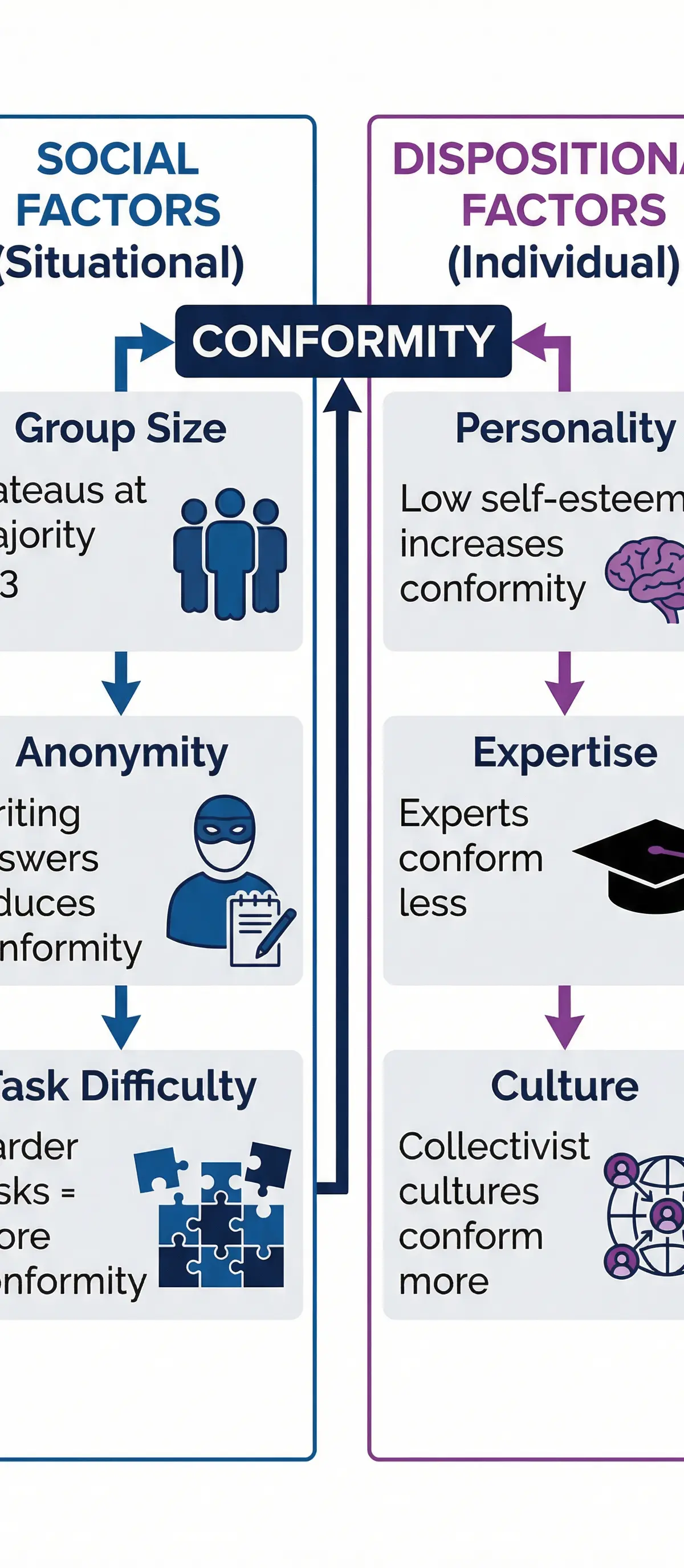
- Group Size: Asch found that with just one confederate, conformity was very low (3%). With two confederates, it rose to 13%. With three confederates, it jumped to 32%. However, adding more confederates beyond a majority of three did not significantly increase conformity. Key point: Conformity plateaus after a majority of three.
- Anonymity / Unanimity: In one variation, Asch had a 'dissenter' – a confederate who gave the correct answer. With this social support, conformity dropped to just 5.5%. In another variation, participants were allowed to write their answers down privately. Here, conformity also dropped significantly. Key point: Having an ally or being able to answer privately drastically reduces conformity.
- Task Difficulty: Asch made the task harder by making the comparison lines much closer in length to the standard line. In this situation, conformity increased. Key point: When we are uncertain, we look to others for guidance (Informational Social Influence).
Dispositional (Individual) Factors
- Personality: Research has suggested that individuals with lower self-esteem and a higher need for social approval are more likely to conform. They are more concerned about being liked and accepted by the group.
- Expertise: Individuals with more expertise in a specific area are less likely to conform. For example, an art student would be less likely to conform in a task judging aesthetics than a maths student, as they would have more confidence in their own judgement.
Evaluation of Asch's Research
For AO3 marks, you must be able to critically evaluate Asch's study. The GRAVE acronym is an excellent framework for this.
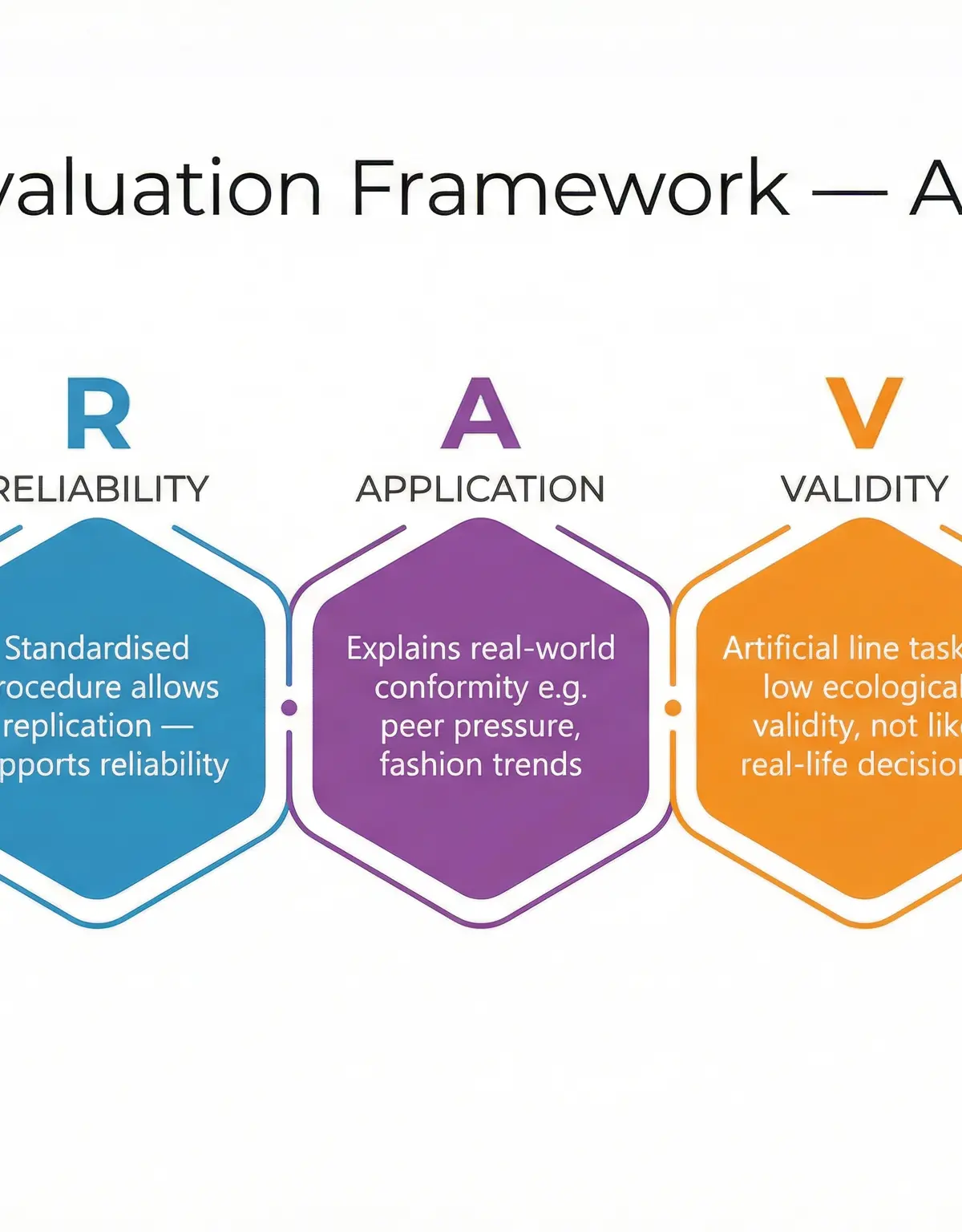
- G - Generalisability: The sample was biased. Asch only used male university students from the USA. Therefore, the results cannot be reliably generalised to females or people from other cultures. This is a major limitation.
- R - Reliability: The study has high reliability. It was a laboratory experiment with a standardised procedure (e.g., same lines, same number of trials, same confederate behaviour). This means it can be easily replicated to check for consistent results.
- A - Application: The research has real-world applications. It helps explain why people engage in behaviours like smoking or drinking due to peer pressure, or why juries might be influenced by a majority verdict.
- V - Validity: The study has been criticised for its low ecological validity. The task of judging line lengths is artificial and does not reflect the complex decisions people make in real-life social situations. Therefore, we cannot be sure that the conformity seen in the lab would be the same in everyday life. It also has low temporal validity, as it was conducted in 1950s America, a more conformist time.
- E - Ethics: There were significant ethical issues. Participants were deceived as they were told it was a study of visual perception, not conformity. They did not give informed consent. They were also put in a stressful and embarrassing situation, which could be seen as a failure in the protection from harm.",
"podcast_script": "CONFORMITY — OCR GCSE PSYCHOLOGY PODCAST
A 10-Minute Study Guide Episode
[INTRO — approximately 1 minute]
Hello and welcome! I'm so glad you've tuned in to this study session. Today we're diving into one of the most fascinating and exam-critical topics in your OCR GCSE Psychology course — Conformity. This sits in Paper 2, Section A, under Social Influence, and trust me, once you understand it properly, it's one of those topics that will earn you marks across multiple question types.
Whether you're revising for the first time or doing a final polish before your exam, this episode has everything you need — the core theory, Asch's famous study, the factors that affect conformity, exam tips, common mistakes, and a quick-fire quiz at the end to test yourself. So grab a pen, get comfortable, and let's get started.
[CORE CONCEPTS — approximately 5 minutes]
Let's begin with the definition, because this is where marks are won and lost right from the start. Conformity is defined as yielding to group pressure. Notice that word — yielding. It's not just copying someone. It's specifically about changing your behaviour, opinions, or beliefs because of real or imagined pressure from a group. Examiners want that precision. If you write "doing what others do" without mentioning group pressure, you're likely to lose a mark on a definition question.
Now, the study you absolutely must know inside out is Solomon Asch's 1955 line experiment. Here's what happened. Asch recruited 123 male American university students. Each participant was placed in a room with what they believed were other participants — but those others were actually confederates, meaning they were actors working with the researcher.
The task seemed simple. Everyone was shown a card with one line on it — called the standard line — and then a second card with three comparison lines labelled A, B, and C. Participants had to say out loud which comparison line matched the standard line. The answer was always obvious. But here's the twist — the confederates had been instructed to give the wrong answer on 12 out of 18 trials. These are called the critical trials. The real participant always answered last or second to last, so they heard the wrong answers before giving their own.
What did Asch find? The results were remarkable. On those critical trials, the real participants gave the wrong answer — matching the confederates — 36.8% of the time. Let me say that again because you need to memorise this: 36.8% conformity rate on critical trials. And even more striking — 75% of participants conformed at least once across the study. Only 25% never conformed at all.
Why did they conform? When Asch interviewed participants afterwards, most said they knew the answer was wrong but didn't want to stand out or look foolish. This is called normative social influence — conforming to fit in or avoid embarrassment, even when you know the group is wrong. A smaller number said they genuinely began to doubt their own perception and thought the group must be right. That's informational social influence — conforming because you believe the group has better information than you.
Now let's talk about the factors that affect conformity, because OCR loves asking you to apply these to scenarios. There are two categories: Social Factors, which are situational — meaning they're about the situation around you — and Dispositional Factors, which are individual — meaning they're about the person themselves.
Starting with Social Factors. First is group size. Asch found that conformity increased as the majority grew from one to three people. But — and this is critical — it plateaued after a majority of three. Adding more confederates beyond three did not significantly increase conformity. So conformity does not increase infinitely with group size. That's a very common mistake in exams.
Second social factor is anonymity. When Asch allowed participants to write their answers privately rather than saying them out loud, conformity dropped dramatically. This shows that public visibility is a key driver — people conform more when others can see their response.
Third is task difficulty. When the line differences were made more subtle and harder to judge, conformity increased. This makes sense — when we're unsure of the correct answer, we're more likely to look to others for guidance. This links to informational social influence.
Now for Dispositional Factors. Personality plays a role — individuals with lower self-esteem or higher need for social approval tend to conform more. Expertise matters too — someone who is knowledgeable in a particular area is less likely to conform because they trust their own judgement. And culture is relevant — research suggests that collectivist cultures, where group harmony is prioritised, tend to show higher conformity rates than individualist cultures like the USA where Asch conducted his research.
[EXAM TIPS AND COMMON MISTAKES — approximately 2 minutes]
Right, let's get into the exam strategy, because knowing the content is only half the battle.
The biggest mistake I see candidates make is confusing conformity with obedience. They are different. Conformity is about peer pressure — changing behaviour because of pressure from people at the same level as you, like classmates or friends. Obedience is about following orders from an authority figure — like a teacher, police officer, or doctor. If an exam question gives you a scenario involving a boss or a teacher telling someone what to do, that's obedience, not conformity.
Second common mistake — saying conformity increases infinitely with group size. It does not. It plateaus at a majority of three. If you say "the bigger the group, the more conformity there will be," you will not receive credit for that point.
Third — when evaluating Asch's study, don't just say "it was unethical." That's too vague. You need to specify that participants were deceived — they were told the other people were real participants when they were actually confederates — and that they did not give informed consent because they didn't know the true aim of the study. Those are the specific ethical issues that earn marks.
Fourth — and this is huge for AO2 application questions — you must anchor your answer to the scenario. If the question gives you a character called Sam who is unsure about a decision because he lacks knowledge in that area, you can't just describe what Asch found. You need to write something like: "Sam is likely to conform because, as shown by Asch, when individuals lack expertise in a task, they are more susceptible to informational social influence — Sam's uncertainty means he will look to the group for guidance." That explicit link to the scenario is what separates a Level 2 answer from a Level 3.
For 13-mark Discuss questions, structure your response as: description of the theory or study first — that's your AO1 — followed by three distinct evaluation points — that's your AO3. Use the GRAVE acronym to make sure your evaluation is broad: Generalisability, Reliability, Application, Validity, Ethics. Each of those gives you a different angle to evaluate from.
[QUICK-FIRE RECALL QUIZ — approximately 1 minute]
Time for a quick-fire quiz! Pause after each question and try to answer before I give you the answer.
Question one: What is the definition of conformity? ... Answer: Yielding to group pressure.
Question two: What percentage of participants in Asch's study conformed on critical trials? ... Answer: 36.8%.
Question three: At what majority size does conformity plateau in Asch's variations? ... Answer: A majority of three.
Question four: What is the difference between normative and informational social influence? ... Answer: Normative is conforming to fit in and avoid embarrassment; informational is conforming because you believe the group has better knowledge.
Question five: Name one ethical issue with Asch's study. ... Answer: Deception — participants were not told the true aim and did not give informed consent.
How did you do? If you stumbled on any of those, go back and review that section.
[SUMMARY AND SIGN-OFF — approximately 1 minute]
Let's wrap up. Today we covered the definition of conformity as yielding to group pressure, Asch's 1955 line experiment with its key statistics of 36.8% and 75%, the social factors of group size, anonymity, and task difficulty, the dispositional factors of personality, expertise, and culture, and the key exam strategies including the GRAVE framework, the Hook and Anchor method for AO2 application, and the critical distinction between conformity and obedience.
Remember — precision earns marks. Know your statistics, name your ethical issues specifically, and always anchor your application answers to the scenario in front of you.
You've got this. Good luck in your exam, and I'll see you in the next episode. Keep revising!
[END OF PODCAST]"
Worked Examples
3 worked examples — open one to explore the question and available guidance.