OCR · GCSE · Psychology
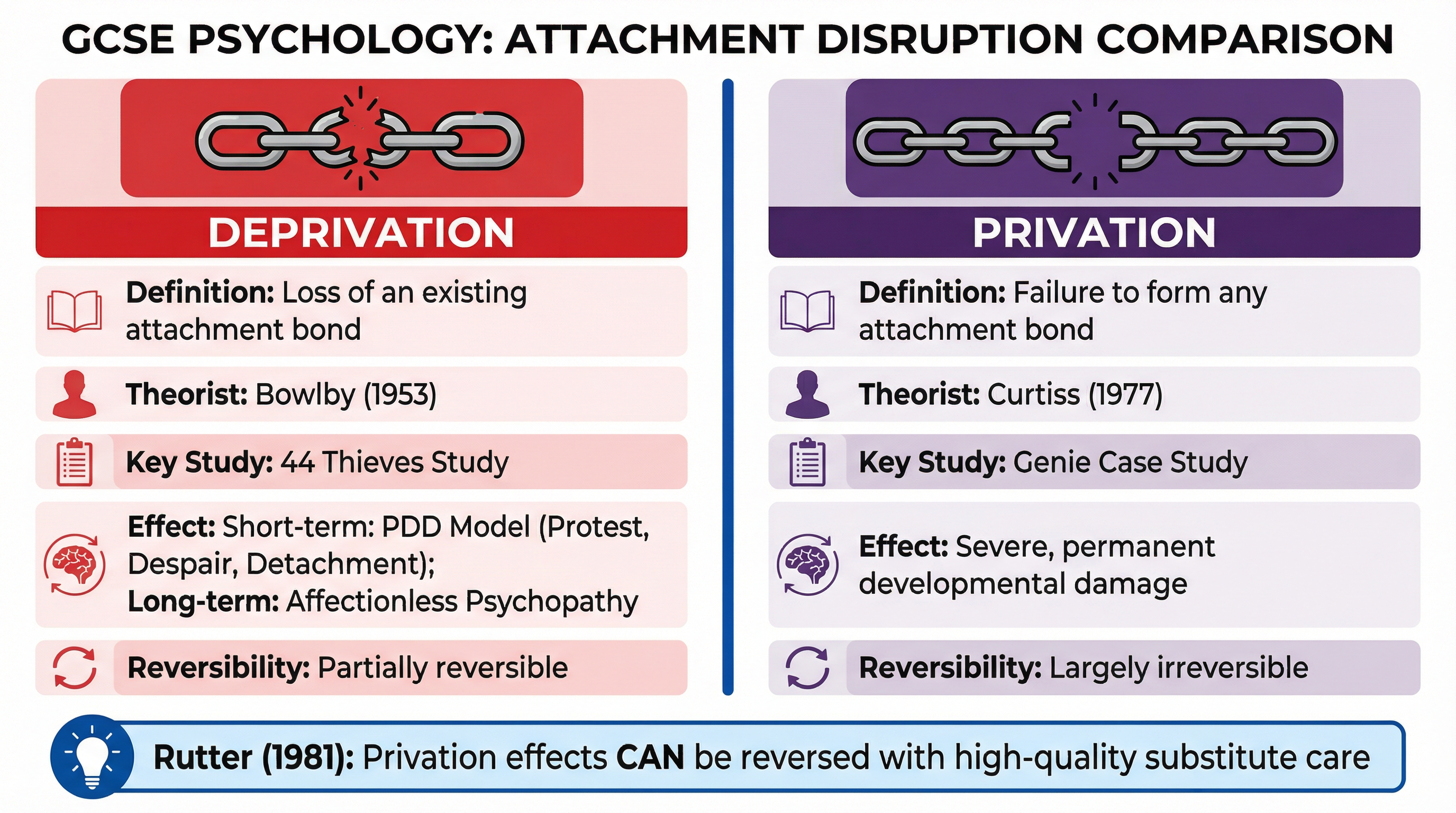
Deprivation and Privation
This guide dissects the critical difference between deprivation and privation in attachment theory, a high-value topic for OCR GCSE Psychology. It unpacks Bowlby's foundational research and Rutter's essential critiques to give candidates the analytical edge needed for top-band marks."
- 7 min read
- 3 worked examples
- 5 practice questions
Study Notes

Overview
This topic explores the profound impact of early childhood experiences on development, focusing on the disruption of attachment. For the OCR exam, candidates must master the distinction between deprivation (the loss of a primary attachment) and privation (the failure to form an attachment). This is not just a matter of definition; it is central to understanding the varying severity and potential for recovery from early emotional trauma. The core of this topic is Bowlby's Maternal Deprivation Hypothesis, a theory that revolutionised our understanding of child development but has also faced significant criticism. Examiners expect candidates to move beyond simple descriptions of studies like the 44 Thieves and engage in sophisticated evaluation, contrasting Bowlby's deterministic view with Rutter's more nuanced perspective on the potential for reversing the effects of privation. Success in this area hinges on precise use of terminology, accurate recall of study findings, and the ability to apply these concepts to novel scenarios presented in the exam.

Key Concepts & Studies
Bowlby's Maternal Deprivation Hypothesis
Date(s): 1951
What happened: John Bowlby proposed that a continuous, warm, and intimate relationship with a mother or permanent mother-substitute is essential for a child's psychological health. He argued for a critical period in the first 2.5 years of life, during which prolonged separation could lead to irreversible negative consequences.
Why it matters: This was a landmark theory that highlighted the importance of emotional care over simple physical care. It led to major changes in institutional childcare, such as allowing parents to visit children in hospital. For the exam, it's the foundation of all questions on this topic.
Specific Knowledge: Candidates must know the term 'Affectionless Psychopathy' – a condition Bowlby believed was caused by maternal deprivation, characterised by a lack of empathy, guilt, and deep feeling for others.
Bowlby's 44 Thieves Study
Date(s): 1944
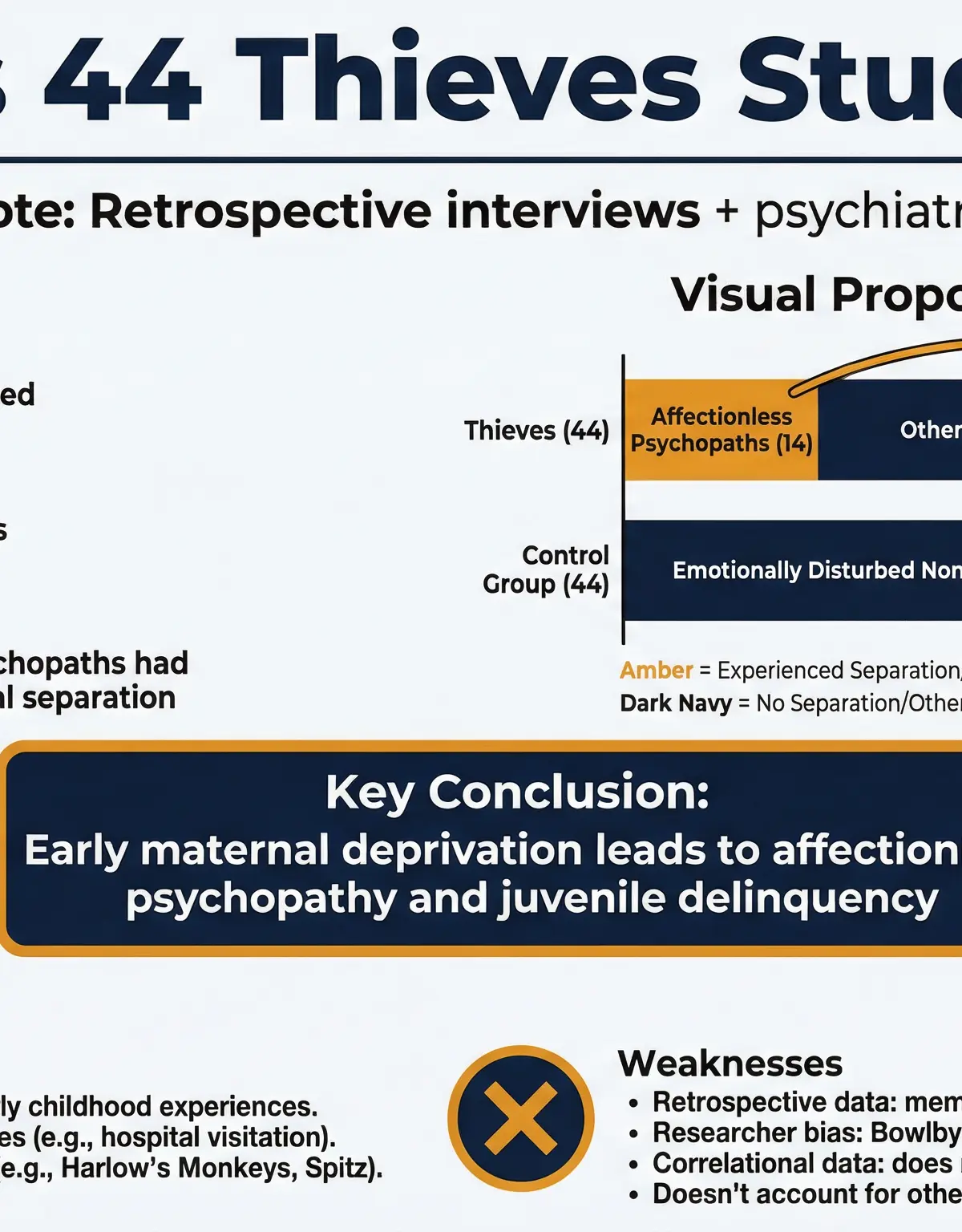
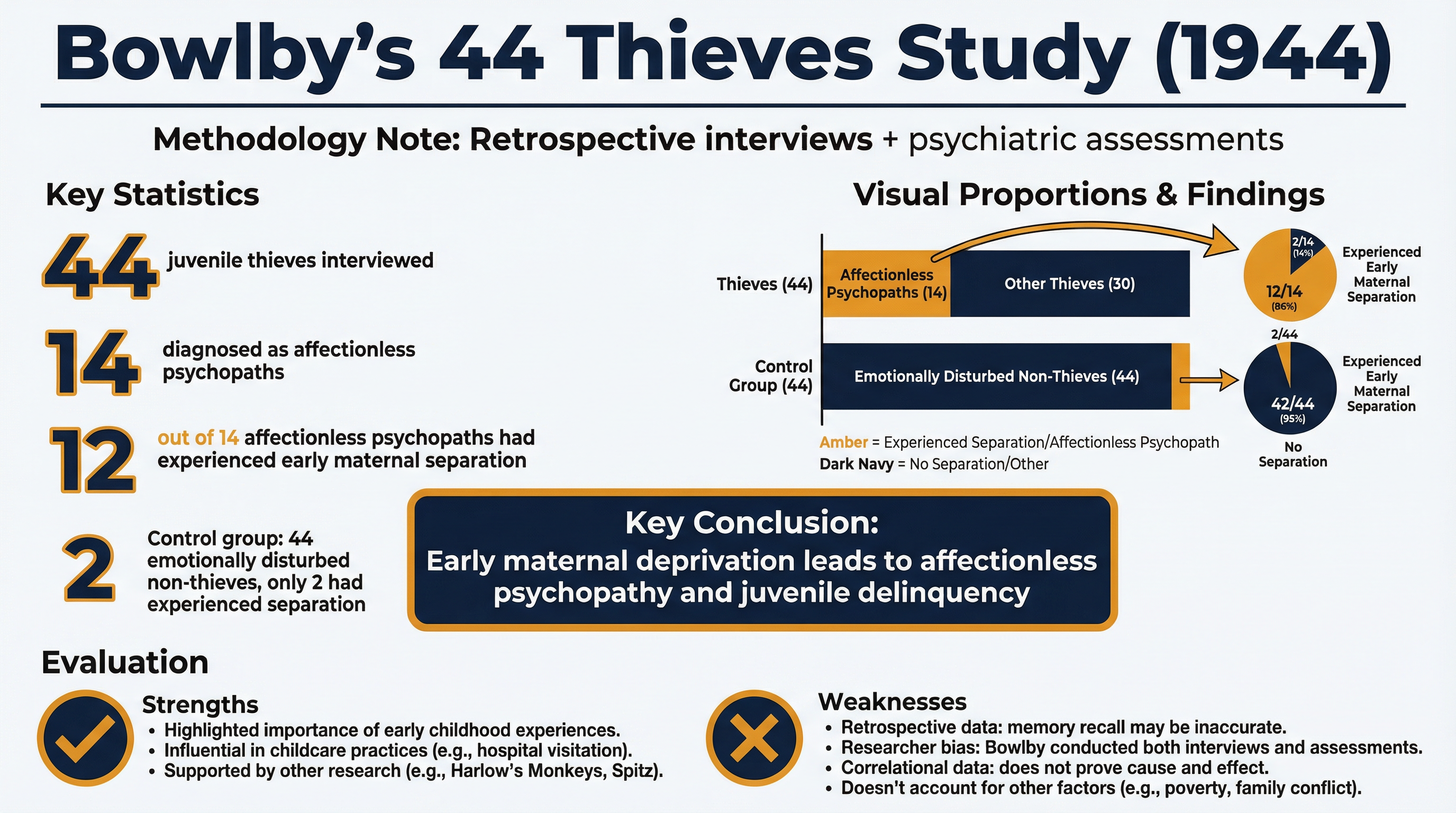
What happened: Bowlby analysed the case histories of 88 children from his clinic. 44 were referred for stealing, and the other 44 were a control group. He diagnosed 14 of the thieves as 'affectionless psychopaths'.
Why it matters: This study provided the primary evidence for his Maternal Deprivation Hypothesis. The findings appeared to show a direct link between early separation and later deviant behaviour.
Specific Knowledge: The key statistic to memorise for AO1 marks is that 12 of the 14 affectionless psychopaths had experienced prolonged maternal separation in the first two years, compared to only 2 in the control group.
The PDD Model
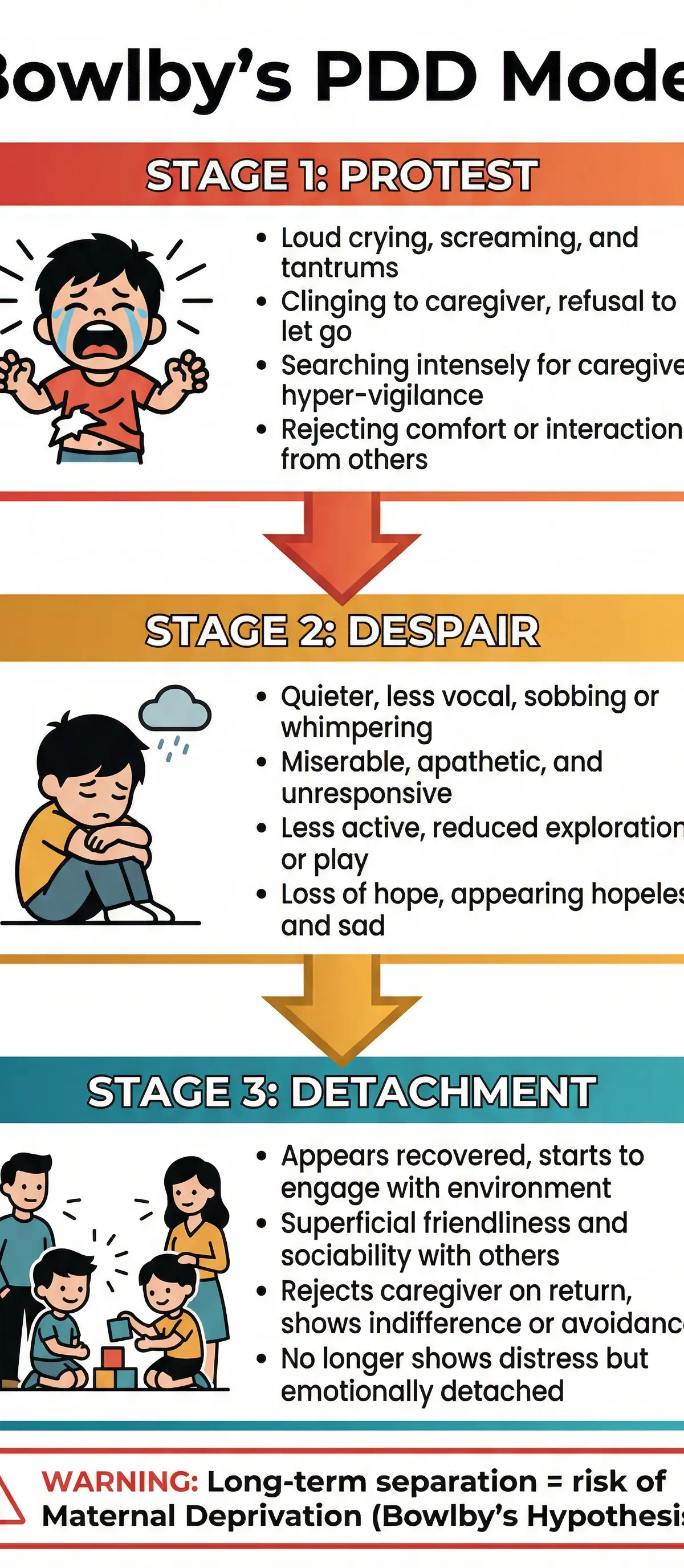
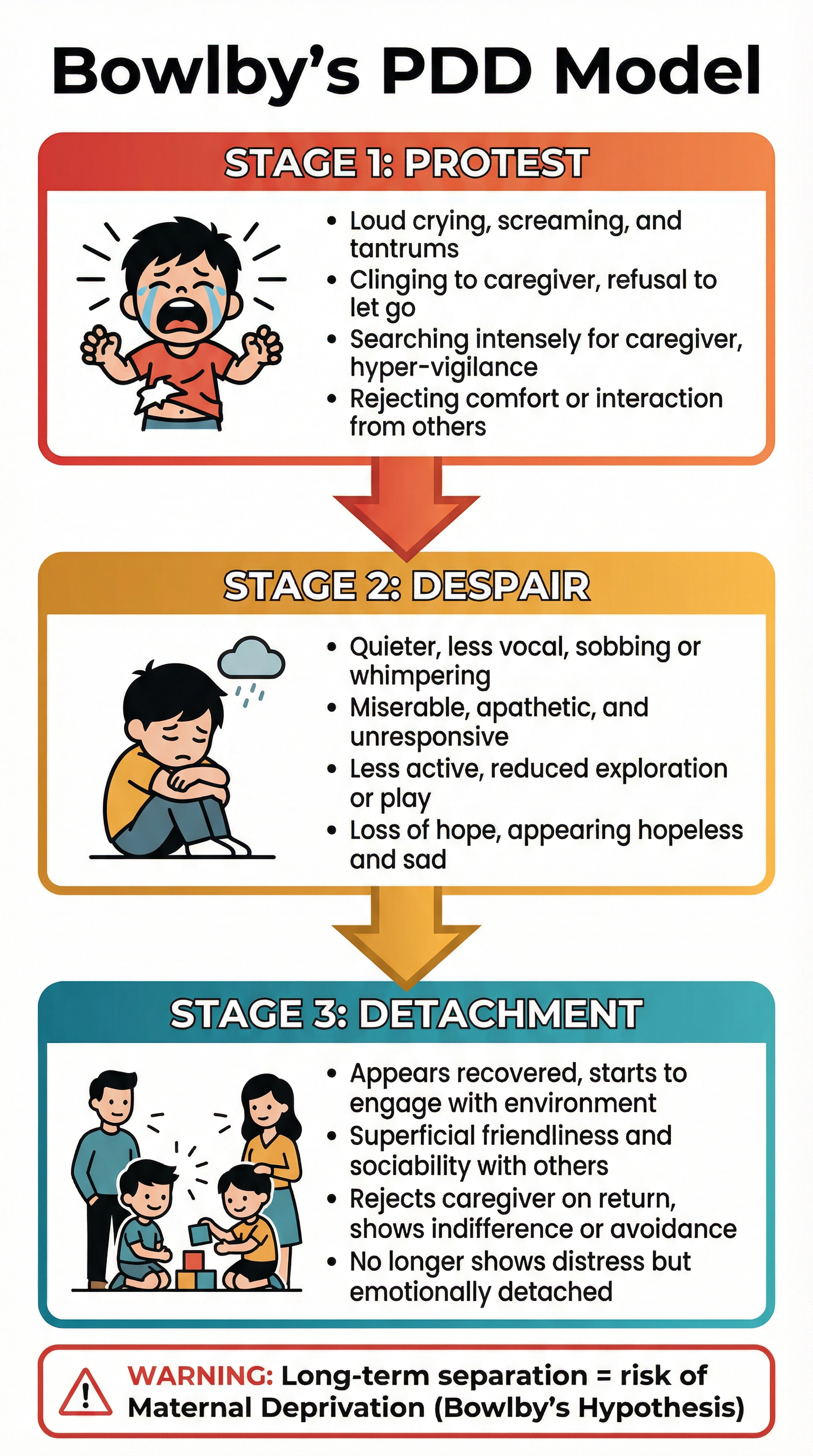
What happened: Bowlby, along with Robertson & Robertson, observed the behaviour of children separated from their caregivers for short periods (e.g., in hospital). They identified a clear sequence of behaviours.
Why it matters: This model describes the immediate, short-term effects of separation, which is distinct from the long-term effects of deprivation. Candidates must not conflate the two.
Specific Knowledge: The three stages are Protest (crying, screaming, clinging), Despair (apathetic, withdrawn, miserable), and Detachment (outwardly recovered, but rejects caregiver on return). Credit is given for using these specific terms.
Rutter's Critique & The Concept of Privation
Date(s): 1981
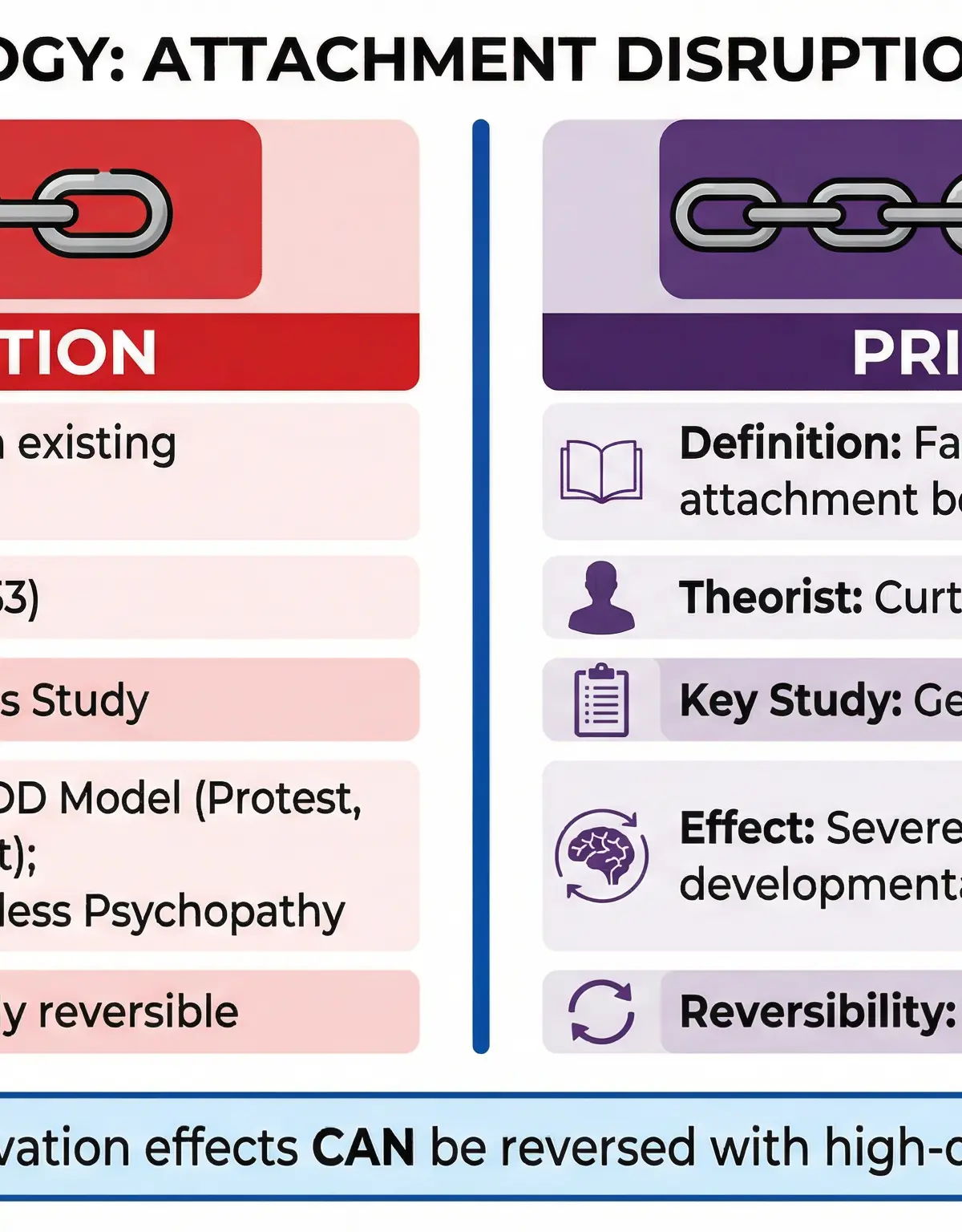
What happened: Michael Rutter argued that Bowlby failed to distinguish between deprivation and privation. He suggested that the most severe, long-lasting damage Bowlby described was actually due to privation (the complete failure to form a bond). Rutter also challenged the idea that the effects were irreversible, arguing that high-quality substitute care could reverse the damage.
Why it matters: Rutter's work provides the main counter-argument to Bowlby, which is essential for AO3 evaluation marks. It introduces a more optimistic and nuanced view.
Specific Knowledge: Referencing Rutter's Romanian Orphan studies (though often an A-Level topic, it's relevant context) shows deeper understanding. The key point is that Rutter believed it was the quality of the attachment bond, not just its presence or absence, that was crucial.
The Case of Genie
Date(s): Discovered 1970
What happened: Genie was a girl who was isolated in a locked room from the age of 20 months to 13 years. She had no social contact and was never spoken to. She is a case of extreme privation.
Why it matters: Genie's case study provides powerful evidence for the effects of privation. Despite intensive therapy, she never fully acquired language or formed strong attachments, suggesting there are critical periods for development that, if missed, can cause permanent damage.
Specific Knowledge: Use Genie to evaluate Bowlby's theory. Does her case support or challenge it? It supports the idea of a critical period and the severity of attachment disruption, but as a case of privation, it also supports Rutter's argument that Bowlby may have been studying the wrong thing.
Second-Order Concepts
Causation
Candidates must understand the causal link proposed by Bowlby: prolonged separation from a primary caregiver during the critical period causes affectionless psychopathy and developmental issues. However, this is a correlation, not necessarily causation. Other factors like poverty, family discord, or poor substitute care could be the true cause.
Consequence
The consequences are divided into short-term (Protest, Despair, Detachment) and long-term (inability to form relationships, delinquency, intellectual delay). Candidates must be able to distinguish between these for full marks.
Change & Continuity
The key change was the shift in understanding from physical needs to emotional needs in childcare, prompted by Bowlby's work. The continuity is the ongoing debate about nature vs. nurture in development – is the damage from early trauma permanent (Bowlby) or can it be overcome (Rutter)?
Significance
Bowlby's work is highly significant for its real-world impact on childcare policies. However, its scientific significance is debated due to methodological flaws in his research (e.g., researcher bias, retrospective data)."
Worked Examples
3 worked examples — open one to explore the question and available guidance.
Practice Questions
Test your understanding — click to reveal model answers
Describe Bowlby's 44 Thieves study. (6 marks)
Hint: Focus on the procedure and the findings. Remember to include both groups and the key numbers.
Outline the difference between deprivation and privation. (4 marks)
Hint: Define both terms clearly and state which is considered more severe.
Explain one criticism of Bowlby's Maternal Deprivation Hypothesis. (4 marks)
Hint: Think about flawed evidence, counter-evidence, or the 'critical period' idea.
Outline the PDD model of short-term separation. (3 marks)
Hint: Name and briefly describe the three stages.
To what extent has research supported Bowlby's Maternal Deprivation Hypothesis? (8 marks)
Hint: This is an evaluation question. You need to present evidence that both supports and challenges the hypothesis to show balance.