OCR · GCSE · Psychology
Obedience
Stanley Milgram's 1963 study on obedience revealed the surprising extent to which ordinary people will follow orders from an authority figure, even when it conflicts with their conscience. This guide unpacks why these findings are crucial for understanding human behaviour and how to secure top marks in your OCR GCSE Psychology exam.
- 6 min read
- 3 worked examples
- 5 practice questions
- 6 key terms
Study Notes

Overview
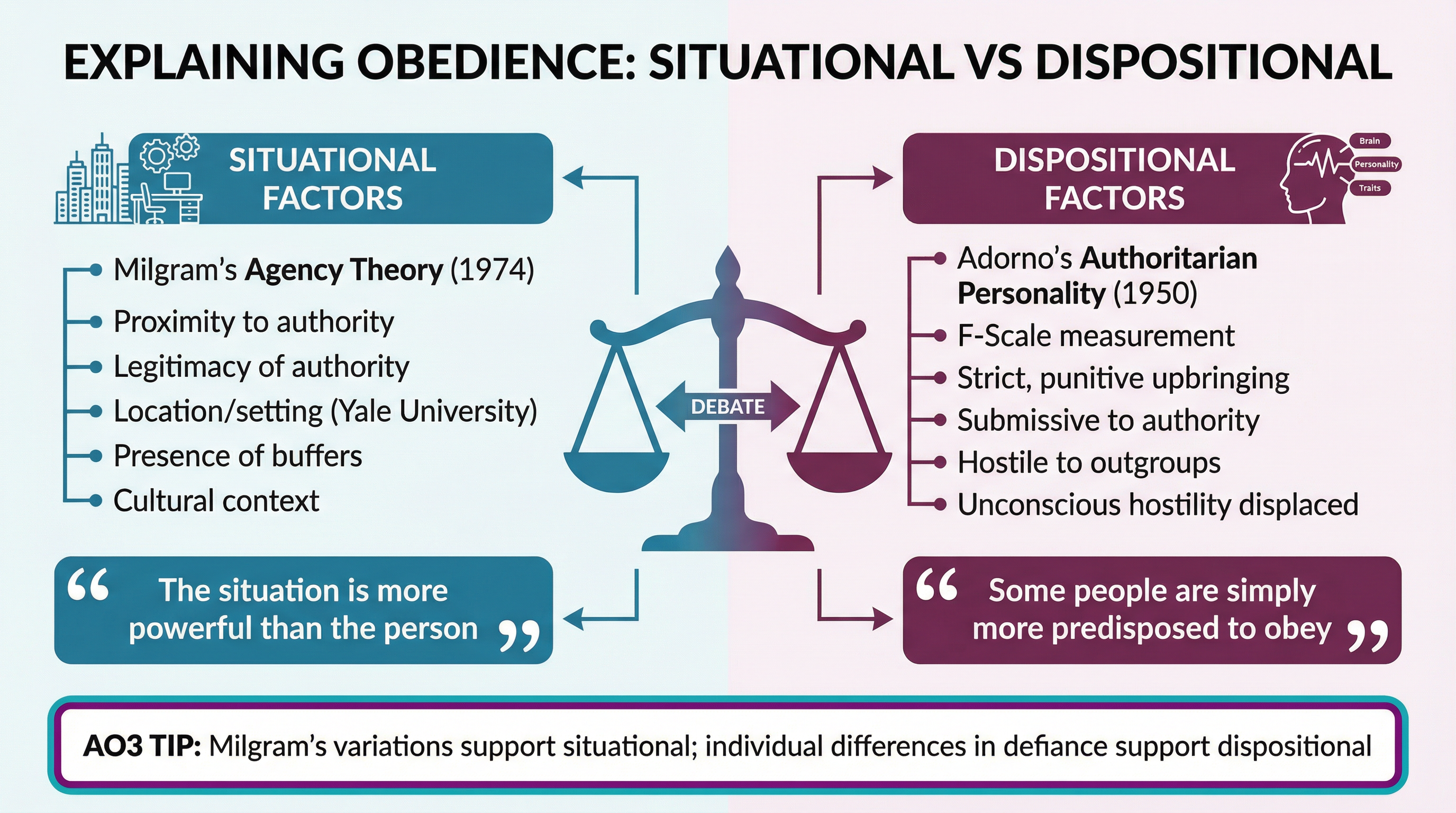
This guide focuses on the topic of Obedience as specified by the OCR GCSE Psychology (J203) curriculum. We will explore the foundational work of Stanley Milgram, whose experiments into how and why people obey authority figures remain some of the most significant in modern psychology. Examiners expect candidates to have a detailed understanding of Milgram's procedures, results, and his subsequent Agency Theory. Furthermore, you must be able to critically evaluate this work using the G.R.A.V.E framework and contrast situational explanations with dispositional ones, such as Adorno's Authoritarian Personality. This topic is not just about memorising facts; it is about understanding the complex interplay between individual autonomy and the power of the situation, a key theme that runs through social psychology.

Key Theories & Studies
Milgram's Obedience Study (1963)
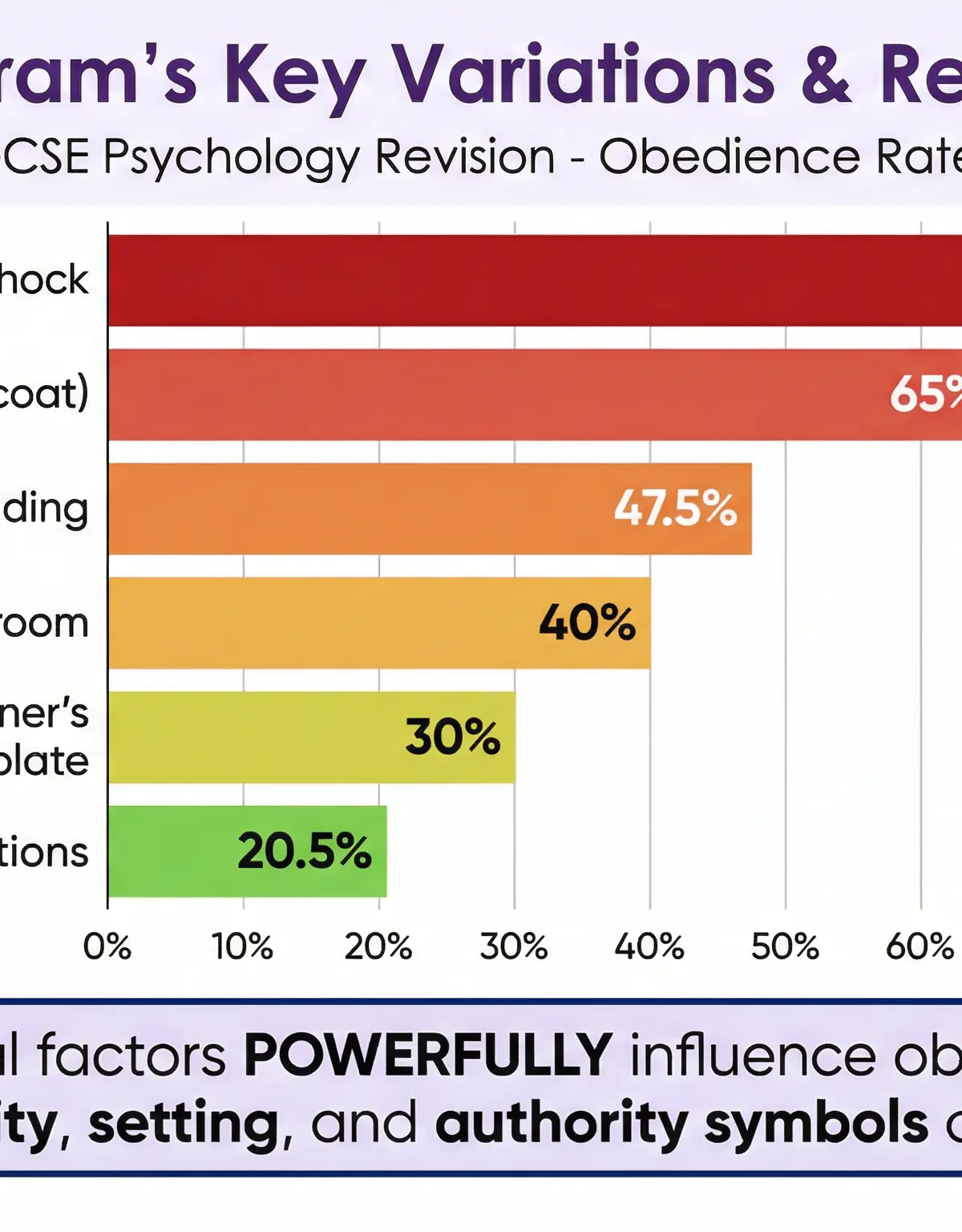
What happened: Stanley Milgram recruited 40 male participants for a supposed study on memory at Yale University. Participants were assigned the role of 'teacher' and ordered by an experimenter in a lab coat to deliver increasingly powerful electric shocks to a 'learner' (a confederate) for incorrect answers. The shocks were fake, but the participant believed they were real.
Why it matters: The study demonstrated that ordinary people are astonishingly likely to obey orders from a person they perceive as a legitimate authority figure, even if those orders involve harming another person. It provided a powerful situational explanation for atrocities like the Holocaust, suggesting that the context, rather than individual evil, can drive terrible actions.
Specific Knowledge: Candidates MUST know the key statistics: 65% of participants administered the full 450V shock, and 100% continued to 300V. You must also be able to describe the standardised prods used by the experimenter, such as, "The experiment requires that you continue."
Milgram's Agency Theory (1974)
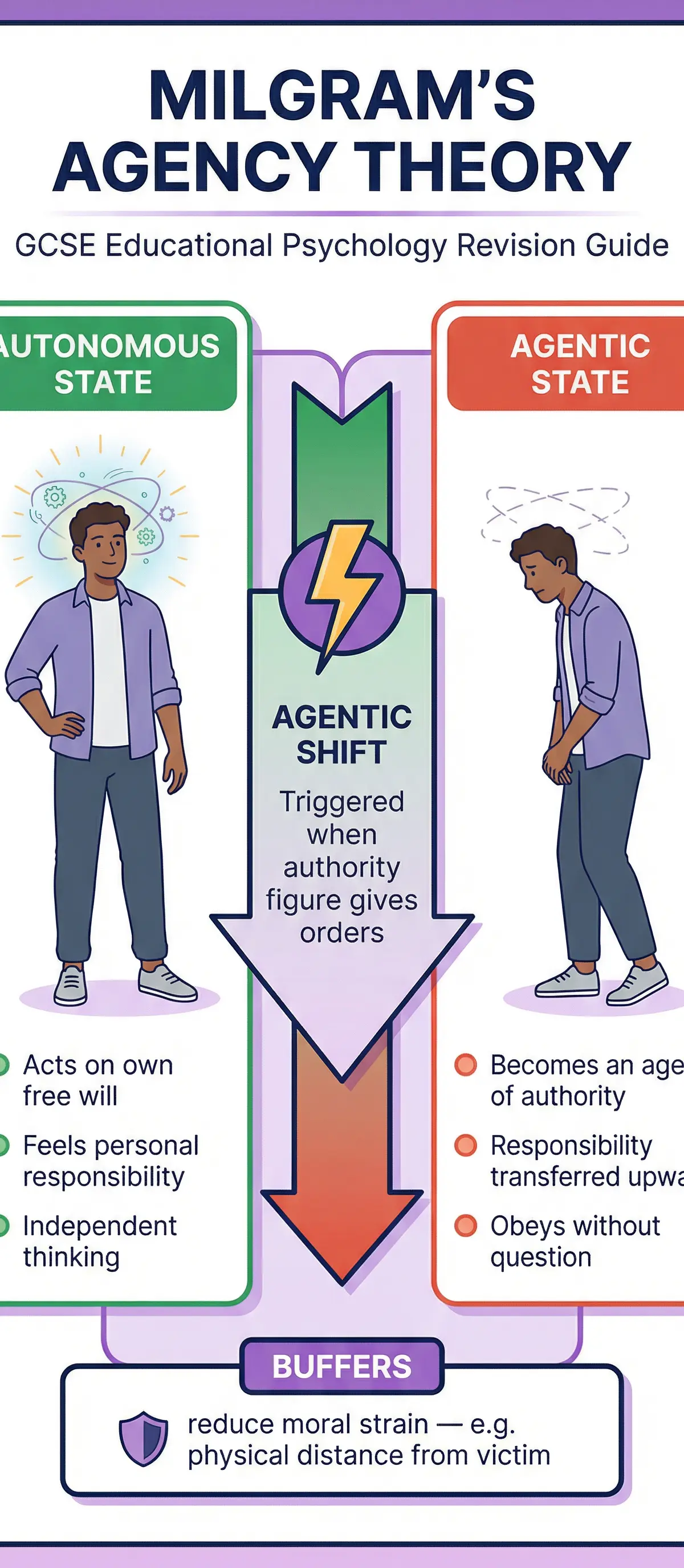
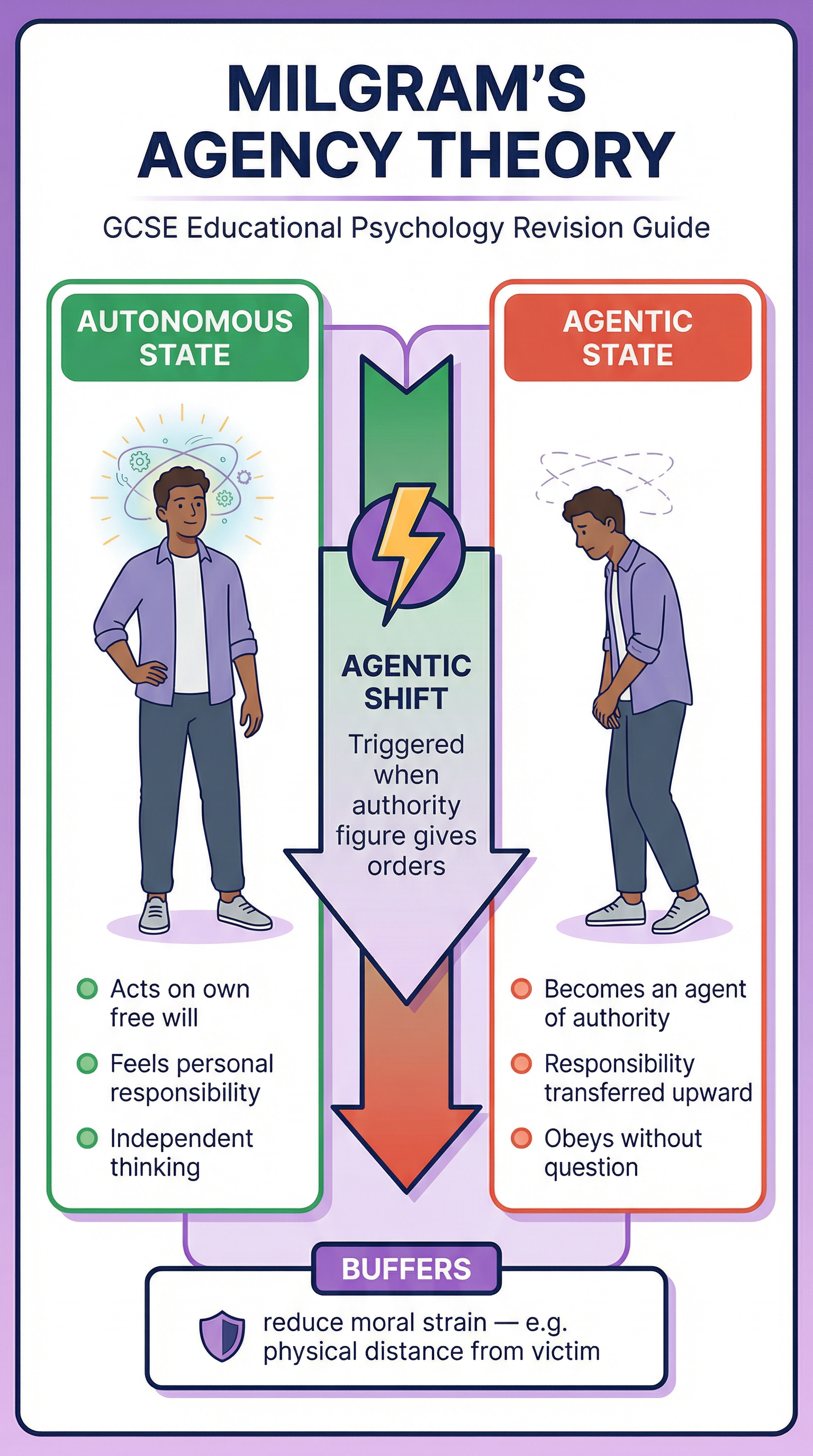
What happened: To explain his findings, Milgram proposed that people can exist in two states. In the autonomous state, individuals act on their own free will and feel responsible for their actions. In the agentic state, they see themselves as an agent of an authority figure and transfer responsibility to them. The switch between these states is the agentic shift.
Why it matters: This theory provides a framework for understanding why people obey. It suggests that when we enter the agentic state, we abdicate personal responsibility, allowing us to perform actions we would normally find morally reprehensible. The presence of a legitimate authority figure and 'buffers' (like physical distance from the victim) facilitate this state.
Specific Knowledge: Be able to define and differentiate between the autonomous state, the agentic state, and the agentic shift. Credit is given for explaining how features of the situation (e.g., the experimenter's lab coat) trigger the agentic shift.
Adorno's Authoritarian Personality (1950)
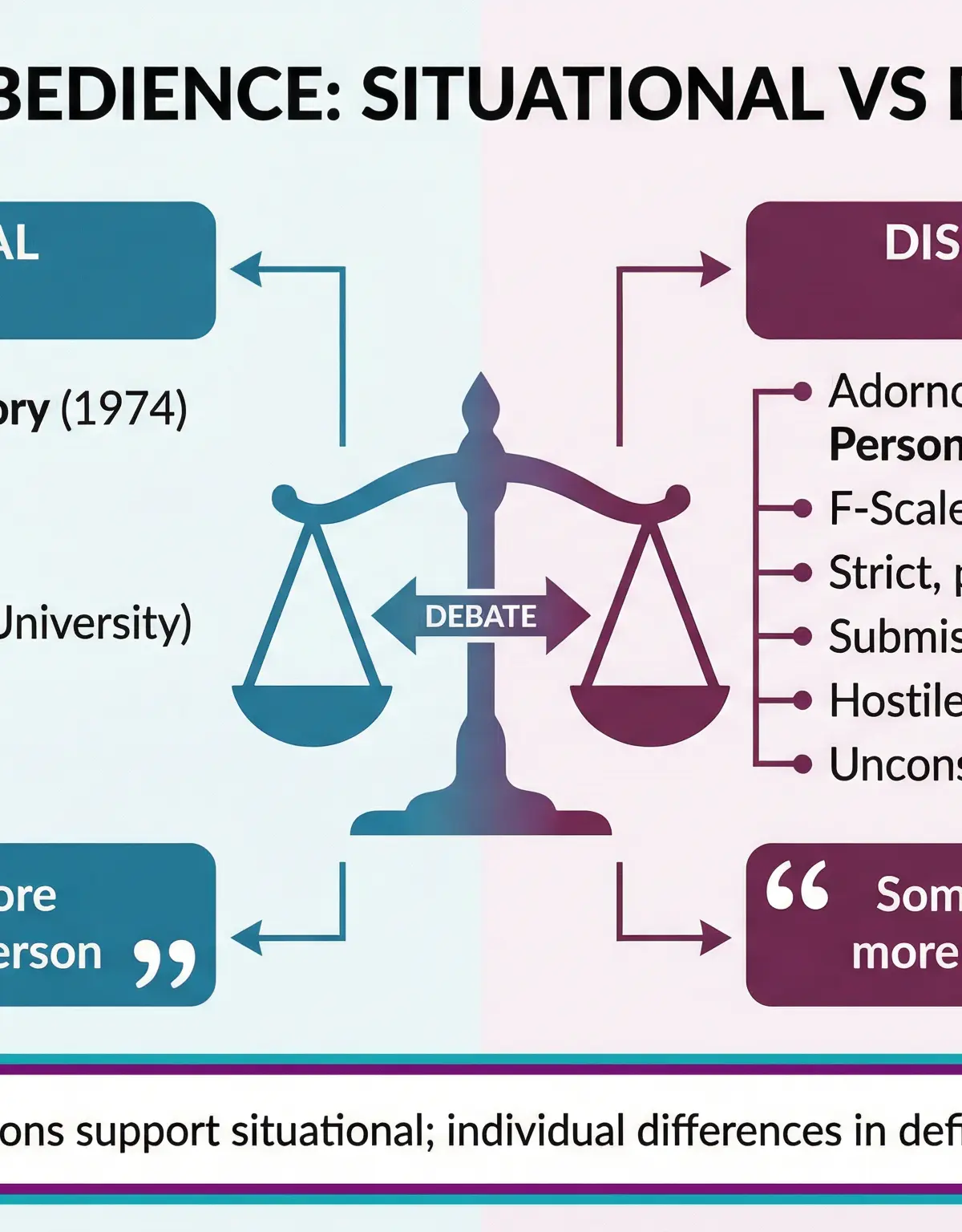
What happened: Theodor Adorno proposed a dispositional explanation for obedience. He argued that a specific personality type—the Authoritarian Personality—is more likely to obey authority. This personality is characterised by submission to authority, contempt for those seen as weak, and rigid, conventional values. Adorno believed it originated from a strict, punitive upbringing.
Why it matters: This theory contrasts with Milgram's situational explanation by suggesting that some people are simply more prone to obedience due to their personality. It highlights the importance of individual differences, a factor that situational theories can overlook.
Specific Knowledge: You must identify this as a dispositional factor. Know that Adorno used the F-Scale (F for Fascism) to measure authoritarian traits and linked its development to childhood experiences.
Second-Order Concepts
Causation
Why did Milgram's participants obey? The primary cause explored is situational pressure. Factors like the legitimacy of the authority figure (a scientist at Yale), the gradual commitment (starting with small shocks), and the presence of buffers (not seeing the victim) all combined to create a powerful situation that overrode participants' moral objections. Dispositional factors, like a potential authoritarian personality, are a secondary, alternative explanation.
Consequence
The immediate consequence of Milgram's work was a profound shift in our understanding of obedience and a major re-evaluation of research ethics. The long-term consequence has been its application to understanding real-world events, from military atrocities to workplace compliance. It forces a difficult conversation about personal responsibility.
Change & Continuity
Milgram's work marked a significant change from previous thinking that attributed evil acts solely to flawed individuals. It introduced the power of the situation as a primary driver of behaviour. However, the debate between situational and dispositional factors represents a continuity in psychology—the person-situation debate is a recurring theme.
Significance
Milgram's study is arguably the most significant in social psychology. It provides a compelling, albeit disturbing, insight into the human capacity for obedience to authority. Its significance lies in its ability to explain real-world obedience and its profound impact on ethical guidelines for psychological research.
Visual Resources
3 diagrams and illustrations

Interactive Diagrams
1 interactive diagram to visualise key concepts
Conceptual Flow Outline
Flowchart showing the process of the Agentic Shift in Milgram's Agency Theory.
Worked Examples
3 worked examples — open one to explore the question and available guidance.
Practice Questions
Test your understanding — click to reveal model answers
Describe Adorno's dispositional explanation for obedience. (4 marks)
Hint: Focus on the key features of the Authoritarian Personality and where it comes from.
Evaluate Milgram's research into obedience. (8 marks)
Hint: Use the GRAVE mnemonic to structure your answer. Aim for two well-developed evaluation points.
What is meant by the 'agentic shift'? (2 marks)
Hint: Think about the two states involved.
Identify two situational factors that were shown to affect obedience in Milgram's variations. (2 marks)
Hint: Think about what Milgram changed in his follow-up studies.
Explain the difference between obedience and conformity. (3 marks)
Hint: Focus on the type of influence and the presence of an order.