OCR · GCSE · Psychology
Psychological Explanations of Criminality
This study guide provides a comprehensive overview of the psychological explanations of criminality for OCR GCSE Psychology. It delves into the nature-nurture debate by contrasting Eysenck's biological theory with Social Learning Theory, equipping students with the detailed knowledge and evaluative skills needed to excel in their exams."
- 4 min read
- 3 worked examples
- 5 practice questions
Study Notes

Overview
This topic explores two contrasting psychological explanations for criminal behaviour: Eysenck's theory of the criminal personality and Sutherland's Social Learning Theory. Examiners expect candidates to not only describe these theories accurately (AO1) but also to apply them to scenarios (AO2) and critically evaluate their strengths and weaknesses using evidence (AO3). A key focus is the nature-nurture debate, with Eysenck representing a biological (nature) perspective and SLT representing an environmental (nurture) view. Mastery of this topic requires understanding the core assumptions of each theory, the evidence that supports or refutes them (especially Heaven, 1996), and the ability to construct a well-argued evaluation comparing their relative merits. Marks are awarded for precision, such as correctly defining Eysenck's PEN dimensions and explaining the cognitive mechanisms of SLT.

Key Individuals
Hans Eysenck
Role: German-British Psychologist
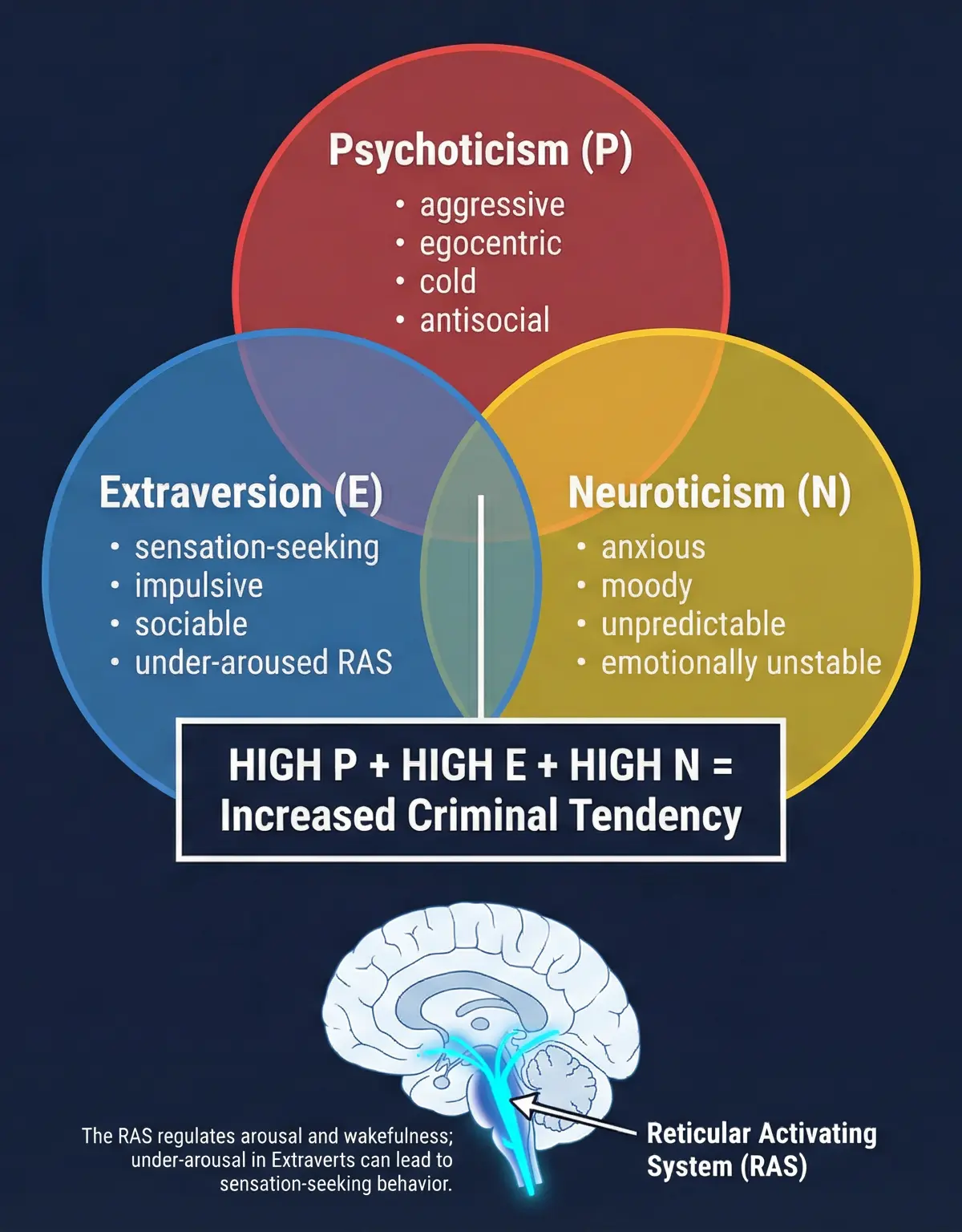
Key Actions: Proposed a theory of personality based on three dimensions: Psychoticism (P), Extraversion (E), and Neuroticism (N). He argued that individuals with high P, E, and N scores have a 'criminal personality' due to their inherited biological makeup.
Impact: His theory provided one of the first comprehensive biological explanations for criminality, linking personality traits to underlying physiological systems like the Reticular Activating System (RAS). It remains a cornerstone of the nature-nurture debate in psychology.
Albert Bandura
Role: Canadian-American Psychologist
Key Actions: Developed Social Learning Theory (SLT), arguing that behaviour is learned through observation and imitation of role models. He conducted the famous Bobo Doll studies, which demonstrated that children learn aggression through observation.
Impact: Bandura's work shifted the focus from purely behavioural explanations to cognitive ones, introducing concepts like vicarious reinforcement and the four cognitive processes (Attention, Retention, Motivation, Reproduction). SLT provides a powerful framework for understanding how criminal behaviour can be transmitted through social environments.
Second-Order Concepts
Causation
Eysenck: Criminality is caused by an inherited, under-aroused nervous system (for Extraverts) and high levels of testosterone (for Psychoticism), making individuals difficult to socialise and prone to risk-taking.
SLT: Criminality is caused by exposure to criminal role models, vicarious reinforcement (seeing crime pay off), and the internalisation of pro-criminal attitudes and behaviours.
Change & Continuity
Change: The focus of explanation has shifted from purely biological determinism (Eysenck) to a more interactionist approach that considers the interplay of biological, social, and cognitive factors.
Continuity: The nature-nurture debate remains a central theme. Both theories, despite their differences, attempt to explain why some individuals are more prone to criminality than others.
Significance
These theories are significant because they have had a major impact on the real world. Eysenck's work, while controversial, influenced early criminal profiling. SLT has had a huge impact on rehabilitation programmes, which often focus on changing an offender's social environment and providing positive role models.
 "
"
Worked Examples
3 worked examples — open one to explore the question and available guidance.
Practice Questions
Test your understanding — click to reveal model answers
Describe Social Learning Theory as an explanation for criminality. (6 marks)
Hint: Remember to include the four cognitive processes (ARM-R) and the concept of vicarious reinforcement.
Heaven (1996) studied the link between personality and delinquency. Outline the findings of this study. (4 marks)
Hint: Be specific about which of Eysenck's traits were supported and which were not. Mention the sample.
Compare Eysenck's theory of criminality with Social Learning Theory. (8 marks)
Hint: Structure your answer around points of comparison, such as the nature-nurture debate and determinism.
Outline one strength and one weakness of Social Learning Theory as an explanation of crime. (4 marks)
Hint: For the strength, think about its explanatory power. For the weakness, think about what it ignores.
Explain the role of the Reticular Activating System in Eysenck's theory. (3 marks)
Hint: Link the RAS to arousal levels and the specific personality trait it explains.