OCR · GCSE · Psychology
Social Influence
This study guide provides a comprehensive, exam-focused breakdown of Social Influence for OCR GCSE Psychology. It unpacks the critical differences between conformity and obedience, details the core studies of Asch, Milgram, and Piliavin, and provides examiner-level insights to help candidates secure top marks."
- 7 min read
- 3 worked examples
- 5 practice questions
Study Notes

Overview
Social Influence is a fundamental topic within psychology, exploring how individuals are affected by others. For OCR GCSE Psychology (J203), a precise understanding of this area is critical for exam success. Examiners expect candidates to clearly differentiate between conformity (majority influence), obedience (authority influence), and crowd behaviour. Mastery of the core studies — Asch (1955), Milgram (1963), and Piliavin et al. (1969) — is non-negotiable. This guide will break down these concepts, providing the specific knowledge, evaluation points, and exam techniques required to achieve high marks. The focus is on moving beyond simple descriptions to a nuanced analysis of situational and dispositional factors, a key skill for top-band responses.

Key Concepts: Conformity vs. Obedience
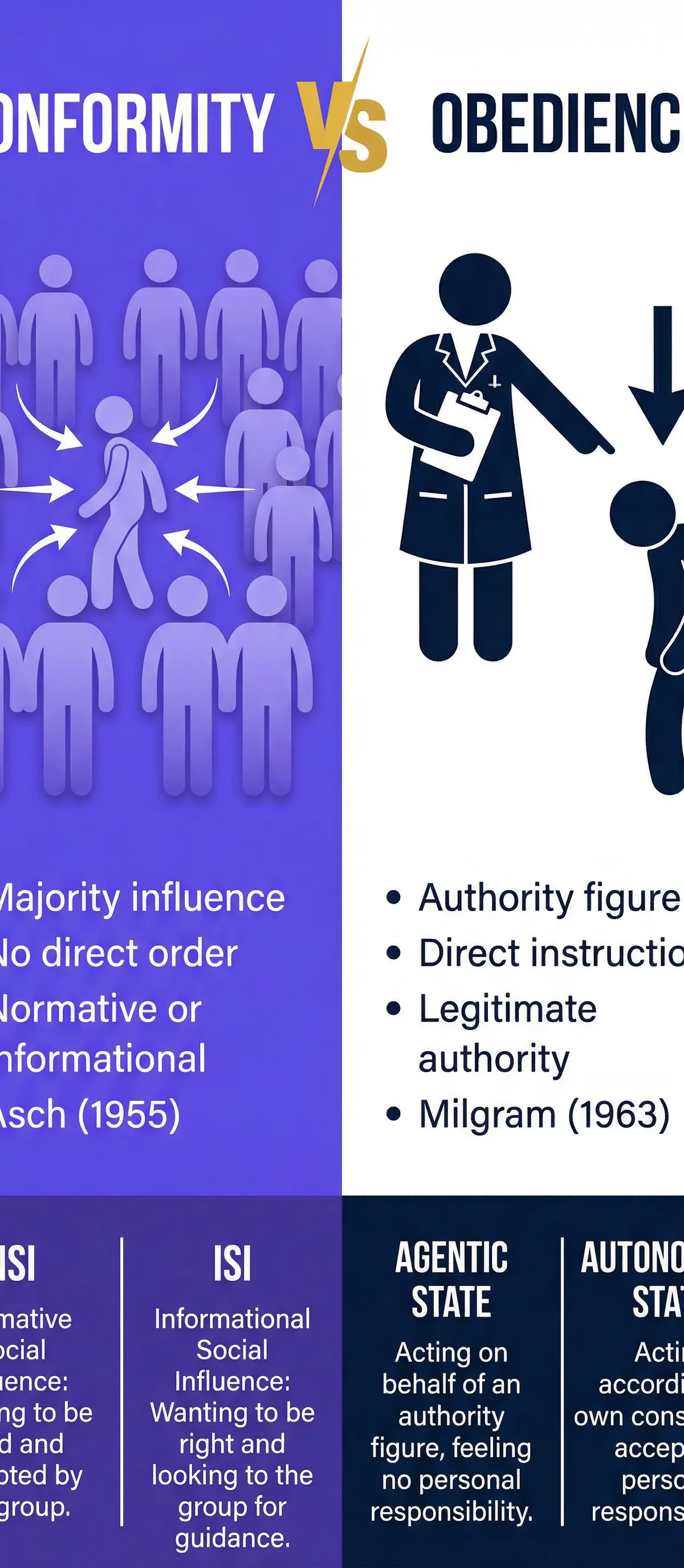
One of the most common mistakes candidates make is confusing conformity with obedience. Nailing this distinction is essential.
Conformity (Majority Influence)
What it is: A change in a person's behaviour or opinions as a result of real or imagined pressure from a person or group of people. There is no direct order to conform.
Why it happens:
- Normative Social Influence (NSI): The desire to be liked and accepted by the group. Individuals conform to fit in and avoid social rejection. This often leads to public compliance but not private acceptance.
- Informational Social Influence (ISI): The desire to be right. When an individual is uncertain, they look to the majority for information and guidance, believing the group is more likely to be correct. This can lead to private acceptance (internalisation).
Key Study: Asch (1955)
Obedience (Authority Influence)
What it is: A form of social influence where an individual follows a direct order, usually from a person in a position of authority.
Why it happens:
- Legitimate Authority: Individuals are socialised to recognise the authority of certain figures (e.g., police, teachers, doctors) and believe they have the right to issue commands.
- Agentic State: A mental state where an individual sees themselves as an 'agent' for carrying out another person's wishes. They feel diminished personal responsibility for their actions.
Key Study: Milgram (1963)
Core Studies
1. Asch (1955) - Conformity
Aim: To investigate the extent to which social pressure from a majority group could affect a person to conform.
Procedure: Asch used a lab experiment with a line judgement task. A naive participant was placed in a room with seven confederates (actors). They were shown a standard line and three comparison lines and asked to state which comparison line matched the standard. The confederates were instructed to give the same incorrect answer on 12 out of 18 trials (the 'critical trials').
Results:
- On the 12 critical trials, the average conformity rate was 36.8%.
- 75% of participants conformed at least once.
- 25% of participants never conformed.
Conclusion: People will conform to a majority view, even when that view is obviously incorrect. This is likely due to a combination of Normative and Informational Social Influence.
Evaluation (GRAVE):
- Generalisability: Low. The sample was androcentric (all male) and ethnocentric (all American students). Findings may not apply to females or collectivist cultures.
- Reliability: High. The standardised procedure (same lines, same number of confederates) makes the study replicable.
- Application: High. Helps explain why people conform to social norms and peer pressure.
- Validity: Low ecological validity. The task was artificial and did not reflect real-life conformity situations.
- Ethics: Poor. Participants were deceived about the true aim and the role of the confederates. This means they could not give fully informed consent.
2. Milgram (1963) - Obedience
Aim: To investigate whether ordinary people would obey an unjust order from an authority figure to inflict pain on another person.
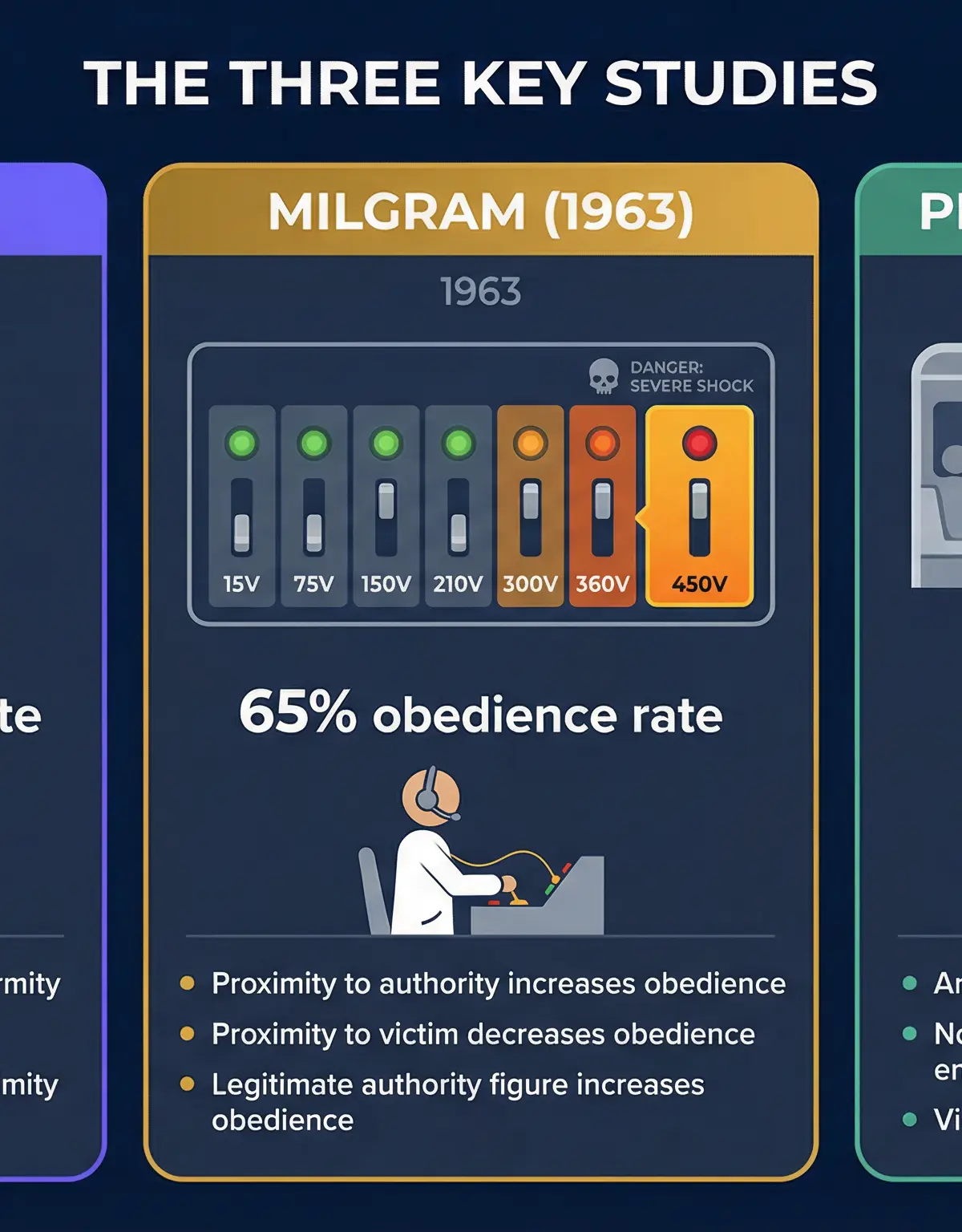
Procedure: A controlled observation at Yale University. 40 male volunteers were recruited. The naive participant was assigned the role of 'teacher' and a confederate played the 'learner'. The teacher was instructed to administer an electric shock to the learner for every incorrect answer on a memory task. The shocks increased in 15-volt increments from 15V to 450V. The learner's protests were pre-recorded. If the teacher hesitated, the experimenter (an authority figure in a lab coat) gave standardised 'prods' to continue.
Results:
- 100% of participants administered shocks up to 300V.
- 65% of participants continued to the full 450V.
Conclusion: Ordinary people are astonishingly obedient to authority, even when asked to behave in an inhumane manner. Milgram suggested this is explained by the agentic state.
Evaluation (GRAVE):
- Generalisability: Low. The all-male volunteer sample from one area of the USA limits the applicability of the findings.
- Reliability: High. The standardised procedure and prods ensure the study can be replicated to check for consistency.
- Application: High. Provides a powerful explanation for atrocities committed under orders, such as the Holocaust.
- Validity: Debated. Some argue it has low ecological validity (artificial task), but others argue the participants' distress shows it had high experimental realism (they believed it was real).
- Ethics: Extremely poor. Participants were severely deceived, denied a clear right to withdraw, and experienced significant psychological distress.
3. Piliavin et al. (1969) - Crowd Behaviour
Aim: To investigate bystander behaviour in a natural setting and understand the factors influencing helping behaviour.
Procedure: A field experiment on the New York subway. A confederate collapsed on a train carriage. In some trials, he appeared ill and carried a cane (cane condition); in others, he smelled of alcohol and carried a bottle in a bag (drunk condition). Observers recorded the speed and frequency of help offered by passengers.
Results:
- Cane condition: Received help in 95% of trials.
- Drunk condition: Received help in 50% of trials.
- Help was just as likely in a crowded carriage as a quiet one, challenging the idea of 'diffusion of responsibility'.
Conclusion: Helping behaviour is influenced by the perceived cause of the problem. Piliavin proposed the Arousal: Cost-Reward Model: seeing someone in need creates arousal, and we weigh the costs and rewards of helping versus not helping before we act.
Evaluation (GRAVE):
- Generalisability: Good. A large, diverse sample of passengers who did not know they were in a study.
- Reliability: Low. As a field experiment, there was little control over extraneous variables (e.g., passenger mood, time of day).
- Application: High. Helps understand why people may or may not intervene in emergencies.
- Validity: High ecological validity. The event occurred in a real-world setting, and participants' behaviour was genuine.
- Ethics: Poor. Participants were deceived and could not give consent. They may have experienced distress seeing someone collapse."
Worked Examples
3 worked examples — open one to explore the question and available guidance.
Practice Questions
Test your understanding — click to reveal model answers
Describe Asch's (1955) study of conformity. (6 marks)
Hint: Focus on the Aim, Procedure, Results, and Conclusion (APRC). Be precise with numbers.
A new student, Ben, sees his classmates all putting their hands up to answer a question he doesn't know the answer to. He also puts his hand up. Using your knowledge of social influence, explain Ben's behaviour. (4 marks)
Hint: Identify the type of social influence and the specific psychological reason for it.
Evaluate Milgram's (1963) study of obedience. (8 marks)
Hint: Use the GRAVE framework. Aim for at least three well-developed evaluation points, including strengths and weaknesses.
Explain the difference between the agentic state and the autonomous state. (4 marks)
Hint: Define both terms and highlight the key difference in terms of personal responsibility.
Describe one variation of Asch's study and explain what its findings show. (4 marks)
Hint: Choose one of: group size, unanimity, or task difficulty.