Development — WJEC GCSE Study Guide
Exam Board: WJEC | Level: GCSE
This study guide for WJEC GCSE Psychology explores the fascinating journey of human development, from the wiring of the infant brain to the powerful theories of Piaget and Dweck. It's a crucial topic that explains how we become who we are, and mastering it is key to unlocking top marks in your exam.
## Overview
The WJEC GCSE Psychology unit on Development is a foundational topic that explores how individuals change and grow cognitively from infancy through to adolescence. It examines the biological underpinnings of early brain development before delving into Jean Piaget's seminal theory of cognitive stages. This is contrasted with contemporary learning theories from Carol Dweck (Mindset) and Daniel Willingham, which provide a more modern perspective on how we learn and think. Examiners expect candidates to have a detailed and critical understanding of these theories, supported by specific knowledge of two key studies: Piaget & Inhelder (1956) and Gunderson et al. (2013). Success in this topic requires not just memorisation, but the ability to apply, evaluate, and compare these psychological concepts in the context of exam questions.
## Key Theories & Concepts
### Early Brain Development
**What happens**: From birth, the brain undergoes rapid development. An infant's brain is packed with around 100 billion neurons, but the crucial connections (synapses) between them are still forming. Through a process of synaptic pruning, frequently used connections are strengthened while unused ones are eliminated. This makes early childhood a critical period for learning and development, as the brain is at its most 'plastic' or adaptable.
**Why it matters**: This biological process provides the 'why' behind the importance of a stimulating environment for young children. For the exam, candidates can be awarded marks for explaining how early experiences physically shape the brain's structure and function, impacting later cognitive abilities.
**Specific Knowledge**: Synaptic pruning, brain plasticity, neurons, synapses.
### Piaget's Theory of Cognitive Development
**What it is**: Jean Piaget proposed that children are active learners who construct their understanding of the world through a series of four distinct, universal stages. He believed children's thinking is qualitatively different from adults'.
**Why it matters**: Piaget's theory was revolutionary and provides a framework for understanding childhood cognition. Examiners will test your knowledge of the stages and the key concepts of schema, assimilation, and accommodation.
**Specific Knowledge**: The four stages (Sensorimotor, Preoperational, Concrete Operational, Formal Operational), their age ranges, and key characteristics. 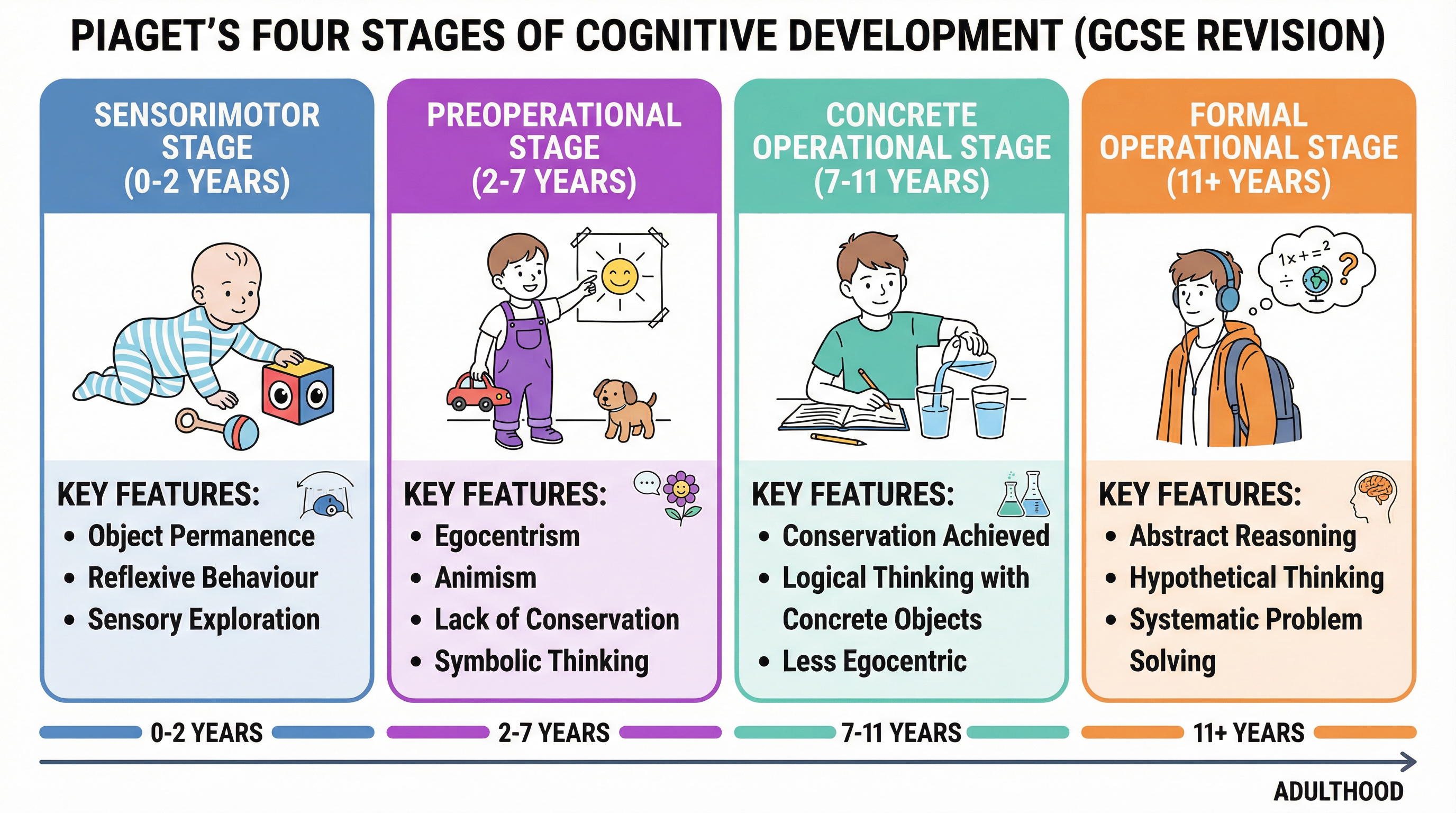
### Dweck's Mindset Theory
**What it is**: Carol Dweck's theory focuses on our beliefs about intelligence. A 'Fixed Mindset' is the belief that intelligence is static, leading to an avoidance of challenges. A 'Growth Mindset' is the belief that intelligence can be developed through effort, leading to a desire to learn and embrace challenges.
**Why it matters**: This theory has huge applications in education. It suggests that praising effort (process praise) rather than ability (person praise) can foster a growth mindset and improve student resilience and achievement. The Gunderson et al. (2013) study provides key evidence for this.
**Specific Knowledge**: Fixed Mindset, Growth Mindset, Process Praise, Person Praise. 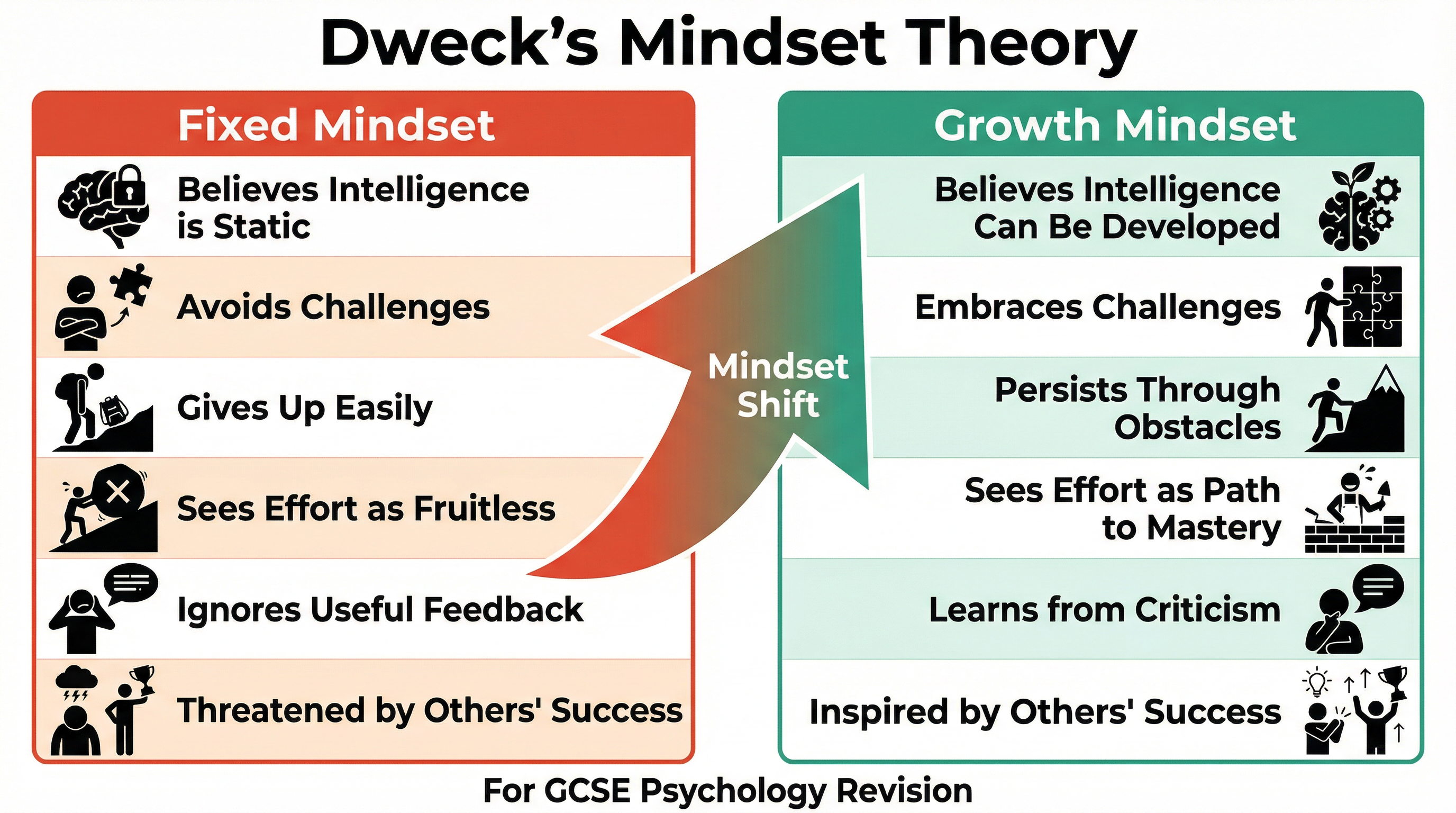
## Key Individuals
### Jean Piaget
**Role**: A Swiss psychologist considered the father of developmental psychology.
**Key Actions**: Developed a stage theory of cognitive development based on observational studies of children. Introduced concepts like egocentrism, conservation, and object permanence.
**Impact**: His work fundamentally changed how we view child development, although some of his methods and findings have been challenged for underestimating children's abilities.
### Carol Dweck
**Role**: A leading American psychologist and researcher in the fields of motivation and mindset.
**Key Actions**: Developed the theory of Fixed and Growth Mindsets based on extensive research with students.
**Impact**: Her work has had a significant influence on educational practices worldwide, promoting the idea that fostering a growth mindset can lead to greater academic success and personal development.
## Podcast Episode
