WJEC · GCSE · Psychology
Social Influence
This guide explores the powerful and often unsettling ways in which social situations shape human behaviour. We will dissect four of the most influential studies in psychology, revealing how conformity, obedience, and social roles can lead ordinary people to act in extraordinary ways. Mastering this topic is crucial for exam success, as it forms a cornerstone of the WJEC GCSE Psychology specification."
- 8 min read
- 3 worked examples
- 5 practice questions
Study Notes

Overview
Social Influence is a core area of psychology that examines how individuals are affected by their social environment. For the WJEC GCSE exam, candidates are expected to demonstrate a precise understanding of conformity, obedience, deindividuation, and bystander intervention. This requires not just knowing the theories, but mastering the aims, procedures, results, and conclusions of four pivotal studies: Asch (1951), Milgram (1963), Haney, Banks & Zimbardo (1973), and Piliavin et al. (1969). Examiners award high marks for the ability to apply these findings to real-world scenarios and to critically evaluate the research. A key theme throughout is the situational vs. dispositional debate – whether our actions are driven by the context we are in or by our own personality. This guide will equip you with the detailed knowledge and exam technique needed to excel.

Core Studies: The Foundations of Social Influence
Asch (1951): Conformity
Aim: To investigate the extent to which social pressure from a majority group could affect a person to conform.
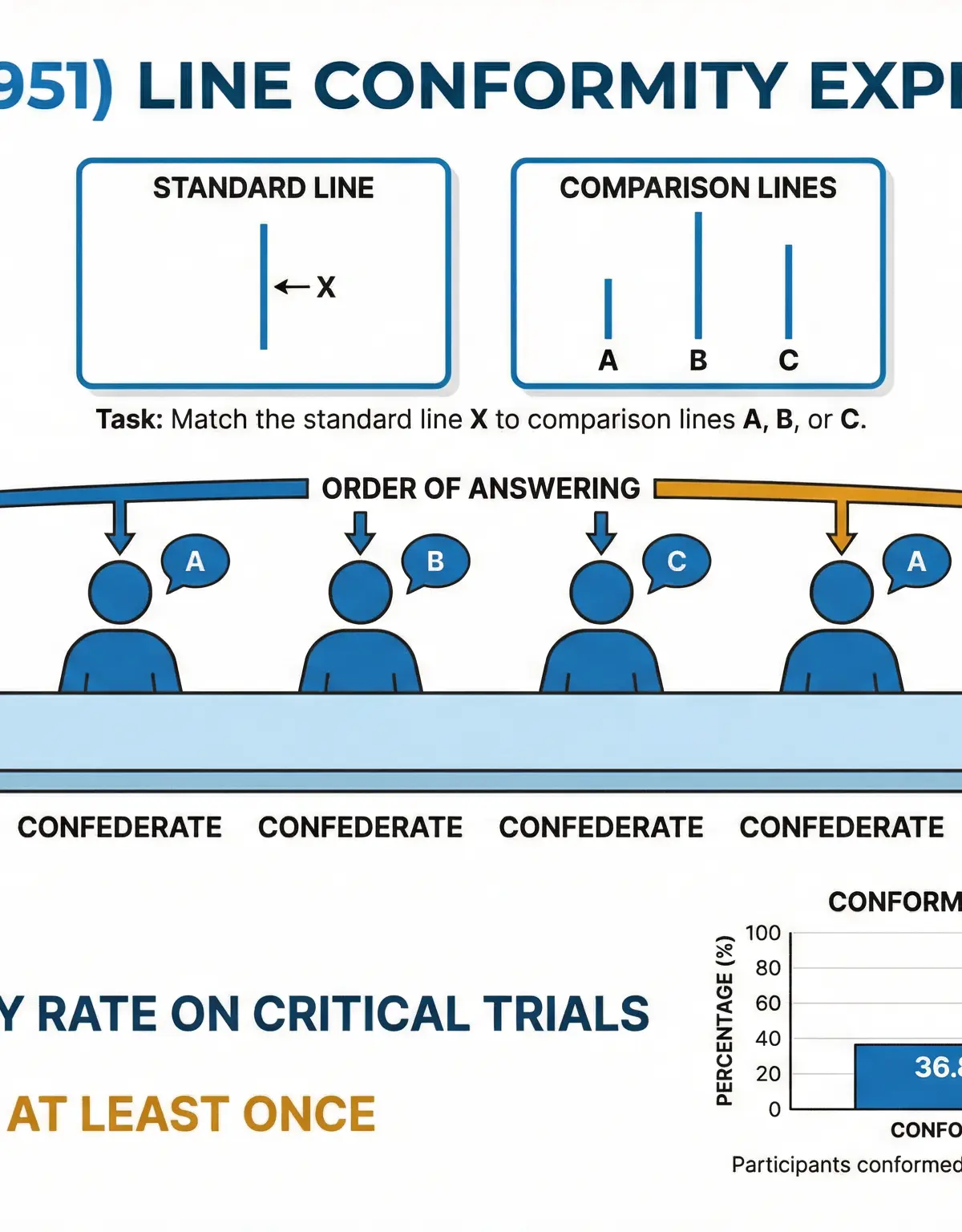
Method: Asch used a lab experiment with a simple perceptual task. A naive participant was placed in a room with seven confederates (actors). They were shown a standard line and three comparison lines and asked to state which comparison line matched the standard. The confederates were instructed to give the same incorrect answer on 12 out of 18 trials (the "critical trials").
Results: On the 12 critical trials, participants conformed to the incorrect majority answer 36.8% of the time. 75% of participants conformed at least once. In a control group with no confederates, less than 1% of participants gave an incorrect answer.
Conclusion: Even in an unambiguous situation, people will conform to a majority view. Asch identified two reasons: Normative Social Influence (the desire to fit in and be liked) and Informational Social Influence (the desire to be right, believing the group knows better).
Specific Knowledge: Remember the key stats: 36.8% conformity on critical trials, 75% conformed at least once.
Milgram (1963): Obedience to Authority
Aim: To investigate what level of obedience would be shown when participants were told by an authority figure to administer electric shocks to another person.
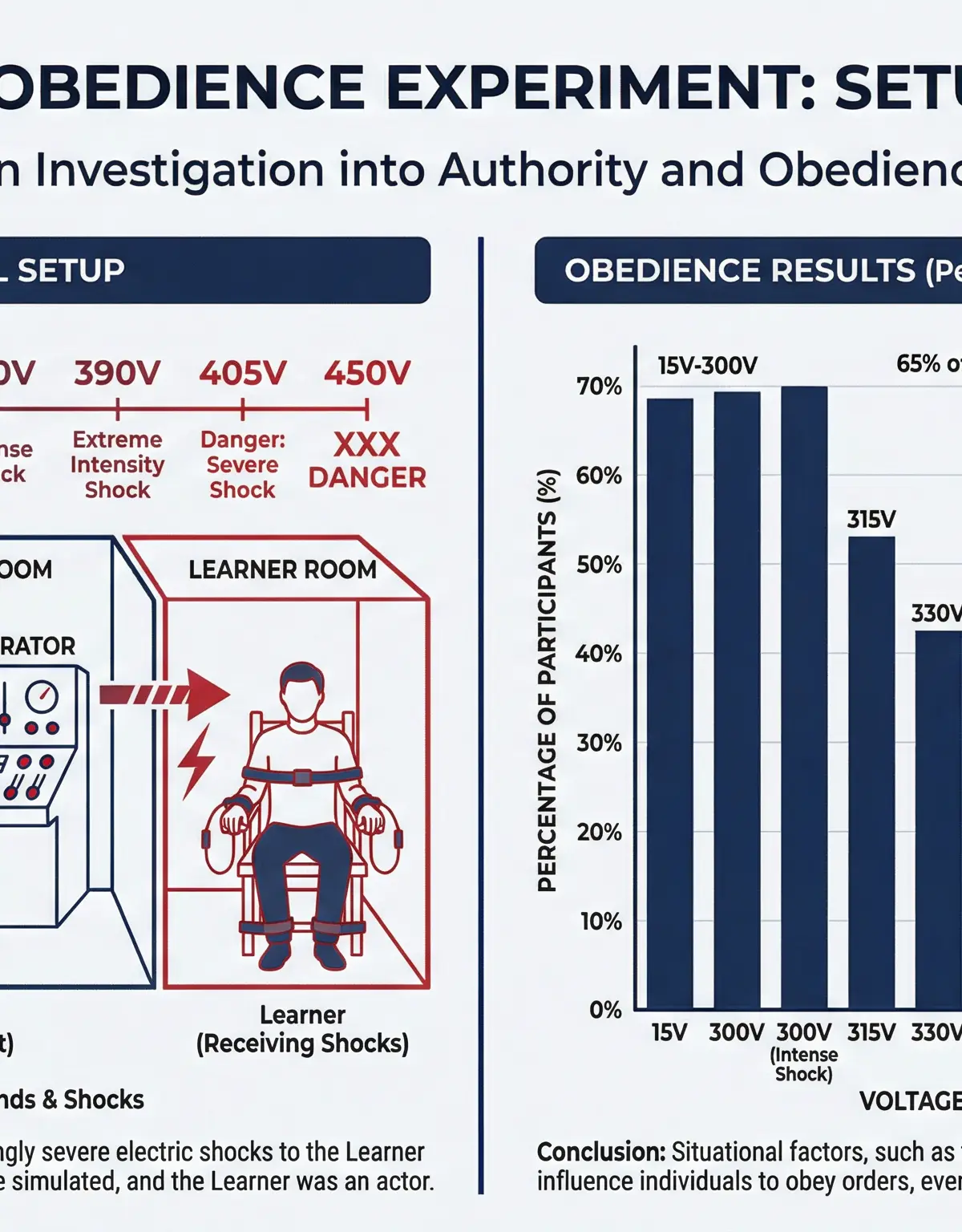
Method: A controlled observation at Yale University. 40 male participants were recruited via a newspaper ad. They were introduced to a confederate (the "Learner") and an "Experimenter" in a lab coat. The participant was assigned the role of "Teacher" and instructed to administer an electric shock to the Learner for every wrong answer on a word-pair task. The shocks increased in 15-volt increments from 15V to 450V. The shocks were fake, but the participant believed they were real.
Results: 100% of participants administered shocks up to 300V. 65% of participants continued to the highest level of 450V.
Conclusion: Ordinary people are astonishingly obedient to authority, even when asked to behave in an inhumane manner. Milgram argued this was due to situational factors, such as the prestigious university setting and the authority of the experimenter, leading to a state of displacement of responsibility where individuals see themselves as an agent for someone else.
Specific Knowledge: The killer stat: 65% of participants went to the full 450V.
Haney, Banks & Zimbardo (1973): The Stanford Prison Experiment
Aim: To investigate how readily people would conform to the social roles of guard and prisoner in a role-playing exercise that simulated prison life.
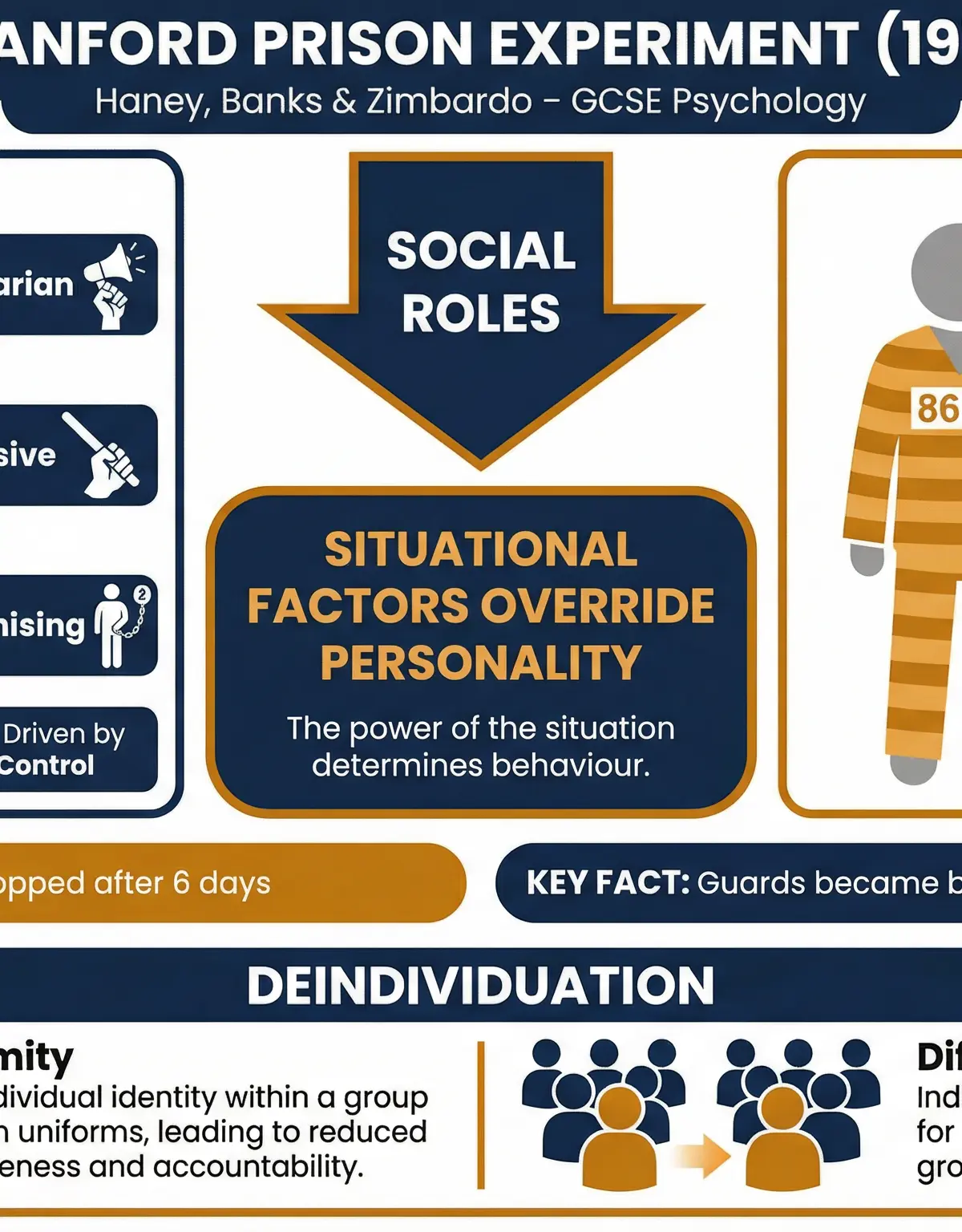
Method: A mock prison was created in the basement of Stanford University. 24 emotionally stable male university students were randomly assigned to the role of either prisoner or guard. The study was planned to last for two weeks. Guards were given uniforms, clubs, and reflective sunglasses to increase their status and anonymity. Prisoners were given smocks and referred to by number only.
Results: The experiment was stopped after just 6 days. The guards became increasingly aggressive and abusive, while the prisoners became passive, submissive, and depressed. The participants rapidly conformed to their assigned social roles.
Conclusion: The powerful influence of the situation (situational factors) can override an individual's personality (dispositional factors). The study demonstrated the power of social roles and the process of deindividuation, where individuals lose their sense of personal identity and responsibility when part of a group.
Specific Knowledge: Stopped after 6 days (planned for 14). Random assignment to roles is a key methodological point.
Piliavin et al. (1969): Bystander Intervention
Aim: To investigate bystander behaviour in a naturalistic setting and to see if the type of victim and race of victim would affect helping rates.
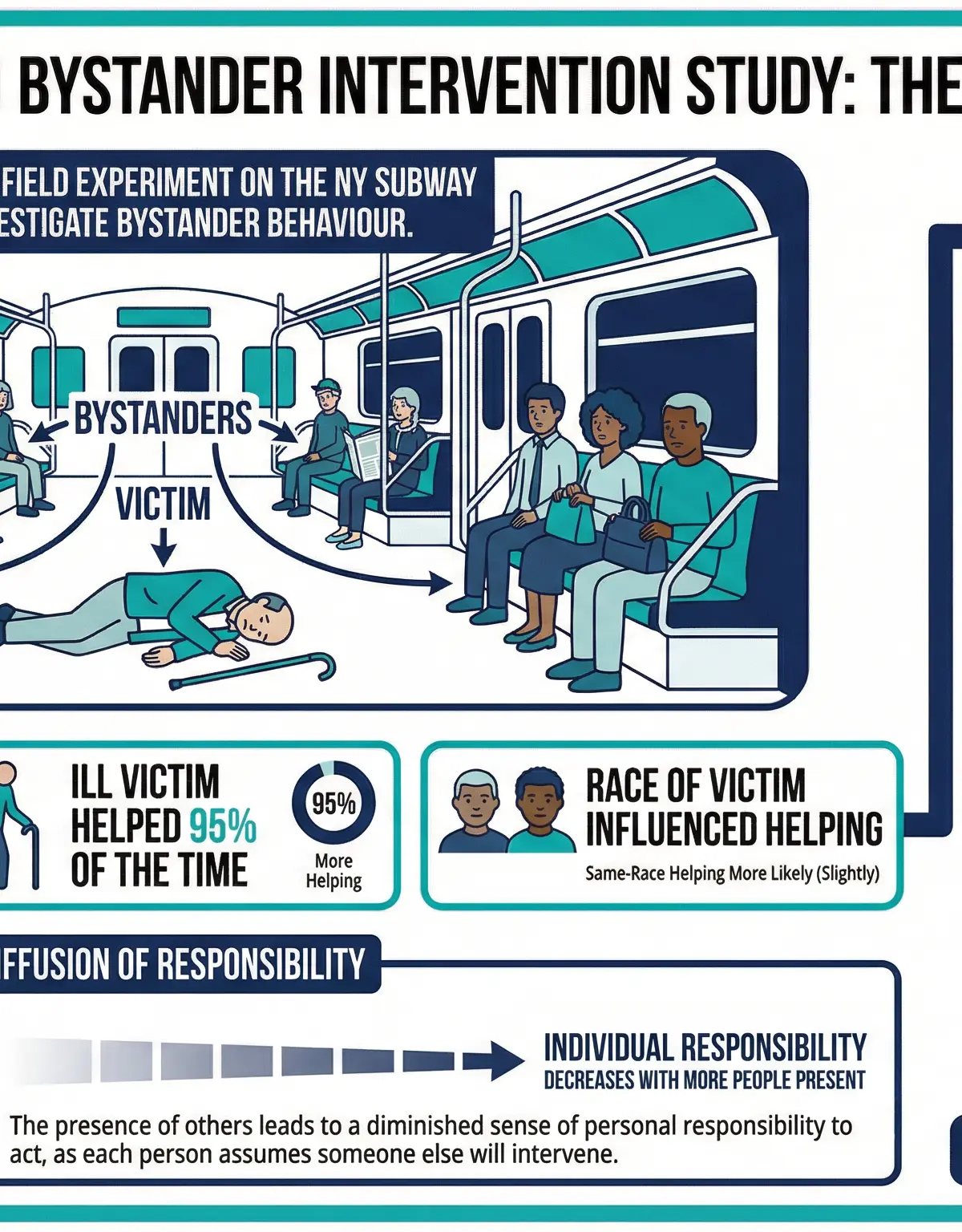
Method: A field experiment on the New York subway. On over 100 journeys, a confederate would collapse on the train. In some trials, the victim appeared ill (carrying a cane); in others, he appeared drunk (smelling of alcohol). Observers recorded how often and how quickly passengers helped.
Results: The victim with the cane received help 95% of the time. The drunk victim received help 81% of the time. Help was just as likely in a crowded carriage as a quiet one, challenging the traditional concept of diffusion of responsibility (the idea that the more people there are, the less likely any one person is to help).
Conclusion: In a naturalistic setting, bystander helping is more common than previously thought. However, the decision to help is influenced by a cost-benefit analysis (e.g., the potential danger or embarrassment of helping a drunk person). The study has high ecological validity as it was conducted in a real-world environment.
Specific Knowledge: 95% help for ill victim vs. 81% for drunk victim.
Key Concepts & Second-Order Concepts
Situational vs. Dispositional Factors
This is the central debate. Situational explanations focus on external factors (the environment, the people around you, the social role you are in). Milgram, Asch, and Zimbardo's studies are powerful evidence for the situational view. Dispositional explanations focus on internal factors (your personality, your morals, your character). While less emphasised in these studies, it's important for evaluation (e.g., why did 35% of Milgram's participants not obey?).
Conformity
Yielding to group pressure. It can be normative (to fit in) or informational (to be right).
Obedience
Following a direct order from a figure of authority.
Deindividuation
A psychological state where an individual loses their personal identity and takes on the identity of the group. Factors like wearing a uniform or being in a large crowd can lead to this. It often results in a loss of normal inhibitions and is used to explain the behaviour of the guards in the Stanford Prison Experiment.
Bystander Effect & Diffusion of Responsibility
The Bystander Effect is the phenomenon where the presence of others discourages an individual from intervening in an emergency situation. This is often explained by Diffusion of Responsibility, where each bystander's sense of responsibility to help decreases as the number of witnesses increases. Piliavin's study challenged the simplicity of this idea, showing high helping rates, but the concept is still crucial.
Source Skills for Psychology
When presented with a scenario (a short story about a person's behaviour), your task is to act like a detective. The scenario is your 'source'.
- Identify the behaviour: What is the person doing? (e.g., conforming, obeying, helping/not helping).
- Identify the key concepts: Which psychological terms can explain this behaviour? (e.g., normative social influence, displacement of responsibility).
- Apply the evidence: Explicitly link the concept to the scenario. Use phrases like "This shows...", "This is an example of...", "The reason for this is...".
- Use study evidence: Back up your point by referencing the findings of a relevant core study. E.g., "This is similar to Milgram's study, where 65% of participants obeyed the authority figure.""
Worked Examples
3 worked examples — open one to explore the question and available guidance.
Practice Questions
Test your understanding — click to reveal model answers
Describe the aim and conclusion of Asch's (1951) study into conformity. (4 marks)
Hint: Be precise. One mark for the aim, one for the conclusion, and two for elaboration.
Using your knowledge of psychology, explain why a soldier might obey an order to fire on an unarmed crowd. (6 marks)
Hint: Think about Milgram's study. What situational factors are at play?
Evaluate the Stanford Prison Experiment (Haney, Banks & Zimbardo, 1973). (9 marks)
Hint: Use the GRAVE acronym to structure your answer. Aim for 3-4 developed points and a conclusion.
Distinguish between normative and informational social influence. (3 marks)
Hint: Define each term and give an example or state the key motivation for each.
Describe two ethical issues with Milgram's study of obedience. (4 marks)
Hint: Name the issue and explain WHY it was an issue in this specific study.