AQA · A-Level · Religious Studies
Christian Moral Action
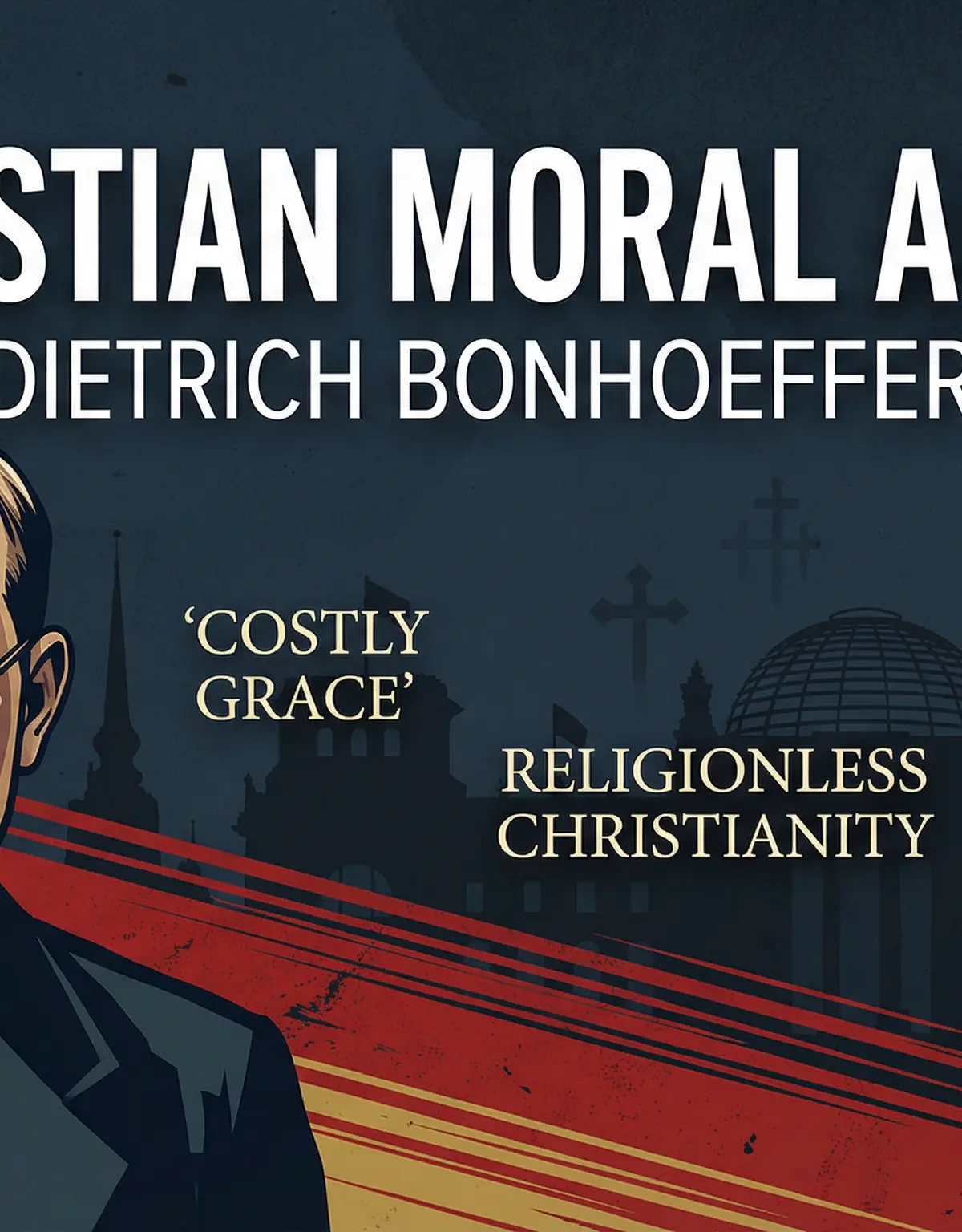
Dietrich Bonhoeffer (1906–1945) stands as one of the most compelling figures in twentieth-century Christian ethics — a theologian who paid with his life for the conviction that genuine faith demands costly action in the world. This topic sits at the intersection of theology, ethics, and history, requiring candidates to analyse Bonhoeffer's framework of 'Costly Grace', his role in the Confessing Church, and his radical concept of 'Religionless Christianity' against the backdrop of Nazi Germany. Examiners reward candidates who treat this as a theological and ethical enquiry, not a biographical narrative.
- 13 min read
- 4 worked examples
- 5 practice questions
- 10 key terms
Study Notes
Overview
This topic forms part of AQA Component 2A (Christianity) and focuses on Dietrich Bonhoeffer's theology of Christian moral action. Candidates are expected to demonstrate precise knowledge of Bonhoeffer's key texts — particularly The Cost of Discipleship (1937) and Letters and Papers from Prison (written 1943–45) — and to evaluate the theological frameworks they contain. The historical context of Nazi Germany is essential background, but examiners are clear: this is a theology paper, not a history paper. Every biographical detail must be anchored to a theological or ethical concept. The AO1/AO2 weighting (40%/60%) means that evaluation and critical analysis must drive your longer answers.
Key Events and Developments
The Rise of National Socialism and the Church Struggle (1933)
Date(s): January–July 1933
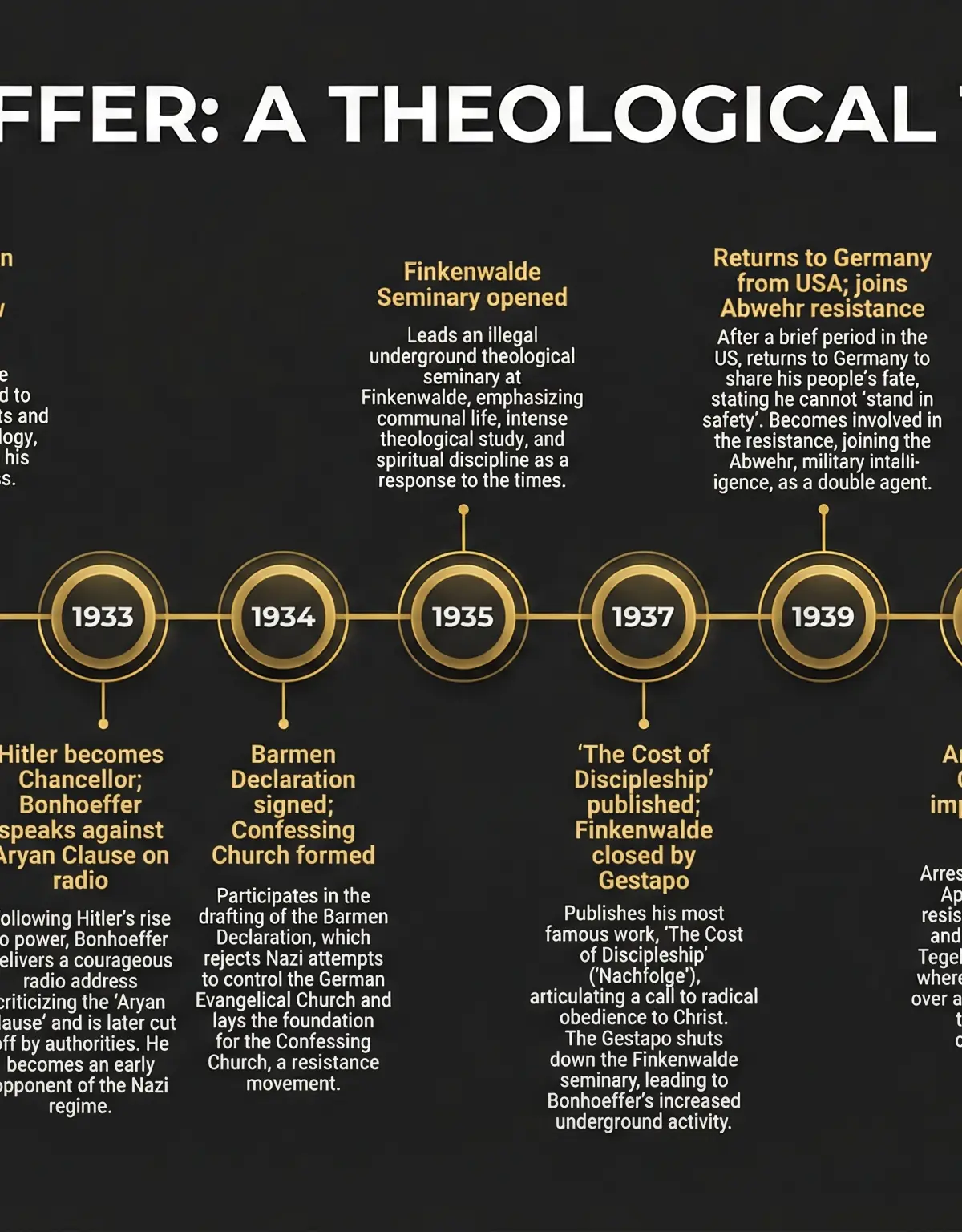
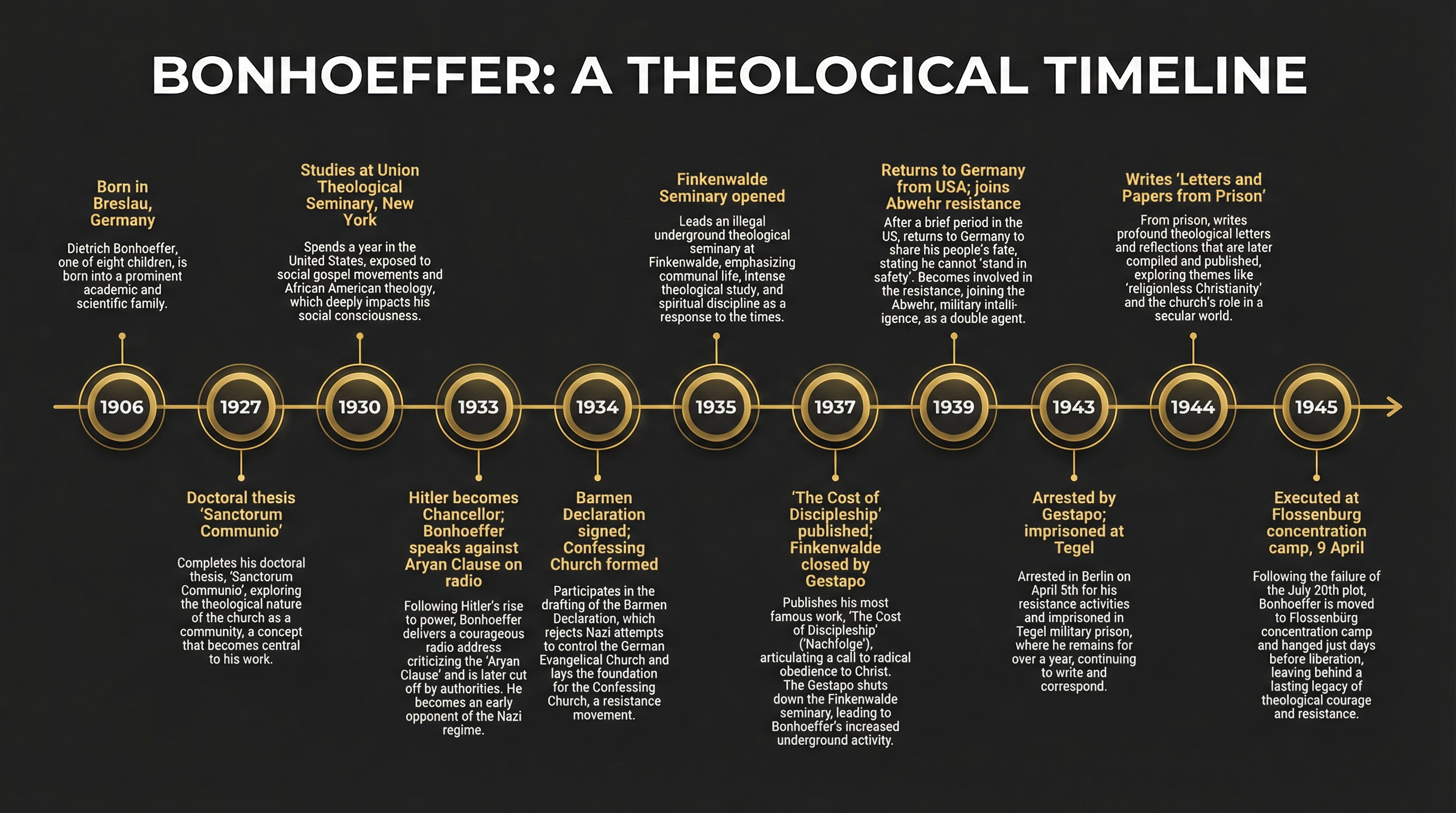
What happened: When Hitler became Chancellor on 30 January 1933, the German Evangelical Church faced immediate pressure to conform to Nazi ideology. The most significant flashpoint was the introduction of the Aryan Clause (Arierparagraph), which sought to exclude Jewish Christians from holding church office. The Deutsche Christen (German Christians) movement enthusiastically embraced Nazi ideology, seeking to align the church with the state. Bonhoeffer responded within days of Hitler's appointment, broadcasting a radio address criticising the Führerprinzip — the principle of blind obedience to a leader — and was cut off mid-broadcast.
Why it matters: This moment establishes the central tension of the entire topic: what does faithful Christian discipleship look like when the state demands complicity in injustice? Bonhoeffer's immediate resistance demonstrates that his theology was not abstract — it was lived. Examiners credit candidates who connect this moment to the concept of Costly Grace: Bonhoeffer's refusal to offer cheap, comfortable acquiescence.
Specific Knowledge: Hitler appointed Chancellor 30 January 1933; Aryan Clause adopted by German Evangelical Church, September 1933; Deutsche Christen movement led by Ludwig Müller; Bonhoeffer's radio broadcast cut off, February 1933.
The Barmen Declaration and the Confessing Church (1934)
Date(s): May 1934
What happened: In response to the capitulation of the official German church, Bonhoeffer was among those who helped found the Confessing Church (Bekennende Kirche) — a movement of pastors and theologians who refused to submit to Nazi control. The theological foundation of this movement was the Barmen Declaration, drafted primarily by the Swiss Reformed theologian Karl Barth, with significant input from Bonhoeffer. The Declaration's central claim was unambiguous: 'Jesus Christ, as he is attested for us in Holy Scripture, is the one Word of God which we have to hear and which we have to trust and obey in life and in death.' This was a direct repudiation of the claim that the Nazi state could be a legitimate source of theological authority.
Why it matters: The Barmen Declaration is the institutional expression of Bonhoeffer's theology. It demonstrates that Costly Grace is not merely personal piety but has ecclesiological (church-related) and political consequences. Candidates should be able to quote or closely paraphrase the Declaration's key assertion and explain why it constituted a radical act of civil disobedience.
Specific Knowledge: Barmen Declaration signed 29–31 May 1934; Karl Barth as primary drafter; six theological theses; repudiation of the Deutsche Christen; formation of the Confessing Church as a parallel ecclesiastical structure.
Finkenwalde Seminary (1935–1937)
Date(s): 1935–1937
What happened: In 1935, Bonhoeffer was appointed to lead a new underground seminary for the Confessing Church at Finkenwalde, in Pomerania. This was not a conventional theological college. Bonhoeffer structured it around communal life, shared prayer, confession, and what he called Arcane Discipline (Arkandisziplin) — the practice of keeping the core mysteries of Christian faith (prayer, sacraments) as a private, sustaining discipline rather than a public performance. The seminary trained approximately 120 pastors before being closed by the Gestapo in September 1937. Bonhoeffer's reflections on the community's life were published as Life Together (1939).
Why it matters: Finkenwalde is the practical embodiment of Bonhoeffer's theology. It shows that Costly Grace requires community, discipline, and formation — not just individual conviction. The Gestapo's closure of the seminary in the same year The Cost of Discipleship was published is a detail examiners note: his writing and his action were simultaneous responses to the same crisis.
Specific Knowledge: Seminary opened 1935 at Finkenwalde, Pomerania; approximately 120 pastors trained; closed by Gestapo September 1937; Life Together published 1939; concept of Arcane Discipline developed here.
The Cost of Discipleship (1937)
Date(s): Published 1937
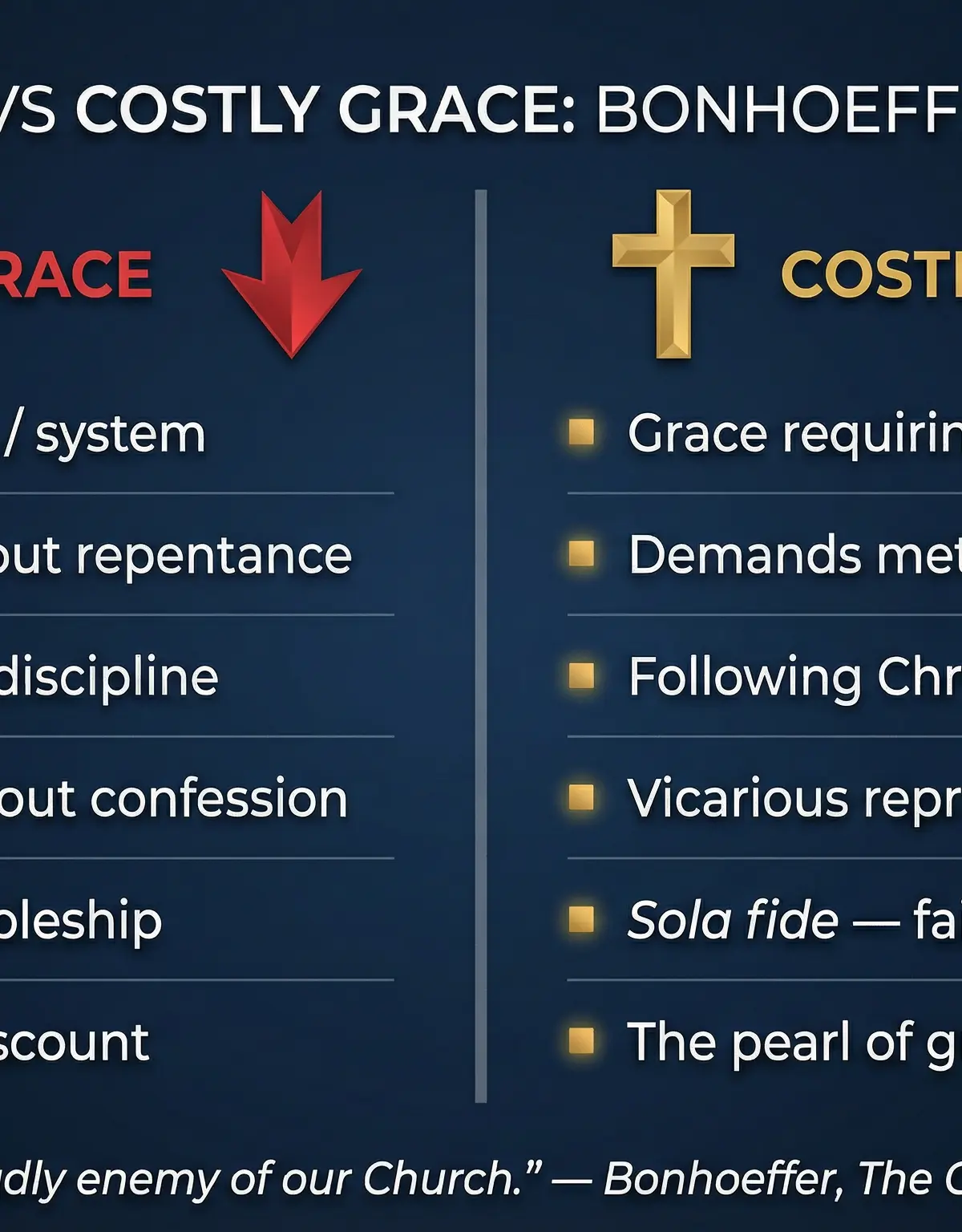
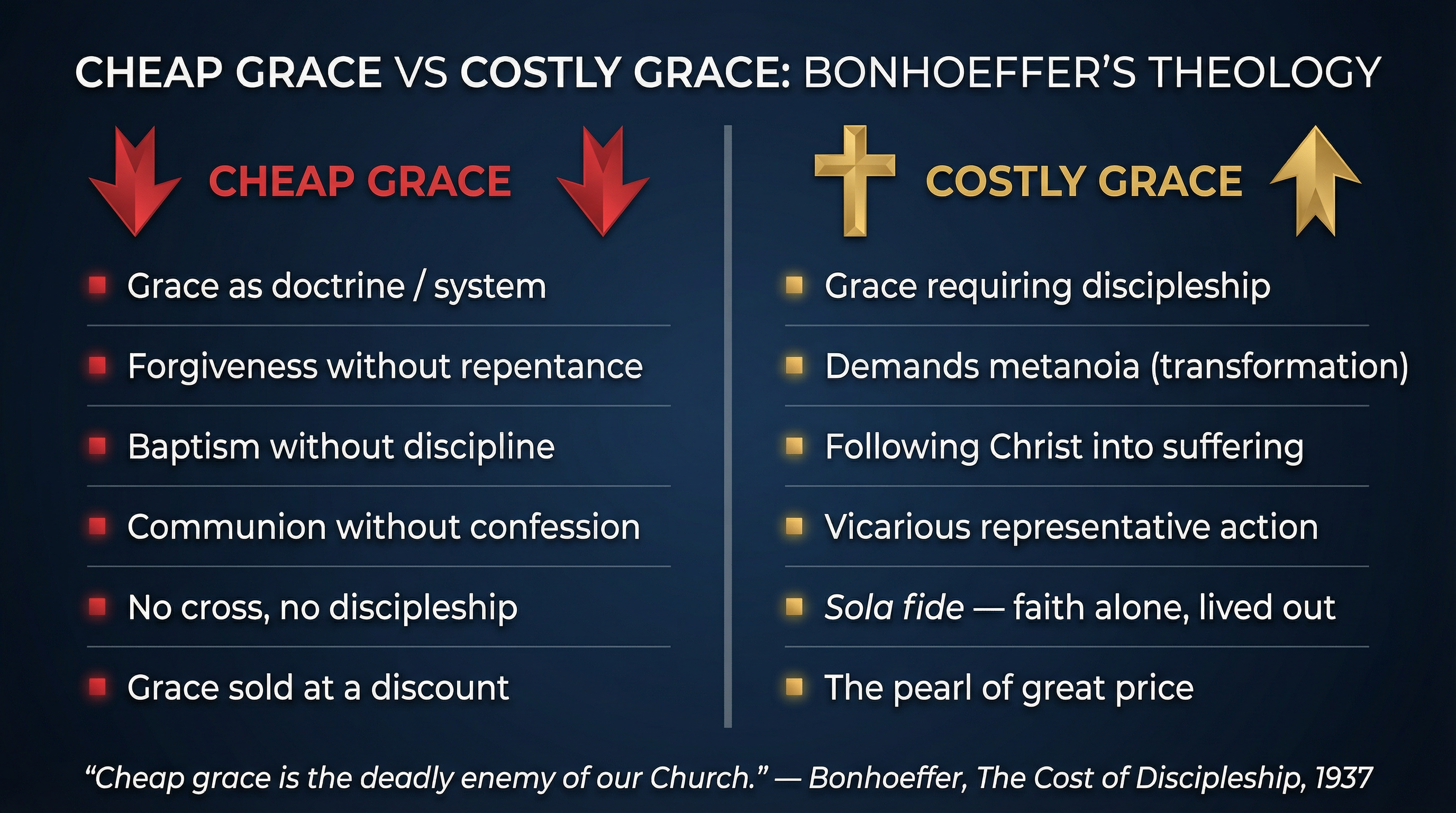
What happened: The Cost of Discipleship (Nachfolge in German) is Bonhoeffer's most systematic theological work and the primary text for this topic. Its opening chapter introduces the foundational distinction between Cheap Grace and Costly Grace. Bonhoeffer argues that the German church had sold grace cheaply — offering forgiveness, sacraments, and absolution without demanding genuine transformation (metanoia) or discipleship. Costly Grace, by contrast, is 'the pearl of great price' — it demands everything. It is sola fide (faith alone) but faith that is necessarily expressed in following Christ, even into suffering.
Why it matters: This text is the theological core of the entire topic. Candidates must be able to distinguish precisely between Cheap and Costly Grace, using Bonhoeffer's own language. Examiners award marks for the use of specific terminology: metanoia, sola fide, vicarious representative action, and the concept of grace as 'the pearl of great price'.
Resistance, Arrest, and Execution (1939–1945)
Date(s): 1939–9 April 1945
What happened: In 1939, Bonhoeffer made the fateful decision to return to Germany from the United States, where he had been offered a safe teaching post. He could not, he wrote, share in the reconstruction of Germany after the war if he had not shared in its trials. He subsequently joined the Abwehr (German military intelligence) as a double agent, using his ecumenical contacts to pass information to the Allies and to participate in the conspiracy to assassinate Hitler — the July 1944 plot (Operation Valkyrie). He was arrested by the Gestapo on 5 April 1943 and imprisoned at Tegel Prison in Berlin. From prison, he wrote the letters and papers later published as Letters and Papers from Prison, in which he developed the concept of Religionless Christianity. He was executed by hanging at Flossenbürg concentration camp on 9 April 1945, three weeks before Germany's surrender.
Why it matters: Bonhoeffer's participation in the assassination plot is the most ethically challenging aspect of this topic. Candidates must be able to explain his theological justification: the concept of vicarious representative action — that responsible Christian action sometimes requires taking on guilt for the sake of others. This is not Situation Ethics; it is a Christological ethic rooted in the model of Christ's own self-giving.
Specific Knowledge: Returned to Germany 1939; joined Abwehr as double agent; arrested 5 April 1943; imprisoned Tegel Prison; Letters and Papers from Prison written 1943–44; executed Flossenbürg 9 April 1945, aged 39.
Key Individuals
Dietrich Bonhoeffer (1906–1945)
Role: Lutheran pastor, theologian, and resistance member.
Key Actions: Opposed the Aryan Clause (1933); co-founded the Confessing Church; drafted the Barmen Declaration (1934); led Finkenwalde Seminary (1935–37); published The Cost of Discipleship (1937); joined the Abwehr resistance; participated in the plot to assassinate Hitler; executed at Flossenbürg, 9 April 1945.
Impact: Bonhoeffer represents the most thoroughgoing attempt in modern Christian theology to integrate faith and ethical action. His framework of Costly Grace challenges any Christianity that separates belief from behaviour. His concept of Religionless Christianity anticipates debates about secularisation that remain live today.
Karl Barth (1886–1968)
Role: Swiss Reformed theologian; primary drafter of the Barmen Declaration.
Key Actions: Led the theological resistance to the Deutsche Christen movement; drafted the Barmen Declaration's six theses; influenced Bonhoeffer's Christocentric approach to ethics.
Impact: Barth's influence on Bonhoeffer is significant for the exam. Both insisted that Christ — not natural law, not the state, not religious tradition — is the sole norm for Christian ethics. Candidates who can reference Barth's influence demonstrate synoptic breadth.
Ludwig Müller (1883–1945)
Role: Leader of the Deutsche Christen movement; appointed Reich Bishop in 1933.
Key Actions: Sought to align the German Evangelical Church with Nazi ideology; supported the Aryan Clause; represented the capitulation to Cheap Grace that Bonhoeffer opposed.
Impact: Müller functions as the theological foil to Bonhoeffer in this topic — the embodiment of the church's failure to resist, and the practical consequence of Cheap Grace at an institutional level.
Key Theological Concepts
Cheap Grace vs Costly Grace
This is the central distinction of the topic. Cheap Grace is grace as a doctrine or system — forgiveness dispensed without repentance, baptism without discipline, communion without confession. It is, in Bonhoeffer's devastating phrase, 'the deadly enemy of our Church.' Costly Grace is the grace that demands discipleship — following Christ into the world, into suffering, into self-giving action. It is sola fide but faith that necessarily transforms life. The distinction is not between two types of divine grace, but between two ways the church can relate to grace: faithfully or unfaithfully.
Religionless Christianity and the World Come of Age
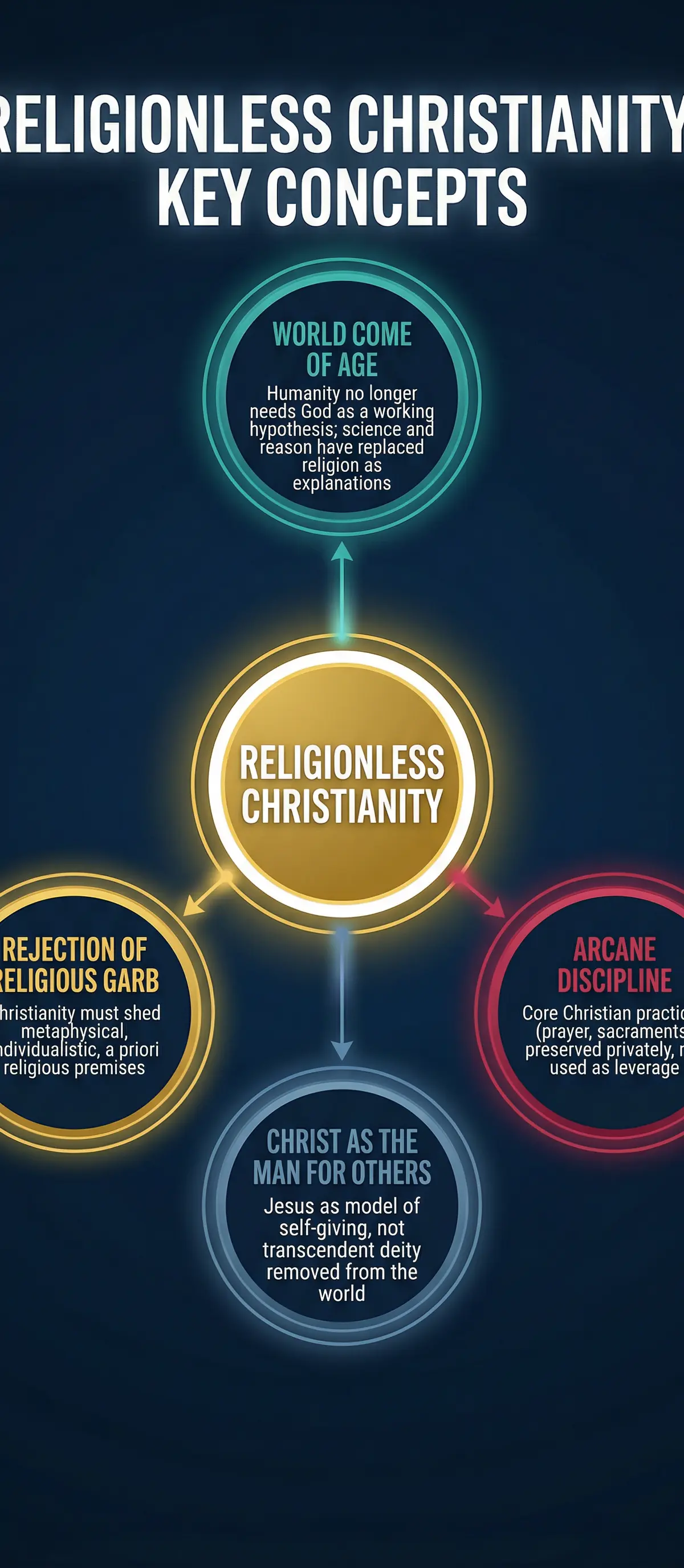
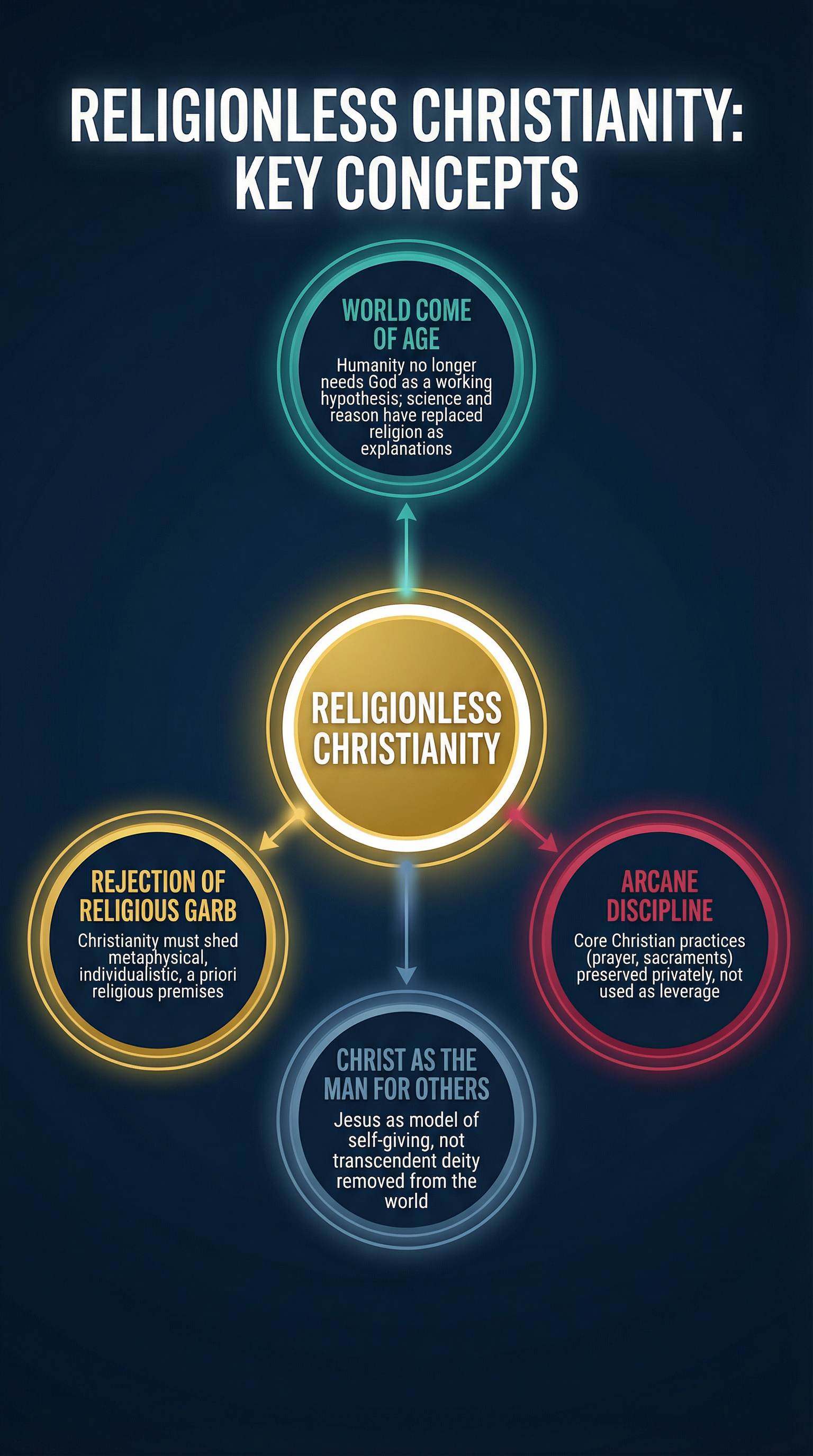
Developed in Letters and Papers from Prison (1943–44), this concept argues that the modern world has 'come of age' — it no longer needs God as a working hypothesis to explain natural phenomena or provide moral order. Science, reason, and technology have displaced religion's explanatory role. Bonhoeffer's response is not despair but a call for Christianity to shed its 'religious garb' — its a priori assumptions that humans are naturally religious — and to engage with the secular world on its own terms. The model is Christ as the 'Man for Others': entirely self-giving, entirely engaged with the world, not retreating into religious institutions. Crucially, this is NOT an abandonment of faith; Bonhoeffer retains Arcane Discipline — the private, sustaining practice of prayer and sacrament — as the hidden core of Christian life.
Vicarious Representative Action
This concept, drawn from Bonhoeffer's Christology, holds that Christ acted on behalf of humanity — taking on the guilt and suffering of others as their representative. Bonhoeffer applies this to Christian ethics: genuine discipleship sometimes requires acting on behalf of others even when this involves moral ambiguity or personal guilt. This is the theological justification for his participation in the assassination plot. He was not claiming the act was morally clean; he was claiming that responsible action in the world sometimes requires taking on guilt, trusting in God's grace to redeem it.
Second-Order Concepts
Causation
The immediate cause of Bonhoeffer's theological development was the crisis of the German church under National Socialism. The longer-term cause was his formation at Union Theological Seminary (1930), where exposure to African American theology demonstrated that faith must engage with social and political injustice. The underlying theological cause was his Christocentric conviction — rooted in Karl Barth's influence — that Christ alone is Lord, which made any accommodation with the Nazi state theologically impossible.
Consequence
In the short term, Bonhoeffer's resistance led to his arrest, imprisonment, and execution. In the longer term, his theology has had enormous influence on liberation theology, political theology, and debates about Christian engagement with secular society. His concept of Religionless Christianity continues to shape discussions about the church's role in a post-Christian West.
Change and Continuity
Bonhoeffer's theology represents both change and continuity within the Lutheran tradition. He maintained Lutheran commitments to sola fide and Christocentrism, but radically reinterpreted their implications — insisting that faith alone necessarily produces costly discipleship, not comfortable acquiescence. His concept of Religionless Christianity represents a significant departure from traditional Lutheran two-kingdoms theology.
Significance
Bonhoeffer's significance lies in his demonstration that theological conviction and ethical action are inseparable. He is significant historically as a martyr of the anti-Nazi resistance; theologically as a pioneer of contextual and political theology; and ethically as a thinker who grappled seriously with the limits of conventional moral categories in extreme situations.
Visual Resources
3 diagrams and illustrations
Interactive Diagrams
3 interactive diagrams to visualise key concepts
Diagram could not be rendered
Key events in Bonhoeffer's life and theological development
Conceptual Flow Outline
How Costly Grace flows into Bonhoeffer's actions
Conceptual Flow Outline
The structure of Bonhoeffer's Religionless Christianity
Worked Examples
4 worked examples — open one to explore the question and available guidance.
Practice Questions
Test your understanding — click to reveal model answers
Examine the significance of the Barmen Declaration (1934) for Bonhoeffer's theology of Christian moral action. (10 marks)
Hint: Focus on the theological content of the Declaration (Jesus Christ as sole Lord) and connect it to Bonhoeffer's concepts of Costly Grace and civil disobedience. This is AO1 only — do not evaluate.
Evaluate the view that Bonhoeffer's participation in the plot to assassinate Hitler was inconsistent with Christian ethics. (15 marks)
Hint: This requires sustained AO2. Present the strongest case FOR the view (traditional Christian prohibition on killing) and AGAINST it (Bonhoeffer's theology of vicarious representative action). Avoid treating this as a simple yes/no question — the nuance is what earns marks.
Examine Bonhoeffer's concept of 'Religionless Christianity' and the 'World Come of Age'. (10 marks)
Hint: This is AO1 only. Explain what Bonhoeffer means by each term, their relationship to each other, and how they connect to his broader theology. Resist the temptation to evaluate — that is not what 'Examine' asks for.
Evaluate the view that Bonhoeffer's theology of Costly Grace is the most important contribution to Christian ethics in the twentieth century. (15 marks)
Hint: This is a broad evaluative question. You need to assess the significance of Costly Grace, compare it with other contributions (you might reference Natural Law, Situation Ethics, Liberation Theology), and reach a sustained judgement. The AO2 weighting means your evaluation must drive the essay.
Examine the role of the Confessing Church in Bonhoeffer's theology of Christian moral action. (10 marks)
Hint: Focus on the theological significance of the Confessing Church, not just its historical role. Connect it to Costly Grace, the Barmen Declaration, and Finkenwalde. This is AO1 only.