AQA · GCSE · Religious Studies
Course version: 8062 · Version from Sept 2018
Beliefs and teachings: The holy books:
Belief in the holy books (Kutub) is a core article of faith in Islam, representing Allah's written revelations to humanity.
Checked against the AQA 8062 specification (opens in a new tab) on .
- Point 10 of 13
- 4 key terms
Study notes
From the checked teaching notes for this specification point.
The idea
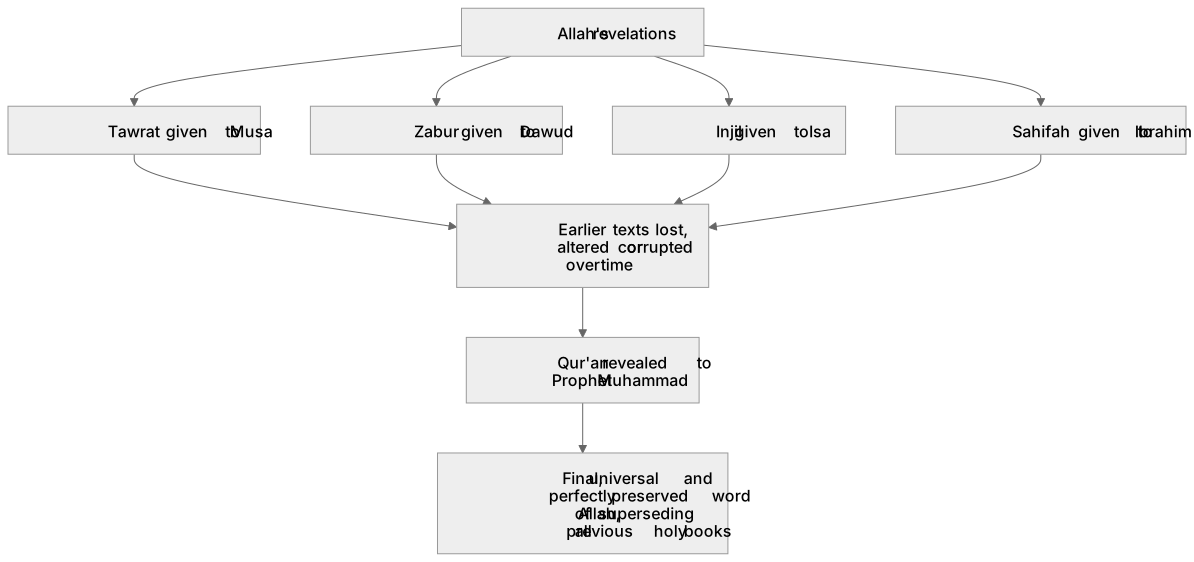
Belief in the holy books (Kutub) is a core article of faith in Islam, representing Allah's written revelations to humanity. Muslims believe Allah sent several scriptures to different prophets to guide specific nations. These include the Tawrat (Torah) given to Musa, the Zabur (Psalms) given to Dawud, the Injil (Gospel) given to Isa, and the Sahifah (Scrolls) given to Ibrahim. However, Muslims believe these earlier texts were either lost, altered, or corrupted over time. Consequently, the Qur'an was revealed to Prophet Muhammad as the final, universal, and perfectly preserved word of Allah, superseding all previous holy books.
What earns the marks
- Identify belief in the holy books (Kutub) as one of the Six Articles of Faith in Sunni Islam.
- Name the key revealed texts prior to the Qur'an: Tawrat (Musa), Zabur (Dawud), Injil (Isa), and Sahifah (Ibrahim).
- Explain the Islamic belief that earlier scriptures were altered or corrupted by human interference over time.
- Contrast the earlier books with the Qur'an, which is believed to be the exact, uncorrupted, and final word of Allah.
Common mistakes and how to put them right
Claiming Muslims completely reject the Torah and the Bible.
Put it right: Muslims respect the original Tawrat and Injil as true revelations from Allah, but believe the current versions have been altered.
Confusing the prophets associated with each book.
Put it right: Ensure correct pairings, such as the Tawrat to Musa (Moses) and the Injil to Isa (Jesus).
Stating the Qur'an was written by Muhammad.
Put it right: The Qur'an is believed to be the direct word of Allah, dictated to Muhammad by the Angel Jibril; Muhammad merely recited it.
Exam tips
- Memorise the Arabic names of the holy books and their corresponding prophets to use as specific evidence in your answers.
- When evaluating the importance of the Qur'an, contrast its universal and eternal nature with the temporary, nation-specific nature of earlier books.
- Use the concept of corruption (tahrif) to explain why Muslims believe the Qur'an was necessary as a final revelation.
Try the lesson
The start of the Beliefs and teachings: The holy books: lesson, made from checked teaching notes for this specification point.
Have a go first
Which of the following is recognised in Islam as a holy book revealed to the prophet Dawud (David)?
Listen
Belief in the holy books (Kutub) is a core article of faith in Islam, representing Allah's written revelations to humanity. Muslims believe Allah sent several scriptures to different prophets to guide specific nations. These include the Tawrat (Torah) given to Musa, the Zabur (Psalms) given to Dawud, the Injil (Gospel) given to Isa, and the Sahifah (Scrolls) given to Ibrahim. However, Muslims believe these earlier texts were either lost, altered, or corrupted over time. Consequently, the Qur'an was revealed to Prophet Muhammad as the final, universal, and perfectly preserved word of Allah, superseding all previous holy books. A strong answer earns marks for these points. Identify belief in the holy books (Kutub) as one of the Six Articles of Faith in Sunni Islam. Name the key revealed texts prior to the Qur'an: Tawrat (Musa), Zabur (Dawud), Injil (Isa), and Sahifah (Ibrahim). Explain the Islamic belief that earlier scriptures were altered or corrupted by human interference over time. Contrast the earlier books with the Qur'an, which is believed to be the exact, uncorrupted, and final word of Allah. A common slip: Claiming Muslims completely reject the Torah and the Bible. Instead, Muslims respect the original Tawrat and Injil as true revelations from Allah, but believe the current versions have been altered. Exam tip: Memorise the Arabic names of the holy books and their corresponding prophets to use as specific evidence in your answers.
See it
Key words
Say what each word means before you turn the card.
Revelation
Try answering aloud or in your head before turning the card.
Authority
Try answering aloud or in your head before turning the card.
Preservation of Scripture
Try answering aloud or in your head before turning the card.
Prophethood
Try answering aloud or in your head before turning the card.
See every definition
- Revelation
- Allah's written communications sent to humanity through prophets to guide specific nations.
- Authority
- The Qur'an holds supreme authority as the final, universal and perfectly preserved word of Allah, superseding all previous holy books.
- Preservation of Scripture
- Earlier texts were lost, altered or corrupted over time, whereas the Qur'an is believed to be perfectly preserved.
- Prophethood
- Allah sent several scriptures to different prophets, including Musa, Dawud, Isa and Ibrahim.
Label the diagram
Some boxes have lost their names. Pick the right name for each number.
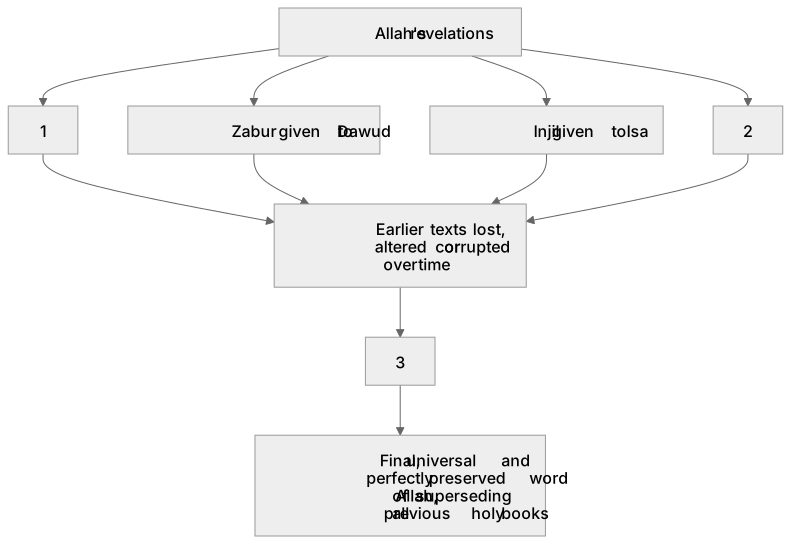
1Box 1
2Box 2
3Box 3
There is more to this lesson
The full lesson goes on to check your understanding and help you earn the marks. Create a free account to carry on, with your progress saved.
A week of Premium from your first lesson · Then the free plan continues · No card, no charge
Test your understanding of Beliefs and teachings: The holy books:
Active recall beats re-reading. Take an instant quiz now to test what you’ve learned and lock it into long-term memory.
A week of Premium from your first lesson · Then the free plan continues · No card, no charge