AQA · GCSE · Religious Studies
Course version: 8062 · Version from Sept 2018
Prayer and its significance, including the Lord’s Prayer, set prayers and…
Full specification wording
Christianity - 3.1.2.2 Practices: Prayer and its significance, including the Lord’s Prayer, set prayers and informal prayer.
Prayer is communicating with God, serving as a vital way for Christians to express gratitude, seek forgiveness, and request help.
Checked against the AQA 8062 specification (opens in a new tab) on .
- Point 5 of 20
- 4 key terms
Study notes
From the checked teaching notes for this specification point.
The idea
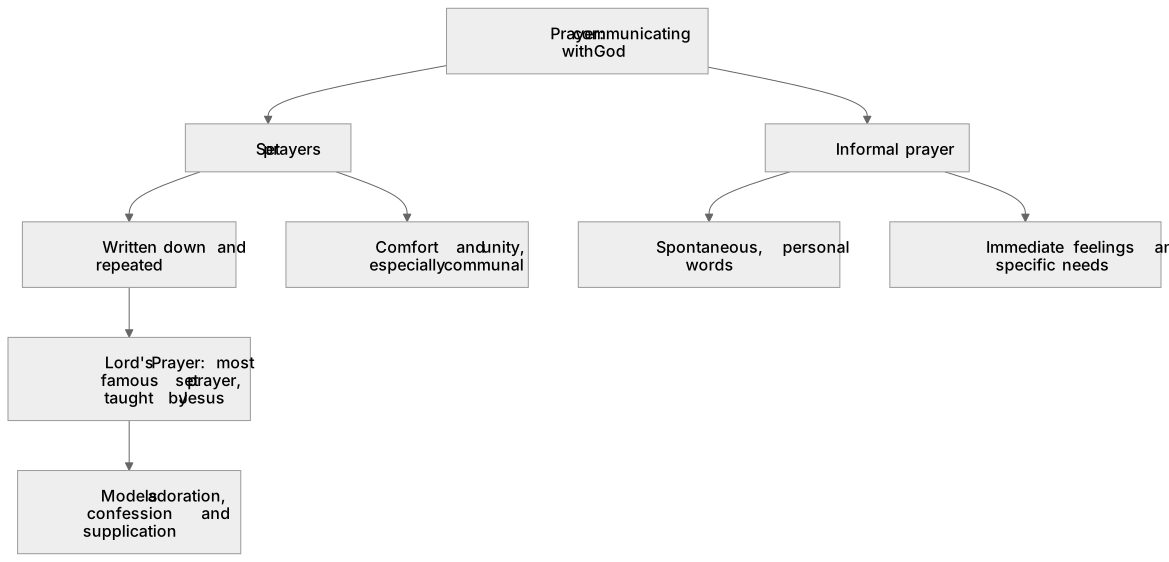
Prayer is communicating with God, serving as a vital way for Christians to express gratitude, seek forgiveness, and request help. Its significance lies in building a personal relationship with the divine. Set prayers are written down and repeated, offering comfort and unity, especially in communal settings. The Lord’s Prayer is the most famous set prayer, taught by Jesus, which models adoration, confession, and supplication. In contrast, informal prayer involves spontaneous, personal words, allowing believers to express their immediate feelings and specific needs intimately. Both forms are essential, balancing structured tradition with personal expression.
What earns the marks
- Explain the significance of prayer as a means of communicating with God, building faith, and seeking guidance or forgiveness.
- Describe set prayers as established, traditional texts that provide structure and unite congregations.
- Analyse the Lord's Prayer as the model prayer given by Jesus, containing key elements of worship: praising God, asking for daily needs, and seeking forgiveness.
- Define informal prayer as spontaneous, unstructured communication that allows for a highly personal and immediate connection with God.
Common mistakes and how to put them right
Claiming that informal prayer is only used in private.
Put it right: Informal, spontaneous prayer is frequently used in public evangelical or charismatic services.
Stating that the Lord's Prayer is only used by specific denominations.
Put it right: It is a universal prayer used across almost all Christian traditions.
Assuming set prayers lack sincerity.
Put it right by explaining that familiar words can provide deep comfort and allow believers to focus on God rather than finding the right words.
Exam tips
- Memorise a short quote from the Lord's Prayer, such as 'forgive us our sins', to illustrate the purpose of confession in prayer.
- Compare the benefits of set prayers (unity, tradition, comfort) with informal prayers (personal, specific, spontaneous) in evaluation questions.
- Link the significance of prayer to the nature of God, showing how believers interact with a personal, listening deity.
Try the lesson
The start of the Christianity - 3.1.2.2 Practices: Prayer and its significance, including the Lord’s Prayer, set prayers and informal prayer. lesson, made from checked teaching notes for this specification point.
Have a go first
Which of the following is the best example of a set prayer in Christianity?
Listen
Prayer is communicating with God, serving as a vital way for Christians to express gratitude, seek forgiveness, and request help. Its significance lies in building a personal relationship with the divine. Set prayers are written down and repeated, offering comfort and unity, especially in communal settings. The Lord’s Prayer is the most famous set prayer, taught by Jesus, which models adoration, confession, and supplication. In contrast, informal prayer involves spontaneous, personal words, allowing believers to express their immediate feelings and specific needs intimately. Both forms are essential, balancing structured tradition with personal expression. A strong answer earns marks for these points. Explain the significance of prayer as a means of communicating with God, building faith, and seeking guidance or forgiveness. Describe set prayers as established, traditional texts that provide structure and unite congregations. Analyse the Lord's Prayer as the model prayer given by Jesus, containing key elements of worship: praising God, asking for daily needs, and seeking forgiveness. Define informal prayer as spontaneous, unstructured communication that allows for a highly personal and immediate connection with God. A common slip: Assuming set prayers lack sincerity. Instead, explaining that familiar words can provide deep comfort and allow believers to focus on God rather than finding the right words. Exam tip: Memorise a short quote from the Lord's Prayer, such as 'forgive us our sins', to illustrate the purpose of confession in prayer.
See it
Key words
Say what each word means before you turn the card.
Prayer
Try answering aloud or in your head before turning the card.
Set prayers
Try answering aloud or in your head before turning the card.
The Lord's Prayer
Try answering aloud or in your head before turning the card.
Informal prayer
Try answering aloud or in your head before turning the card.
See every definition
- Prayer
- Communicating with God, serving as a vital way for Christians to express gratitude, seek forgiveness, and request help.
- Set prayers
- Written down and repeated, offering comfort and unity, especially in communal settings.
- The Lord's Prayer
- The most famous set prayer, taught by Jesus, which models adoration, confession, and supplication.
- Informal prayer
- Spontaneous, personal words, allowing believers to express their immediate feelings and specific needs intimately.
Label the diagram
Some boxes have lost their names. Pick the right name for each number.
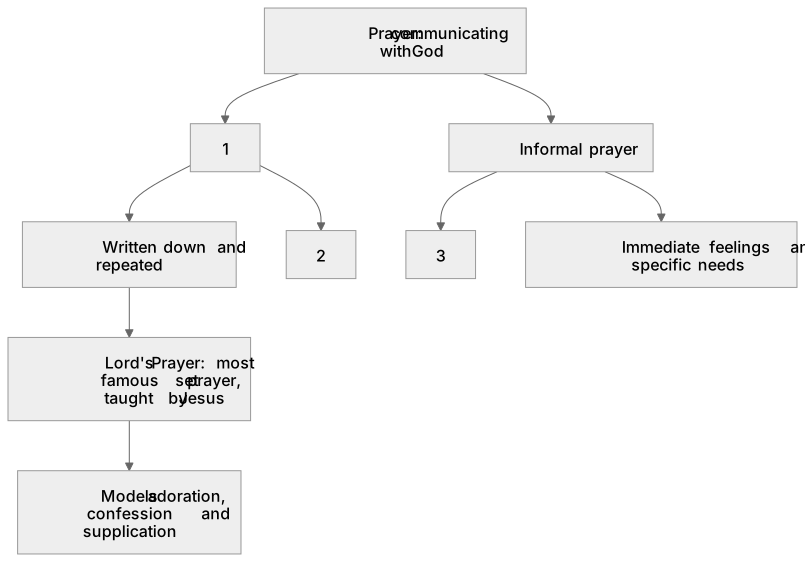
1Box 1
2Box 2
3Box 3
There is more to this lesson
The full lesson goes on to check your understanding and help you earn the marks. Create a free account to carry on, with your progress saved.
A week of Premium from your first lesson · Then the free plan continues · No card, no charge
Test your understanding of Christianity - 3.1.2.2 Practices: Prayer and its significance, including the Lord’s Prayer, set prayers and informal prayer.
Active recall beats re-reading. Take an instant quiz now to test what you’ve learned and lock it into long-term memory.
A week of Premium from your first lesson · Then the free plan continues · No card, no charge