AQA · GCSE · Religious Studies
Course version: 8062 · Version from Sept 2018
The place of mission, evangelism and Church growth.
Full specification wording
Christianity - 3.1.2.2 Practices: The place of mission, evangelism and Church growth.
Mission refers to the calling of Christians to go out into the world to spread their faith, often through practical actions like charity work or building schools.
Checked against the AQA 8062 specification (opens in a new tab) on .
- Point 16 of 20
- 4 key terms
Study notes
From the checked teaching notes for this specification point.
The idea
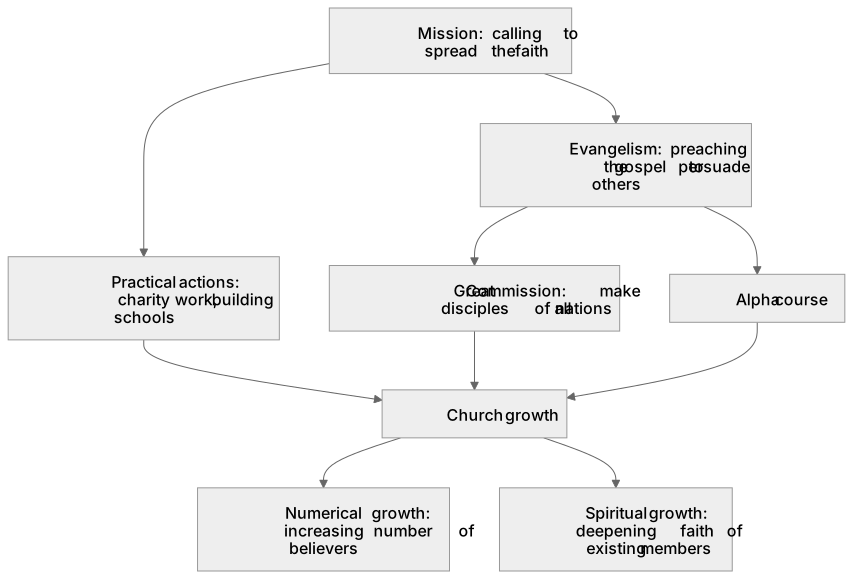
Mission refers to the calling of Christians to go out into the world to spread their faith, often through practical actions like charity work or building schools. Evangelism is a specific form of mission focused on preaching the gospel to persuade others to become Christians, following Jesus' Great Commission to "make disciples of all nations". Together, these practices drive Church growth, which can be both numerical (increasing the number of believers globally) and spiritual (deepening the faith of existing members).
For example: Organisations like the Alpha course facilitate evangelism, leading to significant Church growth by providing a welcoming environment for non-believers to explore the Christian faith.
What earns the marks
- Define mission as a vocation or calling to spread the faith, often through practical charitable actions.
- Define evangelism as spreading the Christian gospel by public preaching or personal witness.
- Explain the Great Commission as the biblical foundation for mission and evangelism.
- Identify that Church growth involves both increasing numbers of followers and deepening spiritual commitment.
- Provide examples of modern evangelism, such as the Alpha course or the work of missionaries.
Common mistakes and how to put them right
Confusing mission and evangelism.
Put it right by stating that mission is the broader calling to serve and spread faith, while evangelism specifically focuses on preaching the gospel.
Assuming Church growth only means building larger physical churches.
Put it right by explaining it refers to the increasing number of believers and their spiritual development.
Thinking evangelism is only historical.
Put it right by providing modern examples like street pastors or digital ministries.
Exam tips
- Use the Great Commission (Matthew 28:19) as a key biblical quote to support answers on why Christians evangelise.
- Link practical charity work to mission, showing how actions can spread the Christian message without explicit preaching.
- When evaluating the importance of evangelism, contrast it with the view that faith should be a private matter.
Try the lesson
The start of the Christianity - 3.1.2.2 Practices: The place of mission, evangelism and Church growth. lesson, made from checked teaching notes for this specification point.
Have a go first
What is the primary meaning of 'evangelism' in Christianity?
Listen
Mission refers to the calling of Christians to go out into the world to spread their faith, often through practical actions like charity work or building schools. Evangelism is a specific form of mission focused on preaching the gospel to persuade others to become Christians, following Jesus' Great Commission to "make disciples of all nations". Together, these practices drive Church growth, which can be both numerical (increasing the number of believers globally) and spiritual (deepening the faith of existing members). For example, organisations like the Alpha course facilitate evangelism, leading to significant Church growth by providing a welcoming environment for non-believers to explore the Christian faith. A strong answer earns marks for these points. Define mission as a vocation or calling to spread the faith, often through practical charitable actions. Define evangelism as spreading the Christian gospel by public preaching or personal witness. Explain the Great Commission as the biblical foundation for mission and evangelism. Identify that Church growth involves both increasing numbers of followers and deepening spiritual commitment. A common slip: Confusing mission and evangelism. Instead, stating that mission is the broader calling to serve and spread faith, while evangelism specifically focuses on preaching the gospel. Exam tip: Use the Great Commission (Matthew 28:19) as a key biblical quote to support answers on why Christians evangelise.
See it
Key words
Say what each word means before you turn the card.
Mission
Try answering aloud or in your head before turning the card.
Evangelism
Try answering aloud or in your head before turning the card.
The Great Commission
Try answering aloud or in your head before turning the card.
Church growth
Try answering aloud or in your head before turning the card.
See every definition
- Mission
- The calling of Christians to go out into the world to spread their faith, often through practical actions like charity work or building schools.
- Evangelism
- A specific form of mission focused on preaching the gospel to persuade others to become Christians.
- The Great Commission
- Jesus' command to "make disciples of all nations", which is the biblical foundation for mission and evangelism.
- Church growth
- Both numerical, increasing the number of believers globally, and spiritual, deepening the faith of existing members.
Label the diagram
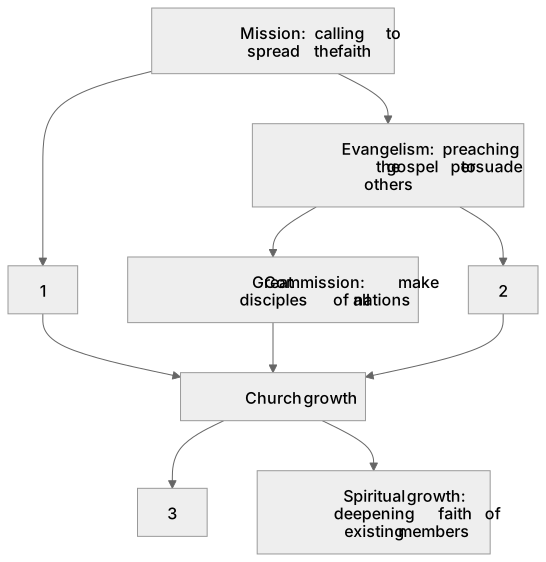
Some boxes have lost their names. Pick the right name for each number.
1Box 1
2Box 2
3Box 3
There is more to this lesson
The full lesson goes on to check your understanding and help you earn the marks. Create a free account to carry on, with your progress saved.
A week of Premium from your first lesson · Then the free plan continues · No card, no charge
Test your understanding of Christianity - 3.1.2.2 Practices: The place of mission, evangelism and Church growth.
Active recall beats re-reading. Take an instant quiz now to test what you’ve learned and lock it into long-term memory.
A week of Premium from your first lesson · Then the free plan continues · No card, no charge