AQA · GCSE · Religious Studies
Component 1: The study of religions: beliefs, teachings and practices
Master Component 1 of your GCSE Religious Studies with this comprehensive guide to beliefs, teachings, and practices. Learn how to structure your answers, apply specialist vocabulary, and secure top marks by effectively linking religious beliefs to their real-world impact.
- 7 min read
- 3 worked examples
- 5 practice questions
- 6 key terms
Study Notes
Overview
Component 1: The study of religions requires you to dive deep into the beliefs, teachings, and practices of two major world religions. This component is foundational because it tests not just what followers of a religion believe, but how those beliefs shape their lives, communities, and societies.
Examiners are looking for specific skills (Assessment Objectives): your ability to demonstrate accurate knowledge (AO1), your understanding of how beliefs influence people, and your skill in constructing balanced, well-informed arguments (AO2). You must also show awareness of divergent views—how people within the same religion might interpret teachings differently (e.g., Orthodox vs. Reform Judaism, or Catholic vs. Protestant Christianity).

The Exam Structure
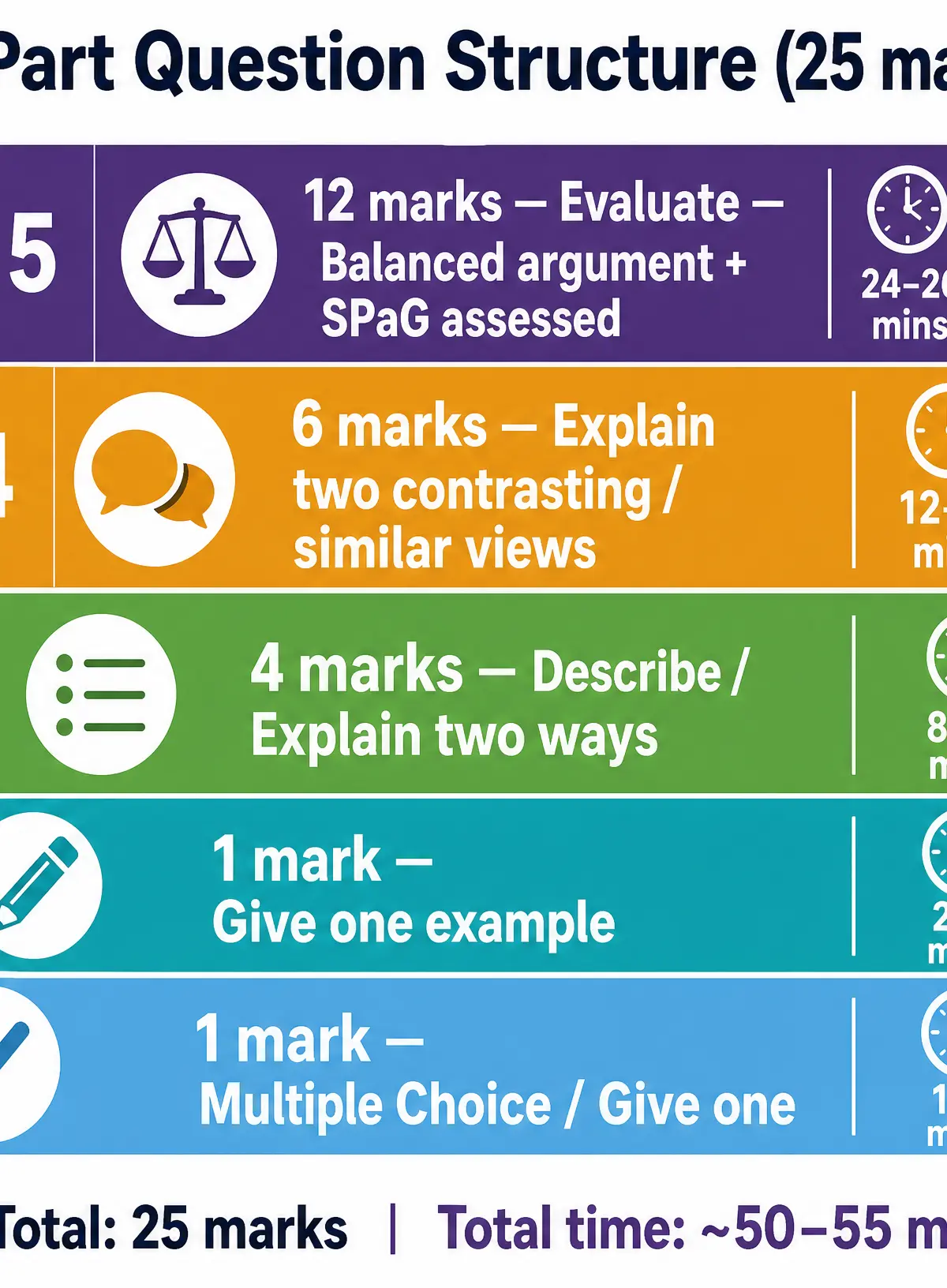
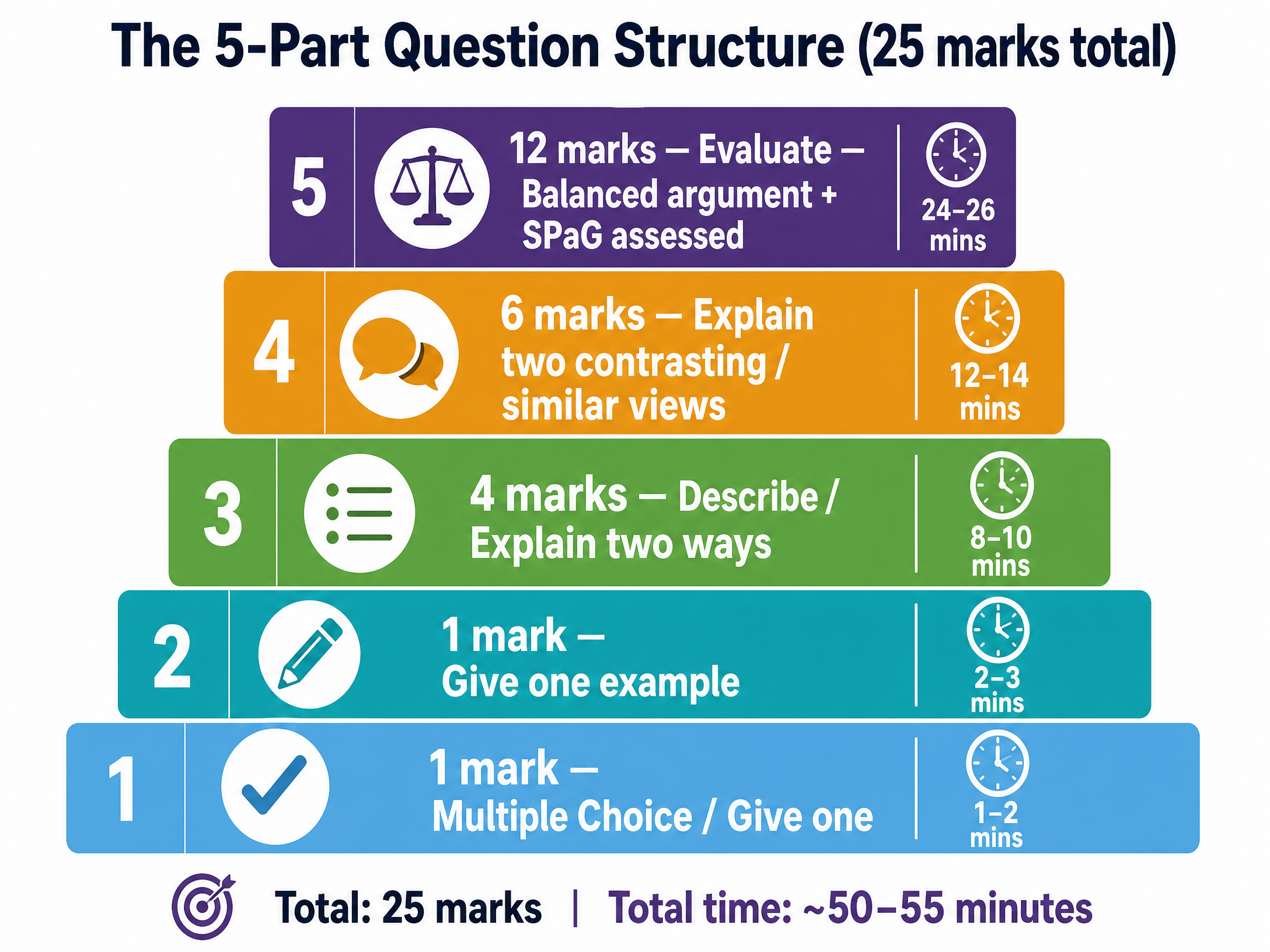
Every question set in this component follows a strict 5-part structure worth 25 marks total. Mastering this structure is the key to time management and maximizing your grade.
The 5-Part Breakdown
- 1 mark (Multiple Choice/Give one): Tests basic factual recall.
- 1 mark (Give one example): Tests specific knowledge.
- 4 marks (Describe/Explain two ways): Requires two developed points. State a point, then explain it with a specific example or teaching.
- 6 marks (Explain two contrasting/similar views): Requires you to explain two different perspectives on an issue, supported by religious teachings or scripture.
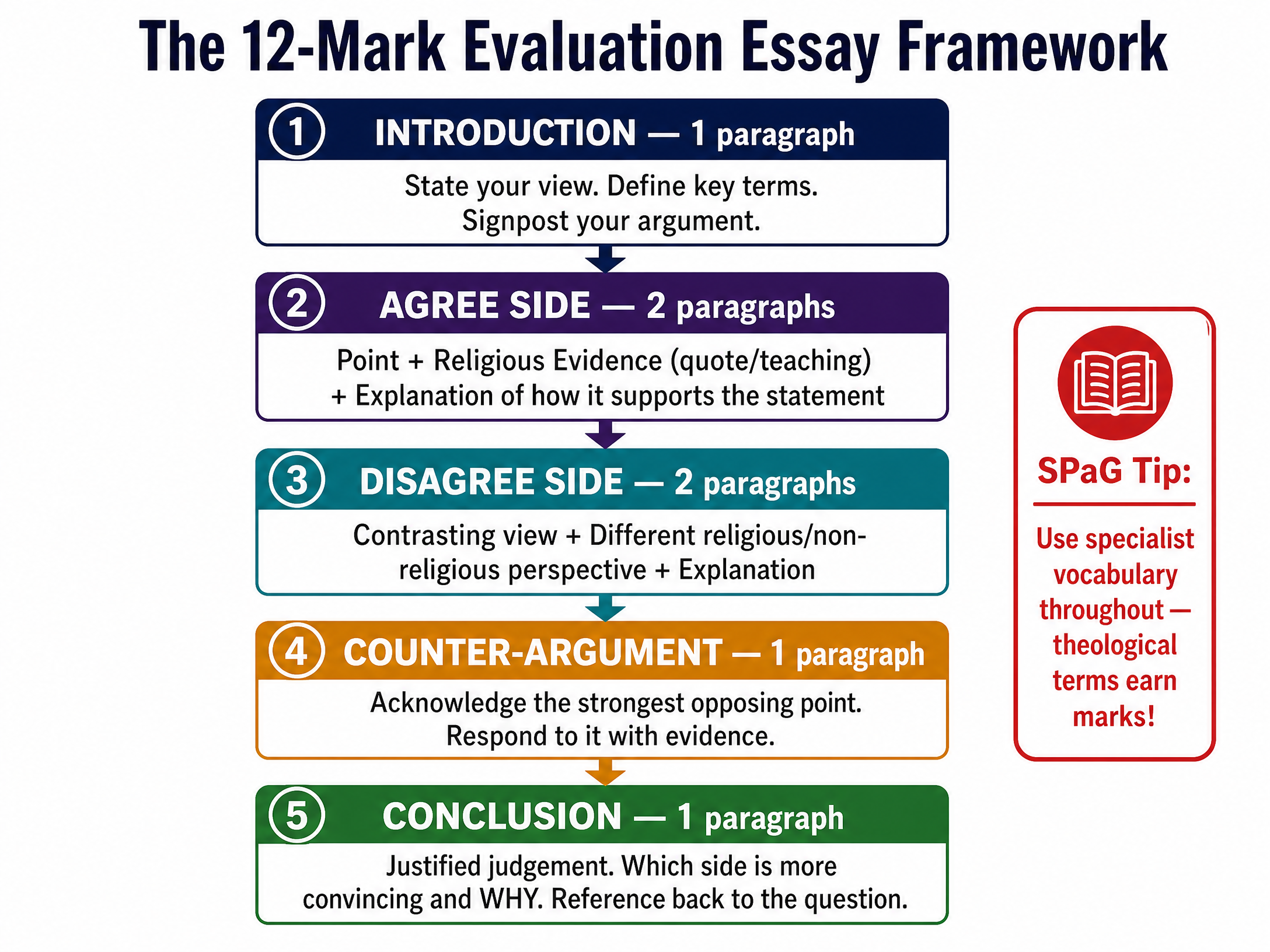
- 12 marks (Evaluate): The essay question. You must evaluate a statement, providing a balanced argument with religious evidence, and reach a justified conclusion. SPaG (Spelling, Punctuation, and Grammar) is assessed here, so use specialist terminology!
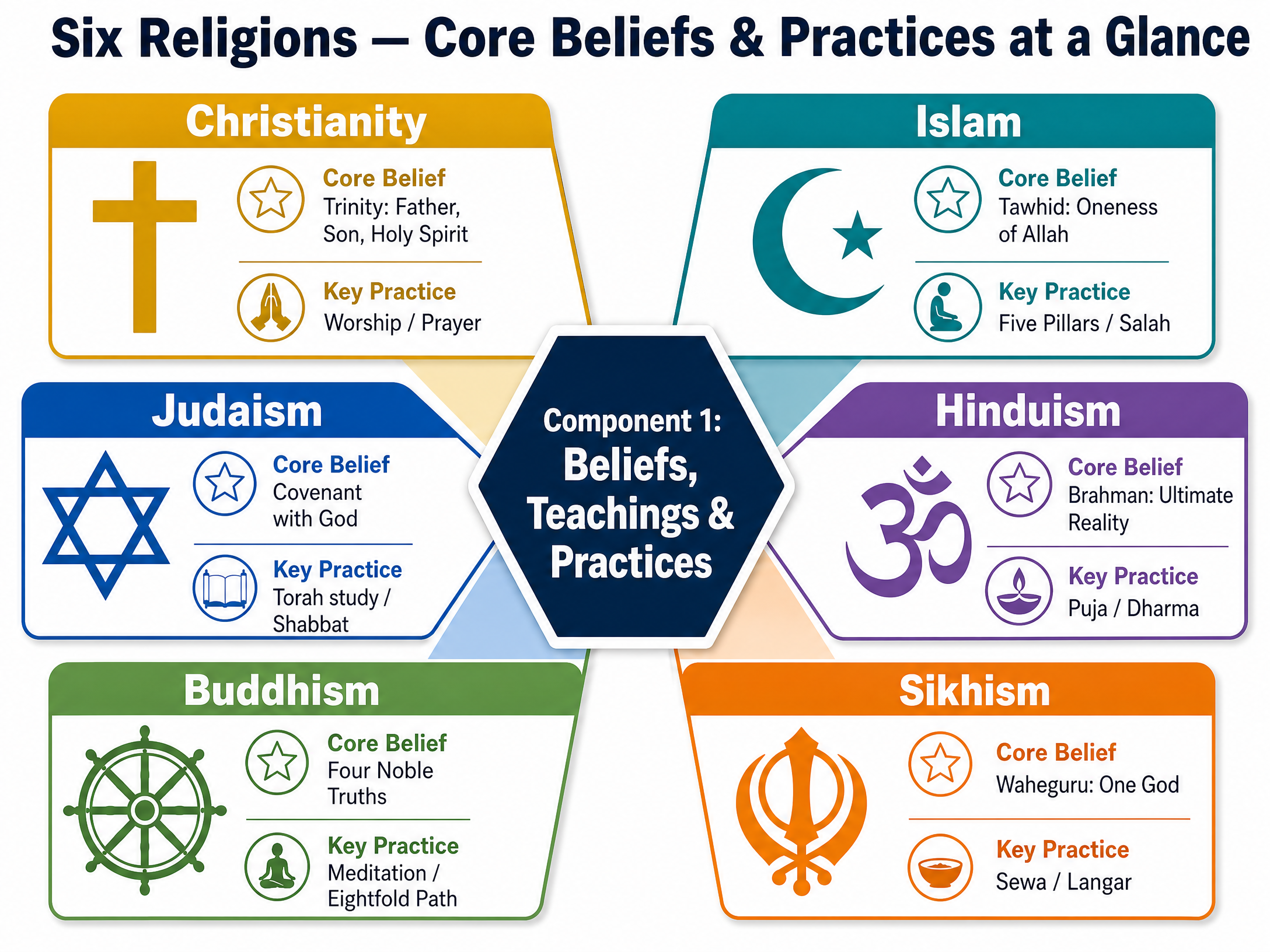
Core Beliefs & Practices: The Six Religions
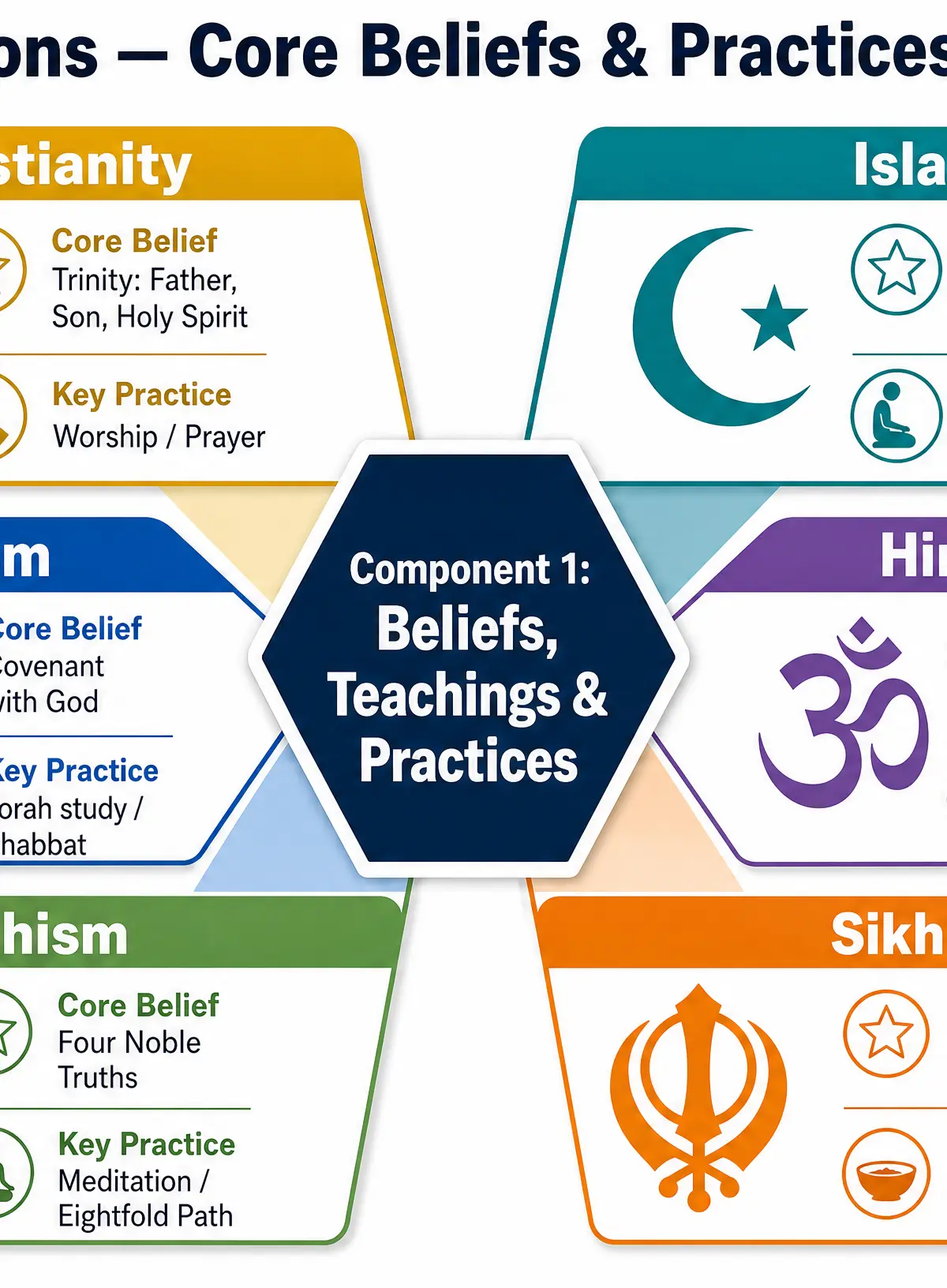
While you will only study two religions for your exam, it is helpful to understand the landscape of all six options. Remember: You cannot choose both Christianity and Catholic Christianity.
Christianity
Key Beliefs:
- The Trinity: The belief that God is one but exists in three persons: Father, Son, and Holy Spirit. This is a foundational doctrine outlined in the Nicene Creed.
- Incarnation and Atonement: The belief that Jesus is the Son of God made flesh, and that his death and resurrection reconciled humanity with God.
Key Practices:
- The Eucharist (Holy Communion): A central act of worship. Catholics believe in transubstantiation (the bread and wine literally become Christ's body and blood), while many Protestants view it as symbolic. This is a crucial divergent view.
- Prayer: Both liturgical (set prayers like the Lord's Prayer) and informal.
Islam
Key Beliefs:
- Tawhid: The absolute, indivisible oneness of Allah. This is the core of Islam; associating anything with Allah (shirk) is the greatest sin.
- Prophethood (Risalah): Belief in the messengers of Allah, with Muhammad as the final seal of the prophets.
Key Practices:
- The Five Pillars: Shahadah (declaration of faith), Salah (prayer 5 times daily), Zakah (charitable giving), Sawm (fasting during Ramadan), and Hajj (pilgrimage to Mecca).
- Divergent Views: Sunni Muslims focus on the Six Articles of Faith and the Five Pillars, while Shia Muslims focus on the Five Roots of Usul ad-Din and the Ten Obligatory Acts.
Judaism
Key Beliefs:
- The Covenant: The special agreement between God and the Jewish people, established with Abraham and Moses.
- The Nature of God: God as One, Creator, Lawgiver, and Judge. The Shema is the central prayer declaring this unity.
Key Practices:
- Shabbat: The weekly day of rest from Friday sunset to Saturday nightfall, central to family and community life.
- Divergent Views: Orthodox Jews believe the Torah is the literal word of God and follow halakha (Jewish law) strictly. Reform Jews view the Torah as divinely inspired but adaptable to modern life.
Hinduism
Key Beliefs:
- Brahman and Atman: Brahman is the ultimate, universal reality. Atman is the individual soul, which is ultimately one with Brahman.
- Samsara, Karma, and Moksha: The cycle of birth, death, and rebirth (samsara), driven by the law of cause and effect (karma). The ultimate goal is liberation from this cycle (moksha).
Key Practices:
- Puja: Worship, which can take place at a home shrine or in a Mandir (temple).
- Dharma: Duty or right living, which varies depending on one's stage of life and social position.
Buddhism
Key Beliefs:
- The Four Noble Truths: Life involves suffering (dukkha), which is caused by craving (tanha). Suffering can end (nirvana) by following the Eightfold Path.
- The Three Marks of Existence: Anicca (impermanence), Anatta (no fixed self), and Dukkha (suffering).
Key Practices:
- Meditation: Central to developing mindfulness, concentration, and insight.
- Divergent Views: Theravada Buddhism emphasizes individual enlightenment through monastic life. Mahayana Buddhism emphasizes the Bodhisattva ideal—delaying one's own nirvana to help all beings achieve enlightenment.
Sikhism
Key Beliefs:
- Waheguru: Belief in one God who is formless, eternal, and present in all things.
- The Gurus: Reverence for the ten human Gurus and the eternal, living Guru, the Guru Granth Sahib (the sacred scripture).
Key Practices:
- The Three Pillars: Naam Japna (meditating on God's name), Kirat Karni (honest living), and Vand Chakna (sharing with others).
- Langar: The free community kitchen found in every Gurdwara, demonstrating equality and service (sewa).
- The Five Ks: Articles of faith worn by initiated (Khalsa) Sikhs, including Kesh (uncut hair) and the Kirpan (ceremonial sword).
Sources of Wisdom and Authority
To achieve high marks, you must refer to specific sources of authority to back up your points.
- Christianity: The Bible (especially the Gospels), the Nicene Creed.
- Islam: The Qur'an (the direct word of Allah), the Hadith (sayings of the Prophet Muhammad).
- Judaism: The Torah (the Law), the Talmud (oral tradition and commentary).
- Hinduism: The Vedas (ancient scriptures), the Bhagavad Gita.
- Buddhism: The Pali Canon (Tripitaka), the Dhammapada.
- Sikhism: The Guru Granth Sahib.
Visual Resources
3 diagrams and illustrations
Interactive Diagrams
1 interactive diagram to visualise key concepts
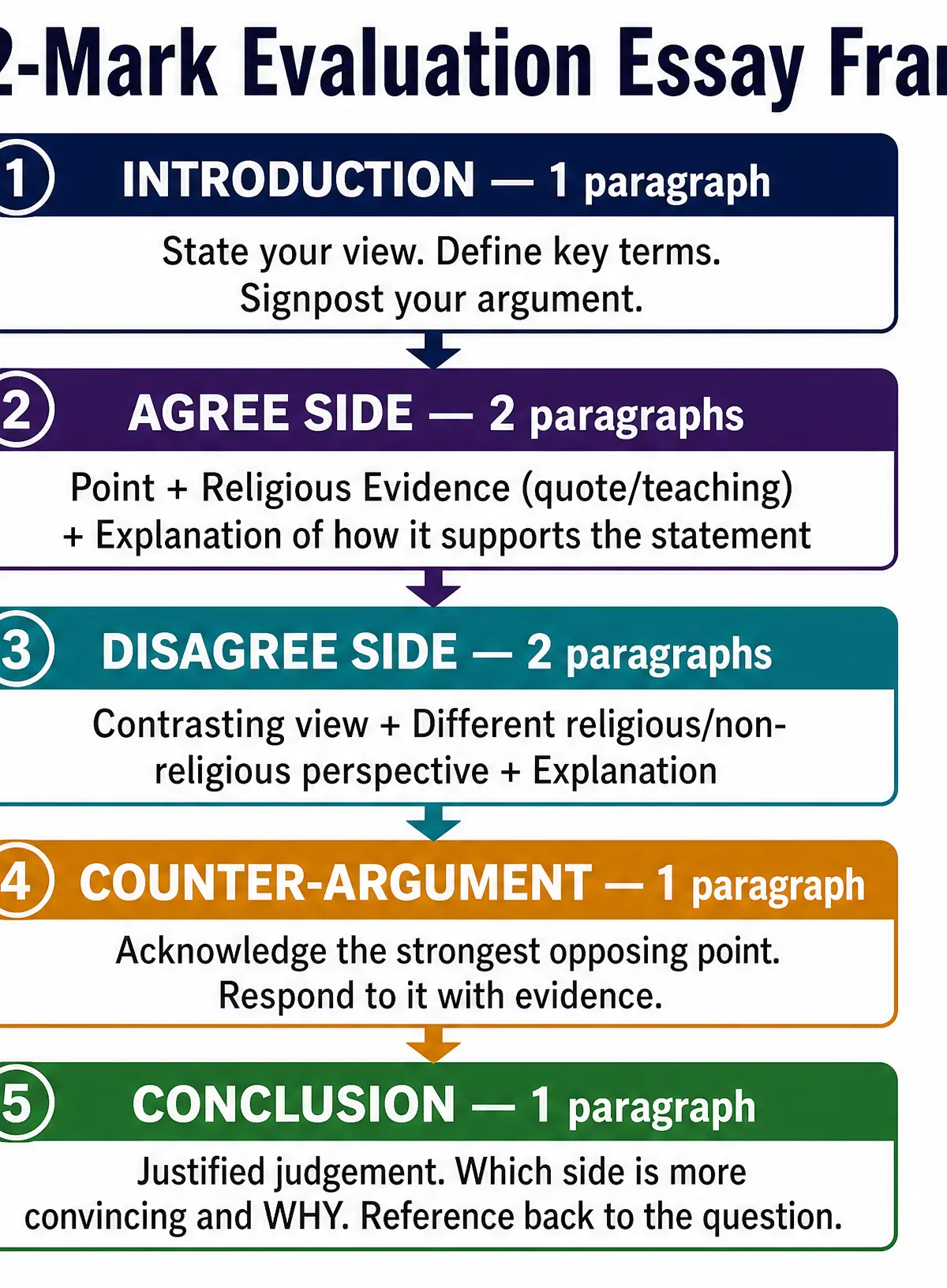
Conceptual Flow Outline
Breakdown of the 5-part question structure for Component 1.
Worked Examples
3 worked examples — open one to explore the question and available guidance.
Practice Questions
Test your understanding — click to reveal model answers
Explain two ways in which the belief in Tawhid influences Muslims today. (4 marks)
Hint: Think about how believing God is ONE affects a Muslim's daily actions and what they avoid doing.
Explain two contrasting beliefs in contemporary British society about the authority of the Bible. In your answer you must refer to one or more religious traditions. (6 marks)
Hint: Contrast a literal fundamentalist view with a liberal or non-religious view.
"The most important duty for a Jew is to observe Shabbat." Evaluate this statement. (12 marks)
Hint: Balance the importance of Shabbat against other duties like following the mitzvot generally, or Pikuach Nefesh (saving a life).
Give one of the Five Pillars of Islam. (1 mark)
Hint: Think of the mnemonic S-S-Z-S-H.
Explain two ways in which the langar expresses Sikh beliefs. (4 marks)
Hint: Think about equality and the concept of sewa (selfless service).