AQA · GCSE · Religious Studies
Course version: 8062 · Version from Sept 2018
Brahman: different Hindu understandings of brahman; ultimate reality as…
Full specification wording
Hinduism - 3.1.4.1 Beliefs and teachings: Brahman: different Hindu understandings of brahman; ultimate reality as divine consciousness (nirguna) and manifestation of God in form (saguna); spiritual worlds.
In Hinduism, Brahman is the supreme, ultimate reality and the source of all existence.
- Point 2 of 19
- 4 key terms
Study notes
From the teaching notes for this specification point.
The idea
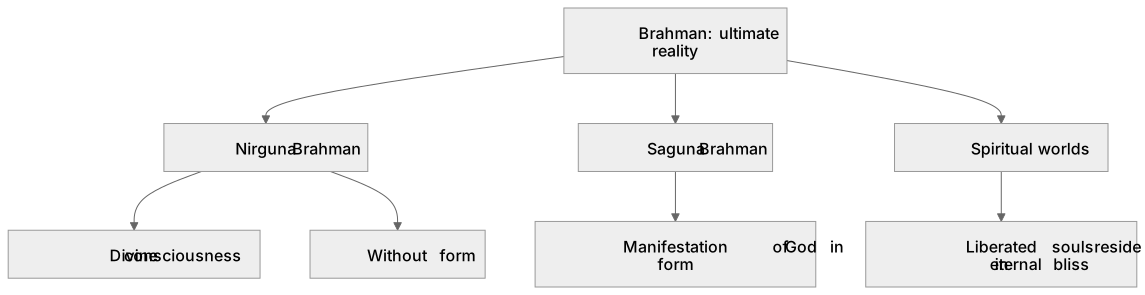
In Hinduism, Brahman is the supreme, ultimate reality and the source of all existence. Hindus understand Brahman in two main ways: Nirguna and Saguna. Nirguna Brahman is the belief in God as a pure, divine consciousness without form, attributes, or gender, often described as an omnipresent spirit that is beyond human understanding. Conversely, Saguna Brahman is the manifestation of God in a physical form with distinct attributes, allowing devotees to worship personal deities such as Vishnu or Shiva. Additionally, Hindus believe in spiritual worlds, such as Vaikuntha (the realm of Vishnu), which are divine realms where liberated souls reside in eternal bliss, free from the cycle of samsara.
What earns the marks
- Define Brahman as the ultimate reality and supreme cosmic power in Hinduism.
- Explain Nirguna Brahman as God without form, representing pure divine consciousness.
- Explain Saguna Brahman as God with form, manifested through personal deities.
- Describe spiritual worlds as divine realms where liberated souls experience eternal peace.
Common mistakes and how to put them right
Confusing Nirguna and Saguna Brahman.
Put it right: 'Nirguna' means 'without qualities' (formless) and 'Saguna' means 'with qualities' (manifested in form).
Stating Hindus believe in many separate, independent Gods.
Put it right: Explain that the many deities are different manifestations of the one supreme Brahman (Saguna Brahman).
Ignoring the concept of spiritual worlds.
Put it right: Ensure you mention spiritual realms like Vaikuntha as the ultimate destination for liberated souls.
Exam tips
- Use the terms Nirguna and Saguna accurately when discussing how Hindus perceive the divine.
- Provide examples of Saguna Brahman, such as Krishna or Rama, to illustrate God manifesting in form.
- Link the concept of spiritual worlds to the ultimate goal of moksha (liberation).
Try the lesson
The start of the Hinduism - 3.1.4.1 Beliefs and teachings: Brahman: different Hindu understandings of brahman; ultimate reality as divine consciousness (nirguna) and manifestation of God in form (saguna); spiritual worlds. lesson, made from teaching notes for this specification point.
Have a go first
What does the term 'saguna Brahman' refer to in Hindu belief?
Listen
In Hinduism, Brahman is the supreme, ultimate reality and the source of all existence. Hindus understand Brahman in two main ways: Nirguna and Saguna. Nirguna Brahman is the belief in God as a pure, divine consciousness without form, attributes, or gender, often described as an omnipresent spirit that is beyond human understanding. Conversely, Saguna Brahman is the manifestation of God in a physical form with distinct attributes, allowing devotees to worship personal deities such as Vishnu or Shiva. Additionally, Hindus believe in spiritual worlds, such as Vaikuntha (the realm of Vishnu), which are divine realms where liberated souls reside in eternal bliss, free from the cycle of samsara. A strong answer earns marks for these points. Define Brahman as the ultimate reality and supreme cosmic power in Hinduism. Explain Nirguna Brahman as God without form, representing pure divine consciousness. Explain Saguna Brahman as God with form, manifested through personal deities. Describe spiritual worlds as divine realms where liberated souls experience eternal peace. A common slip: Confusing Nirguna and Saguna Brahman. Instead, 'Nirguna' means 'without qualities' (formless) and 'Saguna' means 'with qualities' (manifested in form). Exam tip: Use the terms Nirguna and Saguna accurately when discussing how Hindus perceive the divine.
See it
Key words
Say what each word means before you turn the card.
Ultimate reality
Try answering aloud or in your head before turning the card.
Divine consciousness
Try answering aloud or in your head before turning the card.
Manifestation
Try answering aloud or in your head before turning the card.
Spiritual realms
Try answering aloud or in your head before turning the card.
See every definition
- Ultimate reality
- Brahman is understood as the supreme, ultimate reality and the source of all existence.
- Divine consciousness
- Nirguna Brahman is God as a pure, divine consciousness without form, attributes or gender.
- Manifestation
- Saguna Brahman is the manifestation of God in a physical form with distinct attributes.
- Spiritual realms
- Divine realms where liberated souls reside in eternal bliss, free from the cycle of samsara.
Label the diagram
Some boxes have lost their names. Pick the right name for each number.
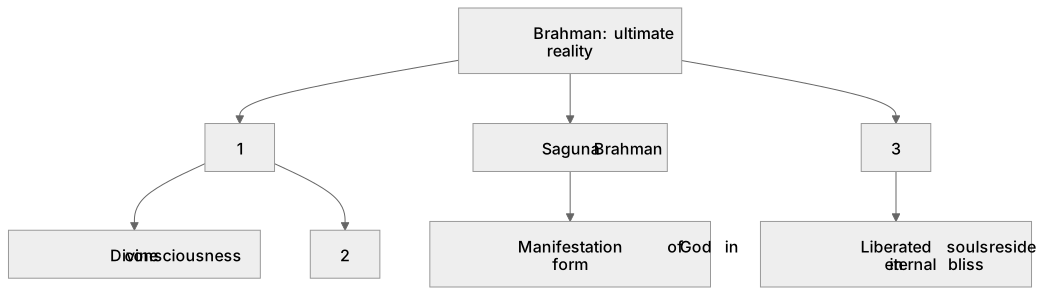
1Box 1
2Box 2
3Box 3
There is more to this lesson
The full lesson goes on to check your understanding and help you earn the marks. Create a free account to carry on, with your progress saved.
A week of Premium from your first lesson · Then the free plan continues · No card, no charge
Test your understanding of Hinduism - 3.1.4.1 Beliefs and teachings: Brahman: different Hindu understandings of brahman; ultimate reality as divine consciousness (nirguna) and manifestation of God in form (saguna); spiritual worlds.
Active recall beats re-reading. Take an instant quiz now to test what you’ve learned and lock it into long-term memory.
A week of Premium from your first lesson · Then the free plan continues · No card, no charge