AQA · GCSE · Religious Studies
Course version: 8062 · Version from Sept 2018
The concept of atman, as individual, eternal inner self, distinct from…
Full specification wording
Hinduism - 3.1.4.1 Beliefs and teachings: The concept of atman, as individual, eternal inner self, distinct from material mind and body.
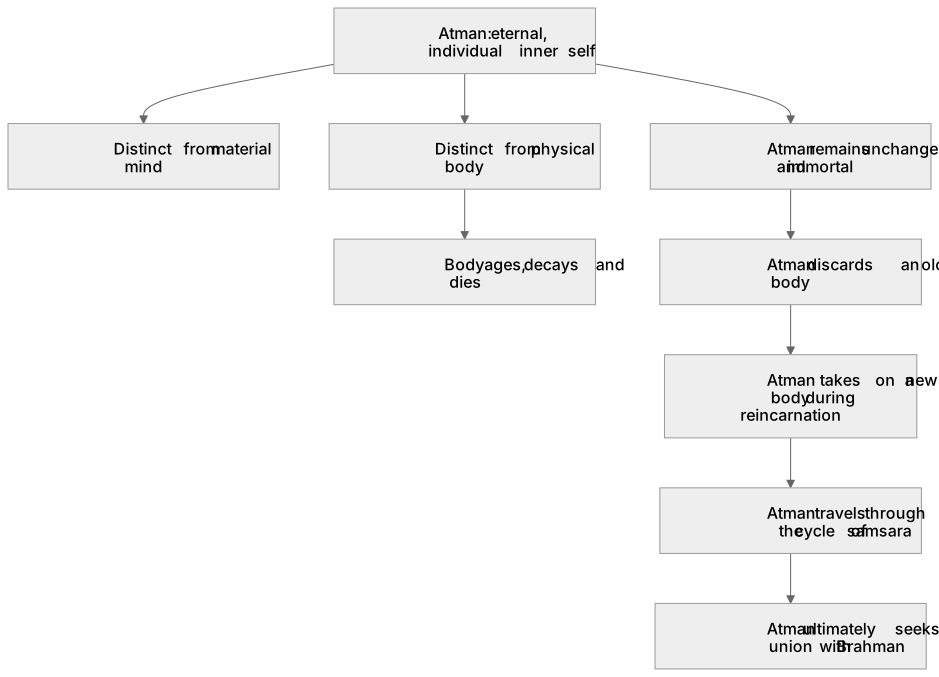
In Hinduism, the atman is the eternal, individual inner self or soul, which is entirely distinct from the temporary material mind and physical body.
- Point 14 of 19
- 4 key terms
Study notes
From the teaching notes for this specification point.
The idea
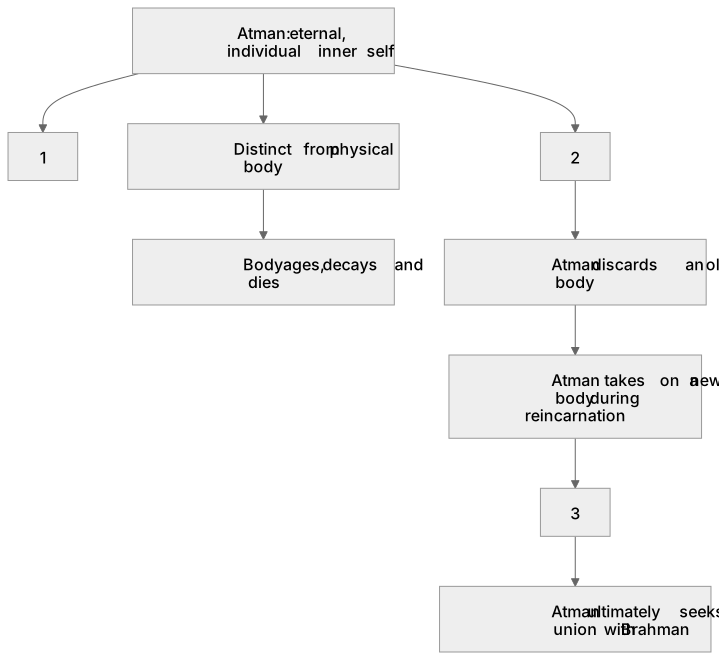
In Hinduism, the atman is the eternal, individual inner self or soul, which is entirely distinct from the temporary material mind and physical body. While the physical body ages, decays, and dies, the atman remains unchanged and immortal. A common analogy used to explain this is a person changing their clothes: just as one discards old garments for new ones, the atman discards an old body to take on a new one during reincarnation. Understanding the atman as separate from the mind and body is crucial, as it is this eternal self that travels through the cycle of samsara and ultimately seeks union with Brahman.
What earns the marks
- Define atman as the eternal, individual inner self or soul present in all living beings.
- Explain that the atman is completely distinct from the physical body and the material mind.
- Describe the atman's eternal nature, meaning it cannot be destroyed when the physical body dies.
- Use analogies, such as changing old clothes for new ones, to illustrate how the atman moves between bodies.
Common mistakes and how to put them right
Confusing the atman with the physical brain or mind.
Put it right: The atman is the spiritual self, entirely separate from the material mind and body.
Stating that the atman dies with the body.
Put it right: The atman is eternal and immortal, surviving physical death to be reincarnated.
Believing only humans have an atman.
Put it right: Hindu teachings state that all living beings possess an atman.
Exam tips
- Always explicitly state that the atman is eternal and distinct from the temporary physical body to secure knowledge marks.
- Use the analogy from the Bhagavad Gita of changing clothes to clearly explain the relationship between the atman and the body.
- Link the concept of the atman to reincarnation, explaining that it is the atman that transmigrates to a new body.
Try the lesson
The start of the Hinduism - 3.1.4.1 Beliefs and teachings: The concept of atman, as individual, eternal inner self, distinct from material mind and body. lesson, made from teaching notes for this specification point.
Have a go first
Which of the following best describes the Hindu concept of the atman?
Listen
In Hinduism, the atman is the eternal, individual inner self or soul, which is entirely distinct from the temporary material mind and physical body. While the physical body ages, decays, and dies, the atman remains unchanged and immortal. A common analogy used to explain this is a person changing their clothes: just as one discards old garments for new ones, the atman discards an old body to take on a new one during reincarnation. Understanding the atman as separate from the mind and body is crucial, as it is this eternal self that travels through the cycle of samsara and ultimately seeks union with Brahman. A strong answer earns marks for these points. Define atman as the eternal, individual inner self or soul present in all living beings. Explain that the atman is completely distinct from the physical body and the material mind. Describe the atman's eternal nature, meaning it cannot be destroyed when the physical body dies. Use analogies, such as changing old clothes for new ones, to illustrate how the atman moves between bodies. A common slip: Confusing the atman with the physical brain or mind. Instead, the atman is the spiritual self, entirely separate from the material mind and body. Exam tip: Always explicitly state that the atman is eternal and distinct from the temporary physical body to secure knowledge marks.
See it
Key words
Say what each word means before you turn the card.
Atman
Try answering aloud or in your head before turning the card.
Reincarnation
Try answering aloud or in your head before turning the card.
Samsara
Try answering aloud or in your head before turning the card.
Brahman
Try answering aloud or in your head before turning the card.
See every definition
- Atman
- The eternal, individual inner self or soul, present in all living beings and entirely distinct from the temporary material mind and physical body.
- Reincarnation
- The process in which the atman discards an old body to take on a new one, like a person discarding old garments for new ones.
- Samsara
- The cycle through which the eternal self travels, ultimately seeking union with Brahman.
- Brahman
- That which the eternal self ultimately seeks union with.
Label the diagram
Some boxes have lost their names. Pick the right name for each number.
1Box 1
2Box 2
3Box 3
There is more to this lesson
The full lesson goes on to check your understanding and help you earn the marks. Create a free account to carry on, with your progress saved.
A week of Premium from your first lesson · Then the free plan continues · No card, no charge
Test your understanding of Hinduism - 3.1.4.1 Beliefs and teachings: The concept of atman, as individual, eternal inner self, distinct from material mind and body.
Active recall beats re-reading. Take an instant quiz now to test what you’ve learned and lock it into long-term memory.
A week of Premium from your first lesson · Then the free plan continues · No card, no charge