AQA · GCSE · Religious Studies
Course version: 8062 · Version from Sept 2018
Charities that promote well-being, social inclusion and women’s rights.
Full specification wording
Hinduism - 3.1.4.2 Practices: Charities that promote well-being, social inclusion and women’s rights.
Hindu charities actively work to improve society by promoting well-being, social inclusion, and women’s rights, driven by the principle of sewa (selfless service).
- Point 26 of 26
- 3 key terms
Study notes
From the teaching notes for this specification point.
The idea
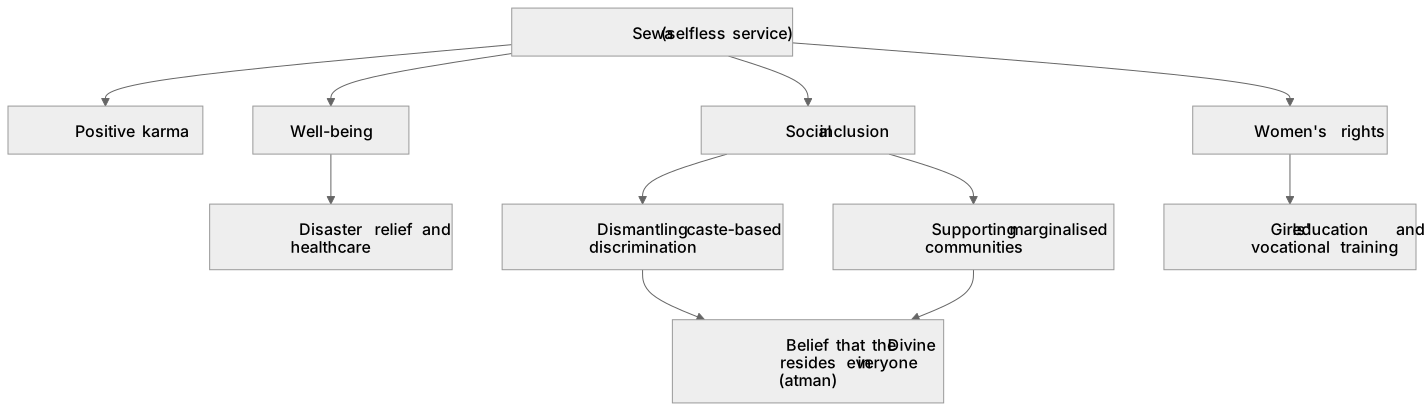
Hindu charities actively work to improve society by promoting well-being, social inclusion, and women’s rights, driven by the principle of sewa (selfless service). Sewa is performed without expectation of reward, generating positive karma. Charities like Sewa International focus on well-being through disaster relief and healthcare initiatives. To tackle social inclusion, organisations work to dismantle caste-based discrimination and support marginalised communities, reflecting the belief that the Divine resides in everyone (atman). Furthermore, charities advocate for women’s rights by funding girls' education and vocational training, challenging historical inequalities and honouring the reverence of female deities (Shakti) in practical, empowering ways.
What earns the marks
- Explain the concept of sewa (selfless service) as the primary motivation for Hindu charitable work.
- Identify how charities promote well-being through healthcare provision, disaster relief, and poverty alleviation.
- Describe efforts towards social inclusion, such as supporting Dalits or other marginalised groups to overcome caste-based prejudice.
- Outline initiatives supporting women's rights, including educational programmes, vocational training, and campaigns against domestic violence.
- Connect charitable actions to core Hindu beliefs, such as the presence of the atman (soul) in all beings and the pursuit of positive karma.
Common mistakes and how to put them right
Providing generic examples of charities without linking them to Hindu teachings.
Put it right: Explicitly mentioning concepts like sewa, karma, or dharma.
Overlooking one of the three specified areas.
Put it right by ensuring well-being, social inclusion, and women's rights are all addressed in comprehensive answers.
Assuming social inclusion only relates to poverty.
Put it right by including efforts to combat caste discrimination and integrate marginalised communities.
Exam tips
- Memorise at least one specific Hindu charity, such as Sewa International or BAPS Charities, to use as a concrete example in your answers.
- Structure 12-mark evaluation answers by dedicating distinct paragraphs to well-being, social inclusion, and women's rights to ensure full coverage of the specification.
- Link the promotion of women's rights to the Hindu concept of Shakti (divine feminine energy) to show depth of understanding.
Try the lesson
The start of the Hinduism - 3.1.4.2 Practices: Charities that promote well-being, social inclusion and women’s rights. lesson, made from teaching notes for this specification point.
Have a go first
Which of the following Hindu concepts directly motivates charitable work aimed at promoting well-being and social inclusion?
Listen
Hindu charities actively work to improve society by promoting well-being, social inclusion, and women’s rights, driven by the principle of sewa (selfless service). Sewa is performed without expectation of reward, generating positive karma. Charities like Sewa International focus on well-being through disaster relief and healthcare initiatives. To tackle social inclusion, organisations work to dismantle caste-based discrimination and support marginalised communities, reflecting the belief that the Divine resides in everyone (atman). Furthermore, charities advocate for women’s rights by funding girls' education and vocational training, challenging historical inequalities and honouring the reverence of female deities (Shakti) in practical, empowering ways. A strong answer earns marks for these points. Explain the concept of sewa (selfless service) as the primary motivation for Hindu charitable work. Identify how charities promote well-being through healthcare provision, disaster relief, and poverty alleviation. Describe efforts towards social inclusion, such as supporting Dalits or other marginalised groups to overcome caste-based prejudice. Outline initiatives supporting women's rights, including educational programmes, vocational training, and campaigns against domestic violence. A common slip: Providing generic examples of charities without linking them to Hindu teachings. Instead, explicitly mentioning concepts like sewa, karma, or dharma. Exam tip: Memorise at least one specific Hindu charity, such as Sewa International or BAPS Charities, to use as a concrete example in your answers.
See it
Key words
Say what each word means before you turn the card.
Sewa
Try answering aloud or in your head before turning the card.
Atman
Try answering aloud or in your head before turning the card.
Shakti
Try answering aloud or in your head before turning the card.
See every definition
- Sewa
- Selfless service performed without expectation of reward, generating positive karma.
- Atman
- The soul, reflecting the belief that the Divine resides in everyone.
- Shakti
- Divine feminine energy, honoured through practical, empowering ways.
Label the diagram
Some boxes have lost their names. Pick the right name for each number.
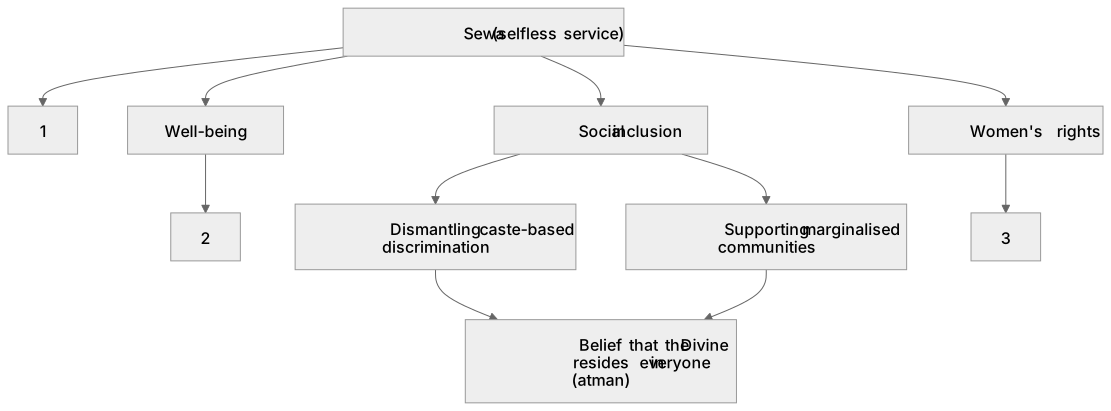
1Box 1
2Box 2
3Box 3
There is more to this lesson
The full lesson goes on to check your understanding and help you earn the marks. Create a free account to carry on, with your progress saved.
A week of Premium from your first lesson · Then the free plan continues · No card, no charge
Test your understanding of Hinduism - 3.1.4.2 Practices: Charities that promote well-being, social inclusion and women’s rights.
Active recall beats re-reading. Take an instant quiz now to test what you’ve learned and lock it into long-term memory.
A week of Premium from your first lesson · Then the free plan continues · No card, no charge