AQA · GCSE · Religious Studies
Course version: 8062 · Version from Sept 2018
Hinduism - 3.1.4.2 Practices: Worship and festivals
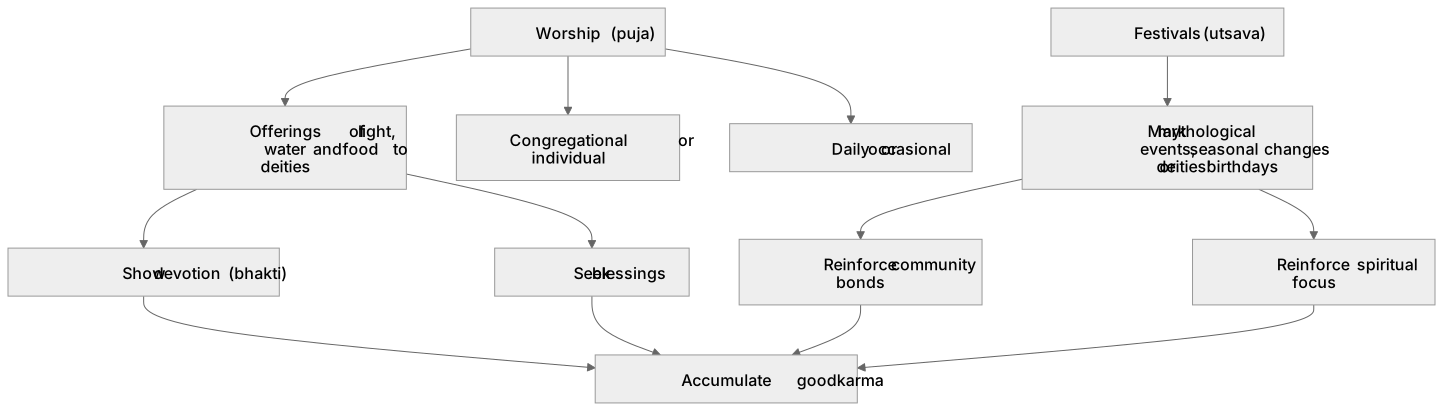
Worship (puja) is central to Hindu life, involving offerings of light, water, and food to deities to show devotion (bhakti) and seek blessings.
- Point 1 of 26
- 4 key terms
Study notes
From the teaching notes for this specification point.
The idea
Worship (puja) is central to Hindu life, involving offerings of light, water, and food to deities to show devotion (bhakti) and seek blessings. It can be congregational or individual, daily or occasional. Festivals (utsava) are vibrant celebrations marking mythological events, seasonal changes, or deities' birthdays, reinforcing community bonds and spiritual focus. For example, Diwali (the Festival of Lights) celebrates Rama's return and the victory of light over darkness, while Holi marks the arrival of spring and the triumph of good over evil. Both worship and festivals serve to accumulate good karma, express devotion, and bring the Hindu community together in shared faith.
What earns the marks
- Explain the purpose of puja, such as showing devotion (bhakti), asking for blessings, or aiding meditation.
- Describe key features of Hindu festivals, including community celebration, fasting, feasting, and special pujas.
- Evaluate the relative importance of daily worship compared to annual festival celebrations in a Hindu's spiritual life.
- Provide specific examples of festivals, such as Diwali or Holi, and explain the religious narratives or beliefs they commemorate.
Common mistakes and how to put them right
Confusing the meaning of different festivals.
Put it right: Ensure Diwali is linked to Rama and Sita or Lakshmi, while Holi is linked to Krishna or Holika and Prahlada.
Assuming worship only happens in a temple.
Put it right: State that worship is highly flexible and primarily takes place in the home.
Stating that Hindus worship idols.
Put it right: Explain that Hindus worship the divine through the murti, which acts as a focal point, not as the deity itself.
Exam tips
- Always link a specific festival to the religious belief or story it celebrates to demonstrate deeper understanding.
- Use Sanskrit terms like 'puja' (worship) and 'bhakti' (devotion) to elevate the quality of your answers.
- When evaluating the importance of festivals, contrast their community aspect with the personal, daily discipline of individual worship.
Try the lesson
The start of the Hinduism - 3.1.4.2 Practices: Worship and festivals lesson, made from teaching notes for this specification point.
Have a go first
Which of the following is the most common term used for Hindu worship, which can take place in the home or at a mandir?
Listen
Worship (puja) is central to Hindu life, involving offerings of light, water, and food to deities to show devotion (bhakti) and seek blessings. It can be congregational or individual, daily or occasional. Festivals (utsava) are vibrant celebrations marking mythological events, seasonal changes, or deities' birthdays, reinforcing community bonds and spiritual focus. For example, Diwali (the Festival of Lights) celebrates Rama's return and the victory of light over darkness, while Holi marks the arrival of spring and the triumph of good over evil. Both worship and festivals serve to accumulate good karma, express devotion, and bring the Hindu community together in shared faith. A strong answer earns marks for these points. Explain the purpose of puja, such as showing devotion (bhakti), asking for blessings, or aiding meditation. Describe key features of Hindu festivals, including community celebration, fasting, feasting, and special pujas. Evaluate the relative importance of daily worship compared to annual festival celebrations in a Hindu's spiritual life. Provide specific examples of festivals, such as Diwali or Holi, and explain the religious narratives or beliefs they commemorate. A common slip: Confusing the meaning of different festivals. Instead, ensure Diwali is linked to Rama and Sita or Lakshmi, while Holi is linked to Krishna or Holika and Prahlada. Exam tip: Always link a specific festival to the religious belief or story it celebrates to demonstrate deeper understanding.
See it
Key words
Say what each word means before you turn the card.
Devotion (Bhakti)
Try answering aloud or in your head before turning the card.
Community
Try answering aloud or in your head before turning the card.
Mythology and narrative
Try answering aloud or in your head before turning the card.
Karma and spiritual progress
Try answering aloud or in your head before turning the card.
See every definition
- Devotion (Bhakti)
- Showing devotion to deities through offerings of light, water, and food is central to Hindu life.
- Community
- Festivals reinforce community bonds and bring the Hindu community together in shared faith.
- Mythology and narrative
- Festivals are vibrant celebrations marking mythological events, seasonal changes, or deities' birthdays.
- Karma and spiritual progress
- Both worship and festivals serve to accumulate good karma and express devotion.
Label the diagram
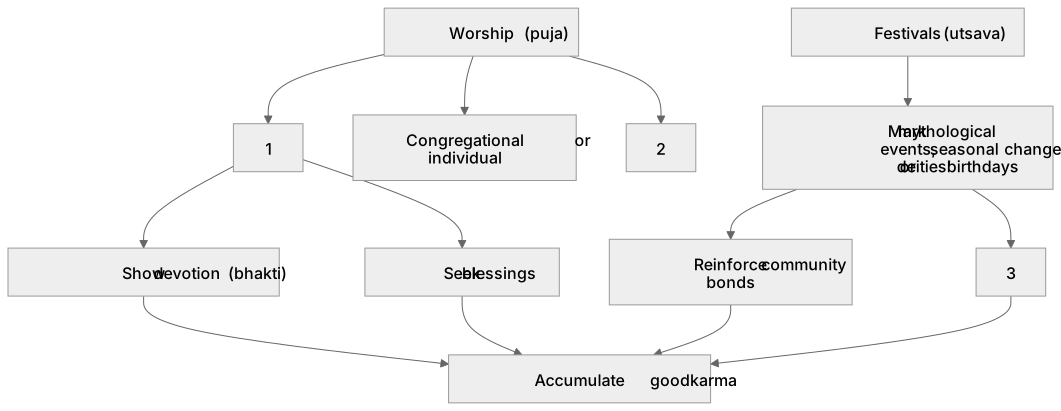
Some boxes have lost their names. Pick the right name for each number.
1Box 1
2Box 2
3Box 3
There is more to this lesson
The full lesson goes on to check your understanding and help you earn the marks. Create a free account to carry on, with your progress saved.
A week of Premium from your first lesson · Then the free plan continues · No card, no charge
Test your understanding of Hinduism - 3.1.4.2 Practices: Worship and festivals
Active recall beats re-reading. Take an instant quiz now to test what you’ve learned and lock it into long-term memory.
A week of Premium from your first lesson · Then the free plan continues · No card, no charge