AQA · GCSE · Religious Studies
Course version: 8062 · Version from Sept 2018
Students should study the influence of the beliefs, teachings and…
Full specification wording
Islam: Students should study the influence of the beliefs, teachings and practices studied on individuals, communities and societies.
Islamic beliefs, teachings, and practices profoundly shape the lives of Muslims at multiple levels.
- Point 2 of 3
- 4 key terms
Study notes
From the teaching notes for this specification point.
The idea
Islamic beliefs, teachings, and practices profoundly shape the lives of Muslims at multiple levels. For individuals, practices like Salah (prayer) provide daily spiritual discipline and a personal connection to Allah, while beliefs in Akhirah (the afterlife) influence moral decision-making. At the community level, the Ummah is strengthened through congregational prayers at the mosque, particularly Jum'ah, and the collective fasting during Ramadan, fostering mutual support. On a societal scale, teachings on Zakah (charitable giving) and Sadaqah drive social welfare initiatives, reducing poverty and promoting economic justice.
What earns the marks
- Explain how individual practices, such as daily Salah, foster personal discipline and spiritual focus.
- Describe the role of communal practices, like attending Jum'ah prayers, in strengthening the local Muslim community (Ummah).
- Evaluate the societal impact of Zakah, explaining how mandatory wealth redistribution addresses poverty and social inequality.
- Analyse how belief in Akhirah (life after death) influences moral choices and ethical behaviour in everyday life.
Common mistakes and how to put them right
Focusing only on personal impacts.
Put it right: Ensure you also discuss how practices affect the wider community and society.
Describing a practice without explaining its influence.
Put it right: Link the action (such as fasting) to its effect (such as developing empathy for the poor).
Treating community and society as identical.
Put it right: Distinguish between the local Muslim congregation (community) and broader national or global impacts (society).
Exam tips
- Use the concept of the Ummah to effectively link individual actions to community cohesion.
- When evaluating a statement in a 12-mark question, explicitly structure paragraphs around individual, community, and societal impacts.
- Provide concrete examples of societal influence, such as Islamic charities like Islamic Relief providing disaster aid.
Try the lesson
The start of the Islam: Students should study the influence of the beliefs, teachings and practices studied on individuals, communities and societies. lesson, made from teaching notes for this specification point.
Have a go first
How does the regular practice of Salah (prayer) most directly influence an individual Muslim's daily routine?
Listen
Islamic beliefs, teachings, and practices profoundly shape the lives of Muslims at multiple levels. For individuals, practices like Salah (prayer) provide daily spiritual discipline and a personal connection to Allah, while beliefs in Akhirah (the afterlife) influence moral decision-making. At the community level, the Ummah is strengthened through congregational prayers at the mosque, particularly Jum'ah, and the collective fasting during Ramadan, fostering mutual support. On a societal scale, teachings on Zakah (charitable giving) and Sadaqah drive social welfare initiatives, reducing poverty and promoting economic justice. A strong answer earns marks for these points. Explain how individual practices, such as daily Salah, foster personal discipline and spiritual focus. Describe the role of communal practices, like attending Jum'ah prayers, in strengthening the local Muslim community (Ummah). Evaluate the societal impact of Zakah, explaining how mandatory wealth redistribution addresses poverty and social inequality. Analyse how belief in Akhirah (life after death) influences moral choices and ethical behaviour in everyday life. Exam tip: Use the concept of the Ummah to effectively link individual actions to community cohesion.
See it

Key words
Say what each word means before you turn the card.
The Ummah (Community)
Try answering aloud or in your head before turning the card.
Social Justice and Charity
Try answering aloud or in your head before turning the card.
Spiritual Discipline
Try answering aloud or in your head before turning the card.
Moral Responsibility
Try answering aloud or in your head before turning the card.
See every definition
- The Ummah (Community)
- The community that is strengthened through congregational prayers at the mosque, particularly Jum'ah, and the collective fasting during Ramadan, fostering mutual support.
- Social Justice and Charity
- Teachings on Zakah and Sadaqah drive social welfare initiatives, reducing poverty and promoting economic justice.
- Spiritual Discipline
- Practices like Salah provide daily spiritual discipline and a personal connection to Allah.
- Moral Responsibility
- Beliefs in Akhirah influence moral decision-making and ethical behaviour in everyday life.
Label the diagram
Some boxes have lost their names. Pick the right name for each number.
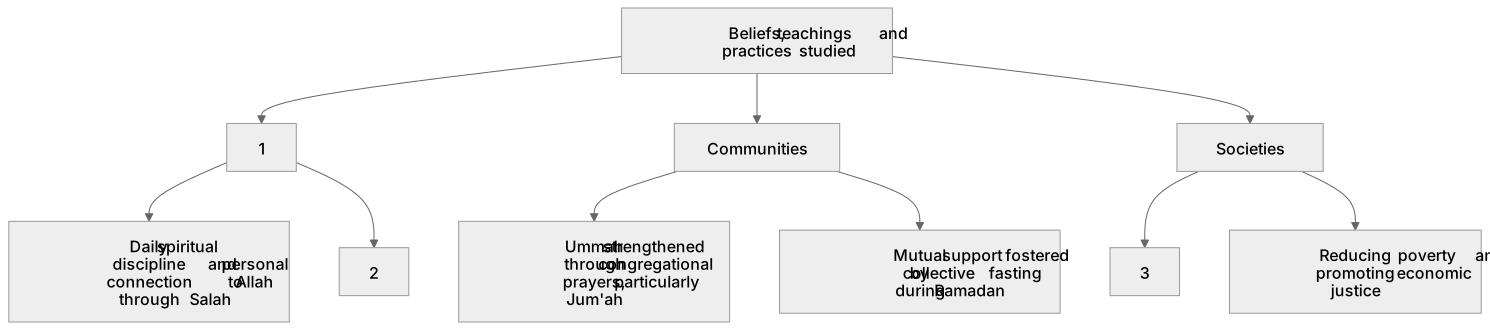
1Box 1
2Box 2
3Box 3
There is more to this lesson
The full lesson goes on to check your understanding and help you earn the marks. Create a free account to carry on, with your progress saved.
A week of Premium from your first lesson · Then the free plan continues · No card, no charge
Test your understanding of Islam: Students should study the influence of the beliefs, teachings and practices studied on individuals, communities and societies.
Active recall beats re-reading. Take an instant quiz now to test what you’ve learned and lock it into long-term memory.
A week of Premium from your first lesson · Then the free plan continues · No card, no charge