AQA · GCSE · Religious Studies
Course version: 8062 · Version from Sept 2018
Students should study the beliefs, teachings and practices of Judaism…
Full specification wording
Judaism: Students should study the beliefs, teachings and practices of Judaism specified below and their basis in Jewish sources of wisdom and authority. They should be able to refer to scripture and/or sacred texts where appropriate. Some texts are prescribed for study in the content set out below and questions may be set on them. Students may refer to any relevant text in their answers and AQA will publish a list of appropriate texts as part of the supporting material for this specification.
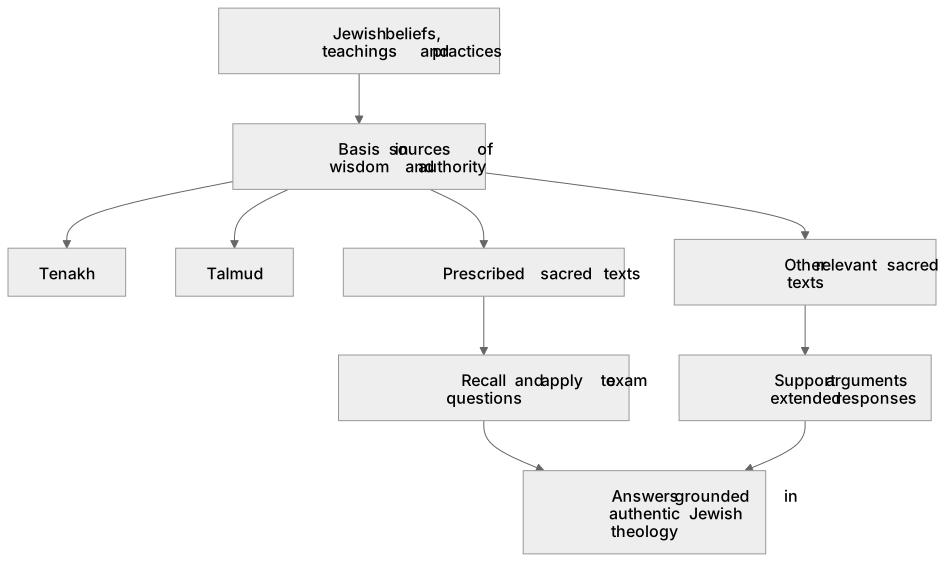
While certain prescribed texts will be directly tested and must be memorised, students are also encouraged to refer to any other relevant sacred texts to support their arguments.
- Point 2 of 5
- 4 key terms
Study notes
From the teaching notes for this specification point.
The idea
While certain prescribed texts will be directly tested and must be memorised, students are also encouraged to refer to any other relevant sacred texts to support their arguments. Mastering this skill ensures answers are grounded in authentic Jewish theology rather than generalisations, demonstrating a comprehensive understanding of how ancient scripture dictates modern Jewish life.
What earns the marks
- Accurately describe specific Jewish beliefs, teachings, and practices as outlined in the specification.
- Link Jewish practices and beliefs explicitly to their basis in recognised sources of wisdom and authority, such as the Tenakh or Talmud.
- Quote or accurately paraphrase prescribed sacred texts to support explanations and evaluations.
- Utilise a range of relevant, non-prescribed scriptural references to strengthen arguments in extended writing tasks.
Common mistakes and how to put them right
Describing a Jewish practice without linking it to a sacred text.
Put it right by pairing a practice with its scriptural basis.
Misattributing quotes to the wrong source.
Put it right by learning the specific book rather than just stating it is in the Bible.
Ignoring prescribed texts in favour of general knowledge.
Put it right by prioritising the exact texts listed in the specification, as questions may specifically target them.
Exam tips
- Create a revision table linking every major belief and practice to at least one specific source of wisdom or authority.
- If you cannot remember a direct quote in the exam, accurately paraphrase the teaching and name the sacred text it comes from.
- Look out for questions that explicitly ask for a reference to scripture, as failing to include one will cap your maximum marks.
Try the lesson
The start of the Judaism: Students should study the beliefs, teachings and practices of Judaism specified below and their basis in Jewish sources of wisdom and authority. They should be able to refer to scripture and/or sacred texts where appropriate. Some texts are prescribed for study in the content set out below and questions may be set on them. Students may refer to any relevant text in their answers and AQA will publish a list of appropriate texts as part of the supporting material for this specification. lesson, made from teaching notes for this specification point.
Have a go first
Which of the following is the foundational written sacred text of Judaism that forms the primary basis for its beliefs and practices?
Listen
While certain prescribed texts will be directly tested and must be memorised, students are also encouraged to refer to any other relevant sacred texts to support their arguments. Mastering this skill ensures answers are grounded in authentic Jewish theology rather than generalisations, demonstrating a comprehensive understanding of how ancient scripture dictates modern Jewish life. A strong answer earns marks for these points. Accurately describe specific Jewish beliefs, teachings, and practices as outlined in the specification. Link Jewish practices and beliefs explicitly to their basis in recognised sources of wisdom and authority, such as the Tenakh or Talmud. Quote or accurately paraphrase prescribed sacred texts to support explanations and evaluations. Utilise a range of relevant, non-prescribed scriptural references to strengthen arguments in extended writing tasks. A common slip: Describing a Jewish practice without linking it to a sacred text. Instead, pairing a practice with its scriptural basis. Exam tip: Create a revision table linking every major belief and practice to at least one specific source of wisdom or authority.
See it
Key words
Say what each word means before you turn the card.
Sources of wisdom
Try answering aloud or in your head before turning the card.
Scriptural authority
Try answering aloud or in your head before turning the card.
Sacred texts
Try answering aloud or in your head before turning the card.
Theological foundations
Try answering aloud or in your head before turning the card.
See every definition
- Sources of wisdom
- The foundational basis to which Jewish beliefs, teachings and practices must be directly connected, such as the Torah and the Talmud.
- Scriptural authority
- The basis in Jewish sources of wisdom and authority to which students should link beliefs and practices explicitly.
- Sacred texts
- Texts that students should be able to refer to where appropriate, including prescribed texts and other relevant texts.
- Theological foundations
- Authentic Jewish theology in which answers are grounded rather than generalisations, showing how ancient scripture dictates modern Jewish life.
Label the diagram
Some boxes have lost their names. Pick the right name for each number.
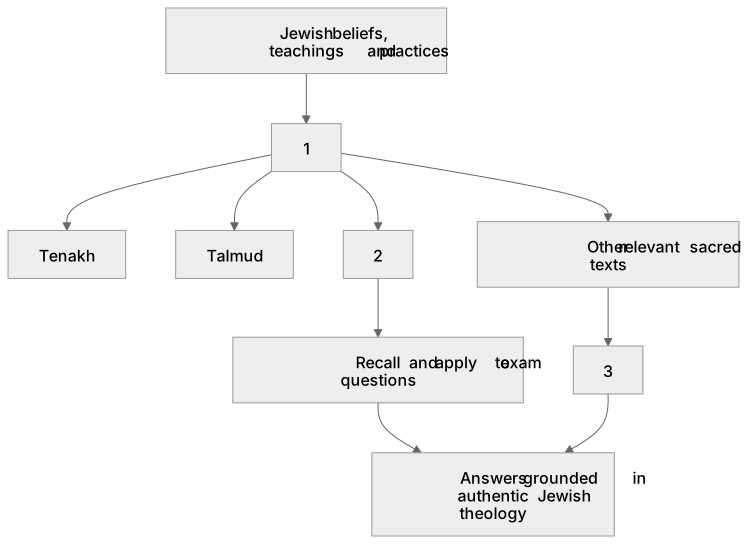
1Box 1
2Box 2
3Box 3
There is more to this lesson
The full lesson goes on to check your understanding and help you earn the marks. Create a free account to carry on, with your progress saved.
A week of Premium from your first lesson · Then the free plan continues · No card, no charge
Test your understanding of Judaism: Students should study the beliefs, teachings and practices of Judaism specified below and their basis in Jewish sources of wisdom and authority. They should be able to refer to scripture and/or sacred texts where appropriate. Some texts are prescribed for study in the content set out below and questions may be set on them. Students may refer to any relevant text in their answers and AQA will publish a list of appropriate texts as part of the supporting material for this specification.
Active recall beats re-reading. Take an instant quiz now to test what you’ve learned and lock it into long-term memory.
A week of Premium from your first lesson · Then the free plan continues · No card, no charge