AQA · GCSE · Religious Studies
Course version: 8062 · Version from Sept 2018
Practices: The role of prayer in the home, GGS 305:4.
In Sikhism, prayer in the home is central to daily spiritual life, allowing individuals to connect with Waheguru outside the Gurdwara.
Checked against the AQA 8062 specification (opens in a new tab) on .
- Point 25 of 37
- 4 key terms
Study notes
From the checked teaching notes for this specification point.
The idea
In Sikhism, prayer in the home is central to daily spiritual life, allowing individuals to connect with Waheguru outside the Gurdwara. The Guru Granth Sahib (GGS 305:4) explicitly outlines this duty, stating that a true Sikh should rise early in the morning, bathe, and meditate on the Lord's Name (Nam Japna). This daily discipline, known as Nitnem, involves reciting specific prayers (Banis) at dawn, evening, and bedtime. Families often set aside a quiet space or a dedicated room containing a Gutka (prayer book) to maintain focus and purity. By praying at home, Sikhs cultivate personal discipline, keep God in mind throughout their daily activities, and reinforce the spiritual education of children within the family environment.
What earns the marks
- Explain that daily prayer (Nitnem) is a fundamental duty for Sikhs, performed at home to maintain a constant connection with Waheguru.
- Reference GGS 305:4 to support the practice of rising early, bathing, and meditating on the Divine Name.
- Describe how families may use a Gutka (small prayer book) in a clean, dedicated space within the home.
- Discuss the role of home prayer in teaching children Sikh values and establishing a disciplined spiritual routine.
Common mistakes and how to put them right
Stating that Sikhs only pray in the Gurdwara.
Put it right: Emphasise that personal prayer at home is equally important and a daily requirement.
Confusing the Guru Granth Sahib with a Gutka.
Put it right: Clarify that while the GGS is kept in the Gurdwara, a Gutka is a smaller collection of daily prayers commonly used at home.
Ignoring the specific reference to GGS 305:4.
Put it right: Link home prayer to the scriptural instruction to rise early and meditate on God's name.
Exam tips
- Memorise the core message of GGS 305:4 (rising early to meditate on God's name) to use as a direct source of wisdom in evaluation questions.
- Use the term 'Nitnem' when discussing the daily routine of prayers to demonstrate subject-specific vocabulary.
- Contrast the communal worship in the Gurdwara with the personal discipline of home prayer to build a balanced argument.
Try the lesson
The start of the Practices: The role of prayer in the home, GGS 305:4. lesson, made from checked teaching notes for this specification point.
Have a go first
What is the main purpose of reciting the Nitnem (daily prayers) in a Sikh home?
Listen
In Sikhism, prayer in the home is central to daily spiritual life, allowing individuals to connect with Waheguru outside the Gurdwara. The Guru Granth Sahib (GGS 305:4) explicitly outlines this duty, stating that a true Sikh should rise early in the morning, bathe, and meditate on the Lord's Name (Nam Japna). This daily discipline, known as Nitnem, involves reciting specific prayers (Banis) at dawn, evening, and bedtime. Families often set aside a quiet space or a dedicated room containing a Gutka (prayer book) to maintain focus and purity. By praying at home, Sikhs cultivate personal discipline, keep God in mind throughout their daily activities, and reinforce the spiritual education of children within the family environment. A strong answer earns marks for these points. Explain that daily prayer (Nitnem) is a fundamental duty for Sikhs, performed at home to maintain a constant connection with Waheguru. Reference GGS 305:4 to support the practice of rising early, bathing, and meditating on the Divine Name. Describe how families may use a Gutka (small prayer book) in a clean, dedicated space within the home. Discuss the role of home prayer in teaching children Sikh values and establishing a disciplined spiritual routine. A common slip: Stating that Sikhs only pray in the Gurdwara. Instead, Emphasise that personal prayer at home is equally important and a daily requirement. Exam tip: Memorise the core message of GGS 305:4 (rising early to meditate on God's name) to use as a direct source of wisdom in evaluation questions.
See it
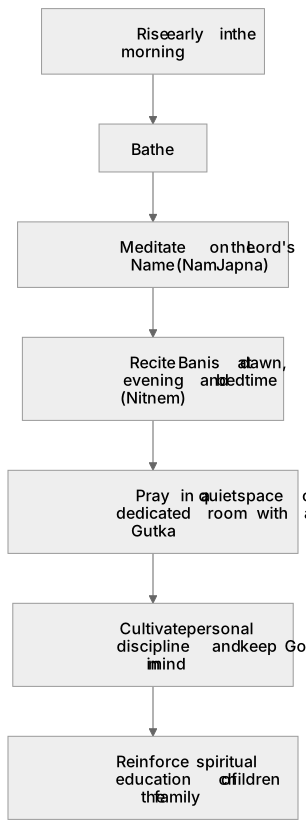
Put it in order
Put these steps in the order they happen.
- 1. Reinforce spiritual education of children in the family
- 2. Cultivate personal discipline and keep God in mind
- 3. Meditate on the Lord's Name (Nam Japna)
- 4. Pray in a quiet space or dedicated room with a Gutka
- 5. Rise early in the morning
- 6. Bathe
- 7. Recite Banis at dawn, evening and bedtime (Nitnem)
Key words
Say what each word means before you turn the card.
Nam Japna
Try answering aloud or in your head before turning the card.
Discipline (Nitnem)
Try answering aloud or in your head before turning the card.
Personal spirituality
Try answering aloud or in your head before turning the card.
Family life
Try answering aloud or in your head before turning the card.
See every definition
- Nam Japna
- Meditating on the Lord's Name, which the Guru Granth Sahib (GGS 305:4) states a true Sikh should do after rising early in the morning and bathing.
- Discipline (Nitnem)
- A daily discipline involving reciting specific prayers (Banis) at dawn, evening, and bedtime.
- Personal spirituality
- Prayer in the home is central to daily spiritual life, allowing individuals to connect with Waheguru outside the Gurdwara.
- Family life
- Families often set aside a quiet space or a dedicated room containing a Gutka to maintain focus and purity, reinforcing the spiritual education of children within the family environment.
Label the diagram
Some boxes have lost their names. Pick the right name for each number.
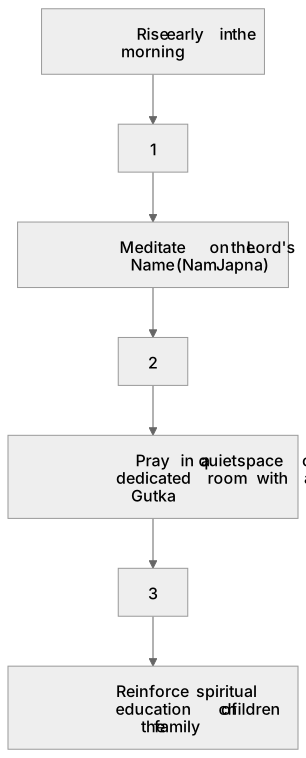
1Box 1
2Box 2
3Box 3
There is more to this lesson
The full lesson goes on to check your understanding and help you earn the marks. Create a free account to carry on, with your progress saved.
A week of Premium from your first lesson · Then the free plan continues · No card, no charge
Test your understanding of Practices: The role of prayer in the home, GGS 305:4.
Active recall beats re-reading. Take an instant quiz now to test what you’ve learned and lock it into long-term memory.
A week of Premium from your first lesson · Then the free plan continues · No card, no charge